
On this page
Start here
Quick answer
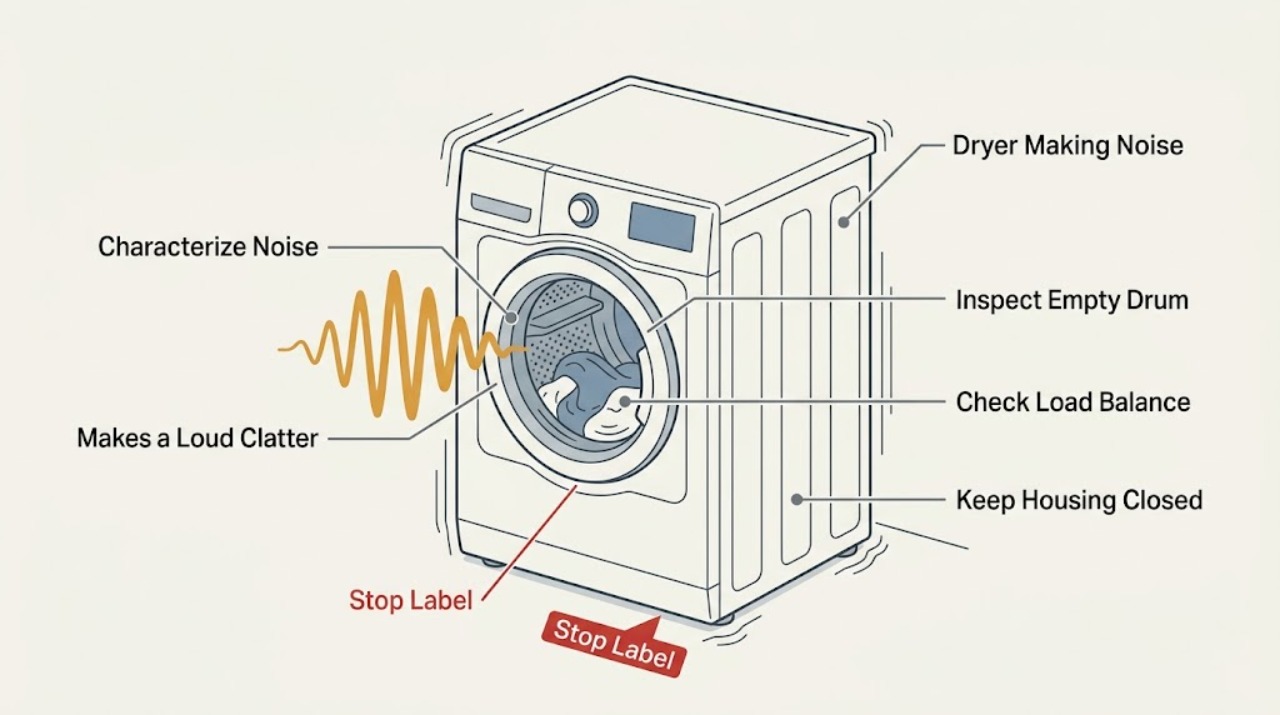
Stop the Bosch dryer and remove the laundry before investigating the sound. First check the empty drum for a coin or another object from a pocket, then check whether the load is uneven and whether the dryer is aligned on a stable surface. Bosch describes compressor hum, compressor ventilation whirring, automatic-cleaning clicks, and condensation-pump sounds as normal on supported dryer documentation, but persistent loud rattling, grinding, scraping, or vibration after the drum, load, and installation checks needs professional assessment. Do not remove panels or reach near moving parts; provide the exact model, sound description, and when it occurs to an authorized or qualified dryer technician.
Before you begin
Safety first
- Do not reach into a moving drum, remove panels, test live electrical parts, tilt a stacked or hard-connected unit, or keep operating the dryer when smoke, burning odor, sparks, overheating, or violent vibration occurs.
Work through in order
Diagnostic checks
Use only checks that match the exact appliance or system and its official guide.
-
Check 1
Stop the program and record the sound without opening the door until the drum stops. Note whether it is a brief hum, whir, or click; a coin-like rattle; thumping that follows the load; scraping or grinding; or vibration of the cabinet, and note the cycle phase.
Expected result: The sound is a brief compressor/pump/cleaning sound, occurs only with one load, follows drum rotation, or is loud and persistent even with no laundry.
Next step: Continue only with the dryer stopped and cool enough to inspect. If there is smoke, a burning odor, exposed wiring, or violent movement, leave it off and arrange service immediately.
Stop if: Stop for smoke, burning odor, sparks, a damaged cord, exposed wiring, or a drum/cabinet that moves violently.
Why this matters
Why: Bosch documents several compressor, pump, ventilation, and automatic-cleaning sounds as normal. A repeated rattle, scrape, grind, or load-independent vibration needs the object, balance, and installation checks rather than a guessed part diagnosis.
-
Check 2
With the dryer stopped and empty, look inside the drum and around the door opening for coins, zippers, hooks, screws, or another unwanted object that could rattle. Remove only a loose object that is plainly accessible; do not remove covers or reach behind the drum.
Expected result: A foreign object is visible and the noise stops after it is removed, or the drum is clear and the sound remains.
Next step: Run no further cycle if an object is trapped, the drum surface is damaged, or the sound persists after a loose object is removed; arrange service. Otherwise continue with the load check.
Stop if: Do not reach through openings, remove drum components, or use tools inside the drum.
Why this matters
Why: Bosch specifically identifies a coin or other object from a pocket as a common source of drum rattling. A clear drum shifts attention to load balance, alignment, or professional diagnosis.
-
Check 3
If the noise occurs only with laundry, stop the dryer and redistribute or reduce the load according to the model's Owner's Manual. Separate a heavy item that has gathered on one side from the rest of the load; do not exceed the program's stated load guidance.
Expected result: The noise reduces when the load is distributed or smaller, or it is unchanged with an appropriately arranged load.
Next step: Use the model manual's load guidance for any supervised retest. If the dryer still bangs or vibrates, stop operation and arrange service rather than repeatedly adding or removing items.
Stop if: Do not open the door while the drum is moving or operate with an overloaded, unstable, or visibly damaged load.
Why this matters
Why: Bosch's troubleshooting guidance lists an unbalanced laundry load as a possible cause of loud noise. If the sound remains with a balanced load, the load alone does not explain it.
-
Check 4
Visually check that all dryer feet contact the floor and that the appliance is not rocking, leaning, or touching a cabinet or wall. Confirm that it is installed on the stable surface required by the model instructions; do not drag the dryer across the floor to inspect underneath.
Expected result: The dryer rocks, a foot is not seated, the installation is misaligned, or the floor is unstable; alternatively, the cabinet is stable and clear of nearby contact.
Next step: Use the Owner's Manual for any safe leveling adjustment. If the dryer remains unstable or the noise persists on a stable surface, leave it off and request professional assessment.
Stop if: Do not tilt, disassemble, or move a stacked or hard-connected dryer without the model-specific installation procedure and appropriate help.
Why this matters
Why: Bosch identifies improper alignment and an unsuitable or unstable installation surface as possible causes of shaking and rattling. A stable installation makes those explanations less likely but does not clear a persistent internal noise.
-
Check 5
Compare the sound with Bosch's normal-noise descriptions: compressor hum, compressor ventilation whirring, automatic-cleaning clicking, or condensation-pump noise. Observe whether the sound is brief or cycle-dependent and whether the dryer otherwise tumbles and heats normally.
Expected result: The sound matches one of the documented normal sounds and the dryer operates normally, or it is a new harsh, rhythmic, or scraping sound that does not match those descriptions.
Next step: If it matches a normal sound and there is no other symptom, monitor without opening the appliance. If it is harsh, worsening, or accompanied by poor tumbling, heat loss, odor, or an error, stop and arrange service.
Stop if: Do not continue operating to compare a sound that is accompanied by smoke, burning odor, overheating, or violent vibration.
Why this matters
Why: A documented normal sound does not by itself indicate a failed component. A harsh or persistent sound outside those descriptions needs service diagnosis; the noise alone cannot establish which internal part is involved.
-
Check 6
After the dryer is empty, the load is balanced, and the visible installation is stable, decide whether the noise remains. Record the exact model number, sound type, cycle phase, whether it occurs empty or loaded, and any heat, drum-motion, odor, or display symptom.
Expected result: The noise is gone after the accessible correction, or it remains / returns with an empty or properly loaded drum.
Next step: Stop using the dryer if the noise remains or returns and give the recorded details to a qualified Bosch technician or authorized servicer.
Stop if: Do not remove panels, test live electrical parts, or keep running the dryer to make an internal noise easier to hear.
Why this matters
Why: A corrected object, load, or installation issue explains that episode. A noise that remains with those conditions is beyond the supported user checks and should not be assigned to a specific bearing, motor, belt, or pulley without inspection.
Use your observations
Decision map
Find the observation that best matches what you see, then follow the next safe action.
-
PATH 01Next step
What you see
The sound matches Bosch's described compressor hum, ventilation whir, automatic-cleaning click, or condensation-pump noise, with no other fault symptom.
Do this next
Monitor the dryer without opening it or changing parts. Escalate if the sound becomes harsh, persistent outside its expected phase, or is joined by poor operation, odor, or vibration.
-
PATH 02Next step
What you see
An empty-drum inspection finds a loose coin or other unwanted object and the noise stops when it is safely removed.
Do this next
Check pockets and keep the object out of the dryer. If the sound continues or the object is trapped, leave the dryer off and arrange service.
-
PATH 03Next step
What you see
Banging or vibration occurs only with a particular uneven load and decreases after redistribution or reduction.
Do this next
Follow the model's load guidance and avoid repeating the unstable load. If noise returns with a normal balanced load, request service.
-
PATH 04Next step
What you see
The dryer rocks, is misaligned, or sits on an unsuitable or unstable surface.
Do this next
Use the exact installation instructions for safe leveling or stabilization. Do not move a stacked or hard-connected unit without qualified help; persistent noise requires service.
-
PATH 05Next step
What you see
Rattling, scraping, grinding, or violent vibration remains with an empty or properly loaded drum on a stable surface.
Do this next
Stop using the dryer and arrange qualified service. Provide the model and the exact phase and conditions in which the sound occurs; do not guess a replacement part.
-
PATH 06Next step
What you see
Noise is accompanied by smoke, burning odor, sparks, damaged wiring, overheating, or violent cabinet movement.
Do this next
Leave the dryer off, keep clear of hot or damaged areas, and obtain urgent professional service. Do not open panels or touch live parts.
Helpful context
Understand the symptom
Start with the sound and the moment it occurs
Turn the program off and note whether the noise starts when the drum begins, only during tumbling, during condensation pumping, or throughout the cycle. A brief hum or click has a different path from a repeated metal rattle or a vibration that moves the appliance. Keep the door closed until the drum stops.
Normal operating sounds versus a fault symptom
Bosch documentation distinguishes normal compressor, pump, ventilation, and automatic-cleaning sounds from a loud noise that remains after basic checks. The sound alone does not identify a bearing, motor, belt, or pulley, so no replacement part is named without the model and a technician's inspection.
Keep the inspection external
An owner can safely remove laundry and inspect the empty drum, load arrangement, and visible installation condition. Internal drive, motor, belt, bearing, heater, and electrical work belongs to a qualified service professional.
Safety boundary
Stop conditions
- Stop immediately for smoke, burning odor, sparks, exposed wiring, a damaged cord, overheating, or violent vibration.
- Do not reach into a moving drum or remove covers to inspect internal components.
- Do not tilt or move a stacked or hard-connected dryer without the model-specific installation procedure and appropriate help.
- Do not repeatedly run the dryer to reproduce a persistent or worsening internal noise.
When checks do not resolve it
Need a professional?
Arrange qualified service when the noise persists with an empty or balanced drum on a stable surface, an object is trapped, the sound is scraping or grinding, operation or heating changes, or any smoke, burning odor, spark, damaged wiring, or violent vibration is present.
Safety scope: Do not reach into a moving drum, remove panels, test live electrical parts, tilt a stacked or hard-connected unit, or keep operating the dryer when smoke, burning odor, sparks, overheating, or violent vibration occurs.
Common questions
FAQ
Why is my Bosch dryer rattling?
Bosch recommends checking the empty drum for a coin or another unwanted object. If the drum is clear, check load balance and whether the dryer is aligned on a stable surface; persistent rattling needs service.
Are humming and clicking sounds normal on a Bosch dryer?
Bosch documentation describes compressor hum, compressor ventilation whirring, automatic-cleaning clicks, and condensation-pump sounds as normal on supported models. A harsh, worsening, or persistent noise is different and should be assessed.
Can an uneven load make a Bosch dryer noisy?
Yes. Bosch's troubleshooting guidance lists an unbalanced laundry load as a possible cause of loud noise. Stop the dryer, redistribute or reduce the load using the Owner's Manual, and request service if the noise remains with a normal load.
Should I replace a belt or bearing because the dryer is noisy?
Not from the sound alone. Bosch's published checks first address objects, load balance, alignment, and the installation surface. A persistent noise requires model-specific professional diagnosis before any part is selected.
Read the exact guide
Official sources
- Dryer Is Making Noises | Dryer TroubleshootingBosch Home Appliances · Official Bosch dryer troubleshooting for loud noises and unwanted objects in the drum.
- Normal noisesBosch Home Appliances · Official Bosch manufacturer manual describing normal compressor, pump, ventilation, and automatic-cleaning sounds and the service escalation when a fault cannot be corrected.
- Bosch Dryer Troubleshooting & Repair GuideBosch Home Appliances · Official Bosch troubleshooting overview identifying unbalanced loads, alignment, and unsuitable installation surfaces as possible noise causes.
- Bosch Dryers Troubleshooting & RepairBosch Home Appliances · Official Bosch dryer support hub linking issue guidance, manuals, maintenance, and authorized service resources.
Community feedback
Share a repair observation
Share a plain-text repair observation. Accepted observations are published automatically; this page may take a moment to update.