
On this page
Start here
Quick answer
If a new Bosch WTW87564AU heat-pump dryer's drum feels stiff when it is turned by hand, do not force it, open the cabinet, or run the appliance just to reproduce the concern. The exact Bosch manual says to remove packaging and supplied accessories, check for transit damage, and install the dryer on a firm, level surface, but it does not publish a user hand-rotation pass/fail test. Hand resistance alone therefore cannot prove a belt, motor, roller, or other internal part is defective. With the power disconnected and the drum fully stopped, record the already observed feel and inspect only the visible drum opening for an accessible obstruction. Abrupt binding, scraping, visible transit damage, or an actual failure to tumble should remain out of service and go to Bosch or a qualified technician.
Work through in order
Diagnostic checks
Use only checks that match the exact appliance or system and its official guide.
-
Check 1
Confirm the rating-plate identity and new-installation state without moving the appliance: verify WTW87564AU and any complete suffix, remove only clearly accessible packaging or supplied accessories from the empty drum, and look for visible transit damage.
Expected result: The rating plate matches WTW87564AU and the drum is clear; packaging or an accessory remains; or the cabinet, door, seal, or drum opening shows transit damage.
Next step: Do not operate a damaged or incomplete installation. Photograph the condition and contact the retailer, installer, Bosch, or a qualified service provider for the next safe step.
Why this matters
Why: Bosch's exact manual requires removal of packaging and supplied accessories and says not to connect an appliance damaged in transit. A new-installation problem is more actionable than guessing an internal drive part from hand feel.
-
Check 2
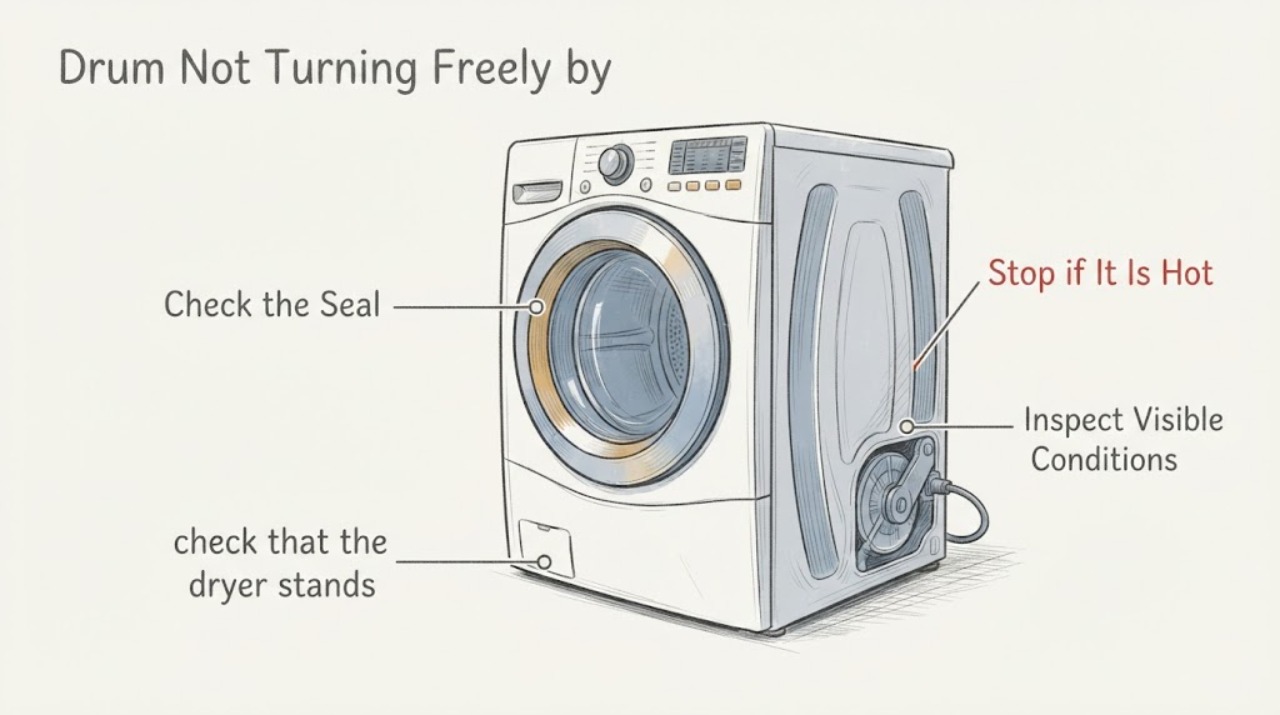
Disconnect the dryer from power, wait until the drum is completely stopped and cool, and inspect only the visible drum opening, door seal, and visible paddles for loose laundry or an accessible piece of packaging; do not force the drum, reach into hidden gaps, or remove a panel.
Expected result: A loose item is visibly accessible; nothing is visible but the previously observed resistance was smooth; or there is an abrupt stop, scrape, grind, or visible deformation.
Next step: Remove only a loose, plainly accessible item with the appliance disconnected. For a hard stop, scrape, deformation, or anything that cannot be removed without force, keep the dryer disconnected and arrange service; do not dismantle it.
Why this matters
Why: A visible obstruction can explain a new installation concern, while a hard spot or scraping behind the drum is not distinguished by Bosch's hand-feel guidance and may involve an internal drive or drum-area fault. The manual warns to wait for a complete stop before reaching inside and reserves repairs for trained specialists.
-
Check 3
From outside, check that the dryer stands firmly on a clean, even, solid surface and is not visibly pressed against a wall or another appliance; do not pull, tilt, stack-adjust, or turn the feet as a hand-rotation test.
Expected result: All feet appear stable and the cabinet is clear; the dryer is visibly rocking or contacting another surface; or the unit has been recently transported or stacked.
Next step: Leave a visibly unstable, damaged, or incorrectly stacked dryer out of service and have the installation corrected by the installer or a qualified technician. Do not move a heavy appliance alone.
Why this matters
Why: Bosch links vibration and noise reduction to correct leveling and requires an appropriate manufacturer connection kit for stacking. Installation movement or contact can create a false impression of a mechanical problem, but it cannot explain a hard internal stop by itself.
-
Check 4
Do not start a powered cycle just to test the hand-turn concern. If the dryer has already been used, record whether the drum actually tumbled, stopped immediately, scraped, or produced an odor, smoke, unusual heat, or a breaker trip.
Expected result: The dryer has already completed a normal cycle; it ran but stopped or scraped; the drum did not tumble; or a heat, odor, smoke, electrical, or breaker symptom occurred.
Next step: Do not repeat the test. Leave the dryer disconnected for a non-tumbling, scraping, overheating, smoking, burning-smell, or breaker-tripping condition and contact Bosch or a qualified technician.
Why this matters
Why: A normal prior cycle makes hand feel alone less decisive, while failure to tumble or a harsh or hazardous symptom needs service. The exact manual does not authorize a live cabinet or drive test, and it identifies trained repair staff as the repair boundary.
-
Check 5
Prepare the exact E-Nr./model suffix, FD or production details if shown, delivery or transport history, installation condition, visible findings, and any already observed powered behavior for service.
Expected result: The concern is limited to an unexplained hand feel; the drum has a hard stop or scrape; or the dryer has an actual no-tumble or safety symptom.
Next step: Keep the new dryer out of service when the drum binds, scrapes, will not tumble, or shows a hazard, and submit the evidence through Bosch support or the installer/warranty channel.
Why this matters
Why: Bosch asks for the product number and production number when contacting Customer Service, and its model-specific service assistant provides a drum-not-turning problem route. These details let service distinguish an installation or delivery issue from an internal repair without the user opening the machine.
Use your observations
Decision map
Find the observation that best matches what you see, then follow the next safe action.
-
PATH 01Next step
What you see
The previously observed hand resistance is smooth and consistent, there is no visible damage or obstruction, and the dryer has already completed a normal cycle without scraping or a safety symptom.
Do this next
Stop hand-testing, keep the installation stable, and monitor normal operation. If the drum later fails to tumble, the sound changes, or a hazard appears, disconnect it and arrange service.
Why this path and its safety boundary
Why it matters: There is no Bosch-published hand-rotation threshold that would turn this observation alone into a failed-part diagnosis. A normal prior cycle lowers the urgency, but it does not justify forcing the drum or opening the cabinet.
-
PATH 02Next step
What you see
The drum has a repeatable hard spot, abrupt stop, scraping or grinding, visible deformation, or the appliance was damaged in transit or left with packaging inside.
Do this next
Do not operate or force the drum. Remove only a plainly accessible loose item with power disconnected; otherwise use the new-appliance warranty, installer, Bosch, or qualified service route.
Why this path and its safety boundary
Why it matters: The pattern is inconsistent with a simple unfamiliar hand feel and may involve an obstruction, delivery damage, or a hidden drum/drive problem; the observation does not identify which internal part is responsible.
-
PATH 03Next step
What you see
The dryer has not yet been run, or it has been run and the drum did not tumble, stopped immediately, or produced scraping, burning odor, smoke, unusual heat, or a breaker trip.
Do this next
Keep the dryer disconnected and request qualified Bosch or appliance service. Do not remove covers, test live terminals, bypass a safety device, or replace a drive part based on the symptom alone.
Why this path and its safety boundary
Why it matters: The issue has crossed from an uncertain hand observation into a functional or safety concern that cannot be separated safely by a user test.
Helpful context
Understand the symptom
What the hand feel can and cannot tell you
A drum that feels different from another dryer is not enough to identify a failed drive part. This Bosch manual gives operating, installation, and service boundaries rather than a hand-turn measurement. Treat a smooth but unfamiliar feel as an observation to document, not as permission to force the drum or order a part.
New-installation boundary
Because this is a new dryer, packaging left in the drum, an accessory left inside, transit damage, an unstable installation, or contact with nearby surfaces should be checked before any fault theory. A hidden obstruction or drive problem is a service issue, especially when the drum has a hard stop or scraping point.
When checks do not resolve it
Need a professional?
Arrange Bosch or qualified appliance service for a hard stop, scraping or grinding, visible transit damage, an unexplained drum that will not tumble, or any concern that remains after the safe external checks. For smoke, burning odor, unusual heat, damaged wiring or cord, or a breaker trip, keep the dryer disconnected and do not operate it again until assessed.
Common questions
FAQ
Should a new Bosch WTW87564AU drum spin freely by hand?
Bosch's exact manual does not provide a consumer hand-spin pass/fail standard. Do not force or repeatedly test it; check the new-installation basics and use service for a hard stop, scrape, damage, or actual failure to tumble.
Can hand resistance prove the belt or motor is bad?
No. Hand resistance alone does not identify an internal part. Keep the dryer disconnected for abrupt binding or scraping and give Bosch or a qualified technician the exact model and observations.
Read the exact guide
Official sources
- Series 8, heat pump tumble dryer, 9 kg WTW87564AUBosch Home Appliances · Bosch WTW87564AU Australian specification sheet; Series 8 heat-pump tumble dryer
- User manual and installation instructions WTW87564AU | BoschBosch Home Appliances · Bosch WTW87564AU Series 8 heat-pump tumble dryer user manual and installation instructions
- Service Assistant e-number WTW87564AU/07 | BoschBosch Home Appliances · Bosch WTW87564AU/07 Series 8 tumble dryer service assistant; includes a Drum not turning problem category
Community feedback
Share a repair observation
Share a plain-text repair observation. Accepted observations are published automatically; this page may take a moment to update.