
On this page
Start here
Quick answer
A burning smell from the Bosch B22CT80SNS/01 refrigerator is a stop-use symptom, not a diagnosis of a compressor, fan, relay, control, cord, or refrigerant part. If there is smoke, flame, sparking, a hot outlet or plug, a damaged cord, or repeated breaker tripping, move people away and contact emergency, fire, electrical, or appliance service from a safe location. Otherwise disconnect power only when it is safe and practical, do not energize the refrigerator again to reproduce the smell, and arrange Bosch or qualified appliance service. Bosch’s model-matched manual requires power disconnection before service or cleaning and warns against flammable cleaners, adapters, and extension cords; USFA says refrigerators should plug directly into a wall outlet.
Before you begin
Safety first
- Do not energize the refrigerator to reproduce the odor, remove panels, probe live or stored electrical energy, bypass protection, tape a damaged cord, use flammable cleaner, or replace a compressor, relay, fan, wiring, or control board based on smell alone.
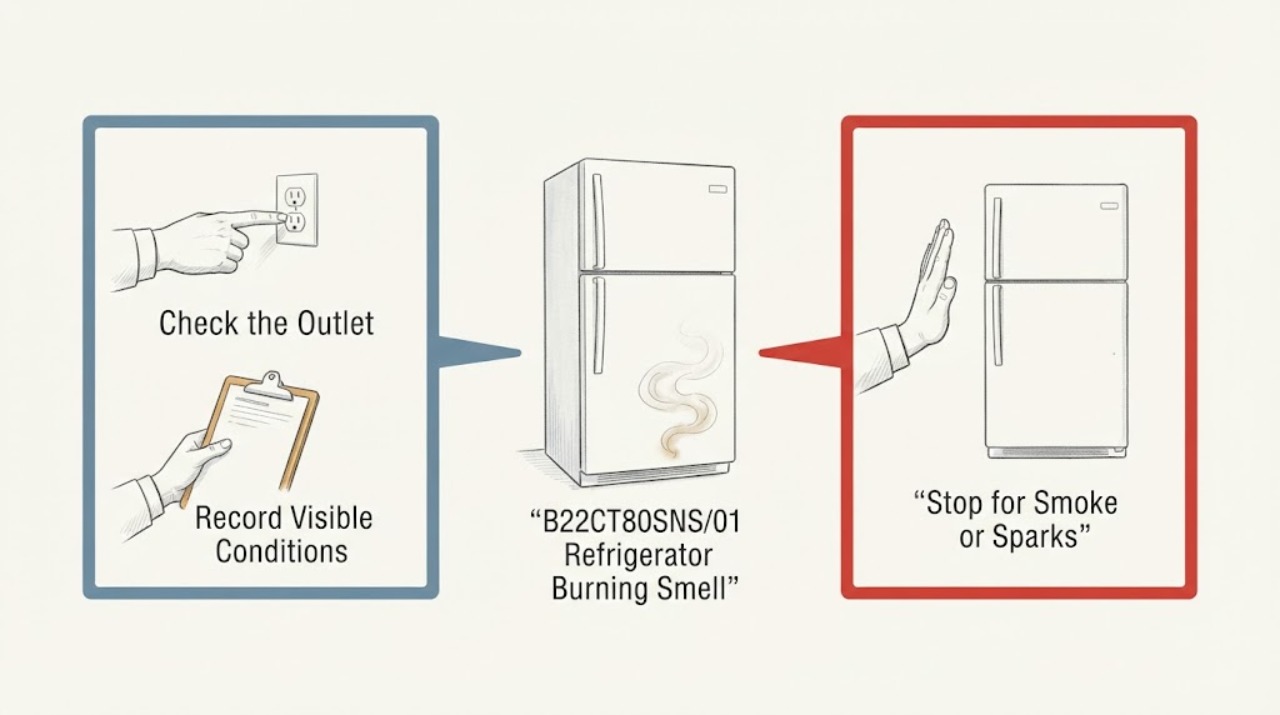
Work through in order
Diagnostic checks
Use only checks that match the exact appliance or system and its official guide.
-
Check 1
If the odor is present now, stop using the refrigerator. If there is smoke, flame, visible arcing, a hot or discolored outlet/plug, a damaged cord, or repeated breaker tripping, move people and pets away; call emergency or fire services for an active fire or smoke condition, and call an electrician or qualified appliance service from a safe location. Disconnect the refrigerator only if doing so is safe and practical.
Expected result: The smell is accompanied by smoke, flame, sparking, heat or discoloration at the plug/outlet, cord damage, or a breaker that trips again.
Next step: Keep the unit de-energized and do not reset the breaker or reconnect the plug to test it. Follow emergency responders, an electrician, or qualified Bosch service; do not enter a smoky or burning area to unplug it.
Why this matters
Why: These are electrical or fire warning signs. They do not distinguish a refrigerator component from the branch circuit and are outside a safe user diagnostic.
-
Check 2
After power is isolated and the refrigerator is cool, make an external-only record of the plug, cord, outlet, floor area, front grille and accessible rear clearance. Look without removing panels or touching wiring for scorching, melted plastic, grease, water, a pinched cord, or a loose plug. Do not pull the refrigerator out unsafely and do not use a meter, test light, flame, or spray.
Expected result: There is visible damage, moisture near electrical parts, a cord that is cracked or pinched, an outlet that is loose or discolored, or no visible external abnormality.
Next step: Leave power off and report the exact observation to an electrician or Bosch/qualified appliance technician. Do not tape a damaged cord, replace an outlet yourself, remove the rear cover, or reconnect the refrigerator simply because the exterior looks normal.
Why this matters
Why: A damaged supply or visible heat/water evidence requires service and may be in the home wiring. A clean exterior does not clear the refrigerator and cannot identify an internal part.
-
Check 3
Without powering the appliance, note where and when the odor was first noticed: at the plug or wall, behind the cabinet, near the lower grille, inside a compartment, after cleaning, or after a spill. Keep doors closed as much as practical while power is off and move perishable food to a safe powered refrigerator or cooler according to local food-safety guidance.
Expected result: The odor is limited to an accessible food or cleaner spill with no electrical signs, or it is strongest near the supply/rear/lower cabinet, persists after the area is cleaned, or cannot be localized safely.
Next step: For a possible food or nonflammable-cleaner spill, clean only accessible surfaces as the exact Bosch manual permits and keep power disconnected until the odor is gone; if the odor persists, is electrical/chemical, or the source is uncertain, do not use the refrigerator and arrange service.
Why this matters
Why: Food or cleaner odor is a possible external explanation, while a persistent cabinet or supply odor remains unresolved. The location alone does not prove a compressor, fan, heater, wiring, or refrigerant fault.
-
Check 4
Record the complete rating-label identity as B22CT80SNS/01 (including the slash and suffix), the time and location of the smell, whether cooling or lights changed, any breaker event, visible damage, and whether the odor was inside or outside the cabinet. Use Bosch’s exact model support path rather than a generic refrigerator code or parts listing.
Expected result: A technician receives an exact model and a repeatable, safety-cleared symptom record, or the smell cannot be safely reproduced or characterized.
Next step: Keep the refrigerator out of service until Bosch or a qualified technician says it is safe. Do not order a compressor, relay, fan, control board, harness, or other part from “burning smell” alone.
Why this matters
Why: Model and symptom details let service identify the correct manual and inspection scope; they do not make a live test or a component guess appropriate for the owner.
Use your observations
Decision map
Find the observation that best matches what you see, then follow the next safe action.
-
PATH 01Next step
What you see
Smoke, flame, arcing, a hot/discolored plug or outlet, cord damage, or repeated breaker tripping accompanies the refrigerator smell.
Do this next
Leave the area or call emergency services as appropriate, keep the refrigerator de-energized when safe, and arrange electrician or qualified appliance service. Do not reset and retest it.
Why this path and its safety boundary
Why it matters: This is a possible fire or electrical event; the evidence does not identify whether the appliance or building wiring is at fault.
-
PATH 02Next step
What you see
The smell persists, returns after the appliance is switched off, is strongest near the cabinet or supply, or cannot be localized without moving panels.
Do this next
Keep the unit out of service and provide Bosch/qualified service with the exact model and odor timeline. Do not open the rear or lower cabinet or run another cycle.
Why this path and its safety boundary
Why it matters: The symptom remains unresolved and may involve the appliance, cord, outlet, installation, or a spill; odor alone cannot name a failed component.
-
PATH 03Next step
What you see
After safe disconnection there is a clearly identified accessible food or nonflammable-cleaner spill, with no smoke, heat, electrical damage, or odor at the supply.
Do this next
Clean only user-accessible surfaces using the Bosch manual’s nonflammable-cleaner guidance, leave power disconnected while cleaning, and escalate if the smell remains or returns.
Why this path and its safety boundary
Why it matters: An accessible spill is a possible odor source, but it has not been shown to explain an odor that persists or smells electrical.
-
PATH 04Next step
What you see
No external damage is visible after power is isolated, but the burning smell was genuine or the source is uncertain.
Do this next
Do not reconnect for a “quick test”; keep the refrigerator out of service and arrange model-specific qualified service.
Why this path and its safety boundary
Why it matters: A visual check cannot rule out an internal electrical or mechanical fault.
Helpful context
Understand the symptom
The smell does not identify a failed part
The exact Bosch service record identifies B22CT80SNS/01 as a French-door bottom-mount refrigerator and provides model-specific manual and service lookup. The opened manual covers safe operation, cleaning, and electrical precautions, but it does not say that a burning smell proves a compressor, fan motor, relay, control board, wiring, or refrigerant fault. Treat the smell as a safety symptom and preserve those possibilities for qualified diagnosis instead of ordering a part from the odor alone.
Disconnect first; do not reproduce a possible electrical fault
Bosch’s manual warns about fire and electric shock, requires disconnection before service or cleaning, and says to use nonflammable cleaner. USFA advises direct wall-outlet connection for refrigerators and replacing an appliance with a cracked, damaged, or loose cord. Those instructions support a stop-use boundary; they do not authorize opening the rear cover, probing live wiring, or running another cycle to locate the smell.
When checks do not resolve it
Need a professional?
Arrange Bosch or qualified appliance/electrical service for any burning smell that persists, returns, follows a breaker event, comes from the cabinet or supply, or cannot be safely explained by an accessible spill. Use emergency or fire services for smoke or fire and an electrician when the outlet, cord, plug, or circuit is suspect.
Safety scope: Do not energize the refrigerator to reproduce the odor, remove panels, probe live or stored electrical energy, bypass protection, tape a damaged cord, use flammable cleaner, or replace a compressor, relay, fan, wiring, or control board based on smell alone.
Have this ready
- Provide the complete rating-label model B22CT80SNS/01, serial information if requested, odor timing and location, cooling/light status, breaker history, plug/outlet/cord observations, any spill or cleaner used, and whether food was moved while power was off.
Common questions
FAQ
Does a burning smell prove that the Bosch refrigerator compressor is failing?
No. The exact Bosch manual and support record do not map this symptom to a compressor or any other named part. Keep the refrigerator de-energized and have the appliance and its electrical supply assessed by qualified service.
Can I plug the refrigerator into an extension cord to see whether the smell stops?
No. Bosch’s manual warns against adapters and extension cords, and USFA says major appliances such as refrigerators should plug directly into a wall outlet. A damaged, loose, or hot supply needs electrical or appliance service, not a test connection.
What should I do if the smell stopped and I see no damage?
Do not assume it is safe solely because the odor stopped. Record the exact model and what happened, keep the refrigerator out of service, and arrange qualified service before reconnecting it; only a clearly identified accessible spill may be cleaned as the Bosch manual allows, with power disconnected.
Read the exact guide
Official sources
- B22CT80SNS / B22CT80SNP Operating InstructionsBosch Home Appliances · Exact model-family manual opened from Bosch media host; used only for user-level safety, cleaning, electrical connection and service boundaries. It does not define burning smell as a particular component fault.
- Appliance and Electrical Fire SafetyU.S. Fire Administration · General safety source used for the refrigerator power-supply boundary; it does not diagnose Bosch appliance parts.
- Appliance Information - French Door Bottom Mount Refrigerator | B22CT80SNS/01Bosch Home Appliances · Exact assigned model identity after formatting the task string B22CT80SNS01 as B22CT80SNS/01; used for model-specific support routing, not a burning-smell component diagnosis.
- Bosch Refrigeration Owner SupportBosch Home Appliances · Official Bosch support route for exact-model lookup and service escalation; it does not establish a burning-smell diagnosis or component fit.
Community feedback
Share a repair observation
Share a plain-text repair observation. Accepted observations are published automatically; this page may take a moment to update.