
On this page
Start here
Quick answer
Record the exact error, model, timing, and function before clearing it. Use the exact manufacturer's manual because codes vary by model. Check water, container/basket, cleaning, and power conditions only as documented; a returning code or unsafe symptom needs service.
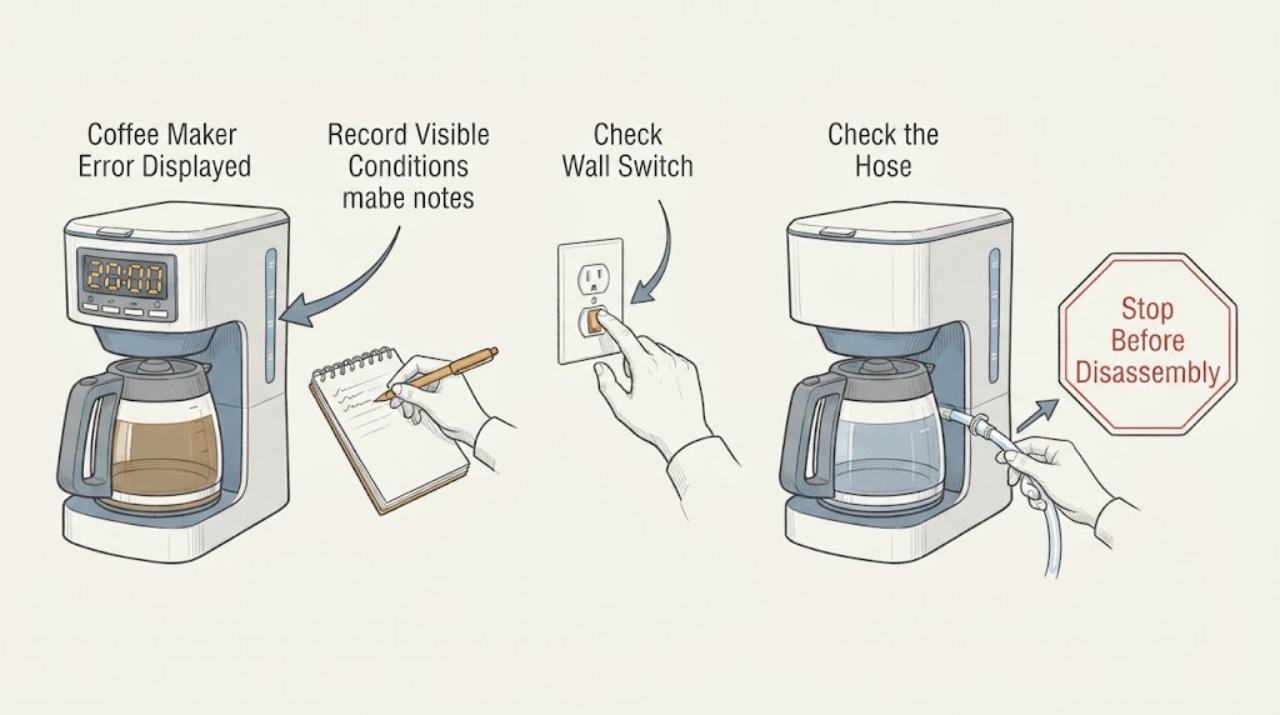
Work through in order
Diagnostic checks
Use only checks that match the exact appliance or system and its official guide.
-
Check 1
Record the symptom, timing, display, and operating state.
Expected result: The fault appears at startup, during a cycle, or after a function.
Next step: Use the exact manual and continue to the matching external check.
Why this matters
Why: Timing separates control, water, airflow, and component branches.
-
Check 2
Check the accessible power source, switch, breaker, or control lock.
Expected result: Power/control is abnormal or normal.
Next step: Correct one obvious condition and retry once.
Why this matters
Why: An absent supply or active lock can prevent operation without an internal failure.
-
Check 3
Inspect the topic-specific user-accessible path: door/filter/vent, water tank and filter, drain hose, or blower inlet.
Expected result: A blockage, misseating, or restriction is present or the path is clear.
Next step: Correct only the manual-described condition and observe one controlled test.
Why this matters
Why: The observed restriction can explain the symptom; a clear path shifts suspicion inward.
-
Check 4
Check the selected mode, temperature, timer, program, load, or container as applicable.
Expected result: The setting or load is unsuitable or normal.
Next step: Restore the documented setting and allow stabilization.
Why this matters
Why: A program or load mismatch can mimic a component fault.
-
Check 5
Run one supervised test while watching for code, sound, temperature, water, and completion behavior.
Expected result: The unit recovers, repeats the symptom, or shows a warning.
Next step: Stop for warning symptoms and record the result.
Why this matters
Why: Recovery after an external correction differs from a recurring internal fault.
-
Check 6
Apply the professional stop boundary for recurring failure, damage, odor, smoke, leak, heat, or inaccessible parts.
Expected result: The issue is resolved or returns.
Next step: Stop using the appliance and arrange qualified service with the record.
Why this matters
Why: Recurrence after safe checks requires component diagnosis.
Use your observations
Decision map
Find the observation that best matches what you see, then follow the next safe action.
-
PATH 01Next step
What you see
The visible power, setup, or setting condition is abnormal and the symptom clears after correction.
Do this next
Maintain the documented setup and monitor one normal cycle.
Why this path and its safety boundary
Why it matters: An external operating condition was the leading explanation.
-
PATH 02Next step
What you see
The relevant path is blocked, misseated, or restricted and the symptom remains after a single correction.
Do this next
Stop repeated testing and arrange service.
Why this path and its safety boundary
Why it matters: A persistent flow, interlock, airflow, or water-path fault is more likely.
-
PATH 03Next step
What you see
External checks are normal but the original symptom or code returns.
Do this next
Keep the unit off and obtain qualified service.
Why this path and its safety boundary
Why it matters: An internal sensor, control, motor, heater, pump, or compressor fault needs diagnosis.
-
PATH 04Next step
What you see
Smoke, burning odor, gas or water hazard, damaged cord, or dangerous heat appears.
Do this next
Disconnect power or supply if safe and obtain qualified service.
Why this path and its safety boundary
Why it matters: A safety fault overrides routine troubleshooting.
Helpful context
Understand the symptom
Record the exact error, model, timing, and function before clearing it. Use the exact manufacturer's manual because codes vary by model. Check water, container/basket, cleaning, and power conditions only as documented; a returning code or unsafe symptom needs service.
Use the exact owner manual for model-specific controls, reset, access, and part information. Do not open live or sealed components.
When checks do not resolve it
Need a professional?
A qualified technician may test the relevant power, control, sensor, motor, heater, pump, fan, valve, or sealed-system components after the external checks.
Common questions
FAQ
What should I check first for Coffee Maker Error Displayed?
Record the exact error, model, timing, and function before clearing it. Use the exact manufacturer's manual because codes vary by model. Check water, container/basket, cleaning, and power conditions only as documented; a returning code or unsafe symptom needs service.
Can I reset it?
Use only the exact manual's reset or cancellation procedure, after recording the symptom. A returning fault needs service.
When should I stop using it?
Stop for smoke, burning odor, exposed wiring, uncontrolled water or gas, damaged cord, dangerous heat, or a recurring failure after safe external checks.
What should service receive?
Provide the exact model, code or display, timing, settings, load, and results of the external checks.
Read the exact guide
Official sources
- Product HubBreville · Use for coffee-maker symptom guidance; exact controls and access remain model-specific.
Community feedback
Share a repair observation
Share a plain-text repair observation. Accepted observations are published automatically; this page may take a moment to update.