
On this page
Start here
Quick answer
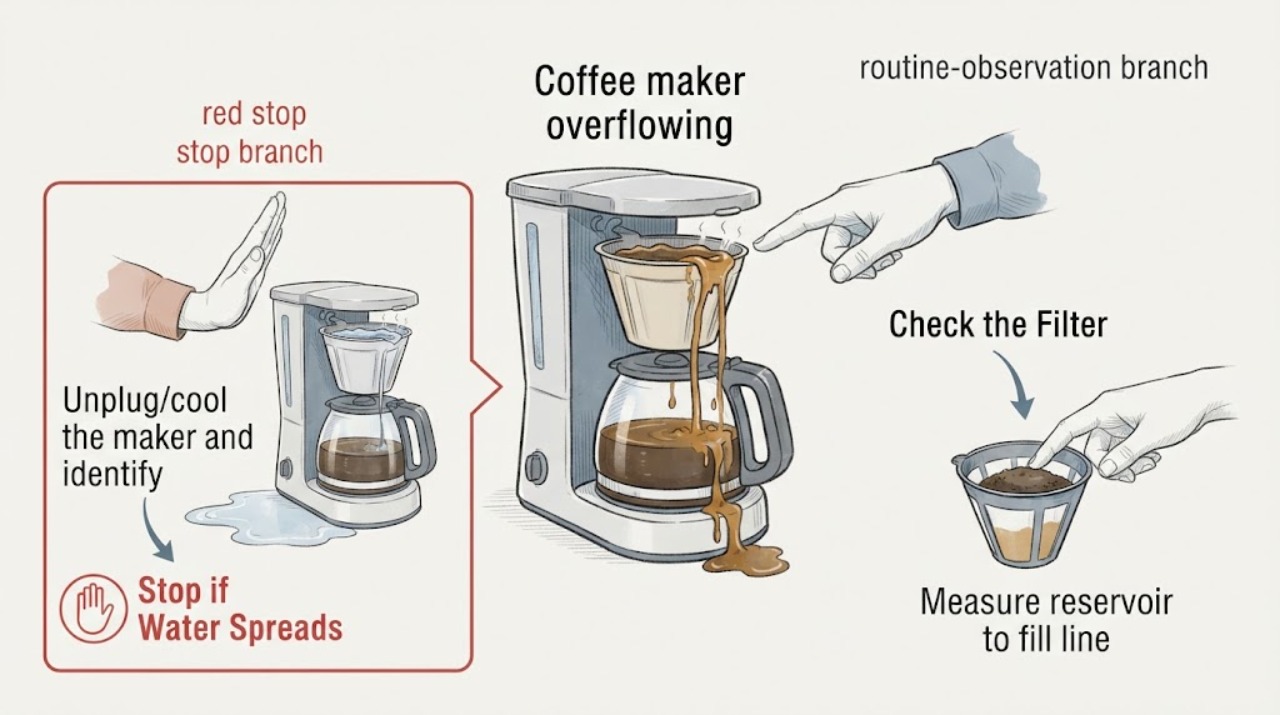
A coffee maker that overflows usually has too much water or coffee, a clogged/collapsed filter, a too-fine grind, a mis-seated carafe, or a blocked brew-head outlet. Unplug and cool it, verify water and coffee limits, clean removable parts, then run one measured test. Base overflow or repeated overflow needs service.
Work through in order
Diagnostic checks
Use only checks that match the exact appliance or system and its official guide.
-
Check 1
Unplug/cool the maker and identify whether liquid spills from basket, carafe, reservoir, or base.
Expected result: Basket fills, carafe does not receive coffee, reservoir spills, or base gets wet.
Next step: Dry it and follow the matching check; do not run with water near cord.
Why this matters
Why: Basket overflow points to flow restriction; base leak is a safety boundary.
-
Check 2
Measure reservoir to fill line and verify centered carafe/lid valve.
Expected result: Water exceeds line, carafe is mis-seated, or both are correct.
Next step: Correct level/seating and run one measured test.
Why this matters
Why: Overfill or closed carafe valve can trap brewed water in basket.
-
Check 3
Check filter, dose, grind, and basket for collapse/clog; use model-recommended grind.
Expected result: Dose high, grind fine, filter clogged/collapsed, or clear.
Next step: Use fresh correctly sized filter and measured dose, then retest once.
Why this matters
Why: Official guidance connects these restrictions to overflow.
-
Check 4
Inspect accessible brew-head outlet/needle for grounds and clean as manual permits.
Expected result: Outlet blocked or path clear but overflow repeats.
Next step: Stop repeated testing and arrange service.
Why this matters
Why: A blocked outlet can back up water; a clear path with recurrence needs control/valve diagnosis.
Use your observations
Decision map
Find the observation that best matches what you see, then follow the next safe action.
-
PATH 01Next step
What you see
Fill level/carafe seating was wrong and overflow stops after correction.
Do this next
Keep fill and seating within manual limits.
Why this path and its safety boundary
Why it matters: Setup error explains the spill.
-
PATH 02Next step
What you see
Basket overflows with excess dose, fine grind, collapsed filter, or blocked outlet.
Do this next
Correct dose/filter/grind and clean removable outlet.
Why this path and its safety boundary
Why it matters: A restricted brew path is likely.
-
PATH 03Next step
What you see
Measured water/dose and correct assembly still overflow.
Do this next
Keep unplugged and contact qualified service.
Why this path and its safety boundary
Why it matters: Valve, sensor, control, or internal blockage needs model diagnosis.
-
PATH 04Next step
What you see
Overflow includes base leak, smoke, burning smell, heat, or water at cord.
Do this next
Stop and isolate power only if safe, then obtain qualified help.
Why this path and its safety boundary
Why it matters: Immediate safety boundary.
Helpful context
Understand the symptom
Overflow is a capacity/flow problem: the basket cannot pass water at the expected rate. Find whether the basket, reservoir, carafe, or base is the source.
Change one variable at a time so the outcome identifies a branch.
When checks do not resolve it
Need a professional?
Arrange service when overflow returns after measured water/dose, filter, grind, seating, and outlet checks or when a base leak appears.
Common questions
FAQ
Why does the basket overflow?
Too much coffee, too-fine grind, clogged filter, or blocked outlet are documented causes; also check water level and carafe seating.
Can too much water cause overflow?
Yes. Keep it below the maker’s fill line and seat the carafe correctly.
Should I restart it repeatedly?
No. After one measured correction, persistent overflow needs model-specific service.
Read the exact guide
Official sources
- Support & FAQs for BVMC-KG5 Coffee MakerMr. Coffee · coffee maker leak and brew-head checks
- 〖コーヒー共通〗水やコーヒーが漏れるDe’Longhi · drip coffee maker leak, overflow, dose, filter, gasket, and grind checks
Community feedback
Share a repair observation
Share a plain-text repair observation. Accepted observations are published automatically; this page may take a moment to update.