
On this page
Start here
Quick answer
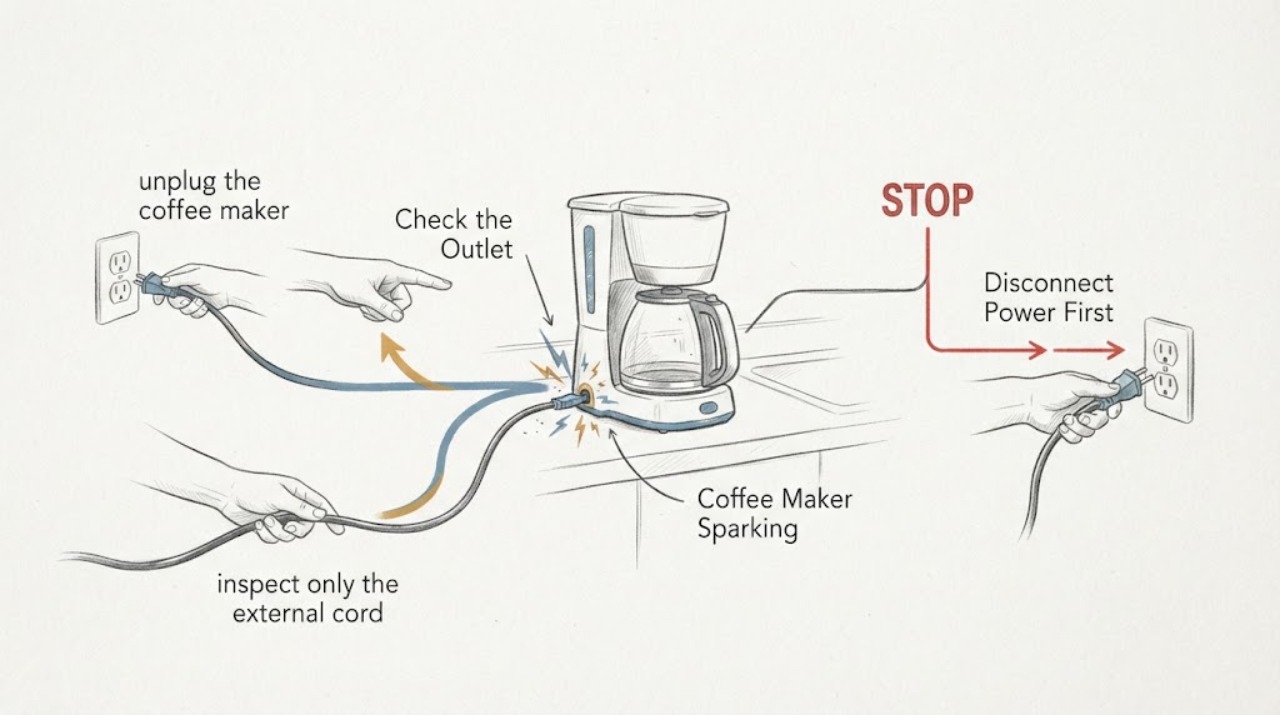
If a coffee maker sparks, stop using it immediately, unplug it only if the plug and outlet are dry and safe to touch, and keep it unplugged. Do not test it again, open the bottom cover, or operate it with a damaged cord or plug. After it is cool, record whether the spark came from the plug, outlet, cord, switch, or inside the machine; a repeat spark, scorch, smoke, heat, or water exposure needs qualified electrical or appliance service.
Work through in order
Diagnostic checks
Use only checks that match the exact appliance or system and its official guide.
-
Check 1
Stop brewing and look from a distance for smoke, flame, a hot or scorched plug/outlet, a damaged cord, water, or continued arcing.
Expected result: Any smoke, flame, heat, scorch, burning odor, water near electrics, or repeated arc is present.
Next step: If safe, cut power at the normal disconnect and keep clear; call qualified emergency/electrical or appliance help.
Stop if: Do not touch a hot, wet, scorched, or arcing plug or outlet.
Why this matters
Why: A spark with these signs is an electrical/fire hazard; diagnosis ends before any cleaning or reset.
-
Check 2
If the outlet and plug are dry and no longer arcing, unplug the coffee maker and let it cool fully before moving or cleaning any removable part.
Expected result: The spark was at the outlet/plug, along the cord, at the switch, or appeared to come from inside the housing.
Next step: Leave the maker unplugged; have an electrician check the outlet/cord or an appliance servicer inspect the machine as appropriate.
Stop if: Stop if the condition becomes unsafe or requires opening the appliance.
Why this matters
Why: The location distinguishes a household outlet/cord inspection from an internal appliance fault, but it does not make a live test safe.
-
Check 3
With power disconnected, inspect only the external cord, plug, visible housing, carafe area, and removable water-contact parts for liquid, cracks, residue, or damage; do not remove the bottom cover.
Expected result: Liquid entered the base, the cord/plug is damaged, or no external cause is visible.
Next step: Do not reconnect it. Arrange manufacturer or qualified service and provide the model and spark location.
Stop if: Stop if the condition becomes unsafe or requires opening the appliance.
Why this matters
Why: Philips says not to operate a malfunctioned or damaged coffee maker and not to remove the bottom cover; an internal fault cannot be safely resolved by a user check.
-
Check 4
After service or replacement advice, compare whether the event was a one-time external outlet fault or a repeat appliance spark; do not use a second outlet as a repeated test.
Expected result: The coffee maker sparks again, trips protection, smells hot, or remains dead.
Next step: Keep it disconnected and arrange service or replacement after a model/recall check.
Stop if: Stop if the condition becomes unsafe or requires opening the appliance.
Why this matters
Why: Recurrence or protective-device operation confirms that continued use is unsafe and a component diagnosis is required.
Use your observations
Decision map
Find the observation that best matches what you see, then follow the next safe action.
-
PATH 01Next step
What you see
Spark, smoke, heat, or scorch is at the wall outlet or plug
Do this next
Leave the circuit off if needed and use a qualified electrician; do not test another appliance at that outlet.
Why this path and its safety boundary
Why it matters: The supply connection or cord is the immediate hazard, and the coffee maker should remain disconnected.
-
PATH 02Next step
What you see
Spark appears inside the coffee maker or after water entered the base
Do this next
Keep the unit unplugged and arrange qualified appliance service; do not remove the bottom cover.
Why this path and its safety boundary
Why it matters: An internal electrical fault or moisture exposure is possible.
-
PATH 03Next step
What you see
There was one visible arc with no heat or smoke but the event recurs
Do this next
Stop use and obtain service or replacement guidance.
Why this path and its safety boundary
Why it matters: Recurrence is enough to treat the appliance as unsafe even if it still powers on.
Helpful context
Understand the symptom
Treat a spark as a stop signal
The key observation is where the spark occurred and whether there is heat, smoke, scorch, or water. Those results determine whether electrical service or appliance service is the next safe step; they do not justify repeated power tests.
When checks do not resolve it
Need a professional?
Call a qualified electrician for a sparking outlet, plug, or household circuit, and qualified appliance service for an internal spark, damaged coffee maker, or recurring event. Seek urgent help for smoke, flame, or active arcing.
Common questions
FAQ
Can I plug the coffee maker in again to see if it sparks?
No. A repeat test can turn an intermittent arc into a shock or fire hazard. Keep it unplugged and arrange qualified evaluation.
Can I remove the bottom cover to find the spark?
No. Philips’ safeguards say the bottom cover should not be removed and identifies no user-serviceable parts inside.
Read the exact guide
Official sources
- Staff Reports on the Cords and Plugs Project Part IIU.S. Consumer Product Safety Commission · Appliance cord and plug arcing hazards
- IMPORTANT SAFEGUARDSPhilips · Philips coffee maker electrical and cleaning safety
Community feedback
Share a repair observation
Share a plain-text repair observation. Accepted observations are published automatically; this page may take a moment to update.