
On this page
Start here
Quick answer
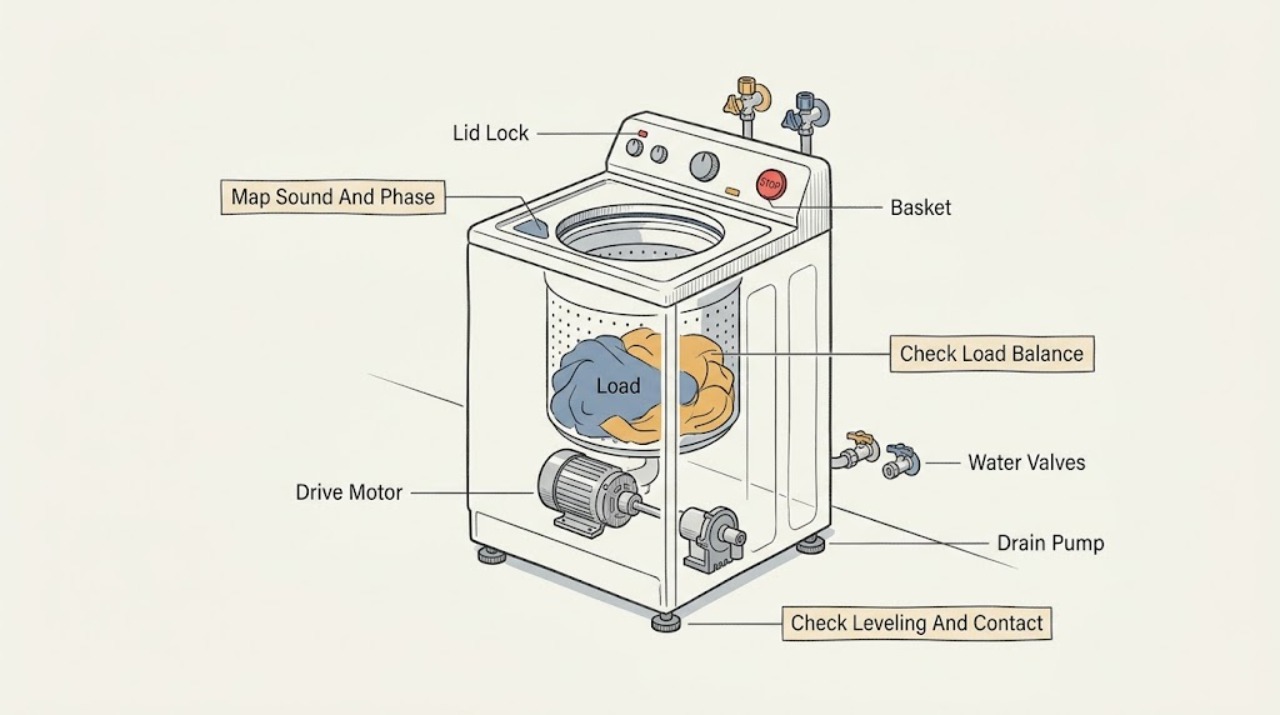
A Crosley washer can make normal clicking, water-flow, gear, electric-hum, or motor sounds, but a new scrape, grinding noise, repeated hard knock, or violent movement needs a stop-and-check decision. Note whether the sound occurs during fill, wash agitation, drain, or spin. With the machine stopped and power safely disconnected, redistribute a bunched load and check from outside that the washer stands firmly on its leveling legs. Crosley's opened owner guide explains that a drain pump may hum during drain and spin, a motor can hum or ramp during wash and spin, and uneven leveling legs can make the washer rock or move. If the noise remains with an empty basket, is harsh or metallic, comes with a leak, burning smell, electrical symptom, or severe movement, keep the washer out of service and arrange qualified repair. Use the exact model guide for any access or installation procedure.
Before you begin
Safety first
- This article supports sound classification and ordinary accessible checks only. Keep the washer out of service for persistent or dangerous noise. Do not open the cabinet, bypass the lid lock, test live wiring, reach into moving parts, or handle wet electrical components.
Work through in order
Diagnostic checks
Use only checks that match the exact appliance or system and its official guide.
-
Check 1
Stop the washer and note whether the sound occurs during fill, wash agitation, drain, acceleration, or high-speed spin. Describe it as a click, water-flow sound, swoosh, hum, gurgle, rattle, knock, scrape, or grinding sound, and record whether the basket turns and the cabinet moves.
Expected result: Crosley's guide associates some clicks and water-flow sounds with the fill valves, a motor hum with wash or spin, a pump hum with draining, and ramping sounds with spin. A sharp metallic sound, repeated impact, or noise that follows every basket revolution is not identified by those normal examples.
Next step: If there is violent movement, smoke, a burning smell, a leak, a damaged cord, or water near electrical parts, isolate the washer only when safe and arrange qualified help. Otherwise continue with the matching external check.
Stop if: Do not run another cycle solely to reproduce a dangerous sound.
Why this matters
Why: The phase and sound pattern determine whether a normal-operation explanation is plausible or whether the washer should remain stopped for service diagnosis.
-
Check 2
With the cycle stopped and power safely disconnected, open the lid only when it is unlocked. Redistribute a heavy item or clothes gathered on one side, remove obvious excess load, and load items loosely and evenly as the exact guide describes.
Expected result: An out-of-balance load can cause thumping, cabinet movement, repeated acceleration attempts, or wetter clothing at the end; a reasonable load that still makes a hard or scraping sound points elsewhere.
Next step: Use the model guide's permitted Drain and Spin or similar test once when the washer is stable and safe. Stop if the noise persists, the machine moves, or water or an error appears.
Stop if: Do not force the lid, reach into moving parts, or continue if the floor or cabinet is damaged.
Why this matters
Why: Crosley says an out-of-balance load can prevent full-speed spin and directs redistribution before a Drain and Spin cycle, but load correction does not prove that suspension, basket, motor, or drive parts are healthy.
-
Check 3
From a dry safe position, check that the washer stands firmly rather than rocking and is not visibly contacting a wall, cabinet, or loose object. If the guide permits owner leveling, follow that exact procedure; do not lift or tilt the washer by guesswork.
Expected result: A washer that rocks or walks during spin may have uneven leveling legs or an installation condition; a stable washer with an internal scrape or grinding noise needs a different diagnosis.
Next step: Correct only the model-documented leveling or clearance issue, then run at most one permitted supervised test. Arrange installation or repair help if the washer remains unstable.
Stop if: Stop for a cracked foot, damaged floor, shifted stacked installation, severe movement, or any need to lift the appliance without suitable equipment.
Why this matters
Why: Crosley's guide associates rocking or moving with uneven leveling legs, but adjusting a foot cannot explain a noise that remains with an empty stable basket.
-
Check 4
With power safely disconnected and the lid unlocked, inspect the visible basket, agitator or wash plate, lid area, and accessible clothing pockets for a coin, wire, button, or other hard object. Remove an item only if it is plainly accessible without forcing or disassembling anything.
Expected result: A loose object may rattle during agitation or scrape once per basket rotation; no visible object, a damaged basket or lid, or a sound that remains after removal leaves an internal source possible.
Next step: Keep the washer off if the basket, lid, or wash plate is damaged or the sound remains. Photograph the finding and arrange qualified service.
Stop if: Do not force the basket, remove the wash plate, defeat the lid lock, or reach under a moving component.
Why this matters
Why: An accessible object can cause a localized noise, but a trapped object under the wash plate, between tubs, or inside the cabinet is not safely diagnosed by reaching farther.
-
Check 5
If the sound occurs as water drains, inspect only the visible drain hose and household drain connection for rubbing, displacement, kinks, or overflow. Do not dismantle the plumbing or open the washer's motor or pump area.
Expected result: A pump hum or gurgle can be part of drain operation, while a hose striking the cabinet, a household drain backing up, or a harsh noise with slow drainage changes the next step.
Next step: Use the exact guide for any explicitly user-accessible drain or filter procedure. Arrange service if the visible path is clear but the noise, poor drainage, or retained water continues.
Stop if: Stop for contaminated water, overflow, a concealed blockage, water near electrical parts, or any need to open the cabinet.
Why this matters
Why: An external routing or drain condition may be corrected without proving a pump failure; persistent harsh pump-area noise or poor drainage requires service assessment.
-
Check 6
Only when the washer is stable, dry, free of visible damage, and the manual permits normal operation, run one short supervised empty or very small-load cycle. Observe from outside; do not touch the lid, basket, motor area, hoses, or controls while the machine is moving.
Expected result: Record whether the noise is absent, returns during the same phase, follows basket speed, or is accompanied by movement, leak, poor drainage, a lid warning, or an electrical symptom.
Next step: Stop at the first return of a harsh sound, severe movement, leak, smoke, burning smell, or error. Preserve the phase and description for the technician rather than repeating the test.
Stop if: Do not test if the washer has an active leak, damaged lid or basket, sharp metal sound, exposed damage, or suspected internal fault.
Why this matters
Why: A noise that disappears after load or leveling correction may be external, while a noise that remains empty or grows with speed is less consistent with imbalance and needs service diagnosis.
-
Check 7
Record the exact Crosley model, sound description, cycle phase, load and balance, leveling condition, visible object or hose findings, and any leak, error, poor drainage, odor, or movement. Use the Crosley customer-service page or exact Use and Care Guide for the correct support route.
Expected result: A precise record distinguishes normal phase sounds, load imbalance, leveling movement, drain-stage behavior, and persistent noise with an empty basket.
Next step: Keep the washer out of service and arrange qualified repair for persistent or harsh noise, noise with an empty basket, a leak, poor drainage, severe movement, smoke, burning smell, or electrical symptom.
Stop if: Stop all user troubleshooting if the washer cannot be safely isolated or the hazard is worsening.
Why this matters
Why: Motor, pump, basket, drive, suspension, bearing, valve, lid lock, or control faults cannot be assigned from the sound alone or by ordering a generic part.
Use your observations
Decision map
Find the observation that best matches what you see, then follow the next safe action.
-
PATH 01Safety boundary
What you see
The sound matches a listed fill click, water-flow sound, motor hum, pump hum, or ramping sound and there is no leak, damage, or abnormal movement.
Do this next
Continue only if operation remains stable and safe; use the exact model guide if the sound changes or a new symptom appears.
Why this path and its safety boundary
Why it matters: Crosley's owner guide describes these as sounds that can occur during normal wash and spin operation.
Safety stop: Stop for a new scrape, grinding sound, hard impact, severe movement, smoke, odor, leak, or electrical symptom.
-
PATH 02Safety boundary
What you see
The load is bunched or heavy and the noise or movement appears during spin, with wetter clothing at the end.
Do this next
Redistribute the load according to the guide and perform one permitted supervised test when the washer is stable.
Why this path and its safety boundary
Why it matters: Crosley's guide says an out-of-balance load can prevent full-speed spin and recommends even redistribution and a Drain and Spin cycle.
Safety stop: Do not continue if the washer moves violently or the noise remains with an empty basket.
-
PATH 03Safety boundary
What you see
The washer rocks or walks during spin and an external check finds uneven feet or contact with a nearby object.
Do this next
Follow only the model guide's leveling and clearance steps, then stop if the machine remains unstable or noisy.
Why this path and its safety boundary
Why it matters: Uneven leveling legs or installation contact may be contributing to movement, but they do not explain every internal noise.
Safety stop: Do not lift or tilt the appliance by guesswork.
-
PATH 04Safety boundary
What you see
The sound occurs during drain and the visible hose or household drain is rubbing, displaced, slow, or overflowing.
Do this next
Correct only visible routing permitted by the guide and arrange service if noise or poor drainage remains.
Why this path and its safety boundary
Why it matters: External drain routing or household drainage may contribute, while a harsh persistent pump-area sound remains unresolved.
Safety stop: Stop for overflow, contaminated water, electrical exposure, or cabinet access.
-
PATH 05Safety boundary
What you see
The sound remains with an empty basket, follows basket speed, is harsh or metallic, comes from underneath, or is paired with a leak, error, severe movement, smoke, odor, or electrical symptom.
Do this next
Keep the washer out of service, isolate power only when safe, and arrange qualified Crosley or appliance repair using the model and recorded symptoms.
Why this path and its safety boundary
Why it matters: An internal motor, pump, basket, drive, suspension, bearing, lid-lock, valve, wiring, or control fault may be involved; no single part is proven.
Safety stop: Do not open the cabinet, bypass the lid lock, test live wiring, or order a part based only on noise.
Helpful context
Understand the symptom
First decide whether the sound matches a normal washer phase
Crosley's opened washer guide lists clicks behind the controls during fill, changing water flow, a motor reversing direction, a drain-pump hum, a drive-motor hum, and a motor ramping up or down during spin as sounds that can occur during normal operation. A new grinding or scraping sound, a hard impact that repeats once per revolution, or movement across the floor is a different complaint. Write down the phase, sound, load, and movement before guessing at a part.
Keep the lid, basket, and electrical parts safe
Do not reach into a moving basket, defeat a lid lock, remove panels, or work on energized motor, pump, or valve parts. Stop for smoke, a burning or electrical smell, a damaged cord, water near electrical parts, a leak, or violent movement. Disconnect power only when the plug and floor are dry and it is safe to do so, and use the model guide for any service-panel or installation step.
Safety boundary
Stop conditions
- Stop for smoke, burning or electrical odor, shock, exposed wiring, a damaged cord, water near electrical parts, an active leak, or a tripped protective device.
- Stop for violent movement, a sharp metallic or grinding sound, a damaged basket or lid, a locked lid with a problem, or a machine that cannot be safely isolated.
- Do not defeat the lid lock, open the cabinet, test live wiring, remove internal parts, tilt the washer, or repeatedly run cycles to reproduce a dangerous sound.
- If the sound remains with an empty basket or after safe load, drain, and leveling checks, keep the washer out of service and arrange qualified repair.
When checks do not resolve it
Need a professional?
Arrange qualified repair when noise persists after safe load, leveling, visible-object, and drain checks; remains with an empty basket; follows basket speed; comes from underneath; or is accompanied by a leak, poor drainage, severe movement, smoke, burning or electrical odor, shock, or visible damage. Use the exact Crosley Use and Care Guide or customer-service route for model-specific instructions.
Safety scope: This article supports sound classification and ordinary accessible checks only. Keep the washer out of service for persistent or dangerous noise. Do not open the cabinet, bypass the lid lock, test live wiring, reach into moving parts, or handle wet electrical components.
Common questions
FAQ
Are clicking or humming sounds normal on a Crosley washer?
Crosley's owner guide describes some fill clicks, water-flow sounds, motor hums, pump hums, and spin ramping as normal phase sounds. A new scrape, grinding sound, hard impact, leak, or severe movement is different; stop and arrange service if it persists.
Why does my Crosley washer bang during spin?
An out-of-balance load or uneven leveling can cause thumping and movement. Stop safely, redistribute the load, and check stability from outside according to the model guide. If the noise remains with an empty basket or movement is violent, call qualified repair.
Why does my Crosley washer hum during drain?
Crosley's guide says the drain pump can hum while pumping after agitation and through spin. Check only visible drain routing and household drainage; call service for harsh or persistent noise, slow drainage, retained water, or a sound from underneath.
Can a coin or object make a Crosley washer noisy?
A plainly visible hard object can rattle or scrape, but do not force the basket, remove the wash plate, defeat the lid lock, or reach under moving parts. Keep the washer off and arrange service if the object is trapped or damage is visible.
When should I call for Crosley washer noise repair?
Call qualified repair when noise persists after safe load, leveling, visible-object, and drain checks; remains with an empty basket; or is paired with a leak, poor drainage, severe movement, smoke, burning or electrical odor, shock, or visible damage.
Read the exact guide
Official sources
- Washer Owners Manual and Installation InstructionsCrosley Home Products · Official Crosley-hosted washer owner guide; the opened guide covers specified Crosley top-load models, so the exact model's manual controls any different layout, options, or access procedure.
- Customer Service - Crosley Home ProductsCrosley Home Products · Official Crosley customer-service page used to direct owners to their dealer or the product's Use and Care Guide because service contact information varies by appliance.
- Crosley WashersCrosley Home Products · Official Crosley washer category page used only to establish that Crosley publishes separate top-load and front-load washer product lines; a model's own guide controls troubleshooting details.
Community feedback
Share a repair observation
Share a plain-text repair observation. Accepted observations are published automatically; this page may take a moment to update.