
On this page
Start here
Quick answer
To troubleshoot a dehumidifier that is overflowing, first identify the exact stage and accompanying signs, then make only the safe external checks supported by the owner guidance. Stop for hazards or recurrence and arrange qualified service.
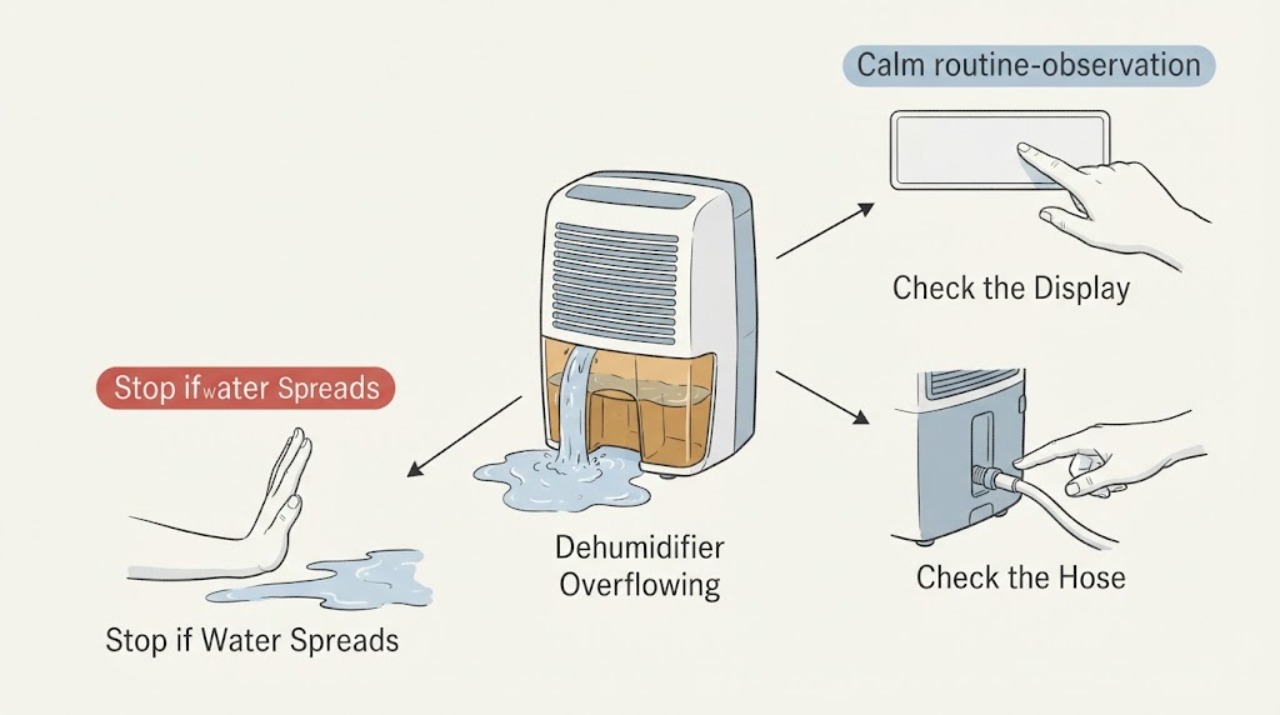
Work through in order
Diagnostic checks
Use only checks that match the exact appliance or system and its official guide.
-
Check 1
Identify how the dehumidifier is overflowing: note the display, fan or compressor behavior, bucket level, room condition, and whether water is reaching the bucket or drain.
Expected result: The symptom is intermittent, constant, or paired with a code, frost, water, or no collection.
Next step: Record the model and use its manual for the matching branch.
Why this matters
Why: These observations separate a container, drainage, frost, control, or sealed-system path without guessing a part.
-
Check 2
Turn the unit off and inspect the bucket, float area, and accessible drain connection for a full, tilted, cracked, or poorly seated bucket.
Expected result: The bucket is full, tilted, damaged, mis-seated, or appears normal.
Next step: Empty or re-seat only an intact accessible bucket; stop for cracks or persistent water.
Why this matters
Why: Frigidaire identifies a damaged or tilted bucket as a leak source and directs owners to service when external checks do not resolve a problem.
-
Check 3
Inspect the visible drain hose for a kink, blockage, frozen section, loose connector, or worn washer; do not open the cabinet.
Expected result: The hose or connector is restricted or leaking, or the visible route is clear.
Next step: Correct only a documented external connection and arrange service for recurrence.
Why this matters
Why: A restricted or leaking drain path can explain water, pump, or collection symptoms; a clear route shifts attention to the unit.
-
Check 4
Check the filter and accessible air openings, and note whether frost or ice forms at the base or coil area without scraping or heating it.
Expected result: Airflow is restricted, frost is present, or the path is clear and frost-free.
Next step: Clean only as the manual directs. Let frost resolve under documented conditions and arrange service if it returns.
Why this matters
Why: Restricted airflow or frost can affect collection and drainage, but the exact model determines safe care.
Use your observations
Decision map
Find the observation that best matches what you see, then follow the next safe action.
-
PATH 01Next step
What you see
The dehumidifier is overflowing only during a specific function or load
Do this next
Follow the exact owner manual for that condition and monitor only when safe.
Why this path and its safety boundary
Why it matters: A function-specific or load-dependent pattern narrows the safe check but does not prove a failed component.
-
PATH 02Next step
What you see
The dehumidifier remains overflowing after the accessible checks
Do this next
Stop testing and arrange qualified service.
Why this path and its safety boundary
Why it matters: The symptom is not resolved by an external condition and needs model-specific diagnosis.
-
PATH 03Next step
What you see
The symptom includes smoke, burning odor, gas odor, exposed wiring, water near electrics, a safety alarm, or a repeat breaker trip
Do this next
Arrange qualified service if the dehumidifier remains overflowing after the safe external checks, if a control or cord is damaged, or if the symptom returns. Do not open the housing, bypass an interlock, or work on energized, gas, sealed, or refrigerant components.
Why this path and its safety boundary
Why it matters: The condition is unsafe to continue testing.
Helpful context
Understand the symptom
The useful decision for a dehumidifier that is overflowing is to separate an accessible loading, setting, assembly, airflow, or supply condition from a symptom that needs model-specific service. Observe each result before choosing the next safe step.
When checks do not resolve it
Need a professional?
Arrange qualified service if the dehumidifier remains overflowing after the safe external checks, if a control or cord is damaged, or if the symptom returns. Do not open the housing, bypass an interlock, or work on energized, gas, sealed, or refrigerant components.
Common questions
FAQ
Can I keep using the dehumidifier while it is overflowing?
Arrange qualified service if the dehumidifier remains overflowing after the safe external checks, if a control or cord is damaged, or if the symptom returns. Do not open the housing, bypass an interlock, or work on energized, gas, sealed, or refrigerant components.
Read the exact guide
Official sources
- Dehumidifier - Water Leaking IssuesFrigidaire · Frigidaire dehumidifier troubleshooting, bucket, drain hose, frost, water, and service guidance
Community feedback
Share a repair observation
Share a plain-text repair observation. Accepted observations are published automatically; this page may take a moment to update.