
On this page
Start here
Quick answer
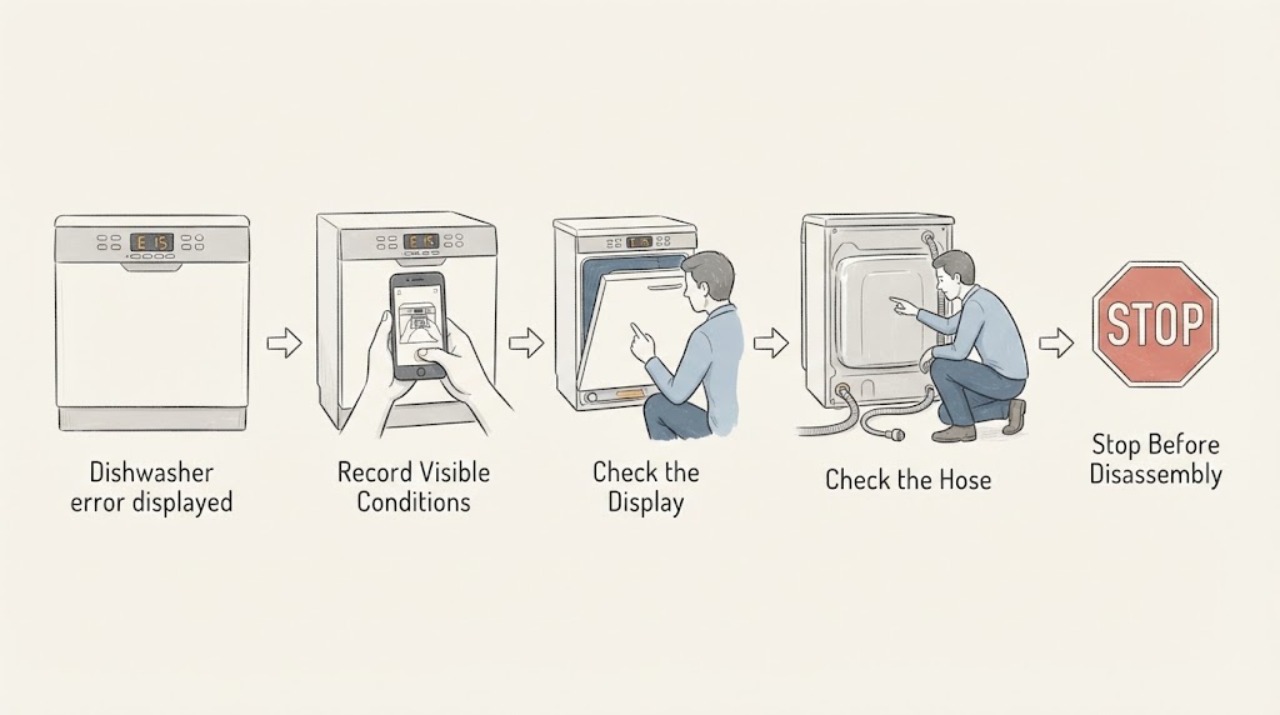
When a dishwasher displays an error, record the exact code or light-flash sequence before resetting. Meanings vary by model; use the matching owner manual, then perform only its accessible check or one power cycle. A returning code, leak, fill/drain failure, or electrical warning needs qualified service.
Work through in order
Diagnostic checks
Use only checks that match the exact appliance or system and its official guide.
-
Check 1
Wake the display and record full code or repeating light groups and pauses.
Expected result: Digital code, flash sequence, lock/water icon, or unreadable display.
Next step: Photograph panel and retrieve exact manual.
Why this matters
Why: Incomplete transcription can map to the wrong fault.
-
Check 2
Note whether code appears during fill, wash, drain, or with leak/standing water.
Expected result: No fill, standing water, poor drain, stopped motor, leak, or no functional symptom.
Next step: Keep off for leak or water near electrics.
Why this matters
Why: Stage narrows manual branch; code alone does not name a part.
-
Check 3
Check accessible water valve/hose, filter/drain hose, door closure, and visible leaks only as model guidance permits.
Expected result: Closed valve, kink, obstruction, door issue, leak, or all normal.
Next step: Correct one accessible condition; do not bypass interlocks or remove panels.
Why this matters
Why: Water/drain/door conditions map to different code families.
-
Check 4
Perform one documented 30-second power cycle only when no leak/hazard is present.
Expected result: Code clears and cycle completes or code returns/stops again.
Next step: Keep code history and arrange service if it returns.
Why this matters
Why: One-time clear may be control state; recurrence needs diagnosis.
Use your observations
Decision map
Find the observation that best matches what you see, then follow the next safe action.
-
PATH 01Next step
What you see
Code/flash sequence or model is incomplete.
Do this next
Record model and panel sequence and use manual lookup.
Why this path and its safety boundary
Why it matters: Meaning cannot be safely mapped.
-
PATH 02Next step
What you see
Exact manual links code to a visible water/drain/filter condition.
Do this next
Correct documented condition and retest once.
Why this path and its safety boundary
Why it matters: Accessible path issue is more likely.
-
PATH 03Next step
What you see
Code returns or dishwasher still cannot fill/drain/wash.
Do this next
Stop resets and arrange qualified service.
Why this path and its safety boundary
Why it matters: Persistent pump, valve, sensor, motor, or control fault is possible.
-
PATH 04Next step
What you see
Leak near electrics, smoke, burning odor, sparks, or repeated trip.
Do this next
Stop and isolate power/water only if safe, then obtain service.
Why this path and its safety boundary
Why it matters: Immediate safety boundary.
Helpful context
Understand the symptom
An error display is an identity problem first: record code, flash pauses, cycle stage, and visible symptom.
A reset is a controlled test, not a repair.
When checks do not resolve it
Need a professional?
Arrange service when the code returns after the exact manual reset, appliance cannot safely fill/drain/wash, or model-specific component testing is needed.
Common questions
FAQ
Why not use a generic error chart?
Codes and flash patterns vary by model. Use the exact owner manual.
Should I reset it?
Record the code first; if safe, one documented cycle is enough. A returning code needs service.
What should I tell a technician?
Give model, code/flash sequence, cycle stage, visible symptoms, and reset result.
Read the exact guide
Official sources
- Dishwasher Error Codes - ReadingWhirlpool · dishwasher error display reading, model-specific interpretation, and reset
- Whirlpool Manuals & LiteratureWhirlpool · dishwasher exact model manual lookup
Community feedback
Share a repair observation
Share a plain-text repair observation. Accepted observations are published automatically; this page may take a moment to update.