
On this page
Start here
Quick answer
A moaning or loud humming sound is best sorted by when it occurs: filling, washing, draining, or drying. Some humming, water movement, pump changes and spray-arm sounds are normal, but a new harsh noise should be checked with the dishwasher stopped and cool. First secure the load and check that the spray arms and filter are clear and seated; then note whether the noise occurs with water present and in the same cycle phase every time. Do not remove panels or reach into the pump. Stop using the dishwasher and arrange service for persistent squealing, grinding, a noise with no water in the tub, burning smell, leaking or damage.
Before you begin
Safety first
- Do not run the dishwasher dry to reproduce a noise, reach into the pump, remove electrical covers, pull out a built-in unit or bypass a door/safety switch. Stop immediately for a burning smell, smoke, electrical odor, water leak or damaged wiring.
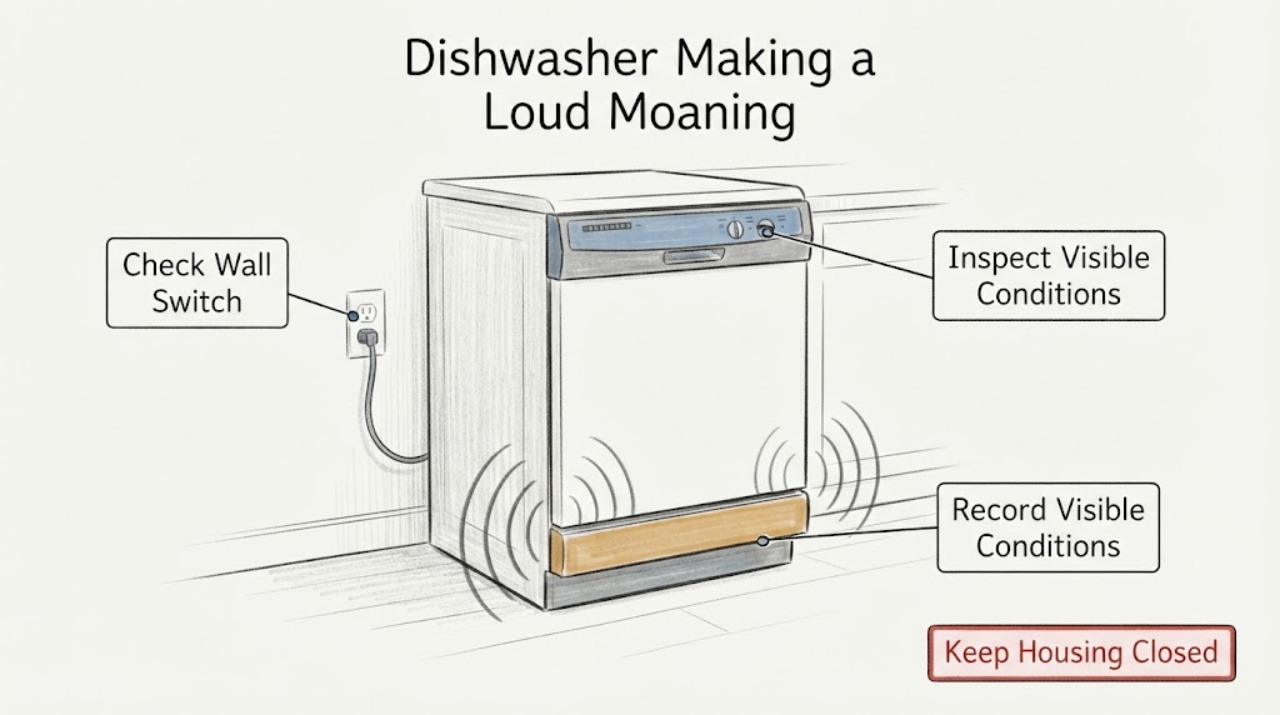
Work through in order
Diagnostic checks
Use only checks that match the exact appliance or system and its official guide.
-
Check 1
From outside the closed dishwasher, note the exact point in the cycle when the moaning starts and stops: fill, spray/wash, drain or dry. Record whether it is a steady hum, a changing pitch, a water sound, a rattle, a squeal or a grinding sound; do not open panels or put hands inside while it is running.
Expected result: The sound matches a brief fill, spray, drain or fan phase, or it is new, harsh, continuous or present across several phases.
Next step: If it is a normal-sounding phase noise with no other symptom, continue with the stopped external checks below. If it is harsh, worsening or accompanied by a leak, burning smell or error, stop the cycle and arrange service.
Why this matters
Why: Cycle phase can distinguish normal water, wash-pump, drain-pump or fan sounds from a symptom that needs model-specific service. A description such as 'moaning' alone does not identify a failed component.
-
Check 2
Cancel the cycle, wait for hot water and steam to clear, and follow the owner's manual for switching off or isolating power before opening the door. Remove only visible items that extend below or through the racks, then check that the spray arms rotate freely by hand and are not contacting a tall dish or utensil.
Expected result: A dish, utensil or rack position could strike the spray arm, or the arms have clearance and turn freely.
Next step: Reload the item so it cannot contact a spray arm and run the model's normal cycle only if the dishwasher is otherwise safe. If the noise remains with clear spray-arm movement, continue to the filter and water checks.
Why this matters
Why: A repeated knock, rattle or thump that disappears when the load is rearranged can be load interference rather than a pump fault. Clearance does not explain every moaning or grinding sound.
-
Check 3
With the dishwasher stopped and power isolated as directed by its manual, remove and reseat the user-accessible filter only as the manual shows. Look for food or foreign material on the filter and around the visible sump area without reaching into guarded pump parts, then refit the filter securely.
Expected result: The filter is loose, clogged or damaged, or it is clean, intact and firmly seated.
Next step: Clean and reseat a serviceable filter according to the manual, then reassess the sound. If the filter is damaged, will not lock or the noise persists, do not improvise a part or reach farther into the pump; use the exact model support route.
Why this matters
Why: A loose or clogged filter can rattle or restrict flow on some models. A clean, correctly seated filter makes that explanation less likely but does not identify the internal source of a persistent squeal or grind.
-
Check 4
After the dishwasher is safe to operate, observe whether the sound occurs only when the tub is filling or draining and whether the tub contains water at that time. Do not add water or repeatedly restart a unit that is grinding, leaking or failing to fill.
Expected result: The sound occurs with normal water movement, or a grinding/squealing sound occurs while the circulation path is dry or the machine is not filling correctly.
Next step: For a dry grinding sound, stop the cycle and check only the manual's external water-supply and fill conditions; if those are normal or the sound returns, request service. Do not run the pump dry to reproduce the noise.
Why this matters
Why: Manufacturers describe water-flow, wash-pump and drain-pump sounds as phase-dependent; GE specifically treats grinding with no water as a filling-related condition that needs its own troubleshooting path. This is a decision point, not proof of a bad pump.
-
Check 5
Check from outside whether the dishwasher is visibly out of level, loose in its opening, missing an external toe-kick or insulation panel, or transmitting vibration to adjacent cabinets. Do not pull out a built-in dishwasher or remove mounting hardware unless the exact installation instructions and safe isolation procedure call for it.
Expected result: The unit or an external panel visibly vibrates, or the installation appears secure and intact.
Next step: Use the exact installation manual or a qualified installer for a confirmed mounting or leveling issue. If the installation is intact but the loud moaning remains, arrange appliance service rather than dismantling the appliance.
Why this matters
Why: Whirlpool notes that leveling, mounting, insulation and the toe-kick affect perceived noise. An intact installation does not rule out an internal issue, and a loose-looking cabinet interface should not be used to diagnose a motor or pump.
Use your observations
Decision map
Find the observation that best matches what you see, then follow the next safe action.
-
PATH 01Next step
What you see
The sound is a brief hum, whoosh, swish or soft pump sound that occurs only during the phase described by the owner guide, with no leak, burning smell or performance change.
Do this next
Keep the exact model manual available and monitor whether the sound changes, becomes harsh or is joined by poor filling, draining or cleaning.
Why this path and its safety boundary
Why it matters: The sound may be normal operation for that dishwasher; manufacturer noise guides describe these sounds as phase-dependent rather than as a universal fault code.
-
PATH 02Next step
What you see
The noise stops when a tall dish is moved, the load is secured or a loose filter is correctly reseated.
Do this next
Use the dishwasher only with the corrected loading or filter position described by the exact manual. Stop if the noise returns with a clear load and secure filter.
Why this path and its safety boundary
Why it matters: The immediate sound was consistent with load interference or a loose filter, not proof of an internal motor or pump failure.
-
PATH 03Next step
What you see
A harsh squeal, grinding or loud moan persists with a clear load and correctly seated filter, or it occurs while there is no water in the tub.
Do this next
Stop using the dishwasher, avoid repeated test cycles and arrange qualified service with the full model number and the cycle phase recorded.
Why this path and its safety boundary
Why it matters: The available official guidance treats persistent abnormal noise or dry grinding as a service decision; it does not establish which internal component failed.
-
PATH 04Next step
What you see
The noise is accompanied by a water leak, burning smell, smoke, electrical odor, visible damage or an error indication.
Do this next
Stop the cycle, isolate power and water only if this can be done safely without reaching into the appliance, and arrange qualified service. Do not open electrical covers or bypass a door or safety switch.
Why this path and its safety boundary
Why it matters: The sound is no longer an isolated noise question and may present an immediate water or electrical safety concern.
Helpful context
Understand the symptom
Describe the sound by cycle phase
Listen from outside the closed dishwasher and note whether the noise begins during fill, spray/wash, drain or dry. Manufacturer guides describe a soft hum, water rushing, swishing and pump sounds as possible normal operation, while the same word can mean a different mechanism on another model. The phase and whether the sound is new or steadily getting louder are more useful than trying to name a part from the sound alone.
Use only external checks before service
With the cycle cancelled, power isolated according to the owner's manual and the tub cool, check the visible filter, spray-arm clearance, dish loading and any loose external toe-kick or insulation panel. These checks can address a loose filter, an item struck by a spray arm or vibration transmitted by the installation. They do not prove that a pump, motor or other internal part has failed.
When checks do not resolve it
Need a professional?
Arrange qualified service if the loud moaning or grinding persists after safe external checks, occurs with no water, is accompanied by a leak, burning smell, smoke, electrical odor, visible damage or an error, or cannot be matched to a normal phase in the exact model manual.
Safety scope: Do not run the dishwasher dry to reproduce a noise, reach into the pump, remove electrical covers, pull out a built-in unit or bypass a door/safety switch. Stop immediately for a burning smell, smoke, electrical odor, water leak or damaged wiring.
Have this ready
- Provide the full model number, the cycle phase when the noise starts, a description or short recording made from outside the closed appliance, whether the tub contains water, whether the sound changes with an empty load, and the results of the stopped filter and spray-arm checks.
Common questions
FAQ
Is a humming or moaning dishwasher always failing?
No. Whirlpool, GE and Frigidaire describe several normal hums, water sounds, pump sounds and spray-arm sounds. A new harsh sound, a sound that occurs with no water, or a sound with a leak or odor needs a stop-and-service decision rather than a diagnosis from the label alone.
Can a tall dish cause a loud dishwasher noise?
It can. GE and Frigidaire describe rattling, clunking or thumping when dishes or utensils interfere with a spray arm. Cancel the cycle, isolate power as directed by the manual and correct the load only if there is no damage or safety symptom.
Should I replace the pump because the dishwasher is moaning?
Do not order a pump from the sound alone. LG notes that squealing or grinding can indicate a pump problem, but the official guidance does not identify a specific failed part without model and inspection evidence. Record the cycle phase and arrange service if the sound persists.
What if the dishwasher grinds when there is no water?
Stop the cycle rather than repeatedly testing it. GE treats grinding with no water as a filling-related condition and directs the user toward filling troubleshooting; if external fill conditions are normal or the sound returns, use qualified service rather than running the pump dry.
Read the exact guide
Official sources
- Normal Dishwasher Sounds and NoiseWhirlpool Product Help · Opened official Whirlpool guidance. It is brand-specific evidence used for the general distinctions it explicitly states: phase-dependent water/pump sounds, load movement, leveling, mounting, insulation, toe-kick and visible filter/spray-arm/drain-path checks. It is not a model-specific diagnosis for an unbranded dishwasher.
- LG Dishwasher - Common NoisesLG USA Support · Opened official LG USA guidance. It supports the explicitly stated checks for loose or clogged filters, loading, water-flow sounds, loud gulping and persistent squealing/grinding; it is not a model-specific diagnosis for an unbranded dishwasher.
- Dishwasher - Noise GuideFrigidaire Owner Support · Opened official Frigidaire guidance. It is used only for the sound descriptions it explicitly ties to water valves, wash/drain pumps, detergent release and spray-arm movement; it is not a cross-brand part diagnosis.
- Dishwasher - Normal and Abnormal NoisesGE Appliances · Opened official GE guidance. It supports the explicitly described distinctions between normal humming/swishing, load rattling, spray-arm contact and grinding with no water; it does not identify a component for another brand or model.
Community feedback
Share a repair observation
Share a plain-text repair observation. Accepted observations are published automatically; this page may take a moment to update.