
On this page
Start here
Quick answer
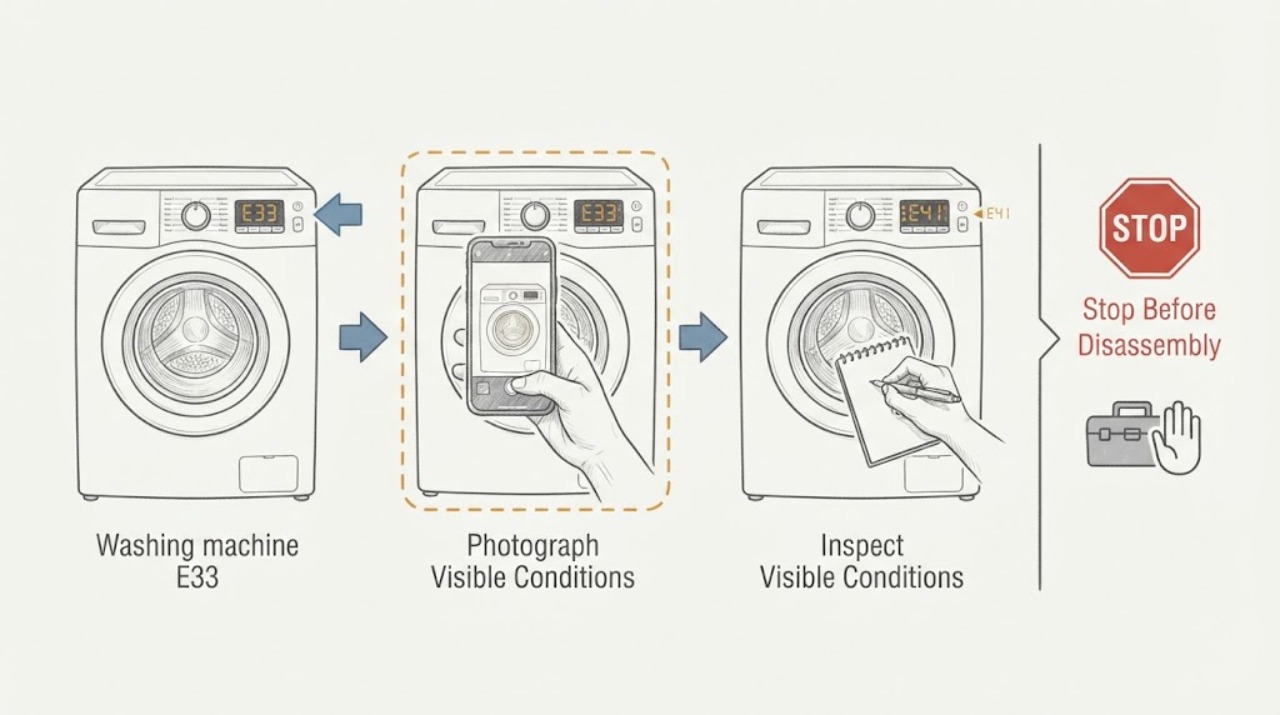
Do not treat E33 as a universal Electrolux washer diagnosis. An opened Electrolux technical alarm guide lists E33 on specific EWM1000-family platforms as an inconsistency between pressure-level information and the anti-boiling pressure switch, with a safety-drain response; the exact table and display method depend on the platform. First photograph the complete display or LED pattern and read the rating-plate model/E-Nr and region. Keep the washer stopped if water is rising, leaking, hot, or near electrical parts, and do not open the cabinet, enter service mode, bypass the door lock, or choose a pressure switch, heater, valve, wiring, or board from E33 alone. Use the exact model manual or qualified Electrolux service to confirm the code before any user-level correction.
Work through in order
Diagnostic checks
Use only checks that match the exact appliance or system and its official guide.
-
Check 1
With the washer stopped and safe to approach, photograph the complete E33 display or record the full LED flash pattern exactly as shown. Record whether it appears during fill, wash, heating, drain, or spin, whether the drum contains water, and the rating-plate model/E-Nr, product code, serial/FD information, and region.
Expected result: You have a text code, a two-digit LED sequence, a different punctuation or prefix, or only a partial label such as ‘33’; the timing and water/door state are also recorded.
Next step: Use the exact model manual or Electrolux support lookup for the recorded display. Do not apply a meaning from another platform or another E-code.
Why this matters
Why: The opened Electrolux technical guide uses different alarm tables and display methods for EWM1000-family platforms. A partial display or missing model cannot establish that this is the E33 described in those tables.
-
Check 2
Check the safety state from a dry position without moving the appliance: look for rising or standing water, a leaking hose, water near the plug, smoke, burning odor, heat, damaged wiring or a breaker that trips again. If water is actively entering or leaking, close the water supply; isolate power only from a safely reachable dry control and only if doing so does not require touching water or damage.
Expected result: Water is rising or leaking, the machine is in a drain response, the door is locked or open, or there is no visible hazard and the washer is simply stopped with E33.
Next step: Keep water off and arrange qualified appliance service for a leak or uncontrolled fill. Use emergency or electrical help for smoke, fire, arcing or unsafe power; do not run another cycle to reproduce the message.
Why this matters
Why: The technical E33 tables describe an emergency/safety-drain response on the covered platforms, but the missing model means the exact door and drain behavior cannot be assumed. A water or electrical hazard takes priority over code interpretation.
-
Check 3
Compare the exact display and symptom with the model manual before checking components. In particular, determine whether the display is actually E35 with continuous water entry/overfill, E41 with a door-switch indication, or a differently formatted code; do not normalize a photographed display into E33 by guesswork.
Expected result: The display matches E33 on the confirmed platform, or it matches E35, E41, another code, or an unresolved LED pattern.
Next step: Follow only the matching model-specific user guidance. For E35 or active filling, keep water off and arrange service; for E41, inspect only obvious door closure obstructions after the drum is safe, and service a recurring latch indication.
Why this matters
Why: Electrolux's owner pages describe E35 as a pressure-sensor overfill indication and E41 as the control board seeing the door switch open. Those are different decision paths from the E33 pressure-level/anti-boiling inconsistency in the older technical tables.
-
Check 4
If the exact manual confirms an E33-capable EWM1000-family platform and there is no active water or electrical hazard, perform only the manual's external user checks: confirm the door is normally closed, the visible hoses are not kinked, and the water supply is not obviously shut off. Do not disconnect a pressurized hose, remove a panel, open the pressure system, or test a heater or valve.
Expected result: The door and visible connections are normal, or an obvious external obstruction or closed tap is found; E33 remains or returns after the allowed check.
Next step: Correct only a clearly visible condition allowed by the exact manual. If E33 remains or returns, stop using the washer and provide the code, model, stage and observations to qualified Electrolux service.
Why this matters
Why: The technical table lists multiple possible pressure, heating, wiring and board causes, so a normal external check cannot identify a single part. The fault may persist even when the supply and door look normal.
-
Check 5
Prepare a service record rather than selecting a replacement part: include the exact model and region, full code or LED pattern, cycle stage, whether water remained, whether the door was locked or released, any recent move or installation work, and whether the code returned after the manual-authorized single recovery step.
Expected result: The same E33 recurs, the washer stops in a safety-drain state, or the display/model pairing cannot be found in the manual.
Next step: Leave the appliance unused and request Electrolux or qualified appliance service. Do not enter diagnostics, bypass the door interlock, or perform live voltage or continuity tests.
Why this matters
Why: A recurring or undocumented pairing is not resolved by guessing a pressure switch, heater, inlet valve, wiring or board. The technical tables themselves list several possible fault paths and require platform context.
Use your observations
Decision map
Find the observation that best matches what you see, then follow the next safe action.
-
PATH 01Next step
What you see
The rating-plate identity and full display match an EWM1000-family table, and E33 appears with a safety-drain or stopped-cycle response.
Do this next
Keep the washer stopped and arrange qualified service with the exact model, code, stage and water/door observations. Do not name or replace one component from the code alone.
Why this path and its safety boundary
Why it matters: On the opened Electrolux technical table for that platform family, E33 represents an inconsistency between pressure-level information and the anti-boiling pressure switch; possible causes span the pressure system, heating element leakage, wiring and board.
-
PATH 02Next step
What you see
The display is actually E35 or water continues entering, rather than a confirmed E33 on the matching platform.
Do this next
Turn off the water supply, isolate power only if safely possible, protect the area from water and arrange service; do not keep restarting the washer.
Why this path and its safety boundary
Why it matters: Electrolux's owner page identifies E35 as a pressure-sensor water-overfill indication; this is an overfill/flooding branch, not proof of the E33 pressure-level mismatch.
-
PATH 03Next step
What you see
The display is E41 or another door indication, the door will not latch normally, or the full code cannot be read.
Do this next
After the drum is stopped and safe, remove only an obvious visible obstruction and close the door normally once. If the latch or code remains abnormal, stop and request service; never force or bypass the lock.
Why this path and its safety boundary
Why it matters: Electrolux's E41 owner guidance treats the door-switch state as a separate front-load washer path. An incomplete model or partial display leaves the code identity unresolved.
-
PATH 04Next step
What you see
The full model, region or display format does not match the opened EWM1000-family table, or E33 returns after the exact manual's permitted external check.
Do this next
Keep the washer out of use and ask Electrolux or a qualified technician to verify the platform from the rating plate before diagnosing it. Provide the photo and event history.
Why this path and its safety boundary
Why it matters: The code is undocumented for the supplied identity, so a cross-platform explanation or part choice would be unreliable.
Helpful context
Understand the symptom
E33 needs an identity check before a repair theory. The opened Electrolux technical guide has separate alarm tables for older EWM1000 and EWM1000plus/EWM2000evo/EWM3000new platforms. Their wording is related but the display and machine response are platform-specific, and the assigned washer has no model or region. Photograph the full display, including punctuation or spaces, or record the complete LED sequence, then photograph the rating plate before interpreting it.
On the documented EWM1000-family tables, E33 is a mismatch in water-level/anti-boiling pressure information and can place the appliance into an emergency or safety-drain state. That does not prove a failed pressure switch, heater, wiring, or control board. It is a service diagnosis, not permission to open the cabinet or run live tests.
Keep the washer out of service for uncontrolled filling, a visible leak, water near the plug or electrical parts, smoke, burning odor, a hot connection, or a breaker that trips again. Do not force a locked door or reconnect water to reproduce E33.
When checks do not resolve it
Need a professional?
Request Electrolux or qualified appliance service when E33 recurs, the model/display pairing cannot be confirmed, the washer remains in a safety-drain or stopped state, or any pressure, heating, wiring, control or door diagnosis would be required. Turn off water and stop using the washer for uncontrolled filling, flooding, a visible leak, water near electrical parts, smoke, burning odor, a hot or damaged connection, repeated breaker trips, or a door that cannot safely latch or release. Do not open panels, enter service mode, bypass the door lock, disconnect a pressurized hose, test live circuits, or keep resetting the appliance.
Common questions
FAQ
Does Electrolux E33 always mean the pressure switch is bad?
No. The opened Electrolux technical table for specific EWM1000-family platforms describes an inconsistency between pressure-level information and the anti-boiling pressure switch, but lists several possible causes, including the pressure system, heating element leakage, wiring and the board. Confirm the exact platform before interpreting it.
Should I replace the inlet valve or heater when E33 appears?
Not from E33 alone. The documented table does not justify choosing one component, and a missing model or region makes cross-platform parts advice unsafe. Preserve the display and arrange model-specific diagnosis if the code returns.
Can I keep running the washer after E33 clears?
Only if the exact model manual explicitly permits a single user recovery and there are no water or electrical hazards. If E33 returns, water rises or leaks, the machine remains stopped, or the door behaves abnormally, leave it unused and request service.
Read the exact guide
Official sources
- What should I do if my washer does not start?Electrolux · Opened official Electrolux washer support article. It covers safe external checks for start conditions, water availability, door closure, power and breaker state; it does not define E33 and is used only for non-invasive context and safety boundaries.
- Laundry front loading washer displaying Error Code E35 pressure sensor indicates water overfillElectrolux · Opened official Electrolux owner support article for applicable front-loading laundry washers. It defines E35 as a pressure-sensor water-overfill indication and identifies continuous water entry as the issue; it is used only to distinguish E35 from E33, not to define E33.
- Laundry front loading washer displaying Error Code E41 door is openElectrolux · Opened official Electrolux owner support article for applicable front-loading laundry washers. It defines E41 as the control board seeing the door switch open and gives external closure/obstruction checks; it is used only to keep the door branch separate from E33.
- Quick Guide and Appliances List — Table of alarm codes EWM1000 / EWM1000plus / EWM2000evo / EWM3000newElectrolux · Opened official Electrolux technical PDF. The EWM1000 table lists E33 as an inconsistency between anti-boiling and first-level pressure-switch contacts with a safety-drain response; the EWM1000plus/EWM2000evo/EWM3000new table lists E33 as an inconsistency between electronic pressure-level information and anti-boiling pressure switches 1-2, with emergency drain. These are platform-scoped technical tables, not a universal code list for an unidentified washer.
Community feedback
Share a repair observation
Share a plain-text repair observation. Accepted observations are published automatically; this page may take a moment to update.