
On this page
Start here
Quick answer
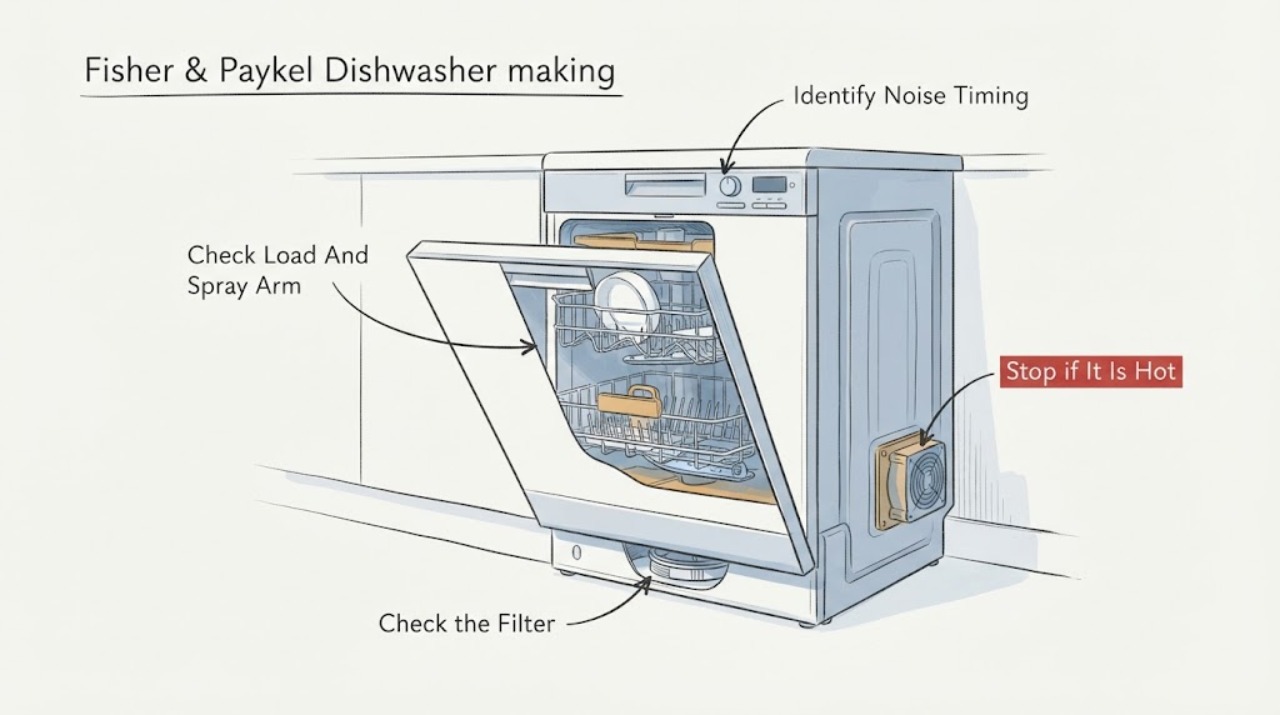
First identify the Fisher & Paykel model and when the sound occurs. The opened Fisher & Paykel guides describe some fan, drain and pulsing pump sounds as normal operating sounds, while a knocking or rattling sound during washing can occur when a spray arm strikes a dish or the load is stacked incorrectly. Pause the cycle, switch off power before handling accessible parts, and check only the visible load, spray-arm clearance and filter area permitted by the exact manual. A persistent grinding or unusually loud sound, a sound with a leak or burning smell, a fault indication, or any noise that remains after the external loading check is a reason to stop using the dishwasher and arrange qualified service; it does not by itself prove a failed pump or motor.
Work through in order
Diagnostic checks
Use only checks that match the exact appliance or system and its official guide.
-
Check 1
From a safe position, note whether the sound occurs during filling, washing, draining, after the cycle, or when the drawer or door is moved. Record whether it is a brief fan or drain sound, a rhythmic pulse, a knock/rattle, or a persistent grind; do not repeat a cycle if there is smoke, burning smell or a leak.
Expected result: The sound is limited to post-cycle fan/drain operation or intermittent pulsing, occurs only during washing, or remains loud and abnormal through several stages.
Next step: If the sound is a documented normal example and the dishwasher is otherwise safe, monitor it. If it is wash-stage knocking or persistent abnormal noise, continue only with the accessible-load check below; stop for a leak, burning smell or electrical concern.
Why this matters
Why: The opened Fisher & Paykel materials distinguish normal fan, drain and pulsing examples from wash-stage knocking/rattling and from symptoms that require service. Timing narrows the decision without naming an unverified component.
-
Check 2
Pause the dishwasher using its model-appropriate control, wait for the spray action to stop, switch off power, and inspect only the accessible racks and spray-arm path. Move a dish, handle or utensil that visibly blocks or contacts the arm; do not force the arm or reach into a moving machine.
Expected result: A dish or utensil is in the arm's path, the arm turns freely with the appliance off, or the arm cannot turn or appears damaged.
Next step: If contact was visible, rearrange the load and use the exact manual's normal cycle guidance. If the arm cannot turn, is damaged, or the noise remains after the load is corrected, stop and arrange service rather than forcing or replacing parts.
Why this matters
Why: Fisher & Paykel's DW60 troubleshooting links knocking/rattling to spray-arm contact or incorrect stacking and advises checking spray-arm rotation. A blocked or damaged arm is an external observation, not proof of a pump fault.
-
Check 3
With power off and the dishwasher cool, inspect the filter area and other user-accessible surfaces only as the exact Fisher & Paykel manual permits. Look for visible food debris or an item resting against the filter; do not remove covers or probe the pump opening.
Expected result: The accessible filter area is visibly obstructed, it is clear, or access would require tools or opening the cabinet.
Next step: If the manual permits cleaning the visible filter, clean and refit it exactly as directed. If it is clear, the noise persists, or access requires disassembly, leave the appliance intact and request model-matched service.
Why this matters
Why: The documented DW60 guide includes filter and spray-arm checks as user-level troubleshooting. A clear accessible filter does not rule in an internal pump or motor problem, and tool-required access is outside this check.
-
Check 4
Look around the floor and visible hose or connection area without moving the appliance or opening panels. If water is present, burning smell occurs, or electrical parts may be wet, stop operation; turn off the water and power only when the shutoffs are safely accessible.
Expected result: There is no visible leak or burning smell, or water, smoke, heat damage or an electrical hazard is present.
Next step: For a leak or electrical/burning symptom, keep the dishwasher off and arrange qualified service. If the area is dry and safe, continue only with the model-matched external observations; do not move or run the appliance to reproduce the sound.
Why this matters
Why: Fisher & Paykel directs owners to turn off water and power and contact service for leaks. These symptoms change the decision from noise classification to immediate safe shutdown; they do not identify a valve, pump or wiring part.
-
Check 5
After recording the exact model, noise timing, load position and accessible-check results, stop using the dishwasher if the loud sound remains, returns with an empty and correctly loaded rack, or is accompanied by a fault indication. Do not operate it with panels removed or attempt an internal pump, motor or bearing repair.
Expected result: The sound disappears after correcting visible spray-arm contact, or it remains persistent/returns without a visible cause.
Next step: If persistent, arrange Fisher & Paykel or qualified authorized service and provide the model/serial, stage of the cycle, sound description, leak/fault observations and checks already completed.
Why this matters
Why: A corrected visible contact supports a loading-related explanation. Persistent or unexplained noise is beyond the supported user checks and needs diagnosis; it is not enough evidence to name a failed internal component.
Use your observations
Decision map
Find the observation that best matches what you see, then follow the next safe action.
-
PATH 01Next step
What you see
The sound is a brief fan or drain sound after washing, or a documented pulsing sound while the dishwasher is operating, and there is no leak or burning smell.
Do this next
Record the exact model and monitor it. Use the exact manual or official support path if the sound changes, becomes persistent or affects cleaning.
Why this path and its safety boundary
Why it matters: Fisher & Paykel documents these types of sounds as possible normal operation for the named product families; this does not confirm that every model uses the same sound profile.
-
PATH 02Next step
What you see
A knocking or rattling sound occurs during washing and a dish, handle or utensil visibly contacts the spray arm.
Do this next
With power off, rearrange the load so the arm has clearance and follow the exact model guide; request service if the noise continues or the arm cannot rotate freely.
Why this path and its safety boundary
Why it matters: The documented DW60 troubleshooting identifies spray-arm contact or incorrect loading as a possible explanation.
-
PATH 03Next step
What you see
The filter or accessible spray-arm area is clear, but the dishwasher still makes a loud grinding or persistent abnormal noise.
Do this next
Stop using the dishwasher and arrange model-matched qualified service; do not open the cabinet or select a replacement part by guesswork.
Why this path and its safety boundary
Why it matters: The user-level loading/filter checks have not explained the symptom. A pump, motor or bearing cannot be diagnosed safely from sound alone.
-
PATH 04Next step
What you see
The noise is accompanied by a leak, burning smell, smoke, water near electrical parts or a persistent fault indication.
Do this next
Stop the appliance, turn off water and power only when safely accessible, keep clear of wet electrical areas and contact qualified service. Do not run another cycle to locate the sound.
Why this path and its safety boundary
Why it matters: This is a safety/service condition rather than a normal-noise decision.
Helpful context
Understand the symptom
Classify the sound by timing before calling it a fault
Record whether the sound occurs while filling, washing, draining, immediately after the cycle, or only when a drawer or door is opened. Fisher & Paykel's DishDrawer guide says a fan may continue after a wash and describes pulsing sounds from rinse aid or the pump; its warranty guidance also lists drain and fan sounds among normal noise examples. These examples are limited to the documented product families, so the exact model remains important.
Check for visible dish or spray-arm contact
A knocking or rattling sound during washing can be caused by a dish, handle or other load item in the spray arm's path. Pause the cycle using the model's controls, wait for moving water to settle, and with power off check only the accessible rack, spray arm and filter areas. The DW60 guide supports rearranging a load and checking that spray arms can rotate; do not infer that a pump or motor has failed from the sound alone.
Keep model-specific controls and service decisions separate
Fisher & Paykel uses different DishDrawer and dishwasher families, and the opened DishDrawer guide's fault-reset instructions are tied to its named models. Use the rating label and the official model-support path before using a reset or removing any user-accessible part. Do not open the cabinet, reach toward a pump or wiring, or run the appliance with guards or panels removed.
Stop for leaks, burning smells or persistent abnormal noise
Turn off the water supply and power and contact qualified service if water is leaking, the sound is persistent or grinding, a fault indication appears, or the dishwasher needs internal access. Fisher & Paykel directs owners to service for leaks and provides an authorized-service path; a noise description alone cannot select a pump, motor, bearing or other replacement part.
When checks do not resolve it
Need a professional?
Arrange Fisher & Paykel or qualified authorized service for persistent or unusually loud noise, grinding with no visible loading cause, a spray arm that cannot rotate, a leak, burning smell, fault indication, or any step requiring cabinet, pump, motor, wiring or control access. Provide the exact model/serial and when the noise occurs; do not choose a replacement part from the symptom alone.
Common questions
FAQ
Is a Fisher & Paykel dishwasher fan noise after the cycle normal?
The opened DishDrawer guide says a fan may continue after a wash, and Fisher & Paykel warranty guidance lists fan and drain sounds among normal noise examples. Confirm the exact model before treating that example as applicable, and escalate if the sound is new, unusually loud or accompanied by a leak or fault.
What can cause a knocking or rattling sound during washing?
For the documented DW60 family, Fisher & Paykel identifies a spray arm striking dishes or incorrect stacking as possible causes. With power off, check visible rack loading and spray-arm clearance. If the arm cannot rotate or the noise persists, use model-matched service rather than assuming a pump failure.
Should I keep running the dishwasher to locate a loud noise?
Do not keep running it if there is a leak, burning smell, smoke, water near electrical parts or a persistent grinding sound. Turn off water and power when safely accessible and contact service. For a dry, otherwise safe appliance, limit checks to the exact manual's external loading and filter guidance.
Can a loud sound prove that the dishwasher pump or motor has failed?
No. The official guides support timing, loading, spray-arm and accessible-filter observations, but the sound alone does not identify a pump, motor, bearing or control failure. Persistent noise that remains after those checks needs qualified diagnosis.
Why do I need the exact Fisher & Paykel model before using a reset or repair step?
Fisher & Paykel publishes separate DishDrawer and dishwasher families. The opened DishDrawer guide lists named models and model-specific fault/reset instructions, while the support page directs owners to use the model code for documentation and service. Do not copy a button sequence or internal procedure from another model.
Read the exact guide
Official sources
- Fisher & Paykel Warranty InformationFisher & Paykel · Fisher & Paykel US warranty/service boundary and examples of normal drain, fan and warning-beep noise.
- Fisher & Paykel DW60 Dishwasher User GuideFisher & Paykel · The documented DW60 dishwasher family; wash-stage knocking/rattling, loading, spray-arm and accessible filter troubleshooting.
- Fisher & Paykel Contact Us and Product HelpFisher & Paykel · Fisher & Paykel model-code documentation lookup, product help and authorized service booking.
- Fisher & Paykel Integrated DishDrawer User GuideFisher & Paykel · Named DD60DTX6I1, DD60STX6I1, DD60DTX6HI1 and DD60STX6HI1 DishDrawer models; normal fan/pulsing sounds, accessible fault/service guidance and leak boundary.
Community feedback
Share a repair observation
Share a plain-text repair observation. Accepted observations are published automatically; this page may take a moment to update.