
On this page
Start here
Quick answer
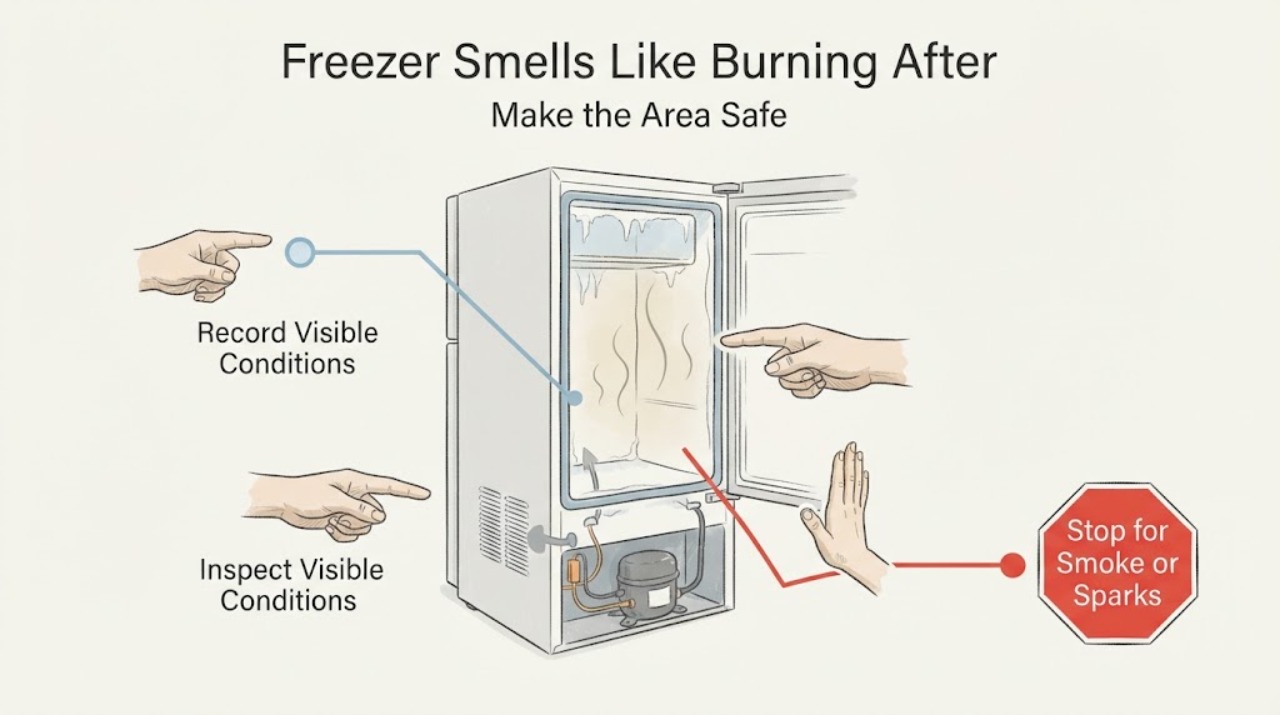
A freezer door left slightly open can admit warm, moist air and create frost, but it does not prove why a burning smell appeared. Treat a true burning or electrical odor as a stop condition: do not keep restarting the freezer, unplug it or switch off its circuit only if that can be done safely, move food to another cold location, and arrange qualified appliance service if the smell persists, returns, or comes from the cord, outlet, rear or underside. Once the unit is safely de-energized and there is no smoke, heat or damaged wiring, check only the door gasket, obstruction, accessible frost, vents and visible food or packaging residue. Do not open panels, use a hair dryer or heat gun, scrape hard frost with a sharp tool, or guess at a compressor or other internal part.
Work through in order
Diagnostic checks
Use only checks that match the exact appliance or system and its official guide.
-
Check 1
Stop the freezer and identify the odor without restarting it. If there is smoke, a strong electrical or burning-plastic smell, sparking, a hot cord or outlet, or visible heat, leave the area as needed and disconnect power only from a dry, safe location; otherwise switch off the appliance before inspecting it.
Expected result: The odor is active or electrical, smoke or heat is present, the cord or outlet is damaged, or none of those warning signs can be ruled out safely.
Next step: Keep the freezer off, avoid flames and powered tools near the odor, and contact appropriate emergency or qualified appliance service from a safe location. Do not open panels or make live electrical measurements.
Stop if: Stop immediately for smoke, flame, sparking, hot or damaged electrical parts, or a worsening odor.
Why this matters
Why: A burning odor can represent an electrical or fire hazard that cannot be distinguished from normal compressor work by sound or by a short test. Samsung directs users to stop using an appliance that produces a burning smell or smoke, unplug if safe, and contact service.
-
Check 2
Protect the food before further checks: move food to another functioning cold storage location if it can be handled safely, record which packages are thawed or leaking, and minimize opening of the affected freezer.
Expected result: Food remains hard frozen, some food has softened or leaked, or the appliance cannot be kept safely powered while its condition is assessed.
Next step: Follow local food-safety guidance for thawed or warmed food, discard visibly spoiled or contaminated items, and keep questionable food separate. Keep the appliance off if its odor or electrical condition is unresolved.
Why this matters
Why: Food preservation is separate from diagnosing the freezer. A door left ajar can admit warm air and reduce cooling performance, but smell is not a reliable test of food safety and does not prove the freezer's internal failure.
-
Check 3
After power is safely isolated and the freezer is not hot or smoking, inspect only accessible areas: verify that the door gasket is seated and undamaged, look for a package preventing closure, note frost near the door or vents, and check for spilled food or melted packaging. Do not remove panels or touch wiring or tubing.
Expected result: The gasket is dirty or damaged, an object held the door open, frost is concentrated at the door or blocked vents, food or packaging is visibly burned or spilled, or no safe external source is visible.
Next step: Remove only the obstruction or accessible residue after the unit is safe and follow the exact model manual for any defrost. If the source is not clearly harmless, leave the freezer off and give the observations and photos to qualified service.
Stop if: Do not touch an exposed wire, melted plug, wet outlet, damaged liner, or any area that requires force or a tool to reach.
Why this matters
Why: Samsung identifies a door gap, dirty or damaged gasket, blocked vents and warm air as supported causes of frost. Frigidaire and Whirlpool identify food, containers, wrapping and spills as common odor sources. None of those observations proves that a compressor, fan, heater or control has failed.
-
Check 4
If there is no electrical warning and the odor is clearly from food or an accessible spill, remove the food and clean accessible interior surfaces only after disconnecting power. Use a soft sponge or cloth and a mild cleaning method permitted by the model manual; rinse or wipe away residue and dry the surfaces.
Expected result: The odor is confined to a removable container or spill and disappears after cleaning, or the odor remains unexplained or is strongest near the cord, rear, underside or a damaged area.
Next step: If the odor does not clearly resolve as food or residue, keep the freezer off and request service. Do not use an air freshener, solvent, flame or powered dryer to mask or locate the smell.
Stop if: Do not clean over smoke damage, melted plastic, damaged wiring or an unidentified electrical odor.
Why this matters
Why: Official freezer guidance supports food-storage review and gentle interior cleaning, while Whirlpool instructs users to disconnect power and avoid abrasive, harsh or flammable cleaners. An unexplained or returning smell remains a service issue even if the interior looks clean.
-
Check 5
If the smell persists or returns when the freezer is safely returned to service, if cooling does not recover, or if the unit trips a breaker or develops unusual heat or noise, stop using it and provide the technician with the model label, door-open duration, food condition, odor location, frost pattern, photos and any breaker or outlet event.
Expected result: The freezer passes an external door and cleanliness check but the smell returns, cooling remains poor, a protection device trips, or the odor cannot be localized safely.
Next step: Keep the appliance out of service and use qualified appliance service. Do not remove covers, bypass a door or thermal interlock, test energized parts, or order an internal part from the smell alone.
Why this matters
Why: The available generic guidance does not identify a failed internal component for an unknown freezer. Persistent or recurrent odor after the ajar-door condition is corrected needs model-specific diagnosis rather than a guessed compressor, fan, heater or control-board replacement.
Use your observations
Decision map
Find the observation that best matches what you see, then follow the next safe action.
-
PATH 01Next step
What you see
Smoke, flame, sparking, a hot or damaged cord/outlet, or a strong electrical or burning-plastic odor is present.
Do this next
Leave the area if necessary, avoid switches and ignition sources, disconnect power only if it can be done without touching a hazardous connection, and contact emergency or qualified service help from a safe location.
Why this path and its safety boundary
Why it matters: This is an electrical or fire stop condition; the open door and frost explanation cannot safely override it.
-
PATH 02Next step
What you see
There is no smoke, heat, sparking or damaged electrical part, and the smell is clearly limited to spoiled food, a spill or melted packaging in the accessible compartment.
Do this next
Move food first, disconnect power safely, clean the accessible surfaces using the exact manual's permitted method, and keep the freezer off if the smell remains or returns.
Why this path and its safety boundary
Why it matters: Food or residue is a supported odor source, but it does not prove that the freezer's cooling system is undamaged after the door was left open.
-
PATH 03Next step
What you see
Frost is concentrated around the door, the gasket is dirty or damaged, a package held the door open, or vents are blocked, and no electrical warning is present.
Do this next
Correct only the accessible obstruction or gasket contamination, follow the exact manual for safe defrosting, and request service if the gasket is damaged, frost rapidly returns, cooling stays poor or the odor remains.
Why this path and its safety boundary
Why it matters: Warm air entering through the ajar or poorly sealing door is a supported explanation for frost and extra cooling load; it does not establish a burned compressor or other component.
-
PATH 04Next step
What you see
The door now seals and accessible residue is gone, but the burning smell persists, returns during operation, cooling does not recover, or the breaker trips.
Do this next
Stop using the freezer and arrange qualified model-specific service. Do not run repeated tests, open panels, use heat to defrost, or replace a compressor, fan, heater or control without a confirmed diagnosis.
Why this path and its safety boundary
Why it matters: The symptom is not explained by the resolved door gap alone. The internal electrical or cooling cause is unconfirmed and cannot be safely identified from a generic freezer page.
Helpful context
Understand the symptom
What the open door can and cannot explain
Leaving a freezer door ajar for hours allows warm, humid air to enter. Samsung describes that as a cause of frost and says to verify that the door closes fully, the gasket is clean, and vents are not blocked. A longer cooling run or frost buildup may follow, but those facts do not establish that the cooling system overheated or that a compressor failed. A burning smell may instead be food or packaging residue, an electrical odor, or another model-specific fault, so keep the causal explanation open until the smell is safely assessed.
Use a safety boundary before an odor-cleanup routine
Do not start with a long powered test. Samsung's home-appliance safety guidance treats a burning smell or smoke as a reason to stop use, disconnect power if it is safe, and contact service. If the smell is clearly a food or spill odor and there is no smoke, heat, sparking, damaged cord or outlet, a safe, model-appropriate cleaning check may be reasonable after the freezer is de-energized. The opened official pages do not identify an internal freezer part from this symptom, and this article does not provide internal electrical or sealed-system repair steps.
Food condition is a separate decision
Preserve food before investigating the appliance. Move food to another functioning freezer or suitable cold storage without repeatedly opening the affected unit. Do not use smell alone to decide whether food is safe; follow local food-safety guidance for food that has thawed or warmed, and discard food that is visibly spoiled or contaminated. If the freezer cannot be safely powered, keep it out of service while a technician assesses it rather than repeatedly opening the door to test cooling.
When checks do not resolve it
Need a professional?
Arrange qualified appliance service for any persistent or returning burning smell, smoke, sparking, hot or damaged cord/outlet, repeated breaker trip, poor cooling after the door is closed, a damaged door seal, or an odor that cannot be localized safely. Seek urgent help for fire, active smoke or an unsafe electrical connection.
Common questions
FAQ
Can leaving a freezer door open cause a burning smell?
It can cause warm-air entry, frost and reduced cooling performance, but the official guidance does not establish that an ajar door itself causes a burning odor. Treat a true electrical or burning-plastic smell as a stop condition and keep the freezer off until it is safely assessed.
Should I run the freezer for a few minutes to see whether the smell comes back?
No. A repeat start is not a safe diagnostic test when the smell may be electrical or the unit may be hot, smoking or damaged. Disconnect power only if safe and use qualified service if the smell is unexplained or returns.
Can I use a hair dryer to remove frost after the door was left open?
Do not use a hair dryer. Samsung specifically warns that it can damage the refrigerator. Use the exact model manual for defrosting; stop and request service if heavy frost, a damaged gasket or an unresolved odor remains.
How do I know whether the food is safe after six hours with the door ajar?
Do not use smell alone to judge food safety. Move food to another cold location, separate visibly spoiled or leaking items, and follow local food-safety guidance for food that has thawed or warmed. Preserve the food first while the freezer stays off if its electrical condition is uncertain.
Does a frost buildup prove the compressor overheated?
No. Official guidance links frost after a door is left open to warm, moist air and a poor seal, but it does not identify a compressor failure. Persistent odor, cooling loss, unusual heat or a breaker trip needs qualified diagnosis.
Read the exact guide
Official sources
- Removing and Preventing OdorsWhirlpool · General manufacturer cleaning guidance used only for separating food/spill odors and for the safe sequence of removing food, disconnecting power, hand-washing accessible parts and avoiding harsh or flammable cleaners. It is not a match for the unidentified freezer.
- How to prevent frost forms in the freezer or fridge?Samsung Malaysia · General manufacturer explanation of warm air entering through a door left open, frost formation, door/gasket checks, vent clearance and safe defrost cautions. It is not a model match for the unidentified freezer and does not diagnose the burning odor.
- What can I do if I detect an odor in my freezer?Frigidaire · General manufacturer odor guidance used for food, container and wrapping checks and gentle accessible interior cleaning. The assigned freezer has no Frigidaire identity, so this does not establish a model-specific cause or procedure.
- Home Appliance Terms and ConditionsSamsung · Manufacturer safety guidance used only for the general stop-use boundary: an appliance producing a burning smell or smoke should be stopped, unplugged if safe and referred to service. It does not identify the unknown freezer's model or cause.
- Refrigerator Troubleshooting GuideSamsung Australia · The page explicitly says it is a general guide for Australian products and that models vary. Used for the limited points that a long-open door can cause frost/dew, a strange smell warrants safe cleaning and support, and repairs should be performed by qualified technicians.
Community feedback
Share a repair observation
Share a plain-text repair observation. Accepted observations are published automatically; this page may take a moment to update.