
On this page
Start here
Quick answer
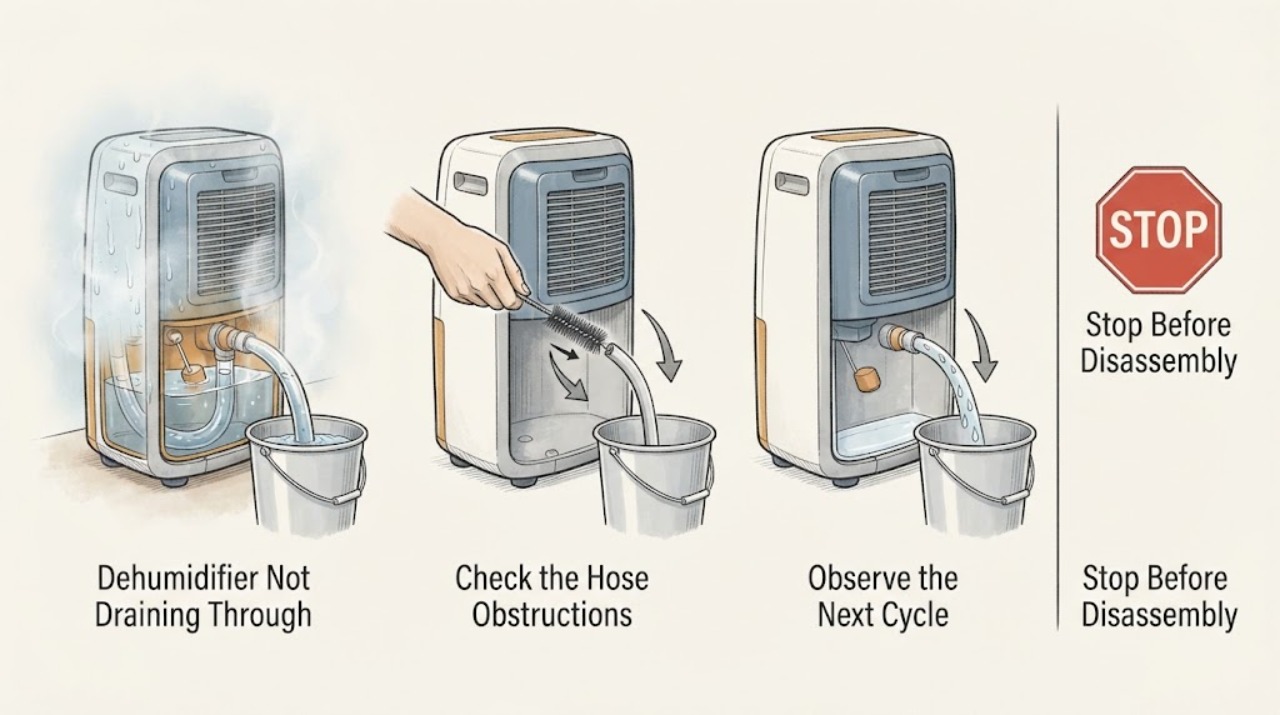
On the Frigidaire FAD504DWD, a humid room can make the dehumidifier run for long periods, but a hose that does not drain still needs a setup check. Unplug the unit before touching the hose, confirm the drain cap is removed, attach a 1/2-inch or larger hose to the continuous-drain connector, and route it below the connector with no kinks or rises. Select the desired humidity setting and fan speed, then allow the model's normal three-minute compressor delay to pass before judging the result. A full bucket, a blocked hose, a leaking connector, or a hose that runs uphill can stop gravity drainage or send water back into the bucket. If the correctly routed hose still produces no flow, the bucket fills, water leaks from the base, or any electrical symptom appears, stop using the unit and arrange Frigidaire service.
Work through in order
Diagnostic checks
Use only checks that match the exact appliance or system and its official guide.
-
Check 1
Turn the FAD504DWD off, disconnect it from power, and identify whether the symptom is a full bucket, no flow from a continuous gravity hose, or a visible leak. Note whether the unit is in a humid room and whether you had just changed a setting or rapidly cycled the power.
Expected result: The Full Bucket light is on, the unit has a hose connected, the hose is absent, or water is visible at the connector, bucket, base, plug, or outlet.
Next step: If water is near electrical parts, the cord is hot or damaged, or there is smoke, a burning smell, sparking, or repeated tripping, leave the unit unplugged and arrange service. Otherwise continue with the accessible drainage setup check.
Why this matters
Why: The drainage method and hazard location determine the safe next check. A long run in high humidity is not the same observation as a failed hose, and a three-minute compressor restart delay can follow a quick off/on cycle.
-
Check 2
With power disconnected, verify the FAD504DWD continuous-drain arrangement: remove the drain cap as shown in the guide, secure a 1/2-inch (12.7 mm) or larger hose to the connector, and place the hose end in a nearby drain. Keep the hose below the connector, flat and as straight as practical, with no kink, rise, or loose connection.
Expected result: The cap is still fitted, the hose is too small, rises above the connector, is kinked, disconnected, or ends somewhere that cannot accept gravity flow; or the route is correctly downhill and secure.
Next step: Correct only the documented cap or visible hose routing, check that the connector is secure and not leaking, then make one normal drainage observation. Do not enlarge or modify the port.
Why this matters
Why: A cap, hose-size, connection, or elevation error can prevent gravity drainage even while the compressor runs. A correctly routed hose makes an installation restriction less likely but does not prove that the internal collection path is sound.
-
Check 3
Inspect the disconnected hose and its accessible ends for dirt, sludge, algae, or a soft obstruction. If the hose is removable and the manual setup permits it, clear or flush only the hose itself; do not open the dehumidifier or probe the connector with a tool.
Expected result: Buildup or a kink is visible, the hose is clear, or the hose cannot be safely disconnected without disturbing the unit or exposing water to electrical parts.
Next step: Restore the hose without kinks and keep its discharge away from the outlet. If the hose cannot be cleared safely or water still backs into the bucket, stop and use the service boundary.
Why this matters
Why: Frigidaire identifies small hose diameter and buildup from dust, sludge, or algae as possible restrictions. A clear external hose shifts suspicion toward the connector, collection path, bucket sensing, or another internal issue.
-
Check 4
Check the visible hose connector and its washer, then inspect the bucket for a crack, distortion, or incorrect seating. Make sure the bucket is stable and the float is not being bypassed; do not move a full bucket while the unit is running.
Expected result: The connector drips, the washer is damaged, the bucket is cracked or tilted, the bucket is not seated, or no visible leak or seating problem is present.
Next step: For a confirmed connector-washer or bucket defect, stop using the unit and confirm exact-model fitment before replacing that conditional part. For a persistent Full Bucket indication or base leak, arrange service.
Why this matters
Why: A connector washer or bucket condition can explain water loss without proving that the drain hose itself is blocked. An empty bucket that remains incorrectly sensed can indicate a float, sensor, tray, or control problem outside the safe user-level checks.
-
Check 5
After the external setup is safe, select the desired humidity setting and fan speed as the FAD504DWD guide directs for continuous draining. Observe one normal operating interval rather than repeatedly switching the unit off and on.
Expected result: Water begins moving through the downhill hose after the control setting is selected and the restart delay has passed, or the hose remains dry while the bucket fills or the Full Bucket light returns.
Next step: If the hose remains dry or water backs into the bucket, disconnect power and arrange service after recording the hose route and bucket result. Do not keep restarting the unit to force drainage.
Why this matters
Why: Flow after the correct setup supports a control or timing misunderstanding rather than a failed drain. No flow after the setup, with a filling bucket, makes a blocked connection, collection path, float, or internal fault more likely.
-
Check 6
Check the floor, bucket, connector, cord, plug, and outlet area after the observation. Keep the unit level and leave clearance around it for airflow; do not operate where a leak can reach electrical parts.
Expected result: The leak is limited to a confirmed bucket or connector condition, water is coming from the base or an unknown location, or the plug or cord is wet, hot, discolored, damaged, sparking, or repeatedly tripping.
Next step: Leave the dehumidifier unplugged for a base or unknown leak or any electrical symptom, and arrange qualified Frigidaire service. Provide the model, drain method, hose size and route, Full Bucket result, setting change, and timing.
Why this matters
Why: A visible bucket or connector defect may be a conditional external part issue. A base or unknown leak, electrical symptom, abnormal heat, odor, smoke, or repeated failure can involve internal components and is not identified safely by hose checks.
Use your observations
Decision map
Find the observation that best matches what you see, then follow the next safe action.
-
PATH 01Next step
What you see
The hose is connected but the cap is still installed, the hose rises above the connector, has a kink, is too small, or shows sludge or algae, and the Full Bucket light returns.
Do this next
With power disconnected, restore the documented cap and hose arrangement, clear only an accessible hose restriction, and make one normal drainage observation. Escalate if the bucket fills again or water leaks.
Why this path and its safety boundary
Why it matters: The pattern is more consistent with a gravity restriction or hose backup than with a pump failure. Frigidaire says a blocked hose can back water into the bucket and trigger the Full Bucket indication.
-
PATH 02Next step
What you see
The bucket is seated and the gravity hose is correctly sized, secure, downhill, and visibly clear, but no water flows and the bucket fills or the Full Bucket light returns.
Do this next
Disconnect power and arrange Frigidaire service. Do not add a pump, alter the port, bypass the float, or open the cabinet.
Why this path and its safety boundary
Why it matters: The external gravity path no longer explains the symptom. A collection tray, outlet, float, sensor, control, or other internal fault is possible, but the visible checks cannot identify it safely.
-
PATH 03Next step
What you see
Water appears at the hose connector, bucket, base, or an unknown location while the unit is running.
Do this next
Stop and unplug the unit if water is near electrical parts. For a confirmed connector or bucket defect, keep the unit off until exact-model fitment is confirmed; for a base or unknown leak, arrange service.
Why this path and its safety boundary
Why it matters: A connector washer, bucket crack or tilt, or an internal/base leak is possible. A leak near the cord or outlet is an immediate electrical hazard.
-
PATH 04Next step
What you see
The room is humid and the dehumidifier runs for a long time, but after the FAD504DWD cap, downhill hose, humidity setting, and fan setting are correct, water reaches the drain after the three-minute restart delay.
Do this next
Keep monitoring the hose end and floor for a leak. If flow stops, the bucket fills, or the Full Bucket indication returns despite the same setup, repeat the external checks once and then arrange service.
Why this path and its safety boundary
Why it matters: The observed pattern supports normal water collection demand and the model's restart timing rather than a failed drain. Long runtime in a humid room can continue while the unit removes moisture.
-
PATH 05Next step
What you see
The cord or plug is wet, hot, discolored, damaged, or accompanied by a burning smell, smoke, sparks, abnormal heat, or a repeated breaker trip.
Do this next
Do not touch wet electrical parts or keep resetting the breaker. Leave the unit disconnected if it can be done without contact with a hazard and arrange qualified service.
Why this path and its safety boundary
Why it matters: This is an electrical or overheating safety condition, not a hose diagnosis.
Helpful context
Understand the symptom
Why a humid summer room changes the first interpretation
A dehumidifier in a humid room may collect water for a long time, so long runtime alone does not prove that the hose has failed. The FAD504DWD guide also documents a three-minute compressor restart delay after a quick off/on cycle. After making a setting change, judge drainage only after the documented cap, hose, and control setup is correct and the normal delay has passed.
The FAD504DWD gravity path
This model's continuous-drain instructions use a nearby gravity drain. The drain cap is removed, the female threaded end of a garden hose is secured to the connector, and the hose end is placed in the drain. The guide specifies a 1/2-inch (12.7 mm) or larger hose and says to avoid kinks or elevations. Frigidaire's support guidance adds that small hoses and buildup from dust, sludge, or algae can restrict flow and send water back toward the bucket.
Keep the repair boundary visible
Only inspect the accessible bucket, cap, hose, connector, and drain destination with power disconnected. Do not bypass the float, open the cabinet, or run the unit with water near the plug or outlet. A persistent no-drain condition after the external checks, a base leak, damaged cord, burning smell, sparks, abnormal heat, or repeated tripping needs qualified service.
Only after diagnosis
Potential parts
- continuous-drain hose gasket or washer
Consider this only if water is confirmed to leak at the hose connector and the visible washer is damaged after the hose is correctly seated.
Confirm the FAD504DWD model and the manufacturer's fit information before ordering; do not treat a gasket as a remedy for an unverified internal no-drain fault. - dehumidifier water bucket
Consider this only if the bucket is visibly cracked or distorted and the leak is confirmed to come from the bucket.
Confirm exact FAD504DWD fitment before ordering and keep the unit off if the bucket leaks near electrical parts.
When checks do not resolve it
Need a professional?
Arrange Frigidaire service when the correctly seated bucket still shows Full Bucket, the documented downhill gravity hose remains dry while the bucket fills, water leaks from the base or an unknown location, or an electrical, heat, odor, smoke, spark, or repeated-failure symptom appears. Give the model FAD504DWD, the continuous-drain cap and hose size, the hose route and drain destination, whether the humidity and fan settings were selected, whether the three-minute restart delay passed, the Full Bucket result, and where any water was found.
Common questions
FAQ
Why does my Frigidaire FAD504DWD run continuously in summer?
A humid room can keep the dehumidifier collecting moisture for a long period. Long runtime alone does not prove a drain failure. Check the documented continuous-drain setup and watch for actual hose flow, bucket filling, or leaks.
How should the FAD504DWD hose be routed for continuous drainage?
Remove the drain cap, secure a 1/2-inch (12.7 mm) or larger hose to the connector, put the hose end in a nearby drain, and keep the hose below the connector without kinks or elevations. Check the connector for leaks.
Can a blocked hose make the Full Bucket light come on?
Yes. Frigidaire says a blocked continuous-drain hose can back water into the bucket and cause the Full Bucket indication. Disconnect power before checking the accessible hose for a kink, small diameter, or buildup.
When should I stop troubleshooting the no-drain problem?
Stop after the documented external checks if the downhill hose remains dry while the bucket fills, the Full Bucket indication persists with a correctly seated empty bucket, water comes from the base or an unknown location, or any electrical, heat, odor, smoke, spark, or repeated-failure symptom is present. Arrange qualified service rather than opening the cabinet.
Read the exact guide
Official sources
- All about the Use & Care of your DehumidifierFrigidaire · Opened the Frigidaire owner's guide linked from the FAD504DWD product-support page; it identifies the dehumidifier use and care instructions and documents the continuous-drain setup and safety limits.
- Dehumidifier - Water Leaking IssuesFrigidaire · Official Frigidaire support article for dehumidifier leaks; used only for accessible bucket, connector washer, level-floor, and service boundaries.
- Dehumidifier - Not DrainingFrigidaire · Official Frigidaire support article for dehumidifiers; used for Full Bucket behavior, continuous hose routing, hose diameter, and buildup-related blockage.
- Product Support - Frigidaire Medium Room 50 Pint Capacity DehumidifierFrigidaire · Official Frigidaire product-support page for model FAD504DWD; used to establish the exact model scope and its linked owner's guide and service route.
Community feedback
Share a repair observation
Share a plain-text repair observation. Accepted observations are published automatically; this page may take a moment to update.