
On this page
Start here
Quick answer
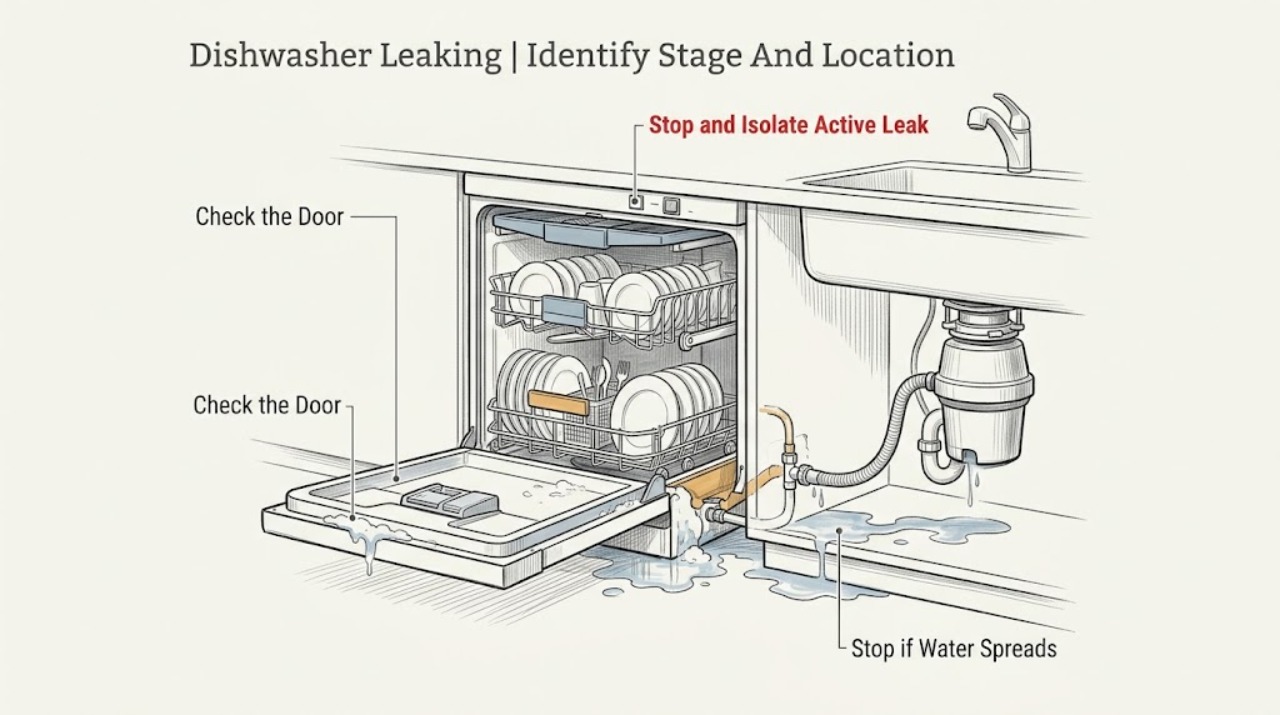
Stop the cycle as soon as water is actively escaping, keep hands away from wet electrical areas, and close the accessible dishwasher water shutoff if the leak continues. Identify both when the leak starts and where the first wet point appears. Foam or water at the front after a wash points first to a door that is not fully closed, a kick plate or load obstruction, incorrect or excessive detergent, or spilled rinse aid. A leak under the sink during filling points to a supply connection or kink; one during draining points to the drain hose, disposer connection, air gap, or a drainage restriction. Frigidaire also says a clogged filter or glass trap can contribute to leaking. After a safe, visible correction, dry the area and make at most one supervised normal check; a leak from the machine base, a continuing leak, a wet electrical area, or an unresolved leak needs professional service. Do not remove the toe-kick or tub panels, tighten concealed fittings while energized, or keep running cycles to locate an internal leak.
Before you begin
Safety first
- This article covers safe isolation, model identification, visible door/load and suds checks, accessible supply/drain observations, and model-authorized filter cleaning. Qualified service or plumbing/electrical personnel must handle pressurized connections, concealed hoses, pumps, valves, tub seals, wiring, base panels, and live diagnosis.
Work through in order
Diagnostic checks
Use only checks that match the exact appliance or system and its official guide.
-
Check 1
Before moving the appliance, record the exact model and serial number and observe the first safe visible wet point. Note whether the leak starts during filling, while spray arms are washing, during draining, or after the cycle, and whether it appears at the door/front, under the sink, at the drain path, or directly beneath the dishwasher. Photograph the dry-to-wet boundary if safe instead of wiping away the only evidence.
Expected result: The first wet point is at the door/front, a supply connection, a drain hose/air gap/disposer route, or the machine base; the timing is known or remains unknown.
Next step: Use the matching branch and keep the water shutoff closed if water is still escaping. If the first wet point cannot be found without moving or opening the appliance, arrange service rather than guessing.
Stop if: Do not pull out the dishwasher, remove a kick plate, or reach beneath a wet appliance to trace the leak.
Why this matters
Why: Timing and location narrow the path: fill plus under-sink moisture favors the supply side; drain plus sink/disposer moisture favors the drain path; front foam or a door edge favors loading, closure, detergent, or rinse aid; a base leak with no accessible source is not a user-level part diagnosis.
-
Check 2
For a continuing leak, stop the cycle using the normal dry control if safe, close the accessible dishwasher water shutoff, and keep the dishwasher off. From a dry position, check whether water has reached the receptacle, cord, junction area, or other electrical component; do not touch those areas. Use towels only where they can be placed without reaching under the machine or disturbing a hose.
Expected result: Water stops when the cycle and supply are isolated, continues despite the control being stopped, has reached an electrical area, or is accompanied by a burning smell, smoke, sparks, or a breaker trip.
Next step: Leave the dishwasher off and provide the leak timing/location to service. For a dry, isolated appliance with no electrical hazard, continue only with the appropriate visible check; otherwise do not restart it.
Stop if: Do not repeatedly reset the breaker, restart a leaking cycle, touch wet electrical parts, or open the base or wiring compartment.
Why this matters
Why: A stopped supply and cycle prevent further filling but do not prove that the leak source is fixed. Continued water, water near electricity, or electrical symptoms are stop-use conditions requiring qualified help, not a reset-and-retry situation.
-
Check 3
If the first wet point is the door or front edge, inspect only the visible door closure, kick plate, racks, and dishes. Confirm the door shuts completely and that a kick plate, tall pan, rack item, or utensil is not holding it open. Check whether the puddle is actually suds or foam. If foam is present, stop adding products; record whether hand dish soap, another non-dishwasher detergent, too much detergent, or spilled rinse aid was used.
Expected result: The door is obstructed or not fully closed, the leak is foamy, the gasket has visible soil or damage, or the door closes normally and the liquid is clear.
Next step: Remove only the visible load or kick-plate obstruction, wipe spilled rinse aid with a damp cloth, and use only the exact model's recommended automatic dishwasher detergent amount. Do not run another cycle until excess suds are gone and the area is dry; if the door or gasket remains damaged, arrange service.
Stop if: Do not pour extra detergent, bleach, drain cleaner, or another chemical into the tub; do not remove the gasket, latch, hinge, or toe-kick.
Why this matters
Why: Frigidaire says a door that does not completely shut, including one obstructed by the kick plate, can contribute to leaking. It also identifies non-dishwasher detergent, excess detergent, and rinse-aid spills as oversudsing causes. Clear water with a correctly closed door is less consistent with a soap-only explanation.
-
Check 4
If water first appears under the sink or at the dishwasher's visible supply route during filling, leave the supply shutoff closed and inspect only the exposed connection for a drip, kink, or obvious looseness. For a recent installation, compare the routing with the installation guide and confirm that an accessible shutoff valve is present. Do not disconnect or retighten a wet connection while the appliance is powered or while water is actively flowing.
Expected result: A supply connection drips during fill, the line is kinked, the leak appeared immediately after installation, or no exposed supply connection is wet.
Next step: Keep the shutoff closed and have the installer, plumber, or appliance technician correct a leaking or improperly routed connection. Do not substitute a hose or fitting based only on appearance or model family.
Stop if: Do not work on a pressurized line, reach behind the dishwasher, pull the appliance out, or energize it to watch a supply leak.
Why this matters
Why: Frigidaire identifies supply-hose connections and kinks as a leak path. Its installation guidance confirms that the dishwasher has a home water connection and an accessible shutoff valve under the sink or behind the location. A dry visible supply route shifts attention to the drain path or concealed appliance components.
-
Check 5
If the leak begins during draining or appears near the sink, disposer, drain hose, or air gap, check only the visible hose routing and sink-side air gap/disposer connection. On a newly installed disposer, verify from the installation documentation that the dishwasher knock-out plug was removed. With power and water isolated and the tub safe to access, clean the model-authorized filter, glass trap, and spray arms exactly as Frigidaire's guide shows, then replace them correctly.
Expected result: The drain hose is kinked or incorrectly routed, the leak followed a new disposer installation, the air gap is dirty, the filter/glass trap is clogged, or the visible drain path is dry and correctly routed.
Next step: Correct only a visible routing obstruction or the documented, accessible filter/glass-trap cleaning. If the drain connection requires disassembly, the leak persists, or water is under the machine, leave the dishwasher off and arrange service or qualified plumbing help.
Stop if: Do not run a cycle with the drain hose disconnected, remove a concealed disposer connection, use drain chemicals, or open the pump/base area.
Why this matters
Why: Frigidaire lists an incorrectly installed or blocked drain hose, an unremoved disposer knock-out plug, and a clogged filter as leak-related checks; its filter guide says a dirty air gap can prevent proper draining. A clear visible drain path with a base leak still does not identify an internal pump, seal, tub, or hose fault.
-
Check 6
If no visible correction explains the leak, keep the dishwasher off and create a service record with the exact model, installation age, cycle phase, first wet point, water-versus-suds description, supply/drain observations, filter and detergent history, and any electrical symptom. Do not remove panels to look for a pump, tub seal, inlet valve, hose, sensor, or wiring fault.
Expected result: The leak stopped after one documented visible correction and the area stays dry, or it recurs, comes from the base, continues with the supply closed, or cannot be traced externally.
Next step: Only after the appliance is isolated, dry, and the correction is model-authorized may one supervised normal check be considered. Otherwise leave it off, keep the water shutoff closed, and provide the record to Frigidaire service, the installer, or a qualified plumber as appropriate.
Stop if: Stop for any continuing leak, water near electrical parts, smoke, burning odor, abnormal heat, repeated breaker trip, or a diagnosis requiring the enclosure to be opened.
Why this matters
Why: A repeatable correction supports an installation, loading, detergent, filter, or visible drain-path issue. A recurring or base-origin leak is compatible with concealed components but the symptom cannot choose a safe replacement part or confirm which internal assembly has failed.
Use your observations
Decision map
Find the observation that best matches what you see, then follow the next safe action.
-
PATH 01Safety boundary
What you see
Foam or water first appears at the door/front edge during or just after washing.
Do this next
Stop the cycle, remove only visible obstructions, wipe any rinse-aid spill, and use the exact model's recommended automatic dishwasher detergent amount. Do not run another cycle while foam remains; call service if the door or gasket will not seal.
Why this path and its safety boundary
Why it matters: A door not fully closed, a kick plate or load obstruction, non-dishwasher detergent, excess detergent, or spilled rinse aid is more likely than a hidden pump fault. Frigidaire specifically warns that these soap-related conditions can create oversudsing that leaks.
Safety stop: Do not add chemicals to suppress foam or remove the latch, hinge, gasket, or kick plate.
-
PATH 02Safety boundary
What you see
Clear water appears under the sink or at a visible supply connection as the dishwasher fills, especially after installation.
Do this next
Close the accessible dishwasher water shutoff and leave the appliance off. Have the installer, plumber, or technician correct the exposed connection or routing without working on a pressurized line.
Why this path and its safety boundary
Why it matters: A loose/incorrect supply connection or kinked line is a leading documented path. The leak is on the water-supply side until proven otherwise; do not infer an inlet valve or internal fitting from a wet floor.
Safety stop: Do not disconnect or tighten a wet connection while energized, pull the dishwasher forward, or reopen the shutoff to test repeatedly.
-
PATH 03Safety boundary
What you see
The leak starts during drain or appears at the drain hose, sink air gap, disposer connection, or after a new disposer was installed.
Do this next
Keep water isolated, correct only the visible routing or documented disposer installation issue, and clean the accessible filter/glass trap as the model guide shows. Escalate if the drain path needs disassembly or the leak returns.
Why this path and its safety boundary
Why it matters: An incorrectly installed or blocked drain hose, an unremoved disposer knock-out plug, a dirty air gap, or a clogged filter/glass trap can interfere with draining and contribute to leakage. A correctly routed visible path does not rule in any particular internal pump or seal.
Safety stop: Do not use drain chemicals, disconnect concealed hoses, run with a hose detached, or open the pump/base area.
-
PATH 04Safety boundary
What you see
Water appears directly beneath the dishwasher, continues after visible checks, or has no identifiable external source.
Do this next
Leave the dishwasher off, close the water shutoff, isolate power only from a safe dry position when necessary, and arrange qualified appliance service. Provide the first wet point, phase, model, and photos.
Why this path and its safety boundary
Why it matters: A concealed tub, pump, hose, seal, valve, or wiring-area problem is possible, but the available evidence cannot distinguish those parts safely. Continuing to run cycles risks water and electrical damage.
Safety stop: Do not remove the toe-kick or base panels, reach under the appliance, or order an internal part from the puddle location alone.
-
PATH 05Safety boundary
What you see
Water is near electrical parts, or there is smoke, a burning smell, abnormal heat, sparking, or a repeated breaker trip.
Do this next
Do not touch the wet appliance. From a safe, dry position isolate power and close the water supply only if that can be done without contacting the hazard; arrange qualified electrical and appliance service.
Why this path and its safety boundary
Why it matters: This is an immediate stop-use condition. Water containment and electrical safety take priority over identifying detergent, hose, pump, or gasket causes.
Safety stop: Do not restart, reset repeatedly, mop around live parts, remove panels, or perform live testing.
Helpful context
Understand the symptom
The first wet point is more useful than the largest puddle
Water often travels along the door, toe-kick, cabinet, or floor before it pools. Note whether the first wet point is at the front door edge, under the sink, at the drain/air-gap route, or directly beneath the dishwasher, and note whether it begins during fill, wash, drain, or after the cycle. Frigidaire's leak guidance uses these same distinctions. A dishwasher that was recently installed or connected to a new disposer deserves an installation-path check before an internal-part diagnosis.
Stop an active leak before troubleshooting
If water is still flowing, press the normal cancel/stop control only if the controls are dry and safe to touch, then close the accessible water shutoff under the sink or behind the dishwasher. If water is near the plug, junction area, or other electrical parts, do not touch the wet area; isolate power from a safe, dry position or have a qualified person do it. Mop up only from a safe position. Do not reach under the machine, remove the toe-kick, pull the dishwasher out, disconnect hoses, or run another cycle while an active leak or electrical hazard remains. Suds are still a leak-control issue: do not add more detergent or chemicals to chase foam.
Safety boundary
Stop conditions
- Stop the cycle and close the accessible dishwasher water shutoff for any continuing leak; do not keep running cycles to locate it.
- Stop immediately for water near electrical parts, smoke, sparks, burning odor, abnormal heat, a wet or damaged cord/outlet, or a repeated breaker trip.
- Do not remove the toe-kick, tub, pump, valve, hose, gasket, latch, or wiring panels; do not perform live electrical or pressurized-water work.
- Do not use hand dish soap, excess detergent, drain cleaner, bleach, or another chemical to address foam or drainage.
- Do not order an inlet valve, pump, hose, gasket, seal, or other internal part without the exact model and a qualified diagnosis.
When checks do not resolve it
Need a professional?
Safety scope: This article covers safe isolation, model identification, visible door/load and suds checks, accessible supply/drain observations, and model-authorized filter cleaning. Qualified service or plumbing/electrical personnel must handle pressurized connections, concealed hoses, pumps, valves, tub seals, wiring, base panels, and live diagnosis.
Common questions
FAQ
Why is my Frigidaire dishwasher leaking suds from the door?
Stop the cycle and do not add more product. Frigidaire identifies hand or non-dishwasher soap, too much detergent, and spilled rinse aid as oversudsing causes; a kick plate, rack, or dish can also prevent the door from closing fully. Remove only visible obstructions, wipe spilled rinse aid, and use the exact model's recommended automatic dishwasher detergent amount after the foam is gone.
What should I check if the leak is under the sink?
Note whether it begins during filling or draining. During fill, leave the water shutoff closed and inspect only the exposed supply connection for a drip or kink. During drain, check the visible drain hose, air gap, or disposer path, and consider the new-disposer knock-out plug if installation was recent. Do not disconnect or retighten a wet connection while energized or pressurized.
Can a clogged dishwasher filter cause a Frigidaire dishwasher to leak?
Frigidaire's leak guide includes a clogged filter among its checks. With power and water safely isolated, clean only the filter or glass-trap design that your model guide authorizes, and replace it correctly. If the leak returns or comes from the base, do not open the pump area; arrange service.
What if the dishwasher leaks from underneath?
Keep it off and close the accessible water shutoff. A base leak may involve a concealed hose, seal, pump, tub, valve, or wiring area, and the puddle alone cannot identify the failed part. Do not remove the toe-kick or reach under the appliance; provide the model, timing, and first wet point to qualified service.
Should I run another cycle to find where my Frigidaire dishwasher leaks?
Not while water is actively escaping, the base is wet, or an electrical hazard is present. Stop the cycle, close the water shutoff, and isolate power only from a safe dry position when necessary. After a documented visible correction, the appliance is dry and isolated, and the exact manual permits normal operation, at most one supervised check may be considered; recurring or concealed leaks need service.
Read the exact guide
Official sources
- Product Support: Frigidaire Gallery 24'' Built-In Dishwasher with Dual OrbitClean Wash System — FGID2468UFFrigidaire Canada · Official product-support page for the specific FGID2468UF model, used only to demonstrate that dishwasher features and access vary by model; it is not a universal parts or procedure guide.
- Dishwasher - Dispenser and Detergents GuideFrigidaire Owner Support · Official dishwasher detergent guidance; the amount depends on the exact model and water hardness, and tablets/packs follow the applicable instructions.
- Dishwasher Glass Trap and Filter GuideFrigidaire Owner Support · Official dishwasher filter-care article; filter shapes and access differ by model, so the matching manual controls what the owner may remove.
- Dishwasher - Water LeakingFrigidaire Owner Support · Official Frigidaire support article marked as applying to dishwashers; exact hose routing, filter access, and installation details remain model-dependent.
- Delivery and Installation Guide - DishwasherFrigidaire Owner Support · Official dishwasher delivery/installation guidance; it provides connection context rather than authorizing a homeowner to disconnect a pressurized or energized installation.
Community feedback
Share a repair observation
Share a plain-text repair observation. Accepted observations are published automatically; this page may take a moment to update.