
On this page
Start here
Quick answer
Because the Frigidaire FFCD2413UB3A was moved for countertop work, first treat this as a possible installation change, not as proof that the pump or control failed. From a dry, safe position, confirm the unit is level and securely anchored, the door closes without striking the countertop, the water supply is on, the water and drain hoses are not kinked or trapped under the cabinet, the drain hose still has its required high loop, and the electrical connection has not been disturbed. Frigidaire's owner guide says the dishwasher fills, pumps water through its spray arms, and drains through the filter/glass-trap path; a moved unit can therefore fill poorly, spray poorly, or leave dirty water if a line, filter, spray arm, or door closure changed. After correcting only an obvious external installation or loading issue, run one suitable cycle. If it still leaves food, stops, leaves standing water, leaks, shows a message, or requires cabinet access, keep it off and arrange Frigidaire service. Do not replace a pump, board, valve, or spray arm from the timing of the move alone.
Before you begin
Safety first
- Do not move the built-in dishwasher alone, pull it out to test hidden connections, open the junction box or kickplate area, disconnect a pressurized water line, defeat the door or overfill protection, use drain chemicals, or perform live electrical tests. Stop for smoke, burning or electrical odor, visible damage, a leak near electrical parts, a hot cord, or repeated breaker operation.
Work through in order
Diagnostic checks
Use only checks that match the exact appliance or system and its official guide.
-
Check 1
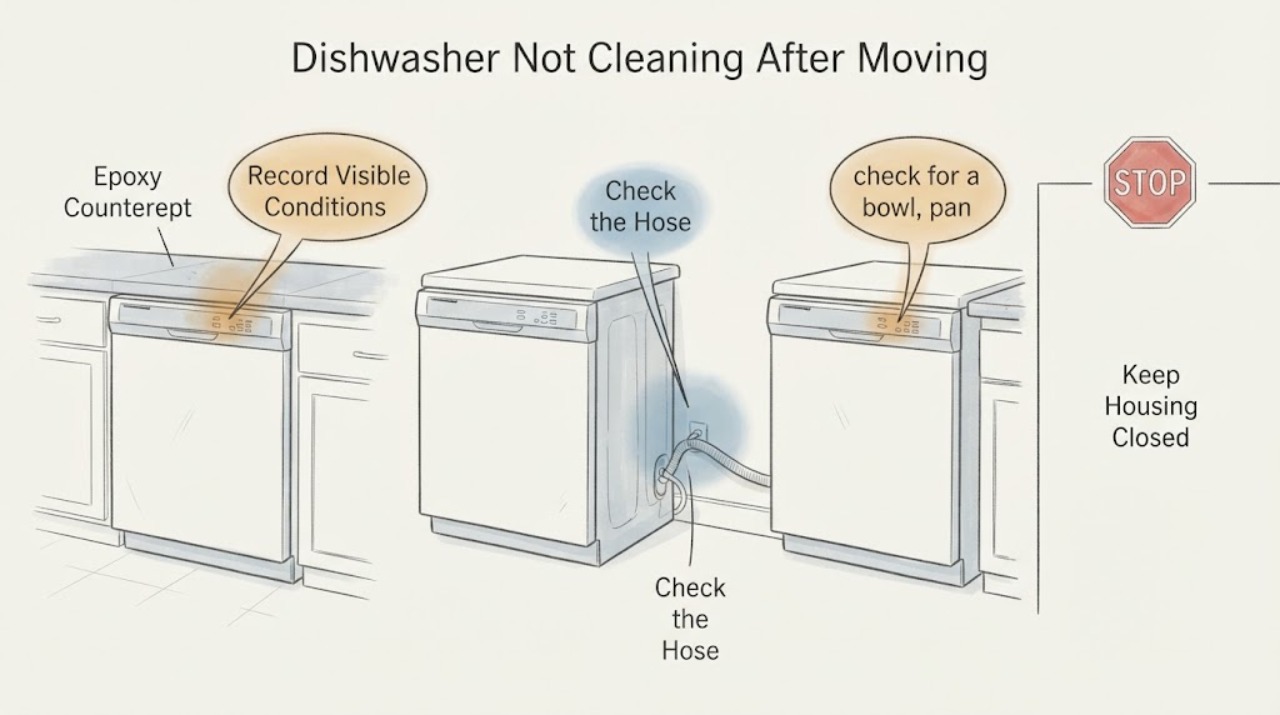
Stop the dishwasher and record which cycle was used, which rack or dishes stayed dirty, whether the detergent cup opened, whether water remains, whether it stopped before the cycle ended, and whether any code, leak, smoke, burning smell, hot plug, or water near electrical parts is present. Do not restart a unit with an active leak or electrical hazard.
Expected result: The symptom began only after the move, one rack is worse, detergent remains, the tub is full or partly full, the panel is dark, or the machine has a hazard or displayed message.
Next step: For smoke, burning odor, visible damage, water near electrics, or a hot/damaged cord, keep the dishwasher off and arrange qualified appliance or electrical help. Otherwise photograph the label and continue with external installation checks only.
Stop if: Do not deliberately run another cycle to reproduce smoke, leaking, repeated breaker operation, or a fault message.
Why this matters
Why: The timing makes installation and connection changes a higher-priority first check, while rack-specific soil, detergent, or standing water points to different branches. A hazard overrides ordinary cleaning troubleshooting.
-
Check 2
From the front and under the sink, inspect without pulling the built-in dishwasher: confirm the door opens and closes without hitting the new countertop, the cabinet does not press on the door, the unit is stable and level as far as can be safely observed, the water supply is on, the drain hose is not kinked or trapped, and no joint is wet.
Expected result: The dishwasher rocks or is visibly out of level, the door rubs or will not close, a water or drain line is kinked or trapped, a connection leaks, or all visible installation conditions appear unchanged.
Next step: Correct only an obvious accessible valve setting or line-routing issue that does not require moving the appliance or opening a junction box. For a built-in unit that needs extraction, leveling, anchoring, plumbing, or electrical work, stop and use a qualified installer or servicer.
Stop if: Do not pull the dishwasher out alone, place weight on the open door, loosen a pressurized connection, or open the electrical junction box.
Why this matters
Why: Frigidaire's installation instructions identify level and secure placement, free utility lines, correct door clearance, and leak-free connections as completion checks. A change in any of those after moving can reduce filling or draining and can stop the cycle without proving a pump or board fault.
-
Check 3
With the machine off and the racks accessible, check for a bowl, pan handle, tall item, or utensil protruding through a rack and blocking the lower or middle spray arm or detergent cup. Rotate a stationary accessible spray arm gently by hand and confirm that it turns freely; do not force an arm or run the unit with a loose part.
Expected result: A rack item blocks an arm or dispenser, an arm does not rotate freely, only one rack is dirty, or the load and arms are clear.
Next step: Rearrange the load so soiled surfaces face the spray and arms have clearance, then use a normal or heavy cycle suited to the soil. If an arm is cracked, loose, blocked internally, or still cannot rotate, leave the unit off and arrange service.
Stop if: Do not reach into a moving dishwasher or use a sharp tool that could damage a spray arm or tub.
Why this matters
Why: Frigidaire says protruding rack items and pan handles can block spray-arm rotation and that nested or poorly oriented items reduce water access. A localized dirty rack supports a loading or spray-coverage issue; both racks remaining dirty after a clear load needs water, filter, drain, or service assessment.
-
Check 4
After allowing the heating element and water to cool, inspect the user-accessible glass trap/filter area according to the exact owner guide. Remove only loose food or broken fragments that are safely reachable, verify the trap and spray-arm assembly are fully seated, and inspect the overfill protector for free movement; do not reach blindly into standing water.
Expected result: The glass trap/filter area is clogged or contains glass, the spray-arm/filter assembly is not fully seated, the overfill protector is stuck, or these areas are clean and correctly seated.
Next step: Clean and reseat only as the model guide permits, wear protection for broken glass, and make one monitored cycle attempt. If the assembly is damaged, cannot lock, or standing water returns, leave the dishwasher off and arrange service.
Stop if: Do not clean a hot interior, force the trap, remove a pump cover, or continue if sharp glass or water is near electrical parts.
Why this matters
Why: The owner guide says the glass trap collects broken glass and debris, the spray arm and trap must snap fully in place, and the overfill protector should move freely. A restriction can reduce circulation or drainage and leave dishes dirty, but a clean, correctly seated assembly does not identify a failed pump.
-
Check 5
From a safe external position, confirm the household water supply is on and run the nearby hot-water faucet until hot before a single suitable cycle. Note whether the dishwasher fills normally, whether other fixtures are consuming water, and whether the accessible supply line has been disturbed; do not adjust an internal valve or heater.
Expected result: The supply was off or restricted, incoming water is cool or pressure is low, the dishwasher does not fill, or filling and incoming water appear normal.
Next step: Restore only a clearly accessible supply setting and run one supervised normal or heavy cycle after the nearby hot tap is ready. If the unit does not fill, fills weakly, leaks, or needs access behind the kickplate, arrange qualified service.
Stop if: Do not disconnect the water line, probe the inlet valve, touch hot water inside the tub, or perform energized tests.
Why this matters
Why: Frigidaire specifies hot incoming water for cleaning and says low pressure or cool water can impair results. A moved connection can create a fill restriction, but normal filling does not prove that the circulation pump or heater is healthy.
-
Check 6
If water remains after the apparent stop, let the interior cool and check only the visible drain arrangement under the sink: the drain hose must be free of sharp bends or kinks, the disposer knockout plug must have been removed if newly connected, and the glass trap/filter must be maintained. Do not pull the unit to reach the drain pump or cabinet wiring.
Expected result: The drain hose is kinked or trapped, a disposer connection still has its knockout plug, the filter/trap is blocked, only normal sump water is visible, or the accessible path is clear but the tub remains full.
Next step: Correct only a documented visible routing issue, then make no more than one monitored attempt. If water remains, the unit leaks, or the drain connection requires extraction or disassembly, leave it off and arrange appliance or plumbing service.
Stop if: Do not use drain chemicals, reach into a disposer, remove the drain pump, run with exposed wiring, or repeatedly restart a full tub.
Why this matters
Why: Frigidaire's installation and drain guidance lists hose routing, disposer preparation, completion status, and a clean installed glass trap as drain prerequisites. Persistent standing water after those checks is a service diagnosis, not evidence that a particular pump is bad.
Use your observations
Decision map
Find the observation that best matches what you see, then follow the next safe action.
-
PATH 01Next step
What you see
The problem began immediately after the dishwasher was moved and the unit is visibly unlevel, the door rubs the countertop, a hose is kinked or trapped, the water supply is off, or a joint is wet.
Do this next
Correct only a safe external setting or route. Use a qualified installer or servicer for extraction, leveling, anchoring, plumbing, or wiring, then run one suitable cycle and compare the result.
Why this path and its safety boundary
Why it matters: A move-related installation change is the strongest supported first explanation; the same conditions can affect fill, spray, drain, door closure, and electrical safety without proving an internal component failure.
-
PATH 02Next step
What you see
Only one rack is dirty or a pan handle, tall item, or utensil blocks a spray arm or detergent cup, while the unit fills and drains without a hazard.
Do this next
Rearrange the load, confirm the stationary spray arm turns freely, and use a normal or heavy cycle suited to the soil. If the same rack remains dirty with a clear load, request service diagnosis.
Why this path and its safety boundary
Why it matters: Loading or spray coverage is more likely than a whole-appliance pump or control failure. Frigidaire says protruding rack items can block spray-arm rotation.
-
PATH 03Next step
What you see
Both racks remain dirty, the glass trap/filter or spray-arm assembly is blocked or unseated, incoming water is cool or weak, or the dispenser leaves detergent after the cycle.
Do this next
Clean and reseat only the user-accessible parts the exact guide permits, correct an obvious safe supply issue, and make one monitored cycle attempt. Escalate if the condition returns or needs internal access.
Why this path and its safety boundary
Why it matters: Circulation, filtration, detergent release, water temperature, or supply conditions remain plausible. These observations narrow the next safe check but do not identify a pump, heater, valve, or control board.
-
PATH 04Next step
What you see
The dishwasher stops with a full tub, leaks, will not fill, has a dark panel or electrical symptom, or still fails to clean after the move-related installation and visible loading/filter checks.
Do this next
Keep the dishwasher off, isolate power only from a dry safe position, and provide the technician the complete FFCD2413UB3A identity, what changed during the move, water level, hose/door observations, cycle, and any message. Use plumbing or electrical service when the problem is in the home connection.
Why this path and its safety boundary
Why it matters: This is no longer a routine cleaning adjustment. A persistent drain, fill, door, power, leak, or internal circulation issue needs model-specific service rather than a guessed replacement part.
Helpful context
Understand the symptom
Why moving the dishwasher changes the first check
The owner guide describes a repeated fill, spray, and drain process: water covers the filter area, is pumped through the spray arms, and carries soil toward the filter and drain. The installation instructions warn that kinked water or drain hoses cause problems and require the dishwasher to be level, securely fastened, and free of utility-line damage. If the unit was pulled out and pushed back for epoxy countertop work, a new restriction, shifted leveling leg, door interference, loose electrical connection, or leak can explain poor cleaning or a stop without identifying an internal part.
Keep the full suffix with the service request
Frigidaire's official support page is labeled FFCD2413UB and links the English owner and installation guides used here; the assigned appliance label adds the FFCD2413UB3A suffix. Keep that full suffix and serial information with the service request. The support page lists four leveling legs, a removable filter trap, direct-feed wash system, hot-water requirements, and a 120-volt rating, but none of those specifications by itself proves that a pump, valve, or control has failed.
When checks do not resolve it
Need a professional?
Arrange Frigidaire or qualified appliance service when the dishwasher still does not clean after one suitable cycle following safe external installation corrections, when it stops with standing water, will not fill, leaks, the door cannot close, a code repeats, or any diagnosis requires extraction or cabinet access. Use plumbing service for a household drain or water connection and qualified electrical service for the circuit or junction box.
Safety scope: Do not move the built-in dishwasher alone, pull it out to test hidden connections, open the junction box or kickplate area, disconnect a pressurized water line, defeat the door or overfill protection, use drain chemicals, or perform live electrical tests. Stop for smoke, burning or electrical odor, visible damage, a leak near electrical parts, a hot cord, or repeated breaker operation.
Have this ready
- Provide the complete FFCD2413UB3A model and serial information, before/after move timing, countertop work details, cycle and load, dirty-rack pattern, detergent-cup result, water level, filter/trap condition, door and leveling observations, hose routing, supply concerns, any leak, code, or electrical symptom, and safe photos.
Common questions
FAQ
Why did my Frigidaire FFCD2413UB3A stop cleaning after it was moved?
Start with the reinstallation: a kinked water or drain hose, an unlevel or unsecured unit, door/countertop interference, a shifted supply connection, or disturbed wiring can appear immediately after moving. Correct only safe visible issues and have a qualified installer handle extraction or connection work.
Should I replace the circulation pump because the dishes are dirty?
No. Confirm the cycle, rack loading, spray-arm clearance, filter/glass trap, detergent release, hot-water supply, drain path, and reinstallation first. Persistent failure after those checks needs a model-specific service diagnosis; the symptom does not select a pump or control board.
What does standing water after the move mean?
Frigidaire's drain guidance points first to a kinked hose, disposer knockout plug, paused rather than completed cycle, or clogged/misinstalled glass trap. Check only the visible permitted path after the water cools. If the tub remains full or the path needs cabinet access, keep the unit off and call service.
When should I stop using the dishwasher immediately?
Stop for a leak near electrical parts, smoke, burning or electrical odor, a hot or damaged cord, repeated breaker trips, visible wiring or cabinet damage, or a door that cannot close safely. Isolate power only from a dry safe position and arrange qualified appliance, plumbing, or electrical help.
Read the exact guide
Official sources
- What is the best way to load my dishwasher to optimize my cleaning performance?Frigidaire · Official Frigidaire loading guidance used for safe, model-aware rack and spray-arm checks; it warns that rack features vary and the owner manual controls.
- Dishwasher Installation InstructionsFrigidaire · Official installation instructions linked from the Frigidaire FFCD2413UB support page. They apply to this built-in dishwasher family and are used here to prioritize reinstallation checks; extraction, plumbing, anchoring, and wiring work require qualified help.
- All about the Use & Care of your DishwasherFrigidaire · Official English owner guide linked from the Frigidaire FFCD2413UB support page. It covers the FFCD2413U family and states that features and rack appearance can vary; the complete FFCD2413UB3A label and matching guide remain controlling.
- What can I do if my dishwasher is not draining?Frigidaire · Official Frigidaire drain guidance used for the visible post-move drain branch; it supports hose, disposer knockout-plug, cycle-status, and glass-trap checks without selecting an internal pump.
- How can I ensure the best cleaning results?Frigidaire · Official Frigidaire cleaning guidance used for the non-invasive hot-water and household-use branch. It supports incoming water and pressure observations and does not authorize internal heater or valve work.
- Product Support: Frigidaire 24'' Built-In Dishwasher Black-FFCD2413UBFrigidaire · Opened official Frigidaire support page for the FFCD2413UB base model. It links the owner and installation guides and lists family specifications including four leveling legs, removable filter trap, hot-water operation, direct-feed wash system, 120-volt rating, and the FFCD2413UB3A suffix must be confirmed on the appliance label before ordering or servicing.
Community feedback
Share a repair observation
Share a plain-text repair observation. Accepted observations are published automatically; this page may take a moment to update.