
On this page
Start here
Quick answer
Start by identifying whether the frost is on packages, around the freezer opening, on one wall, or across much of the freezer, and whether the unit is a frost-free GE Profile model or a manual/cycle-defrost model. In a frost-free refrigerator, heavy wall frost is not expected: check for a package, shelf, basket, or drawer preventing full closure; inspect the visible gasket for a gap, tear, or loose section; and consider frequent opening, high humidity, or warm uncovered food. Move food away from the rear wall and vents without blocking airflow, and use the exact model manual before changing temperature settings or defrosting. A light, temporary frost layer after a warm load or frequent opening may clear in a few days, while recurring heavy frost, a fan that is not running, an unusual one-wall frost pattern, or frost that remains after the documented recovery/defrost procedure points to service. Do not chip ice, use a knife, hair dryer, heat gun, or boiling water, remove freezer panels, or live-test a fan, heater, sensor, or control.
Before you begin
Safety first
- Owner checks stop at accessible food placement, closure, visible gasket condition, normal controls, dry-towel wiping, and model-authorized defrost instructions. Qualified service must handle evaporator covers, fans, heaters, sensors, controls, wiring, refrigerant circuits, and live testing.
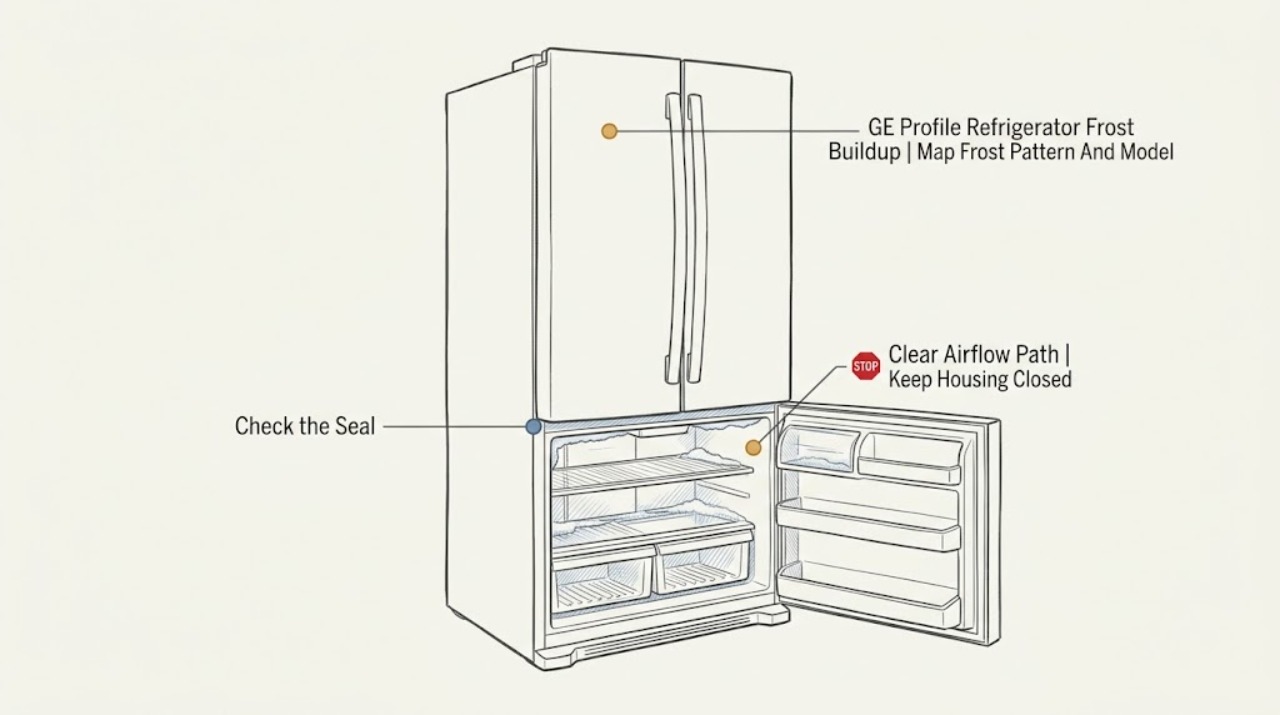
Work through in order
Diagnostic checks
Use only checks that match the exact appliance or system and its official guide.
-
Check 1
Record the exact GE Profile model, configuration, freezer type, and where frost appears: on food or packages, around the door or drawer opening, on the rear wall, on one concentrated wall, across shelves, or as ice under a basket. Note whether it started after a move, outage, warm load, cleaning, or a period of frequent opening.
Expected result: Only packages have crystals; frost is around the opening; a package or shelf touches the rear wall; frost covers one wall heavily; or the pattern is widespread and recurring.
Next step: Use the exact owner's manual and continue with the branch matching the pattern. Do not assume a manual-defrost procedure applies to a frost-free Profile refrigerator.
Stop if: Do not remove interior panels or scrape the frost to expose a component.
Why this matters
Why: Crystals on food can come from moisture in the food or humid air and may be normal. Frost around the opening makes a closure or gasket path more likely. A concentrated one-wall or recurring pattern is not identified by appearance alone and can require model-specific service.
-
Check 2
Close the freezer door or drawer normally and inspect the visible gasket around its perimeter. Remove only food, shelves, baskets, shipping material, or a drawer obstruction that prevents closure; check that a bottom-freezer basket is fully seated and that the gasket sits in its groove without an obvious tear or gap.
Expected result: The door or drawer springs back open, a package prevents closure, the gasket is loose, torn, uneven, or not touching the frame, or the closure appears even all around.
Next step: Correct only the accessible obstruction or reseat a gasket section when the exact manual permits it, then monitor. A torn gasket, uneven door, or continuing frost needs model-specific service or a documented gasket procedure.
Stop if: Do not force, heat, glue, or remove the gasket, adjust hinges, or remove a door without the exact installation instructions.
Why this matters
Why: Warm humid air entering through an incomplete seal is a leading owner-check explanation for frost around the opening. GE specifically links bottom-freezer drawer sealing, basket seating, and gasket contact to frost. A sound visible seal lowers that likelihood but does not rule out an internal fault.
-
Check 3
Inspect the accessible freezer load without dismantling anything. Move uncovered warm food to a suitable container, keep packages from the rear wall, vents, and door edge, and reduce unnecessary door openings during hot or humid conditions. Do not block the air path with a large container.
Expected result: A warm or uncovered load was recently added; food rests against the rear wall; an opening is blocked; the room is humid; or the load and airflow are normal.
Next step: Correct the accessible loading or usage issue and allow the frost to clear over the next few days while monitoring the seal and temperature. If it returns heavily, continue to service rather than repeatedly thawing it.
Stop if: Do not press food against an evaporator cover, reach into a vent, or remove an airflow panel.
Why this matters
Why: GE identifies warm food, high humidity, frequent opening, and packages against the rear wall or holding the door open as causes of temporary or recurring frost. If those conditions are absent and heavy frost remains, a seal, fan, or defrost issue becomes more likely.
-
Check 4
Read the temperature controls and the exact GE Profile owner's manual. Confirm whether the refrigerator is frost-free/automatic-defrost, cycle-defrost, or manual-defrost, and use only the model's documented setting or defrost instructions. If the manual permits a normal owner defrost, protect food and control water as it melts.
Expected result: The model is frost-free; it is a manual or cycle-defrost design; the temperature was set unusually cold; or the defrost type and procedure are unknown.
Next step: Use the exact manual's control or defrost path. If a frost-free model continues to build heavy frost, or frost returns soon after the documented procedure, arrange service.
Stop if: Do not select a temperature by another model's number, enter a hidden service mode, or manually energize a heater.
Why this matters
Why: Almost all current refrigerators use automatic defrost, but GE documents separate manual and cycle-defrost behavior. A manual-defrost procedure copied to the wrong Profile model can damage food or create water and electrical risk. A colder setting can contribute to excess frost but does not explain every pattern.
-
Check 5
After correcting an obstruction, seal, loading, or documented setting issue, monitor the frost and temperature trend without opening covers. Note whether it clears in the expected recovery period, whether a fan is audibly operating during a normal cooling period without touching it, and whether frost returns in the same location.
Expected result: Frost clears over a few days; frost remains heavy; it returns in the same area; the freezer fan is not running when the model should be cooling; or the temperature is not maintained.
Next step: If the pattern does not recover, document photos and the time trend and arrange qualified GE Profile service. Do not use a fan sound as proof of a particular failed part.
Stop if: Do not touch the fan, remove its cover, or test the motor, heater, sensor, or board with power applied.
Why this matters
Why: GE says frost from humidity, opening, warm loads, and rear-wall packages should go away in a few days. A non-running fan, persistent heavy frost, repeated one-area buildup, or poor temperature maintenance points beyond a simple loading correction and needs service.
-
Check 6
Prepare a service record with the GE Profile model, freezer configuration, frost location and thickness trend, door/gasket and loading observations, temperature setting, recent events, fan symptom, and photographs before any frost is removed. Include any food-temperature or electrical safety symptom.
Expected result: Heavy frost persists after documented owner checks, returns quickly, blocks airflow, is concentrated on one wall, the fan is not running, or smoke, odor, abnormal heat, water near electrical parts, cord damage, or breaker trips occur.
Next step: Stop at safe external checks and arrange qualified GE Profile refrigerator service. Protect food and flooring if temperatures or meltwater are unsafe.
Stop if: Do not bypass a door switch, remove panels, live-test wiring, force a defrost cycle, or order a heater, fan, sensor, or board from the frost pattern alone.
Why this matters
Why: A persistent or unusual pattern can involve the fan, defrost system, control, sensor, airflow, or seal alignment. The broad symptom does not identify a compatible part, and a safety symptom overrides further troubleshooting.
Use your observations
Decision map
Find the observation that best matches what you see, then follow the next safe action.
-
PATH 01Safety boundary
What you see
Crystals are mainly on packages, or frost appeared after adding warm/uncovered food or opening the freezer frequently.
Do this next
Cover or reposition food, reduce openings, keep the door sealed, and monitor for several days. Escalate if heavy wall frost or poor temperature returns.
Why this path and its safety boundary
Why it matters: Moisture from food or humid air can freeze on packages and may be a normal temporary effect rather than an appliance failure.
Safety stop: Do not scrape crystals with a sharp tool or heat the compartment.
-
PATH 02Safety boundary
What you see
Frost forms around the freezer opening and a package, shelf, basket, drawer, uneven door, or gasket gap prevents full contact with the frame.
Do this next
Correct the accessible obstruction or use the exact model's documented gasket/door procedure, then monitor. Arrange service for a torn gasket or continuing frost.
Why this path and its safety boundary
Why it matters: Air leakage through incomplete closure is more likely than a proven defrost failure.
Safety stop: Do not force or heat the gasket, remove hinges, or adjust a built-in door without model instructions.
-
PATH 03Safety boundary
What you see
The model is frost-free and heavy wall frost remains or returns after loading, closure, gasket, and setting checks.
Do this next
Arrange GE Profile service with the model, photos, frost location, temperature trend, and fan observation. Keep internal panels closed.
Why this path and its safety boundary
Why it matters: A frost-free appliance should not accumulate persistent wall ice; a fan or defrost/airflow fault is possible, but the pattern does not identify the failed component.
Safety stop: Do not repeatedly unplug, enter service mode, remove the evaporator cover, or test a heater or fan.
-
PATH 04Safety boundary
What you see
The exact manual identifies a manual or cycle-defrost refrigerator and frost has reached the manual's documented threshold or condition.
Do this next
Follow only the exact owner's manual, protect food, and use safe non-sharp methods. If the frost pattern is unusual or returns abnormally, arrange service.
Why this path and its safety boundary
Why it matters: Manual/cycle-defrost models can require owner defrosting, unlike frost-free models; the exact manual controls the safe procedure and threshold.
Safety stop: Do not assume a threshold or procedure from another Profile model; never use pointed tools or direct heat.
-
PATH 05Safety boundary
What you see
Frost is concentrated on one wall, the fan is not running, temperature is not maintained, or smoke, burning odor, abnormal heat, water near electrical parts, cord damage, or repeated trips occur.
Do this next
Stop use for a hazard or uncontrolled temperature problem and arrange qualified service. Isolate power only from a safe dry position and do not re-energize to reproduce the symptom.
Why this path and its safety boundary
Why it matters: This is no longer a simple loading or condensation check; an internal refrigeration, defrost, airflow, control, or electrical issue is possible, and a hazard makes testing unsafe.
Safety stop: No live testing, panel removal, repeated breaker resets, bypasses, sharp tools, or heat sources.
Helpful context
Understand the symptom
Frost location changes the diagnosis
Frost inside a food package or a few crystals after adding warm food is different from a sheet of frost on the freezer wall, a band around the door opening, or ice that returns in one concentrated area. GE Profile includes different refrigerator configurations and defrost arrangements. Record the model and frost pattern before copying a temperature or defrost procedure from another model.
Do not attack frost with tools or heat
Keep owner work to moving accessible food, checking normal door closure and visible gasket condition, reading controls, wiping loose surface frost with a dry towel, and following the exact owner's manual. Do not chip or pierce ice, use a knife or pointed tool, pour hot or boiling water, use a hair dryer or heat gun, remove an evaporator cover or fan guard, or perform a live electrical test. If a damaged cord, hot outlet, burning odor, smoke, water near electrical parts, or repeated breaker trip is present, stop using the appliance and arrange qualified service.
When checks do not resolve it
Need a professional?
Safety scope: Owner checks stop at accessible food placement, closure, visible gasket condition, normal controls, dry-towel wiping, and model-authorized defrost instructions. Qualified service must handle evaporator covers, fans, heaters, sensors, controls, wiring, refrigerant circuits, and live testing.
Common questions
FAQ
Is a little frost on GE Profile freezer packages normal?
A few crystals on or inside packages can come from moisture in the food or humid air entering during door openings. Heavy frost on a frost-free freezer wall, frost around the opening, or frost that keeps returning needs a seal, loading, defrost, airflow, or service check.
Why is frost building up around my GE Profile freezer door?
Check for a package, shelf, basket, drawer, shipping material, uneven door, or damaged/loose gasket preventing full closure. Correct only accessible obstructions and follow the exact model's gasket or door instructions; persistent frost needs service.
Can I manually defrost a GE Profile refrigerator?
Only if the exact owner's manual identifies the appliance as manual or cycle defrost and gives that procedure. Most modern refrigerators use automatic defrost, and a manual-defrost method copied to a frost-free model can be unsafe or inappropriate. Never use sharp tools or direct heat.
What does frost on only one freezer wall mean?
An unusual heavy concentration on one wall is not enough to name a failed part. GE routes an unusual frost pattern to service, especially when the freezer is frost-free or the frost returns after closure and loading checks.
When should I stop troubleshooting GE Profile freezer frost?
Stop when frost is heavy or recurring after the model-authorized checks, the freezer fan is not running, temperature is not maintained, panels would need removal, or smoke, burning odor, abnormal heat, water near electrical parts, cord damage, or repeated breaker trips occur. Arrange qualified service.
Read the exact guide
Official sources
- Refrigerator & Freezer - Ice on Freezer WallGE Appliances · GE frost-free refrigerator wall ice, humidity, loading, gasket, and fan symptoms
- Refrigerator - Interior MoistureGE Appliances · GE refrigerator interior moisture, door opening, food, and defrost-cycle behavior
- User Manual & Care for PVD28BYNFS - GE Profile RefrigeratorGE Appliances · GE Profile refrigerator model identity and model-specific owner's manual access
- Refrigerator - Manual DefrostingGE Appliances · GE manual-defrost refrigerator safe defrosting and abnormal frost pattern escalation
- Refrigerator - Frost or Ice Crystals on Food in FreezerGE Appliances · GE refrigerator frost crystals on food and package moisture
- Refrigerator and Freezer - Types of Defrost SystemsGE Appliances · GE frost-free, automatic, manual, and cycle-defrost system distinctions
- Refrigerator - Frost in FreezerGE Appliances · GE refrigerator freezer frost checks, door closure, gasket, alignment, leveling, and model temperature control
- Bottom Freezer Refrigerator - Freezer Drawer Not Sealing ProperlyGE Appliances · GE French-door and bottom-freezer drawer closure, basket seating, and gasket contact
Community feedback
Share a repair observation
Share a plain-text repair observation. Accepted observations are published automatically; this page may take a moment to update.