
On this page
Start here
Quick answer
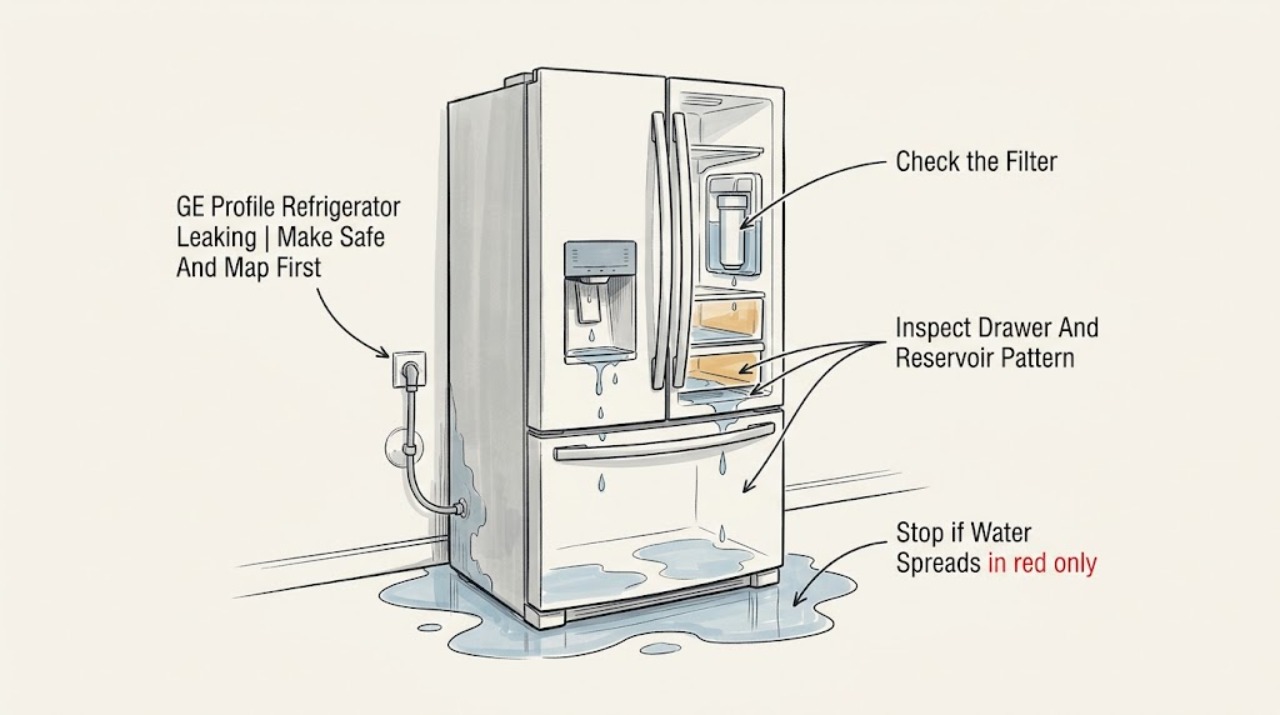
First contain the water and identify where it starts: dispenser recess, filter area, under fresh-food drawers, freezer floor, rear connection, or the floor in front. If water is near an outlet, cord, or other electrical part, stop using the refrigerator and isolate power only from a safe accessible point. For an active supply leak, turn off the refrigerator's water shutoff valve if it is safely reachable; GE's guidance distinguishes a house copper line, the appliance water valve, the icemaker fill line, and internal tubing. A few drops immediately after dispensing can be normal, but dripping that continues after the glass is removed needs service. Water under drawers can indicate a leaking reservoir or tubing, while water or ice on a bottom-freezer floor can indicate a defrost drain that requires disassembly and service. If a model with an RPWFE filter shows a Leak Detected message, inspect the filter area and install the filter only as the exact model requires; the message and filter behavior are not universal to every GE Profile refrigerator. Do not pull a built-in or tightly connected unit, remove panels, clear a drain with tools, loosen water fittings, or perform electrical or live leak tests. Arrange qualified appliance service for an internal reservoir, valve, drain, filter housing, or tubing leak, and a qualified plumber when the house water line itself is the source.
Before you begin
Safety first
- The owner may contain water, inspect visible external areas, wipe the dispenser recess, use the exact model's filter procedure, and turn off an accessible water shutoff. Qualified personnel must handle hidden tubing, filter housing, reservoir, valve, defrost drain, freezer panels, internal electrical parts, live testing, and any hazard condition.
Work through in order
Diagnostic checks
Use only checks that match the exact appliance or system and its official guide.
-
Check 1
Keep people away from the wet area, wipe up standing water, and identify the first wet location without moving the refrigerator: dispenser recess, filter area, under fresh-food drawers, freezer floor, rear water connection, or floor in front. Check whether water is near a cord, receptacle, power strip, or electrical component.
Expected result: Water is near electricity; a puddle is actively growing; the first wet point is at the dispenser, filter, drawers, freezer, rear connection, or not yet identifiable.
Next step: If there is electrical risk or an active uncontrolled leak, isolate the refrigerator and water supply only from safe accessible controls and arrange service. Otherwise continue with the location-specific check below, keeping the unit stable.
Stop if: Do not touch wet electrical parts, reach behind a wet cabinet, pull a built-in unit, or use a live electrical test.
Why this matters
Why: Water near electricity is an immediate stop-use condition. The first wet point separates a normal dispenser dribble, filter or reservoir leak, defrost drainage problem, and supply-line or valve leak; the front puddle alone is not enough to identify the source.
-
Check 2
If the wet area is the dispenser recess or filter area, empty and wipe the recess, note whether the dripping occurs only after dispensing or continues at rest, and inspect the accessible filter connection for visible moisture. On a model showing Leak Detected, record the exact message and confirm the filter is the one specified for that model.
Expected result: Only a few drops appear immediately after dispensing; water continues long after use; the filter area is wet; the filter was recently changed; or a Leak Detected message remains.
Next step: Use only the exact Owner's Manual procedure to reseat or replace the specified filter, if the model supports that check. If water returns at rest, the message persists, or the housing leaks, shut off water when safe and arrange service.
Stop if: Do not force the filter, use an unapproved filter or improvised plug, remove the housing, or open the dispenser or door wiring.
Why this matters
Why: GE considers a few immediate post-dispense drops normal, but continuing drips point to service. A wet filter area or persistent model-specific message shifts concern to filter fit, filter housing, or internal water-system service; it does not prove the filter is the only cause.
-
Check 3
If water or ice is under the fresh-food drawers, remove only the drawers or pans that the Owner's Manual identifies as user-removable and look for the earliest wet area. Do not remove a reservoir, tubing, cover, or rear wall. If the refrigerator has a door water dispenser and there is no electrical hazard, observe the accessible reservoir area only while dispensing a small amount of water.
Expected result: Water collects under the drawers; the visible reservoir or tubing becomes wet while dispensing; the reservoir appears frozen or split; or the drawer area stays dry while the floor leak continues.
Next step: Stop dispensing and shut off the water supply if the reservoir or tubing leaks. Arrange qualified appliance service; do not attempt to thaw, patch, or replace internal tubing yourself.
Stop if: Do not use tools on the reservoir, pierce ice, remove internal panels, or continue dispensing into a visibly leaking cabinet.
Why this matters
Why: GE identifies water under fresh-food drawers as a possible storage-tank or tubing leak and notes that a frozen tank may split and leak onto the fresh-food floor. A visible internal water-path leak requires service, while a dry drawer area moves the investigation to another branch.
-
Check 4
If water or ice is on the freezer floor or under a full-width fresh-food drawer, note whether the refrigerator is a bottom-freezer design and whether the wet pattern follows a defrost event rather than dispenser use. Inspect only visible surfaces; do not remove freezer panels or try to clear a drain with a wire, heat source, or sharp tool.
Expected result: Ice or water repeatedly forms on the freezer floor; water appears under a drawer without using the dispenser; the refrigerator is not a bottom-freezer model; or the leak clearly follows a water-line or dispenser event.
Next step: Arrange qualified appliance service for a suspected defrost-drain blockage or pan problem. If the pattern instead follows dispenser or icemaker use, use the water-supply branch and shut off water for an active leak.
Stop if: Do not chip ice, insert objects into the drain, remove evaporator covers, or apply heat near plastic, wiring, or refrigerant components.
Why this matters
Why: GE says automatic-defrost bottom-freezer units route water through a drain tube to a pan and that a blocked drain can cause water or ice on the freezer floor or under a fresh-food drawer. Access requires disassembly, so the pattern supports service rather than a user drain repair.
-
Check 5
For water on the floor in front or at the rear connection, only inspect visible tubing and fittings from a dry, stable position. Distinguish the house copper or plastic supply line, the refrigerator water valve area, and the icemaker fill line. If an active leak is visible and the shutoff valve is safely accessible, turn off the refrigerator water supply and the icemaker when applicable.
Expected result: The house line is split or loose; the appliance valve is flooding or remains wet; the icemaker fill line is loose or split; or the source cannot be seen without pulling the refrigerator.
Next step: Keep the water supply off for an active leak and arrange a qualified plumber for the house line or qualified appliance service for the valve and fill line. Photograph the visible location and provide the model to the technician.
Stop if: Do not disconnect tubing, tighten hidden fittings, pull a built-in unit, or work near wet electrical parts.
Why this matters
Why: GE directs a house-line leak to a plumber, while a leaking appliance valve or fill line requires appliance service. An inaccessible connection is not a reason to pull a built-in or strain the water line.
-
Check 6
Stop owner diagnosis for continuing water at rest, a repeated puddle, a persistent Leak Detected message, a wet internal reservoir or filter housing, a suspected defrost drain, water near electricity, or any leak requiring panel removal. Keep the water supply off when safe and protect food from unsafe temperatures.
Expected result: The leak stops after a documented external filter or dispenser correction; the leak continues; water is hidden behind panels; the unit is built in; or electrical or cabinet damage is present.
Next step: Arrange qualified appliance service, or a plumber for the house supply line. Give the technician the exact model, first wet location, water use or defrost timing, filter history, message text, and whether the water supply is off.
Stop if: Do not operate with water near electrical parts, bypass leak detection, patch tubing, remove panels, or perform live tests.
Why this matters
Why: A temporary external correction may explain a filter or dispenser symptom, but persistent or hidden water requires qualified diagnosis. Water near electricity or structural damage raises the urgency and rules out further owner troubleshooting.
Use your observations
Decision map
Find the observation that best matches what you see, then follow the next safe action.
-
PATH 01Safety boundary
What you see
Only a few drops appear immediately after a glass is removed from the dispenser and the recess does not keep filling.
Do this next
Wipe and empty the recess, remove the glass more slowly, and monitor. If water continues long after dispensing or returns while idle, arrange service.
Why this path and its safety boundary
Why it matters: GE describes a small post-dispense dribble as normal on dispenser models, but a continuing drip or recurring puddle is a different fault.
Safety stop: Do not remove the dispenser housing or door wiring.
-
PATH 02Safety boundary
What you see
The filter area is wet, a filter was recently changed, or a bottom-freezer model displays Leak Detected.
Do this next
Use the exact model manual to inspect and correctly seat the specified filter. If the leak or message persists, turn off water when safe and arrange service.
Why this path and its safety boundary
Why it matters: On GE models that use RPWFE, the message can relate to filter installation or identification; other GE Profile models may use another filter or no such message.
Safety stop: Do not force, puncture, bypass, or substitute a filter without model documentation.
-
PATH 03Safety boundary
What you see
Water or ice appears under fresh-food drawers, on a freezer floor, or under a full-width fresh-food drawer without a clear dispenser event.
Do this next
Keep panels intact and arrange qualified appliance service. Record whether the pattern follows defrost, whether a water dispenser exists, and whether the reservoir area becomes wet.
Why this path and its safety boundary
Why it matters: A reservoir or tubing leak is possible under fresh-food drawers; in a bottom-freezer design, a defrost drain blockage can produce water or ice in these areas and requires service access.
Safety stop: Do not insert objects into drains, chip ice, or disassemble the freezer.
-
PATH 04Safety boundary
What you see
The first wet point is at a rear supply connection, appliance valve, or icemaker fill line, or the floor leak grows while water is supplied.
Do this next
Turn off the refrigerator water supply if safely accessible and arrange the appropriate qualified service. Do not pull a built-in or disconnect hidden tubing.
Why this path and its safety boundary
Why it matters: GE distinguishes the house plumbing line from appliance valve and fill-line faults. The house line belongs to plumbing service; appliance components belong to appliance service.
Safety stop: Stop immediately for water near electricity or an inaccessible wet connection.
-
PATH 05Safety boundary
What you see
Water is near a cord, receptacle, control, or other electrical part, or the leak is active and cannot be stopped safely.
Do this next
Keep people away, isolate power and water only from safe accessible controls, and arrange qualified appliance or electrical service. Use a plumber for a house-line leak.
Why this path and its safety boundary
Why it matters: This is an immediate stop-use and professional-service branch; wiping the floor does not make wet electrical equipment safe.
Safety stop: Do not touch wet electrical parts, move the refrigerator, or restore power to test it.
Helpful context
Understand the symptom
The location of the first wet spot changes the diagnosis
Dry the visible water, place a towel under the suspected area, and observe without reaching behind panels. A wet dispenser recess, filter area, drawer floor, freezer floor, or rear connection points to different water paths. Water that appears at the front may have traveled from behind the cabinet, so trace the earliest wet point rather than assuming the puddle's edge is the source.
Separate a normal dispenser dribble from an ongoing leak
GE describes a few drops immediately after removing a glass as normal on dispenser models, partly because of line pressure and condensation. A stream, repeated puddle, water that continues long after dispensing, or a wet filter area is not the same symptom. Empty and wipe the dispenser recess, then observe whether water returns without using the dispenser.
Do not treat every GE Profile leak as a filter problem
Some bottom-freezer models using the RPWFE filter can show a Leak Detected message and use filter identification. Other Profile models have different filters or no such display. Record the exact model and message, inspect only the accessible filter area, and use that model's Owner's Manual before replacing a filter or interpreting a code.
Safety boundary
Stop conditions
- Stop using the refrigerator for water near a cord, outlet, control, or other electrical part; smoke, burning odor, a hot cord, repeated breaker operation, cabinet damage, or an active uncontrolled leak.
- Turn off the refrigerator water supply when safely accessible for an active water leak, and turn off the icemaker when applicable. Do not pull a built-in refrigerator or strain hidden tubing to reach a valve.
- Do not remove freezer or rear panels, clear a defrost drain with tools or heat, patch or disconnect tubing, open a filter housing, bypass leak detection, or perform live electrical tests.
- Use the exact GE Profile Owner's Manual for filter type, display messages, water connections, removable drawers, and model-specific service instructions.
Only after diagnosis
Potential parts
- water filter
Consider only when the exact model supports a filter and the documented filter-area inspection or leak message indicates an incorrectly fitted, clogged, or leaking filter.
Filter type and identification vary across GE Profile models; confirm the complete model and use the manufacturer's specified filter before ordering. - water reservoir or internal tubing
Consider only after qualified diagnosis confirms water under the fresh-food drawers or a visible internal reservoir or tubing leak, rather than a dispenser dribble or house supply issue.
Reservoir and tubing geometry is model-specific and requires qualified service access; do not treat a floor puddle alone as proof of this part.
When checks do not resolve it
Need a professional?
Arrange qualified appliance service for a continuing leak, wet filter housing, internal reservoir or tubing leak, appliance water valve or icemaker fill-line leak, suspected defrost-drain blockage, persistent Leak Detected message, or any leak that requires panel removal. Use a qualified plumber when the house copper or plastic supply line is the source, and qualified electrical help for outlet or circuit damage. Keep the refrigerator powered only when there is no electrical hazard and a service provider wants the symptom preserved.
Safety scope: The owner may contain water, inspect visible external areas, wipe the dispenser recess, use the exact model's filter procedure, and turn off an accessible water shutoff. Qualified personnel must handle hidden tubing, filter housing, reservoir, valve, defrost drain, freezer panels, internal electrical parts, live testing, and any hazard condition.
Common questions
FAQ
Why is my GE Profile refrigerator leaking onto the floor?
Trace the first wet point instead of diagnosing the puddle's edge. GE lists an appliance water valve, the house supply line, and the icemaker fill line as different possibilities. Shut off the refrigerator water supply when it is safely accessible for an active leak; use a plumber for a house-line leak and appliance service for an internal valve or fill-line fault.
Is a few drops under the GE Profile water dispenser normal?
A few drops immediately after removing the glass can be normal. Wipe the recess and watch whether the water stops. Dripping that continues long after dispensing, returns while the dispenser is idle, or creates a recurring puddle needs service.
Why is there water under the fresh-food drawers?
GE identifies a leaking water reservoir or tubing as possible causes, and a frozen reservoir can split and leak onto the fresh-food floor. Inspect only accessible surfaces; if the reservoir or tubing becomes wet, stop dispensing, turn off water when safe, and arrange qualified service.
Can a clogged refrigerator drain cause water on the freezer floor?
On bottom-freezer models, GE says a defrost drain blockage can produce water or ice on the freezer floor or under a full-width fresh-food drawer. The drain requires disassembly to access, so do not clear it with a tool; arrange appliance service.
What does Leak Detected mean on a GE Profile refrigerator?
On GE bottom-freezer models using the RPWFE filter and an LCD touch screen, the message can relate to moisture around the filter, filter installation, or filter identification. Check only the exact model's filter instructions. If the message or leak persists, shut off water when safe and arrange service; do not generalize the RPWFE procedure to another Profile model.
Should I unplug a leaking GE Profile refrigerator?
If water is near a cord, outlet, control, or other electrical part, stop using the refrigerator and isolate power only from a safe accessible point. Do not touch wet electrical parts or move the appliance. If the water is confined away from electricity, turn off the refrigerator water supply for an active leak when safely accessible and arrange the appropriate qualified service.
Read the exact guide
Official sources
- Bottom Freezer Refrigerator - Clogged Drain Tube, Ice on Freezer FloorGE Appliances · Use only when the GE Profile refrigerator is a bottom-freezer design and the water or ice pattern matches a defrost-drain symptom.
- Refrigerator - Dripping or Leaking Water from DispenserGE Appliances · Use for GE Profile models equipped with a water dispenser; a few immediate drops differ from an ongoing leak.
- Refrigerator - Not Getting Water from the DispenserGE Appliances · Use for GE Profile models with a water dispenser; filter, reservoir, and door-harness features vary by model.
- Refrigerator - Leak Detected Message on DisplayGE Appliances · Use only for models with an LCD touch screen and the RPWFE filter configuration; do not generalize to every GE Profile refrigerator.
- User Manual & Care for PVD28BYNFSGE Appliances · Use as a concrete GE Profile example showing that manuals and support are model-specific; it is not evidence that an unidentified refrigerator is PVD28BYNFS.
- Refrigerator - Water Leaking Onto The FloorGE Appliances · Use for visible floor leaks on GE refrigerators; exact plumbing layout and access depend on the GE Profile model.
- Refrigerator - Water Under the Fresh Food DrawersGE Appliances · Use for GE models with fresh-food drawers and a water system; exact reservoir location and service access are model-specific.
- Refrigerator - Slow Water Flow or Dribble from DispenserGE Appliances · Use for GE Profile models with built-in filtration and a water dispenser; exact filter and reservoir configuration must be verified by model.
Community feedback
Share a repair observation
Share a plain-text repair observation. Accepted observations are published automatically; this page may take a moment to update.