
On this page
Start here
Quick answer
First identify where the sound comes from and when it occurs. GE Appliances says many GE refrigerator sounds are normal: a hum or pulsation from the compressor, air movement from changing fan speeds, gurgling from refrigerant or drain water, clicks from controls or dampers, cracking or popping around defrost, and ice-maker or water-valve sounds during a fill or harvest. A short sound tied to door movement, dispensing water, a defrost cycle, or ice production is usually less concerning than a new sound that is continuous, gets louder, scrapes, grinds, or is accompanied by poor cooling, a leak, an alarm, smoke, a burning odor, or repeated electrical trips. From outside the cabinet, make sure the refrigerator is not touching a wall or cabinet, and check accessible shelves, bins, bottles, and the ice bucket for vibration. If an ice maker is enabled without a connected water supply, turn that ice maker off using the model's documented control. A freezer sound like a fan blade hitting something, a persistent lower-rear rattling, or any noise with a safety or cooling symptom needs service; do not remove covers, reach toward a fan or compressor, or perform live electrical or sealed-system work.
Before you begin
Safety first
- The user may identify the model, listen from outside, check accessible contents and external contact points, and use a documented ice-maker control when water is not connected. Cabinet removal, fan or compressor access, live electrical tests, wiring work, water-valve disconnection, refrigerant handling, and sealed-system work belong to qualified service.
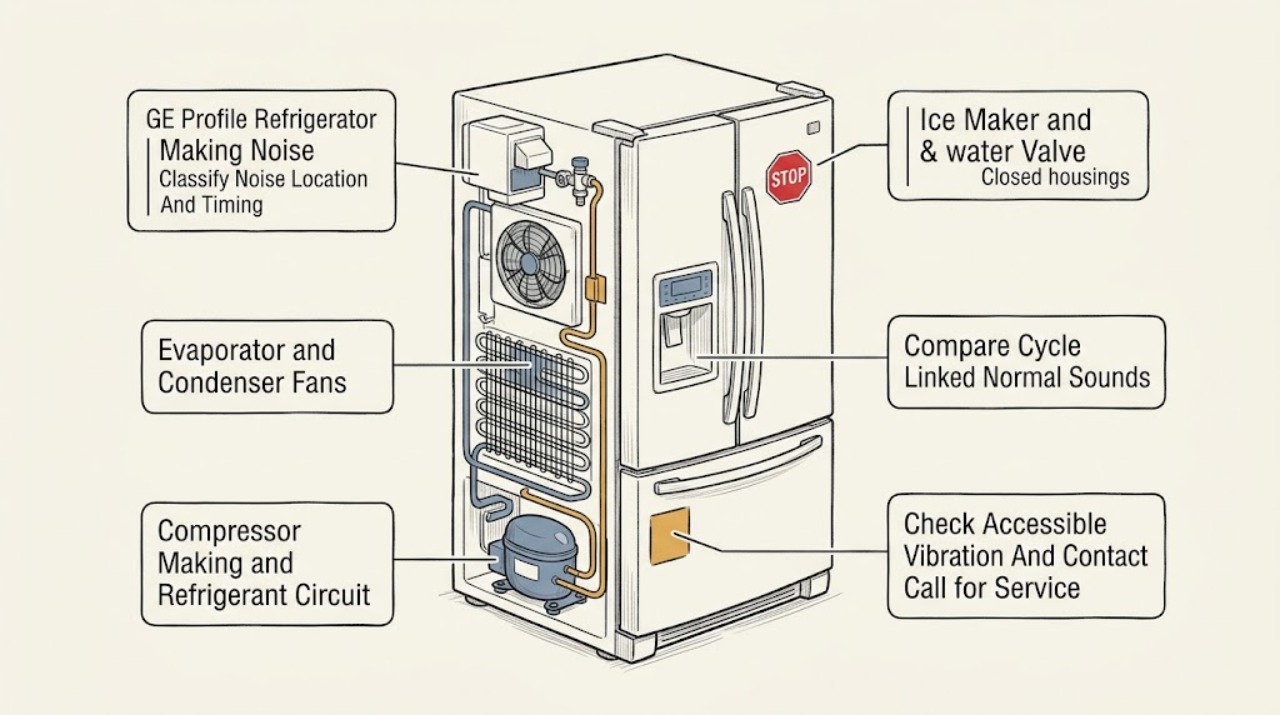
Work through in order
Diagnostic checks
Use only checks that match the exact appliance or system and its official guide.
-
Check 1
From a safe position, listen briefly and record the sound type, its location, its duration, and what event starts it: compressor or fan operation, door movement, water dispensing, ice making, or defrost. Record whether cooling, lights, and controls otherwise work normally, and identify the exact GE Profile model before using a model-specific control instruction.
Expected result: The sound is brief and tied to a known cycle, repeats at a regular interval, runs continuously, changes with a door or dispenser action, or sounds like scraping, grinding, or electrical arcing.
Next step: Continue with the branch matching the location and event. If the sound is accompanied by smoke, burning odor, sparking, a hot cord, water near electrical parts, repeated breaker trips, or loss of cooling, stop using the refrigerator and arrange service.
Stop if: Do not remove panels, use a probe or recording device inside the cabinet, or place hands near fans, the compressor, wiring, or refrigerant tubing.
Why this matters
Why: Cycle-linked hum, gurgle, click, whoosh, crack, water, or ice sounds fit GE's normal-sound explanations more closely. A new continuous, mechanical, or hazard-associated sound is less likely to be normal and needs a different branch.
-
Check 2
Compare the sound with the documented cycle that appears to trigger it: compressor or fan running, a door closing, a defrost period, a water dispense, or an ice harvest. Do not deliberately run an unfamiliar service or test mode; simply note what happens during ordinary use.
Expected result: A hum or pulsation follows compressor operation, airflow changes after door openings, a gurgle follows cooling or door closure, a click follows control or damper operation, a crack or pop follows defrost, or an ice/water sound occurs only during its function.
Next step: If the timing and sound remain normal and the refrigerator cools correctly, monitor it and keep the model manual available. If the sound does not match a cycle or has changed, continue to the external-contact and abnormal-noise checks.
Stop if: Do not remove the ice maker, open the sealed system, or use a live electrical measurement to distinguish a normal cycle from a fault.
Why this matters
Why: The timing matches GE's listed normal operating sources. The same sound becomes more concerning if it is newly much louder, persists outside its cycle, changes to scraping or grinding, or occurs with another symptom.
-
Check 3
Inspect only accessible external contact points and contents: confirm the refrigerator is not pressing against a wall or cabinet, make sure accessible shelves, bins, bottles, and the ice bucket are seated, and check that no loose item is touching the cabinet or tubing. Do not force a built-in unit out of its installation position.
Expected result: The sound changes or stops when an accessible item is reseated or an external contact is relieved, or the sound continues unchanged with no visible contact.
Next step: Secure or reposition only the accessible item and monitor one ordinary cooling cycle. If the noise persists, returns without the item, or is accompanied by cooling loss, arrange service rather than removing a cover.
Stop if: Do not level by dismantling the appliance, remove rear or bottom covers, reach through grilles, or touch moving parts while energized.
Why this matters
Why: A change caused by an accessible item or installation contact makes transmitted vibration more likely. An unchanged rattling, especially from underneath or a fan area, makes an internal fan, mounting, or other component more likely and cannot be confirmed by listening alone.
-
Check 4
If the sound is near the ice maker, filter, dispenser, or water connection, note whether it occurs during an ice fill, ice drop, water dispense, or at a regular interval. Verify from the model instructions whether the refrigerator has an ice maker or dispenser and whether the water supply is connected; if it is not connected, switch the ice maker off using the documented user control.
Expected result: The sound is brief during fill or dispense, ice drops into the bin, a buzz repeats about every 15 minutes with no water connection, a filter-related sound occurs on a compatible model, or the noise is persistent and mechanical.
Next step: Restore water only when the installation and exact model support it, or leave the ice maker off when it is not supplied. If the sound remains after the documented control change or the mechanism is jammed or leaking, arrange service.
Stop if: Do not dismantle the ice maker, reach into a moving auger or fan, bypass a water valve, or disconnect water tubing while pressurized.
Why this matters
Why: Brief fill, dispense, or harvest sounds are covered by GE's normal operation guidance. Repeated buzzing with no water supply points to an ice maker calling for water; persistent grinding, a jam, or leaking water is not explained by that normal pattern.
-
Check 5
If the sound is a scrape, grind, or repeated rattle from the freezer or lower rear, observe from outside whether it follows a fan cycle and whether airflow, cooling, frost, or temperature has changed. Do not reach through vents. Do not remove a cover; if the exact GE guidance for the model calls for any underside inspection, disconnecting power and access must be handled only within that documented boundary.
Expected result: The sound resembles a fan blade striking something, continues after the cycle changes, comes from underneath, or occurs with frost, weak cooling, or abnormal temperature.
Next step: Stop at external observation and arrange qualified appliance service for persistent scraping, grinding, fan-related noise, or any cooling change. Keep the appliance out of service if the sound is accompanied by smoke, burning odor, sparking, or a hot cord.
Stop if: Do not open the cabinet, remove a fan guard, touch a blade, clear an obstruction through a grille, or perform a live test near the fan, compressor, or wiring.
Why this matters
Why: GE identifies a fan-blade striking sound as abnormal and says some lower-rear rattling can involve an obstruction at a condenser fan. A cooling or frost change raises the chance of an internal airflow or refrigeration fault, but the sound does not identify the failed part.
-
Check 6
After the safe external checks, compare the noise with refrigerator performance: confirm whether both compartments still cool, whether an alarm or error is present, whether water is leaking, and whether the cord or cabinet is unusually hot. Record the model, sound location, timing, and any change in cooling for service.
Expected result: Cooling is normal and the sound is a documented brief cycle sound, or the noise is persistent or paired with poor cooling, a leak, alarm, heat, smoke, odor, sparking, or repeated breaker operation.
Next step: Arrange qualified GE Profile or appliance service for an unexplained persistent noise or any cooling symptom. Isolate power from a dry accessible disconnect and keep people away from the appliance for smoke, sparking, a hot or damaged cord, repeated trips, or water near electrical parts.
Stop if: Do not keep resetting a breaker, operate through a burning smell or sparking, remove panels, live-test wiring, or handle refrigerant or sealed-system components.
Why this matters
Why: Normal cooling and cycle-linked timing support monitoring. A persistent noise with a performance or safety symptom needs professional diagnosis; it may involve a fan, compressor, water system, control, wiring, or sealed system, and no single part can be selected from the sound alone.
-
Check 7
If the noise remains after accessible contents and contact points are ruled out, provide service with the complete model and serial information, a recording made from outside the cabinet if safe, the location and timing, and whether cooling, ice, water, lights, and controls are affected.
Expected result: The sound is unresolved, recurs on every cooling cycle, follows a fan or compressor, or is accompanied by a cooling, water, or electrical symptom.
Next step: Keep the refrigerator in service only when it is cooling normally and no safety sign is present; otherwise stop using it. Arrange qualified service and supply the recorded symptom history instead of opening the appliance.
Stop if: Do not remove the cabinet, disassemble the ice maker, touch the compressor or fan, bypass a control, perform live electrical tests, or open the refrigerant circuit.
Why this matters
Why: A persistent unresolved sound may require inspection of internal fans, mounts, compressor operation, the ice-maker or water valve, controls, or the sealed system. These are professional diagnostic boundaries, not proof that a particular part has failed.
Use your observations
Decision map
Find the observation that best matches what you see, then follow the next safe action.
-
PATH 01Safety boundary
What you see
The sound is brief and repeatable with compressor or fan operation, defrost, door movement, water dispense, or ice harvest, while cooling and safety conditions remain normal.
Do this next
Monitor the sound, keep contents and external clearances stable, and use the exact model manual if the control or cycle needs identification. Escalate if it becomes persistent, much louder, or changes to scraping, grinding, or an electrical warning.
Why this path and its safety boundary
Why it matters: This pattern is consistent with GE's documented normal compressor, fan, refrigerant, damper, defrost, ice-maker, or water-valve sounds rather than an immediate component failure.
Safety stop: Do not open the appliance merely to locate a normal operating sound.
-
PATH 02Safety boundary
What you see
A rattle or vibration changes when an accessible bottle, shelf, bin, ice bucket, tubing loop, wall, cabinet, or other external contact is repositioned.
Do this next
Reseat or move only the accessible item and observe one normal cycle. Arrange service if the noise returns without the contact, remains loud, or is accompanied by cooling loss or cabinet movement.
Why this path and its safety boundary
Why it matters: Transmitted vibration or an unsecured accessible item is more likely than a confirmed internal failure, although a recurring cycle-related source can still be present.
Safety stop: Do not force a built-in refrigerator out, remove covers, or adjust internal mounts without model-specific professional service.
-
PATH 03Safety boundary
What you see
A short buzz or rattle occurs near the ice maker or water valve at regular intervals, especially when the ice maker is on but water is not connected.
Do this next
Confirm the exact model's water and ice-maker arrangement. Turn the ice maker off with the documented user control when water is not connected, or correct the water supply only if the installation supports it. Service is needed for persistent mechanical noise, a jam, or a leak.
Why this path and its safety boundary
Why it matters: GE identifies an ice maker calling for water as a likely cause; the exact interval and filter behavior vary by model, so the sound alone does not establish a failed valve.
Safety stop: Do not dismantle the ice maker or handle water tubing and valves while connected or pressurized.
-
PATH 04Safety boundary
What you see
The noise comes from the freezer or lower rear and resembles a blade striking something, scraping, grinding, or a new persistent mechanical rattle.
Do this next
Stop at an outside observation and arrange qualified service, particularly if the sound continues, airflow or cooling changes, or frost appears. Do not use the noise to select a fan or motor part without diagnosis.
Why this path and its safety boundary
Why it matters: GE treats a freezer fan-blade striking sound as abnormal and notes that some lower-rear sounds can involve a condenser fan obstruction. The precise component and safe access depend on the model.
Safety stop: Do not remove a guard or cover, reach through a grille, touch a moving blade, or perform energized inspection.
-
PATH 05Safety boundary
What you see
The refrigerator makes an unexplained persistent noise and also has poor cooling, a leak, alarm, smoke, burning odor, sparking, a hot or damaged cord, or repeated breaker operation.
Do this next
Stop using the refrigerator and arrange qualified appliance or electrical service. From a dry safe position, isolate power if practical; provide the model and symptom history and do not restart it to reproduce the noise.
Why this path and its safety boundary
Why it matters: The combined pattern is not a normal-sound decision. It may involve an internal electrical, airflow, control, water, compressor, or sealed-system fault, and continued operation can increase risk or food loss.
Safety stop: Do not reset a repeatedly opening breaker, operate through smoke or odor, open panels, perform live tests, or handle refrigerant or sealed-system parts.
Helpful context
Understand the symptom
Classify the sound before opening anything
Record whether the noise is a hum, whoosh, gurgle, click, crack, buzz, rattle, scrape, or grind. Note its location—freezer, fresh-food compartment, door, dispenser area, underneath, or at the side—and whether it starts with a door opening, water dispensing, ice production, defrosting, or compressor cycling. GE Profile models differ in layout and controls, so use the complete model information for any model-specific instruction. A short sound tied to a known cycle is interpreted differently from a new sound that runs continuously or has changed character.
Know which sounds can be normal
GE describes high-efficiency compressor hum or pulsation, fans changing speed after door openings or a large food load, refrigerant boiling or gurgling, water dripping during defrost, clicks from a control or damper, and cracking or popping as coils cool after defrost. Ice cubes dropping, a brief water-valve buzz during an ice-maker fill, and a brief dispenser sound can also be expected on equipped models. These explanations do not make every sound harmless: timing, duration, location, cooling performance, and any accompanying hazard matter.
Check external vibration and accessible contents
From outside the appliance, make sure the cabinet, handles, water tubing, and rear or side surfaces are not pressed against a wall, cabinet, or nearby object. Check that bottles, shelves, bins, and the ice bucket are seated and not touching in a way that amplifies vibration. Do not force the refrigerator out or remove a rear cover just to chase a sound. If the noise changes when an accessible object is repositioned but returns with the compressor or fan cycle, document that relationship rather than assuming the object is the only cause.
Separate ice-maker and water-valve buzzing
A brief buzz or hum during an ice-maker fill or water dispense can be normal. GE says an ice maker that is switched on without a connected water supply may buzz about every 15 minutes; on some models with an XWF or XWFE filter, a short valve-related sound can occur less often. Confirm that water is actually connected and turned on only if the installation and model support it. If water is not connected, use the model's documented ice-maker off control. Persistent grinding, a jammed mechanism, leaking water, or a sound that does not follow the ice or water cycle needs service.
Treat scraping, grinding, and cooling changes as escalation clues
GE specifically says a freezer sound like a fan blade hitting something is not normal. A lower-rear sound that resembles an object striking fan blades can also indicate an obstruction on models where the condenser fan is accessible, but the owner guidance requires unplugging before any underneath inspection and model-specific access varies. For a GE Profile refrigerator, stop at an outside observation: do not reach through a grille, remove a cover, bend a blade, or work near the compressor. If the sound persists, cooling changes, frost or water appears, or the noise follows a fan cycle, arrange qualified service.
Use cooling and safety symptoms to set the boundary
A noise by itself does not identify a failed fan, compressor, water valve, control, or sealed-system component. Stop using the refrigerator and seek prompt appliance or electrical help for smoke, a burning smell, a hot or damaged cord, sparking, repeated breaker trips, a water leak near electrical parts, or a cabinet that is unusually hot. Arrange appliance service for a persistent abnormal noise, a fan-blade scraping sound, loss of cooling, a recurring alarm, or a noise that began after a repair or move. Do not open the cabinet, perform a live test, touch a fan or compressor, or handle refrigerant.
Only after diagnosis
Potential parts
- evaporator or condenser fan assembly
Consider this category only when qualified diagnosis confirms a persistent fan-related scrape, grind, or airflow problem after accessible external causes are ruled out.
Fan location and assembly vary by GE Profile model; verify the complete model and service diagnosis before selecting a component. - ice-maker or water-valve assembly
Consider this category only when the noise follows a confirmed ice-maker or water-valve fault, such as persistent buzzing with a correct water supply, a failed fill, or a diagnosed leak.
Only models equipped with the relevant ice maker, filter, or dispenser use these parts; confirm model-specific fit and configuration. - compressor mounting or sealed-system component
Consider this category only after professional diagnosis of a persistent compressor-area vibration or a confirmed sealed-system performance fault.
Compressor and sealed-system work is not user repair; the noise pattern alone cannot establish compatibility or failure. - roller, leveling, or vibration-isolation hardware
Consider this category only if service confirms that an installation, roller, mount, or isolator is causing vibration after external contact and accessible-load checks.
Built-in and freestanding GE Profile designs use different support hardware; verify the complete model and installation configuration.
When checks do not resolve it
Need a professional?
Arrange qualified GE Profile or appliance service for a persistent or newly changed noise, a freezer fan-blade sound, lower-rear mechanical rattling, a noise with poor cooling or frost, a recurring ice-maker or water-valve noise after the documented user control is corrected, or any diagnosis that would require a cover or internal access. Stop using the refrigerator immediately for smoke, burning odor, sparking, a hot or damaged cord, repeated breaker trips, water near electrical parts, or an unusually hot cabinet. Do not open panels, perform live tests, touch moving parts, or handle refrigerant.
Safety scope: The user may identify the model, listen from outside, check accessible contents and external contact points, and use a documented ice-maker control when water is not connected. Cabinet removal, fan or compressor access, live electrical tests, wiring work, water-valve disconnection, refrigerant handling, and sealed-system work belong to qualified service.
Common questions
FAQ
Why is my GE Profile refrigerator humming or buzzing?
A hum or buzz can be normal when it follows compressor operation, a fan cycle, ice-maker fill, or water dispensing. If it repeats with the ice maker on but no water connected, use the exact model's documented ice-maker off control. A new continuous buzz, scraping sound, poor cooling, leak, odor, or heat needs service.
Is a gurgling or popping sound from a GE Profile refrigerator normal?
GE describes refrigerant gurgling, drain water, and cracking or popping during or after defrost as possible normal sounds. Treat the sound as an issue if it is newly persistent, much louder, accompanied by frost or poor cooling, or combined with a leak or electrical warning.
What if my GE Profile refrigerator sounds like a fan is hitting something?
GE says a freezer sound like a fan blade hitting something is not normal. Do not reach through a grille or remove a cover; record the location and arrange qualified service, especially if airflow, frost, or cooling has changed.
Why does my GE Profile refrigerator rattle when the ice maker is on?
If water is not connected, GE says an enabled ice maker may buzz or rattle while calling for water. Turn the ice maker off with the model's documented control until water is connected. Persistent grinding, a jammed ice mechanism, or a leak is a service condition.
Can I remove the back cover to find the noise?
Do not open the cabinet or reach toward a fan or compressor to locate a sound. GE's unusual-noise guidance makes access model-dependent and includes an unplug-before-checking warning; the safer path for a persistent or mechanical sound is qualified service with the exact model and symptom history.
Read the exact guide
Official sources
- Refrigerator - Buzzing NoiseGE Appliances · GE refrigerators with an automatic ice maker or internal/external water dispenser
- Refrigerator - Normal Sounds and Noises MadeGE Appliances · GE refrigerators; exact sound sources and controls vary by model
- Refrigerator - Unusual NoisesGE Appliances · GE refrigerators; access instructions depend on the model and condenser design
- Refrigerator - Intermittent Buzzing or Vibrating NoiseGE Appliances · GE refrigerators with the relevant ice-maker, water supply, or XWF filter configuration
- GE Refrigerator Owner's Manual 49-60412GE Appliances · Official GE refrigerator manual example; use for general mechanisms only and defer controls, access, and fit to the exact GE Profile model
- Troubleshooting for PTC22MFMLBBGE Appliances · GE Profile CustomStyle PTC22MFMLBB top-freezer refrigerator; used to establish model-specific GE Profile support, not as a universal instruction for every configuration
Community feedback
Share a repair observation
Share a plain-text repair observation. Accepted observations are published automatically; this page may take a moment to update.