
On this page
Start here
Quick answer
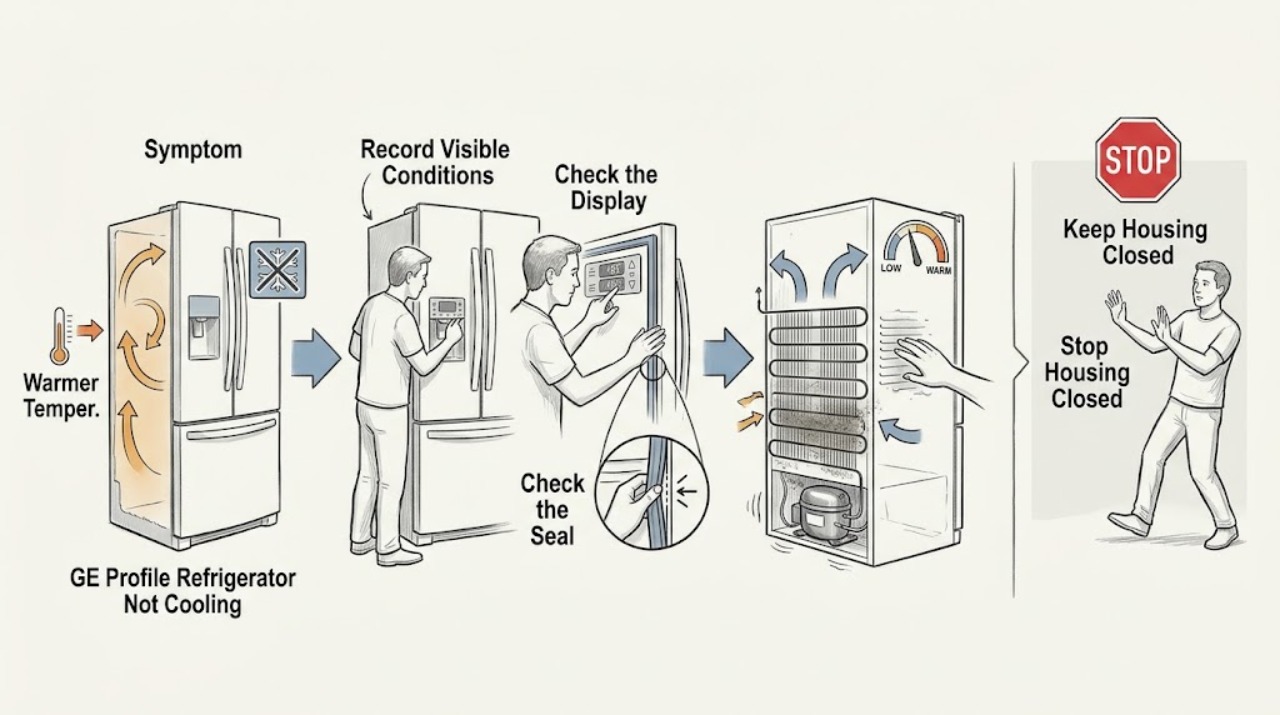
If a GE Profile refrigerator is not cooling, first distinguish a newly installed or heavily loaded cabinet from one that is warm despite correct settings. Record the exact model, displayed temperatures, whether the freezer is also warm, whether the compressor or fans run, and whether the doors and gaskets seal. GE's official troubleshooting guidance covers model-specific temperature controls, allowing a newly installed unit time to stabilize, door closure, large containers blocking airflow, installation clearance, condenser cleaning only when the Owner's Manual calls for it, and an interior light that stays on. A refrigerator can also run for much of the time during normal operation, so long run time alone does not prove failure. Do not remove sealed-system or electrical covers, use direct heat to clear frost, make live measurements, or handle refrigerant. Stop using the appliance and arrange qualified service for smoke, burning odor, a hot or damaged cord, water near electrical parts, repeated breaker trips, exposed damage, or persistent warming after the model-specific external checks.
Before you begin
Safety first
- Do not remove covers, make live measurements, handle refrigerant or sealed tubing, force fans, apply direct heat or sharp tools to frost, bypass door sensors, or order internal parts without model-confirmed diagnosis. Isolate power only when safe for a hazard condition.
Work through in order
Diagnostic checks
Use only checks that match the exact appliance or system and its official guide.
-
Check 1
Record the complete GE Profile model number, installation type, displayed temperatures, and whether the fresh-food section, freezer, or both are warm. Note whether the unit was newly installed, recently restarted, heavily loaded, or exposed to frequent door openings.
Expected result: Only one compartment is warm, both compartments are warm, the unit is newly installed or recently loaded, or the model cannot be read safely.
Next step: Retrieve the exact model's Owner's Manual and use the matching checks below. If the label requires moving or opening the appliance, leave it in place and provide the missing identification to service.
Stop if: Do not remove panels or move a built-in refrigerator to find the model label.
Why this matters
Why: The temperature pattern separates an airflow or compartment-specific issue from a whole-unit cooling problem, while installation and load can explain a temporary warm condition. The model determines the correct control and clearance instructions.
-
Check 2
Check the temperature control state and adjust it only through the exact model's normal user controls. If the refrigerator was newly installed or has just been loaded with warm food, allow the model-specific stabilization period before judging the result.
Expected result: A control was set warmer than intended, the unit is still within the documented stabilization period, or settings are correct and the cabinet remains warm afterward.
Next step: Use the model manual's documented setting and wait for the stated stabilization period. If the temperature does not recover, continue with door, airflow, clearance, and light checks and prepare for service.
Stop if: Do not enter diagnostic/service mode, repeatedly change settings, or use a guessed setting from another refrigerator model.
Why this matters
Why: A control setting or temporary stabilization period can explain the symptom. Correct settings after stabilization make door sealing, airflow, condenser/clearance, or an internal cooling diagnosis more relevant, but do not identify a part.
-
Check 3
Inspect the door opening from outside for a package, tray, ice, or other item preventing closure. Look at the visible gasket for a gap, damage, or dirt and confirm the doors close normally without force. Do not remove the gasket unless the exact manual identifies it as user-removable.
Expected result: An item blocks closure, the gasket does not seal evenly, the door is misaligned, or the doors and gaskets appear to close normally.
Next step: Remove only an accessible obstruction and clean or adjust the gasket as the model manual permits, then observe temperature recovery. For a damaged/misaligned door or a persistent warm cabinet, arrange service.
Stop if: Do not force a door, remove hinges, bend a gasket, or continue using an appliance whose door cannot seal.
Why this matters
Why: GE identifies blocked closure and poor gasket sealing as causes of cold-air loss. A normal external seal shifts attention to airflow, installation, temperature, or internal cooling diagnosis rather than just the door.
-
Check 4
Look for large containers blocking a visible internal air outlet and check the visible installation clearance around the cabinet. If the exact Owner's Manual says the model has user-cleanable condenser coils, disconnect power and clean only as directed; otherwise do not remove panels or assume coils need cleaning.
Expected result: An internal air outlet is blocked, clearance is less than the model requires, user-cleanable coils are visibly dirty, or no safe external obstruction is found.
Next step: Move only an accessible container, restore model-required clearance without shifting a built-in unit, or clean accessible coils only per the manual. Allow cooling time; if the cabinet remains warm, call service.
Stop if: Do not drag a built-in refrigerator, remove a rear cover, spray liquid into the cabinet, or clean a condenser whose model instructions do not authorize user access.
Why this matters
Why: GE lists blocked airflow, insufficient model-specific clearance, and dirty condenser coils on applicable models as possible cooling factors. A clear airflow path and correct clearance make professional diagnosis more likely if the temperature remains abnormal.
-
Check 5
Close the refrigerator door slowly while observing from outside whether the interior light goes out, and note whether the compressor or fans appear to run normally without touching them. Do not remove a light housing or fan guard.
Expected result: The interior light stays on with the door nearly closed, run behavior is absent or unusually loud, or the light and apparent run behavior are normal.
Next step: If the light clearly stays on, correct only a model-documented door alignment or user adjustment and recheck. If run behavior is absent/abnormal or cooling remains poor, stop troubleshooting at the exterior and arrange service.
Stop if: Do not touch a fan, bypass a door switch, remove a light cover, or make live voltage/current measurements.
Why this matters
Why: GE says a light that remains on can add heat, while compressor run time alone can be normal. An absent or abnormal run state combined with warming needs model-specific service diagnosis; visual observation cannot identify a motor, switch, or control part.
-
Check 6
Arrange qualified service when temperature remains abnormal after the exact model's settings, stabilization, door, airflow, clearance, and permitted maintenance checks. Escalate immediately for smoke, burning or chemical odor, a hot or damaged cord, water near electrical parts, repeated breaker trips, exposed damage, or a sealed-system symptom.
Expected result: Temperature recovers after a documented external correction with no hazard, or the refrigerator remains warm or has a safety symptom.
Next step: Monitor a normal cycle after recovery. Otherwise keep the refrigerator out of service as appropriate, isolate power only if safe for a hazard, and contact GE/GE Profile or qualified appliance service with the model and observations.
Stop if: Do not restore power to test a hazardous unit, remove covers, handle refrigerant, force a fan, or order an internal part from the symptom alone.
Why this matters
Why: A successful external correction supports monitoring. Persistent warming can involve fans, sensors, controls, compressor, defrost, or sealed refrigeration; the symptom cannot select a compatible part across GE Profile models.
Use your observations
Decision map
Find the observation that best matches what you see, then follow the next safe action.
-
PATH 01Safety boundary
What you see
The refrigerator is newly installed, recently restarted, or has just received a large warm load, and there is no hazard symptom.
Do this next
Use the exact model's settings and allow its documented stabilization period, then recheck both compartments. Escalate if it remains warm afterward.
Why this path and its safety boundary
Why it matters: The cabinet may need the model's stabilization period; GE identifies installation time and loading as factors affecting temperature and run time.
Safety stop: Do not repeatedly reset controls or open panels to accelerate cooling.
-
PATH 02Safety boundary
What you see
A package blocks closure, a gasket has a visible gap/damage, a large container blocks an air outlet, or the installation clearance is not the model's required clearance.
Do this next
Correct only the accessible, model-documented condition and allow temperature recovery. Arrange service for a damaged/misaligned door, built-in clearance problem, or persistent warming.
Why this path and its safety boundary
Why it matters: Cold-air loss or restricted airflow is more likely than an immediate sealed-system conclusion.
Safety stop: Do not force the door, shift a built-in unit, or remove panels to reach an air path.
-
PATH 03Safety boundary
What you see
The interior light stays on when the door is nearly closed, or the compressor runs frequently while temperatures remain within the model's normal range and no hazard is present.
Do this next
Correct only the model-documented door/light condition and monitor temperature. If the light cannot be corrected or temperature rises, call service.
Why this path and its safety boundary
Why it matters: A light/door issue can add heat, while frequent or long compressor operation can be normal under GE's documented conditions. Run time without a temperature change is not enough to diagnose a compressor.
Safety stop: Do not bypass the door switch or remove the light housing.
-
PATH 04Safety boundary
What you see
Both compartments remain warm after correct settings and stabilization, with no accessible door, airflow, clearance, light, or permitted condenser explanation.
Do this next
Keep doors closed as practical to protect food, record temperatures and run behavior, and arrange qualified GE Profile appliance service. Do not dismantle or force-defrost the refrigerator.
Why this path and its safety boundary
Why it matters: An internal fan, sensor, control, compressor, defrost, or sealed-system diagnosis is more relevant, but the observation cannot safely identify a part or refrigerant condition.
Safety stop: Do not remove covers, probe wiring, handle refrigerant, apply direct heat, or make live measurements.
-
PATH 05Safety boundary
What you see
Smoke, burning or chemical odor, hot/damaged cord, water near electrical parts, repeated breaker trips, exposed damage, or another immediate electrical/refrigeration hazard is present.
Do this next
Keep clear, isolate power only if safe, protect food only without touching damaged or wet parts, and contact GE/GE Profile or qualified appliance/electrical service.
Why this path and its safety boundary
Why it matters: This is a stop-use condition rather than a temperature-adjustment problem; internal electrical or sealed-system work requires qualified service.
Safety stop: Do not restore power to test, touch wet controls, remove covers, or continue operating the refrigerator.
Helpful context
Understand the symptom
Start with the temperature pattern
Write down the displayed or measured temperature in the fresh-food section and freezer, and note whether either section is still cold. Also record whether the refrigerator is newly installed, was recently loaded with warm food, or has had frequent door openings. GE's guidance treats a newly installed refrigerator, a heavily loaded cabinet, and a correctly running but warm appliance as different starting conditions. A model number is essential because Profile refrigerators use different control layouts and installation clearances.
Check airflow and sealing before assuming a sealed-system failure
A large container against a rear air outlet, a package preventing the door from closing, a damaged gasket, or a light that stays on can make the cabinet warm even though the refrigerator is powered. GE also notes that clearance requirements vary by style and model, and that condenser cleaning is appropriate only on models whose Owner's Manual identifies accessible coils for cleaning. These are external, model-bounded checks; they do not prove a compressor, fan, sensor, control, or refrigerant fault.
Do not confuse long run time with no cooling
GE says modern refrigerator compressors may run for most of the time to maintain temperature. Long operation can follow hot weather, a large warm load, frequent door openings, blocked vents, or a poor gasket seal. The decision changes when the cabinet temperature is rising, the freezer is also warm, frost is abnormal, or an error or electrical symptom appears. If the unit remains warm after the model's external checks and stabilization period, service is more appropriate than replacing a guessed part.
Keep electrical and refrigeration work with a technician
Stop using the refrigerator and isolate power only when safe if there is smoke, a burning or chemical odor, a hot or damaged cord, water near electrical controls, repeated breaker trips, or exposed damage. Do not remove panels, probe live wiring, handle refrigerant, cut tubing, use direct heat or sharp tools on frost, or bypass a fan, switch, or door sensor. For ordinary cleaning, disconnect power first and follow only the exact Owner's Manual; internal cooling, electrical, and sealed-system diagnosis belongs to qualified service.
When checks do not resolve it
Need a professional?
Contact GE/GE Profile or qualified appliance service when the refrigerator remains warm after model-specific external checks and stabilization, when both compartments lose cooling, or when a fan, control, compressor, defrost, or sealed-system diagnosis would be required. Stop immediately for smoke, burning or chemical odor, a hot/damaged cord, water near electrical parts, repeated breaker trips, or exposed damage.
Safety scope: Do not remove covers, make live measurements, handle refrigerant or sealed tubing, force fans, apply direct heat or sharp tools to frost, bypass door sensors, or order internal parts without model-confirmed diagnosis. Isolate power only when safe for a hazard condition.
Have this ready
- Complete model number, installation type, fresh-food and freezer temperatures, installation/restart and loading timing, control settings, door/gasket and airflow observations, clearance and model-approved condenser maintenance findings, light/run behavior, error indications, and all safety symptoms.
Common questions
FAQ
How long should a new GE Profile refrigerator take to cool?
GE's troubleshooting guidance says a newly installed refrigerator needs about 24 hours to cool down and stabilize. Use the exact Profile model's control and installation instructions; if it remains warm after that period with correct settings, service may be needed.
Is it normal for a GE Profile refrigerator to run most of the time?
Often, yes. GE says refrigerator compressors are designed to run much of the time. Hot weather, a large warm load, frequent door openings, blocked vents, poor gaskets, condenser condition, or a light that stays on can increase run time. Judge the condition by temperature and symptoms, not run time alone.
Why is my GE Profile refrigerator warm but the freezer still cold?
Start with the fresh-food temperature setting, large containers blocking an air outlet, door closure/gasket sealing, and the interior light staying on. If those external checks are normal and the fresh-food section remains warm, use the exact model manual and arrange service rather than removing an air duct or panel.
Can I clean the condenser coils on a GE Profile refrigerator?
Only if the exact Owner's Manual identifies accessible, user-cleanable coils and gives a procedure. GE notes that many newer models do not require coil cleaning, while some compact or smaller models may. Disconnect power before any model-approved maintenance and do not remove a cover to reach a condenser.
Read the exact guide
Official sources
- Refrigerator - Not Cooling EnoughGE Appliances (GE Profile support) · GE refrigerators; temperature controls, clearances, and maintenance access vary by model.
- Refrigerator and Freezer Troubleshooting and SupportGE Appliances (GE Profile support) · GE appliance owners, including GE Profile refrigerators; model identification is required for exact instructions.
- Troubleshooting for PYE22KELDSGE Appliances (GE Profile) · Exact PYE22KELDS GE Profile counter-depth French-door refrigerator; use the appliance's own model support for other Profile models and formats.
- Refrigerator or Freezer - Normal Run TimeGE Appliances (GE Profile support) · GE refrigerators and freezers; actual behavior varies with model and conditions.
Community feedback
Share a repair observation
Share a plain-text repair observation. Accepted observations are published automatically; this page may take a moment to update.