
On this page
Start here
Quick answer
A GE dishwasher can normally hum, swish, whine, click, snap, or pause as its pumps, spray system, drain valve, detergent cup, and controls operate. First note when the noise occurs and whether the racks are loaded; a rattle or rhythmic knock that disappears on an empty run usually points to dishes, utensils, or a spray arm striking the load. A grinding or squealing pump sound on a new dishwasher or one unused for a long time can be related to an initially dry pump, while grinding that persists with water present or an empty tub needs service. Pipe banging points to household water hammer, not necessarily the dishwasher. Stop for smoke, burning or electrical odor, sparks, a hot cord or outlet, leaking water near electrical parts, or repeated breaker trips; do not open panels or perform live tests.
Before you begin
Safety first
- Do not open panels, remove a pump or drain assembly, bypass the door latch, probe wiring, perform energized measurements, or repeatedly reset a breaker. Stop using the dishwasher for smoke, burning or electrical odor, sparks, abnormal heat, a hot or damaged cord or outlet, water near electrical parts, a leak into an electrical area, or repeated breaker trips. De-energize only from a dry, safe position if that can be done without touching the hazard.
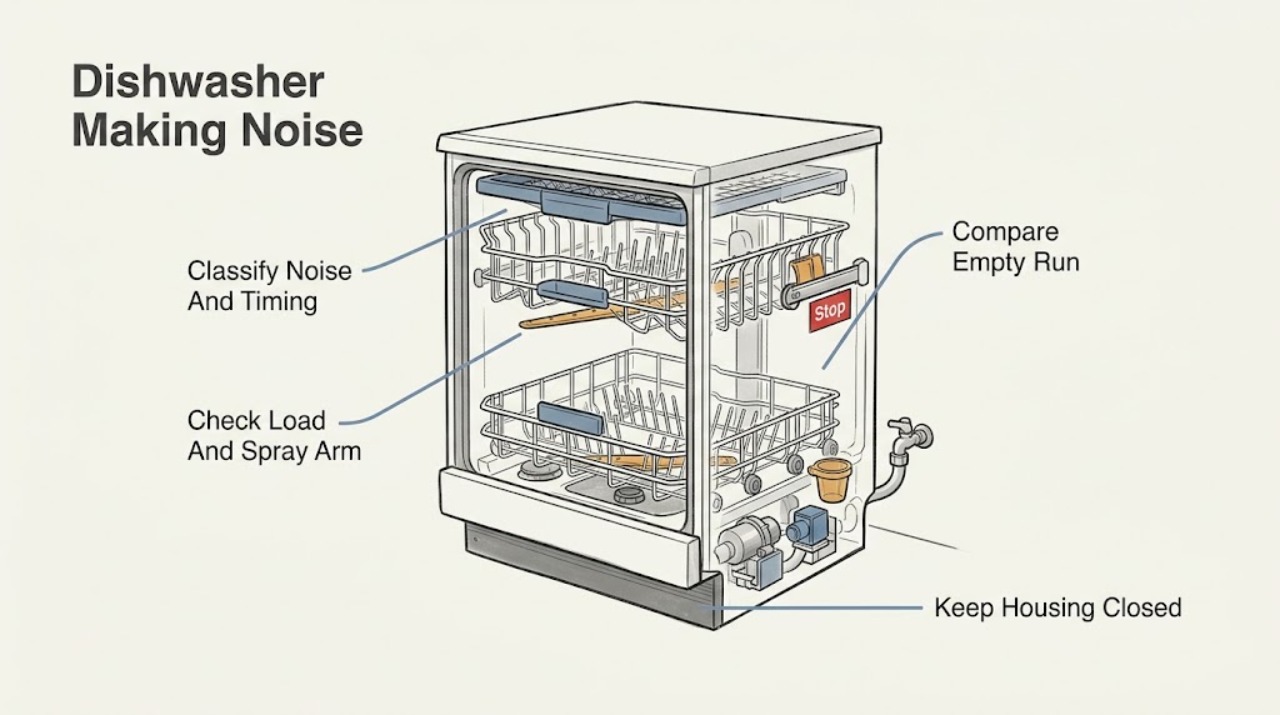
Work through in order
Diagnostic checks
Use only checks that match the exact appliance or system and its official guide.
-
Check 1
From a dry position outside the dishwasher, identify the sound as hum, swish, whine, click, snap, rattle, rhythmic knock, grinding, squeal, or pipe bang. Record whether it starts during fill, wash, drain, a control transition, door opening, or drying, and whether the machine completes the cycle.
Expected result: The sound follows spraying or water movement; appears several times during drain transitions; occurs at the control panel; is tied to door opening; is a rhythmic impact; persists as a harsh motor or pump noise; or comes from the house plumbing.
Next step: Continue with the branch matching the observed timing. Stop without further testing if any smoke, burning or electrical odor, spark, abnormal heat, water near electrical parts, hot power connection, or repeated breaker trip is present.
Why this matters
Why: Timing narrows the mechanism: water and wash-pump sounds can be normal, drain or control transitions can create clicks or snaps, a rhythmic impact suggests the load or spray arm, and a pipe bang points toward water hammer. A persistent harsh noise with cycle failure needs service rather than a guessed part.
-
Check 2
When the dishwasher is stopped and safe to open, inspect only the visible racks, utensils, lightweight plastic items, and spray-arm clearance. Reposition a visibly loose item so it cannot touch another item or the arm; do not force the arm, remove a pump cover, or reach into a moving machine.
Expected result: The noise is a loose-item rattle or rhythmic knock during spraying, a lightweight item has shifted, the spray arm visibly contacts the load, or nothing in the load can account for the sound.
Next step: Run one normal cycle after correcting the visible loading issue if the dishwasher is otherwise safe. If the same noise remains with the tub empty, stop troubleshooting and arrange service because GE identifies pump debris or another service issue as possible.
Why this matters
Why: GE says water action can make dishes rattle or push lightweight plastic out of the rack, and a rhythmic knock commonly occurs when the spray arm hits dishware. If the sound has no visible load cause, do not assume the pump is defective yet; use an empty-run comparison only when the appliance has no safety warning.
-
Check 3
If there is no hazard and the door, power cord, and installation appear normal, compare the noise on a single normal cycle with the racks empty. Do not run the dishwasher empty merely to reproduce a grinding noise, and do not use a cycle that requires opening the door while operating.
Expected result: The sound disappears when empty, remains with the tub empty, or the cycle cannot be completed safely.
Next step: Use the exact Owner's Manual for loading guidance if the empty run is quiet. If noise persists empty, document its timing and arrange qualified service; do not remove the pump or filter housing beyond the model's explicit owner-cleaning instructions.
Stop if: Stop immediately for smoke, electrical or burning odor, sparks, water near electrical parts, abnormal heat, or a hot/damaged cord or outlet.
Why this matters
Why: Disappearing noise supports a loading or spray-arm contact problem. A rattle that remains empty is less likely to be dishes; GE says debris in the pump may then require repair. A cycle that cannot be completed or presents a hazard should not be tested further.
-
Check 4
If the sound is a squeal or pump rattle and the GE dishwasher is new or has been unused for an extended period, verify that the tub is otherwise dry and that there is no leak or electrical warning. Only if the exact model guidance permits this simple step, add the one quart of water GE specifies to the bottom of the tub before a normal cycle; do not pour water into the controls or use this step on a leaking appliance.
Expected result: The noise occurs only on initial use or after long non-use and becomes quiet after the documented water-lubrication step, or it remains loud during a normal water-filled cycle.
Next step: If the noise does not improve, stop adding water or repeating cycles and arrange service. Never open the pump, test it live, or use the one-quart step to mask a leak or abnormal electrical symptom.
Why this matters
Why: GE attributes this narrow new-or-unused symptom to a pump that initially lacks water and says the water lubricates its seals. Improvement supports that limited explanation; persistence with water present makes a pump, debris, installation, or another internal issue more likely and does not identify a universal replacement part.
-
Check 5
If the reported noise is a click, snap, or beep, note whether it occurs as the cycle changes, as the machine begins draining, when the detergent cup opens, or after the door was opened. Check that the door is fully closed; do not bypass or adjust the latch.
Expected result: A click occurs repeatedly during pump transitions, a snap occurs during a drain transition or detergent-cup movement, a beep occurs after the door was unlatched, or an unexplained beep/blinking pattern continues.
Next step: Close the door fully and consult the exact Owner's Manual for an unknown code or sound pattern. If beeping or blinking continues after the model-specific reset guidance, arrange service instead of repeatedly cycling power.
Why this matters
Why: GE says four to eight pump-transition clicks, a drain-solenoid snap on applicable models, and detergent-cup snaps can be normal. A beep about every 30 seconds or minute indicates an unlatched door, while other light or beep patterns vary by model and may need the exact manual or service.
-
Check 6
Listen from outside the cabinet to determine whether the bang or boom comes through the supply or drain pipes rather than from the dishwasher tub. Check only for an obvious external installation vibration or a loose visible item; do not disconnect water lines or open the toe-kick panel.
Expected result: The house pipes bang when the dishwasher fills or stops filling, the cabinet vibrates against surrounding surfaces, or the sound is clearly generated inside the tub or pump.
Next step: For pipe banging, arrange a qualified plumber or installer to assess the water-hammer or installation condition. For an internal persistent noise, arrange appliance service; do not adjust valves or test plumbing pressure yourself.
Why this matters
Why: GE identifies pipe rattling, banging, or booming as household water hammer, which is different from a dishwasher motor fault. Installation contact can transmit vibration, while an internally generated grinding or persistent empty-run rattle needs appliance service.
-
Check 7
Record the exact model, noise description, cycle stage, loaded-versus-empty result, whether water was present, any door or control indication, and whether the cycle completed. Provide this sequence to GE-authorized or otherwise qualified appliance service; do not order a pump, motor, valve, or control from the sound alone.
Expected result: The noise recurs with an empty tub, the cycle stops or fails to drain, the model's manual does not explain the sound, or the symptom is accompanied by a leak, electrical odor, heat, sparks, or breaker operation.
Next step: Stop use for a hazard or leaking condition and arrange qualified appliance or electrical service. For non-hazardous persistent noise, leave the appliance available for diagnosis and provide the recorded model and symptom sequence.
Stop if: Do not remove panels, defeat the latch, probe wiring, reach into pumps, perform live measurements, or repeatedly reset a tripping breaker.
Why this matters
Why: A recurring unexplained noise or a functional failure requires model-specific diagnosis. Safety symptoms can indicate an electrical, water, or mechanical hazard and are not suitable for user-level part testing.
Use your observations
Decision map
Find the observation that best matches what you see, then follow the next safe action.
-
PATH 01Next step
What you see
The sound is a hum, swish, wash-pump whine, brief click, drain pause, or model-dependent snap that follows the documented cycle stages and the dishwasher completes normally.
Do this next
Use the exact Owner's Manual for model-specific sound examples and continue monitoring. Arrange service if the sound becomes harsh, changes pattern, or is joined by poor washing, draining, leaking, or a safety symptom.
Why this path and its safety boundary
Why it matters: Normal water movement, pump changes, drain-solenoid action, detergent-cup action, and control transitions are more likely than a failed component.
-
PATH 02Next step
What you see
A rattle or rhythmic knock occurs during spraying and disappears after a visible dish, utensil, plastic item, or spray-arm clearance problem is corrected or when the dishwasher is run empty.
Do this next
Follow the GE loading guidance for the exact model. If the sound returns with a correctly loaded machine or persists empty, stop and arrange service rather than dismantling the pump.
Why this path and its safety boundary
Why it matters: Load movement or spray-arm contact is more likely than an internal motor fault.
-
PATH 03Next step
What you see
A new dishwasher or one unused for a long time squeals or rattles at initial operation, with no leak or electrical hazard, and the sound improves after GE's documented one-quart water step.
Do this next
If the noise persists once the dishwasher is water-filled, stop user testing and arrange qualified service. Do not use water to conceal a leak or open the pump.
Why this path and its safety boundary
Why it matters: An initially dry pump seal condition is plausible for this narrow situation; improvement does not establish a replacement part or explain persistent noise on later cycles.
-
PATH 04Next step
What you see
A bang, boom, or pipe rattle occurs at a fill or stop event and is heard through the household plumbing or cabinet rather than as an internal tub noise.
Do this next
Have a qualified plumber or installer assess the water-hammer or installation condition. Do not disconnect the supply, alter valves, or open the cabinet to test it.
Why this path and its safety boundary
Why it matters: Household water hammer or installation contact is more likely than a dishwasher wash-pump failure.
-
PATH 05Safety boundary
What you see
Grinding or squealing persists with water present or with an empty tub, the cycle fails, a noise has no safe visible explanation, or there is smoke, burning/electrical odor, sparking, abnormal heat, water near electrical parts, a hot cord/outlet, or a breaker trip.
Do this next
Stop using the dishwasher for a hazard and obtain qualified appliance or electrical service. For a non-hazardous persistent noise, arrange model-specific appliance service and provide the recorded timing and observations.
Why this path and its safety boundary
Why it matters: A pump, debris, motor, control, installation, water, or electrical fault may be involved, and the symptom is beyond safe user-level diagnosis. The sound does not identify a universal GE part.
Safety stop: Do not remove panels, bypass the door latch, probe wiring, perform live tests, reach into the pump, or repeatedly reset a tripping breaker.
Helpful context
Understand the symptom
Separate normal operating sounds from a fault
Noise alone is not enough to identify a failed part. GE describes a dishwasher's wash-pump hum or whine, spray-water swish, control clicks, drain pauses, and model-dependent snaps as normal operating sounds. The useful discriminator is the combination of sound, timing, water state, and whether anything is loose in the racks. Note the exact model before applying a feature-specific explanation because GE says sound and controls vary by model.
Use timing to locate the sound
From a dry position outside the machine, record whether the noise happens during filling, spraying and washing, draining, a control transition, door opening, or drying. A rhythmic knock during spraying is more consistent with the spray arm or load; a snap during a drain transition can be a solenoid; a rattle that remains with an empty tub is a different path from a dish rattle. Do not deliberately run an unsafe appliance to reproduce a hazardous sound.
Stop before internal or energized work
Do not remove the lower access panel, reach into a pump, bypass the door latch, probe wiring, or test a motor, valve, or heater while energized. If there is smoke, a burning or electrical odor, a spark, abnormal heat, a hot or damaged cord or outlet, water near electrical parts, or a repeated breaker trip, stop using the dishwasher from a dry, safe position and arrange qualified appliance or electrical service. If a safe shutoff is accessible without touching a hazard, leave the appliance de-energized until it is assessed.
When checks do not resolve it
Need a professional?
Call qualified appliance service for persistent grinding, squealing, or rattling with water present or with an empty tub; a noise accompanied by poor washing, failure to drain, leaking, or an unexplained control problem; or any internal diagnosis. Call a qualified plumber or installer for pipe banging or cabinet installation vibration. Stop immediately for smoke, burning or electrical odor, sparks, abnormal heat, a hot or damaged cord or outlet, water near electrical parts, or repeated breaker trips.
Safety scope: Do not open panels, remove a pump or drain assembly, bypass the door latch, probe wiring, perform energized measurements, or repeatedly reset a breaker. Stop using the dishwasher for smoke, burning or electrical odor, sparks, abnormal heat, a hot or damaged cord or outlet, water near electrical parts, a leak into an electrical area, or repeated breaker trips. De-energize only from a dry, safe position if that can be done without touching the hazard.
Have this ready
- Exact dishwasher model and serial information, the sound in plain language, when it occurs in the cycle, loaded-versus-empty result, whether the tub had water, door or control indications, whether the cycle completed, and any safe recording made from outside the appliance.
Common questions
FAQ
Is a humming or swishing GE dishwasher noise normal?
Often. GE describes wash-pump and cooling-fan humming, spray-water swishing, pump whining, cycle clicks, and pauses during draining as possible normal operating sounds. Use the exact model manual and watch for a changed pattern, poor performance, a leak, or a safety symptom.
Why does my GE dishwasher rattle during the wash cycle?
Water action can make dishes, utensils, or lightweight plastic items rattle, and a spray arm can knock against a load. Secure the visible load and confirm arm clearance with the machine stopped. If the noise remains with the dishwasher empty, GE says service may be needed and pump debris is one possibility.
Why is my new GE dishwasher squealing or rattling?
GE says a new dishwasher, or one unused for an extended period, may have no water in the pump and can squeal or rattle initially. Its guidance says one quart of water in the bottom of the tub lubricates the pump seals. Do not use that step if there is a leak or hazard, and arrange service if the sound persists once the dishwasher is water-filled.
What does a clicking or snapping noise mean?
GE says a control-panel click or four to eight pump-transition clicks per cycle can be normal. A drain solenoid can make a snap on applicable models, and the detergent cup can snap as it opens. If the sound is accompanied by a model-specific blinking light or repeated beep, use the exact Owner's Manual rather than assuming the noise is normal.
Why does the plumbing bang when the GE dishwasher runs?
GE identifies pipe rattling, banging, or booming as household water hammer. Because that sound can come from the home's plumbing rather than the dishwasher, have a qualified plumber or installer assess it. Do not disconnect the water line or open the dishwasher cabinet to investigate.
Read the exact guide
Official sources
- Dishwasher - Snapping NoiseGE Appliances · Only GE models equipped with the described detergent-cup or drain-solenoid mechanisms
- Dishwasher Squealing or Rattling Pump NoiseGE Appliances · GE dishwashers that are new or have been unused for an extended period; exact model instructions still control
- Dishwasher - Normal and Abnormal NoisesGE Appliances · GE dishwashers; exact sound and feature availability vary by model
- Dishwasher - Clicking NoiseGE Appliances · GE electronic and mechanical dishwasher models as applicable; exact model sound behavior can differ
- Dishwasher - Rattling NoiseGE Appliances · GE dishwashers; consult the exact Owner's Manual for loading and service details
- Dishwasher - Blinking Lights or Beeping SoundsGE Appliances · GE dishwashers with electronic controls; exact indicators and reset behavior vary by model
Community feedback
Share a repair observation
Share a plain-text repair observation. Accepted observations are published automatically; this page may take a moment to update.