
On this page
Start here
Quick answer
If ‘freezing’ means a GE dryer is installed or stored in freezing weather, do not run it there. GE says a dryer should not be exposed to temperatures below freezing and recommends a location above 50°F for satisfactory control-system operation; below 50°F, the thermostat may not operate correctly and drying times can increase. Move or allow the appliance and room to reach a suitable, dry indoor temperature before testing. If the controls or cycle still behave abnormally after the temperature is corrected, stop using the dryer and have GE service diagnose the exact model rather than changing parts by guesswork.
Before you begin
Safety first
- This article supports identifying cold exposure, restoring a dry suitable operating environment, observing normal user controls, and checking the visible lint and airflow path. It does not authorize cabinet removal, live testing, thermostat bypass, safety-device defeat, or internal part replacement.
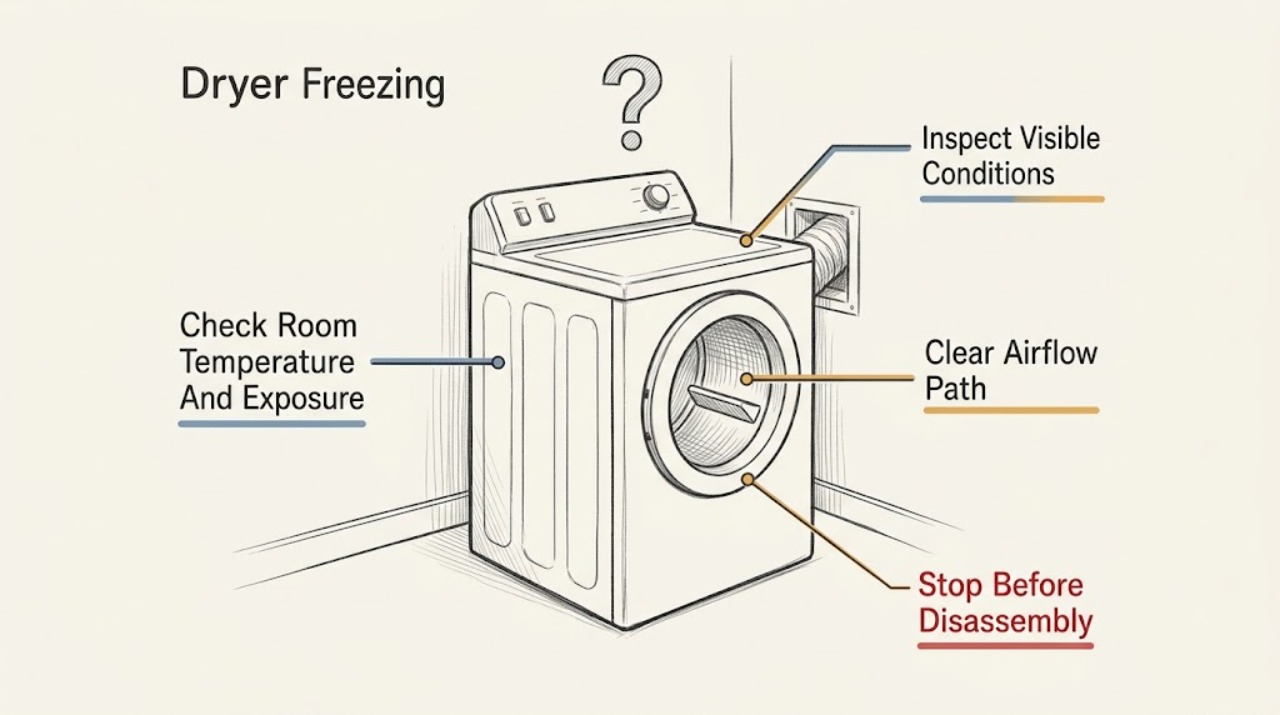
Work through in order
Diagnostic checks
Use only checks that match the exact appliance or system and its official guide.
-
Check 1
From a safe position, identify whether the GE dryer is in an indoor heated room or an exposed garage, shed, trailer, or other location, and measure or otherwise document whether the surrounding room is below freezing, below 50°F, or above the recommended range.
Expected result: The dryer or room has been below freezing, the room is below 50°F, the appliance is exposed to weather, or the room is above 50°F and dry.
Next step: Do not operate or store the dryer in below-freezing conditions. Move it only if safe to do so, or restore a dry room above 50°F before making a normal user test; then continue by recording the control and cycle behavior.
Stop if: Do not operate an appliance exposed to weather, ice, standing water, or a frozen supply or exhaust connection, and do not open the cabinet to look for ice.
Why this matters
Why: Below-freezing exposure can cause permanent damage, and GE says a room below 50°F may make the thermostat operate incorrectly or extend drying times. A suitable dry room makes low ambient temperature less likely as the main explanation.
-
Check 2
After the room and dryer have returned to a dry, suitable indoor temperature, make one ordinary user test using the exact model's normal controls and record whether the display responds, the cycle starts, the drum turns, and the dryer completes or extends the cycle.
Expected result: The controls and cycle return to normal; the display remains unresponsive; the cycle starts but takes unusually long; or the dryer still stops or behaves abnormally.
Next step: If normal, keep the dryer in the suitable environment. If abnormal, record the model, display behavior, cycle, room temperature, and timing, then consult the exact manual or arrange GE service.
Stop if: Do not repeatedly restart the dryer, change thermostat or control settings, or continue testing if there is smoke, a burning odor, a damaged cord, water near electrical parts, or a tripped breaker.
Why this matters
Why: Recovery after warming supports a cold-environment control or thermostat effect. A persistent symptom after temperature normalization is not proof of a frozen component and needs model-specific diagnosis.
-
Check 3
Only after the room is suitable and the dryer is cool, inspect the user-accessible lint filter and visible exhaust path for lint buildup, a crushed or unusually long duct, or an obstructed outlet; do not open the cabinet or alter the vent system.
Expected result: The filter or visible airflow path is restricted, or the path is clear while the dryer still cycles, stops, or produces an abnormal temperature or drying result.
Next step: Clean or restore only the user-accessible filter and visible path specified by the exact model manual, then monitor one normal cycle. If abnormal behavior persists, stop using the dryer and arrange qualified service.
Stop if: Do not bypass a safety thermostat, insert tools into the duct or cabinet, dismantle the exhaust system, or keep operating with overheating, smoke, or a blocked vent.
Why this matters
Why: GE says airflow restrictions can make temperatures rise and cause safety thermostats to cycle the heat source off. A clear visible path makes the original cold exposure or an internal temperature/control fault more important, but does not identify a part.
-
Check 4
Prepare a service record if the GE dryer remains unresponsive, extends cycles, stops, or shows abnormal temperature behavior after the room is dry and above the recommended temperature and the visible filter or airflow path is addressed.
Expected result: The problem occurs only in the cold location and disappears when warm; it occurs in every suitable location; or it is accompanied by smoke, burning odor, electrical damage, or repeated safety trips.
Next step: Keep the dryer out of use for persistent or unsafe symptoms and provide GE service with the model, room temperature, exposure history, behavior before and after warming, and visible observations.
Stop if: Do not open the cabinet, test live circuits, bridge a thermostat, defeat a safety device, or order a control, sensor, or heater based only on the word ‘freezing.’
Why this matters
Why: A symptom limited to the cold location supports an environmental cause. A symptom that remains in a suitable room requires model-specific control, thermostat, airflow, heating, or safety diagnosis; safety signs require immediate stop regardless of temperature.
Use your observations
Decision map
Find the observation that best matches what you see, then follow the next safe action.
-
PATH 01Safety boundary
What you see
The GE dryer was in a below-freezing or sub-50°F location, and the display, cycle, or drying behavior returns to normal after the room and appliance warm in a dry indoor environment.
Do this next
Keep the dryer in a dry location above 50°F and do not store or operate it where it is exposed to freezing weather.
Why this path and its safety boundary
Why it matters: Cold ambient conditions are the most supported explanation; GE specifically warns that temperature can affect the control system and thermostat operation.
Safety stop: Do not return the dryer to the freezing location or treat temporary recovery as permission to operate it in exposed weather.
-
PATH 02Safety boundary
What you see
The GE dryer was cold, but the controls or cycle remain abnormal after the room is dry and above the recommended temperature.
Do this next
Stop using the dryer and arrange GE service with the model, temperature history, exact behavior, and any displayed message. Do not replace a part by guesswork.
Why this path and its safety boundary
Why it matters: Cold exposure may have contributed, but it no longer explains the whole symptom; an internal control, thermostat, airflow, heating, or safety fault cannot be separated safely from this information.
Safety stop: Do not open the cabinet, bypass a thermostat or safety device, or run repeated cycles to force a result.
-
PATH 03Safety boundary
What you see
The GE dryer is in a suitable room, but the visible lint filter or exhaust path is restricted and the dryer cycles, stops, or takes unusually long.
Do this next
Clean or restore the user-accessible airflow path under the exact manual and arrange service if the restriction is inaccessible or the symptom persists.
Why this path and its safety boundary
Why it matters: GE says airflow restrictions can raise dryer temperatures and cause safety thermostats to cycle the heat source, which is separate from freezing ambient conditions.
Safety stop: Do not bypass a safety thermostat, modify the duct, or continue operating with overheating, smoke, or a blocked vent.
-
PATH 04Safety boundary
What you see
The dryer has been exposed to weather, ice, standing water, smoke, burning odor, damaged wiring, or repeated safety trips, regardless of whether the room later warms.
Do this next
Keep the dryer out of use and arrange qualified GE service after the area is safe. Provide the exposure and safety history without opening the appliance.
Why this path and its safety boundary
Why it matters: The appliance may have damage or an electrical or thermal safety condition; ordinary cold-environment troubleshooting is no longer appropriate.
Safety stop: Do not energize a wet or damaged dryer, defeat protection, or attempt an internal inspection.
Helpful context
Understand the symptom
Treat freezing as an environmental condition first
This page uses ‘freezing’ to mean that the GE dryer is in a below-freezing or very cold room, garage, shed, trailer, or other exposed location. GE says not to install or store a dryer where it can be exposed to temperatures below freezing and recommends a location above 50°F for satisfactory control-system operation. A cold location can make the thermostat operate incorrectly or extend drying times; it does not establish a failed part.
Normalize the room before interpreting the symptom
Check the room and the dryer's exposure without opening the cabinet. If the room is below the recommended temperature, move the appliance only when it can be handled safely and keep it in a dry, temperature-controlled location until the appliance and surrounding air have warmed. Then record whether the control panel responds, the cycle starts, and the drying result returns to normal.
When cold is not the whole explanation
GE also notes that room temperature and airflow affect dryer temperatures, and that restricted airflow can make safety thermostats cycle the heat source. If the room is suitable but the dryer still freezes, will not run, or behaves abnormally, use the exact model manual and arrange qualified diagnosis. Do not bypass a thermostat, open the cabinet, or substitute a control or sensor without model-specific evidence.
Safety boundary
Stop conditions
- Do not install, store, or operate the GE dryer where it is exposed to below-freezing temperatures or weather; restore a dry location above the manufacturer's recommended ambient temperature first.
- Stop for water near electrical parts, smoke, burning odor, damaged wiring, overheating, repeated safety trips, or a dryer exposed to ice or standing water.
- Do not open the cabinet, test live circuits, bypass a thermostat or safety device, or change control settings as a freezing test.
- Do not order a control, thermostat, sensor, heater, or other part based only on the word ‘freezing’; obtain the exact model diagnosis.
- Arrange GE service when the symptom persists after the room is dry and suitably warm, or when the visible filter and airflow checks do not explain the behavior.
When checks do not resolve it
Need a professional?
Arrange qualified GE service when the dryer remains unresponsive, stops, extends cycles, or behaves abnormally after it has been in a dry room above 50°F, when the visible airflow path is clear but temperature behavior remains abnormal, or after exposure to ice, weather, water, smoke, damaged wiring, or repeated safety trips. Do not operate a dryer that has unsafe exposure or electrical or thermal symptoms.
Safety scope: This article supports identifying cold exposure, restoring a dry suitable operating environment, observing normal user controls, and checking the visible lint and airflow path. It does not authorize cabinet removal, live testing, thermostat bypass, safety-device defeat, or internal part replacement.
Common questions
FAQ
Can freezing room temperature make a GE dryer stop working?
It can affect operation. GE says not to install or store a dryer below freezing and recommends a location above 50°F because a colder room may affect the thermostat and extend drying times. Restore a dry suitable environment before testing; if the symptom remains, arrange service.
How long should I wait before using a GE dryer that was in a freezing garage?
Do not use it while the room or appliance is below the manufacturer's recommended environment. Move it only when safe and allow the room and appliance to return to a dry, suitable indoor temperature; use the exact model manual for any additional storage or restart instructions.
Why does my GE dryer still stop after the room warms up?
Cold exposure may not be the whole cause. GE notes that airflow restrictions can make safety thermostats cycle the heat source, and persistent temperature or control symptoms require model-specific technician diagnosis. Do not bypass a thermostat or keep restarting the dryer.
Should I replace the thermostat if my GE dryer is freezing?
Not based on that symptom alone. First correct the operating environment and document whether the behavior recovers. If it persists in a suitable room, have GE service identify whether the cause is environmental, airflow, thermostat, heating, control, or another model-specific fault.
Read the exact guide
Official sources
- Dryer - Explanation of Dryer TemperaturesGE Appliances · Official GE Appliances support guidance for dryer temperature behavior; model-specific temperature and service procedures vary.
- Dryer LocationGE Appliances · Official GE Appliances support guidance for GE dryers; exact installation requirements and model exceptions are controlled by the applicable owner manual.
- GE Appliances Support Articles by Product CategoryGE Appliances · Official GE Appliances support library; the exact repair path depends on model and product category.
Community feedback
Share a repair observation
Share a plain-text repair observation. Accepted observations are published automatically; this page may take a moment to update.