
On this page
Start here
Quick answer
First determine whether the GE dryer is a ventless condenser model and where the water appears. GE says a ventless condenser dryer sends extracted moisture to a removable tank or an external drain; on that setup, an overfilled tank, a misrouted drain hose, or a hose pushed too far into the standpipe can cause leaking. GE specifies that the dryer hose should not extend more than 4 inches into the standpipe. If the model is not a ventless condenser dryer, do not apply that drain procedure; record the exact model and arrange model-specific support instead.
Before you begin
Safety first
- Stop using the dryer if water reaches the electrical area, a plug or outlet, or continues after visible checks. Do not stand in water to handle the plug, open panels, test live wiring, or work on an internal pump or water path.
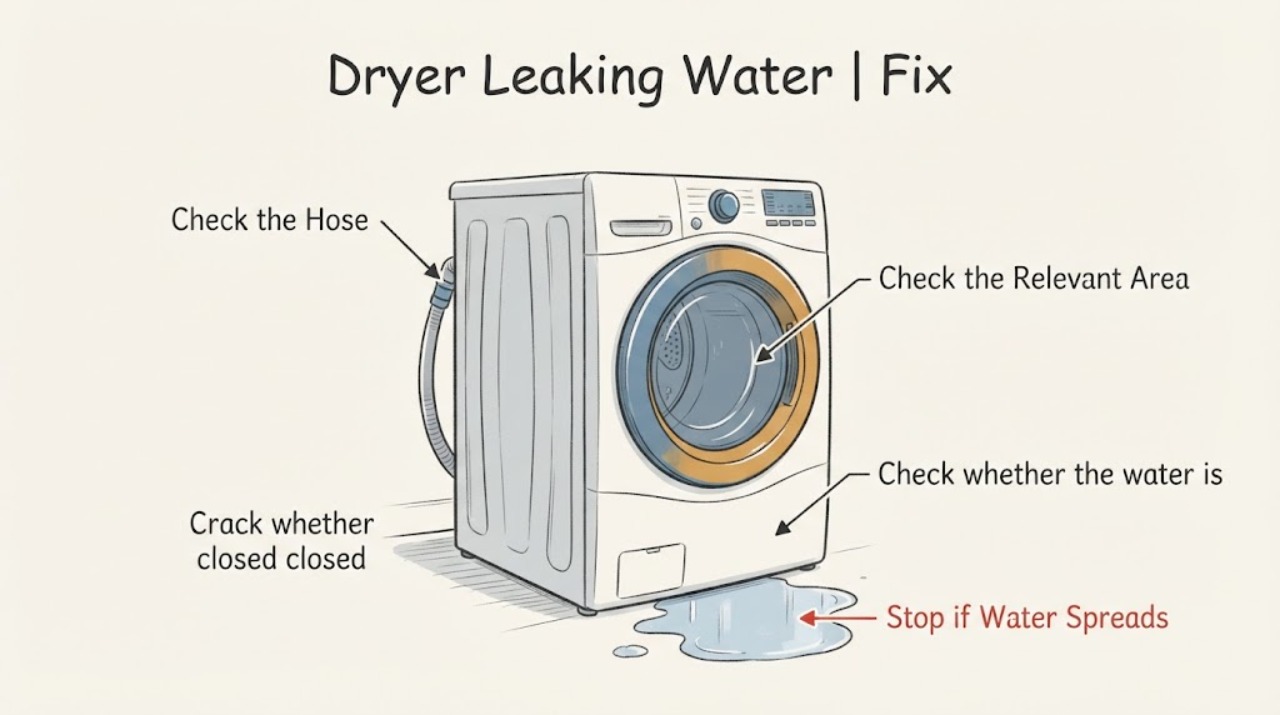
Work through in order
Diagnostic checks
Use only checks that match the exact appliance or system and its official guide.
-
Check 1
Stop the cycle and record the complete GE model number. Check whether the appliance has a condensate tank or a dedicated drain hose, and note exactly where the water first appears: at the tank, hose, standpipe, front, rear, or floor beside the appliance.
Expected result: The dryer is confirmed as a ventless condenser model with a tank or drain, or its dryer type and water source remain uncertain.
Next step: If it is ventless, continue with the tank and drain checks. If the type or source is uncertain, keep the model information and use the model-specific installation instructions or service path.
Why this matters
Why: GE's tank and drain instructions are specific to ventless condenser dryers; an uncertain type or source cannot be safely narrowed to a condenser hose problem.
-
Check 2
For a confirmed ventless condenser dryer, empty the removable water tank if the model uses one. If it drains to a standpipe or washstand, inspect the hose from a dry position for kinks, disconnection, or an insertion depth greater than 4 inches.
Expected result: The tank is full, the hose is disconnected or kinked, or the hose is inserted too far; alternatively, the tank and visible drain route are dry and correctly positioned.
Next step: Correct only the visible tank or hose condition described by the model's installation instructions, then dry the area and monitor one normal cycle. If the visible route is correct or water returns, stop and arrange service.
Why this matters
Why: A full tank or visible drain-routing problem can explain water escaping from a condenser setup. GE specifically warns that pushing the hose more than 4 inches into the standpipe can cause leaking.
-
Check 3
Check whether the water is actually coming from the dryer rather than wet clothing, a nearby washer, a standpipe, or a damp floor or wall. For a ventless condenser dryer in a closet, check that the installation has the air access required by the model instructions and keep the lint trap and accessible condenser clean as directed.
Expected result: The dryer source is confirmed, or the moisture originates from clothing, plumbing, the room, or another appliance.
Next step: If the dryer is not the source, correct the identified room, plumbing, washer, or load issue instead of servicing the dryer. If the dryer is the source and the visible checks do not resolve it, stop using it and contact GE service.
Why this matters
Why: GE describes condenser dryers as collecting moisture in a tank or external drain and says their performance depends on suitable ambient-air access and routine cleaning; another source requires a different repair path.
-
Check 4
Use the complete GE model number to open the owner's manual and parts or service path before removing panels, opening the pump or condenser housing beyond the manual's user steps, or selecting a replacement part.
Expected result: The model-specific instructions identify a user-accessible check, or they direct the issue to service.
Next step: Follow only the exact manual's user-accessible instruction. If water continues, reaches the electrical area, or the manual does not cover the condition, stop the appliance and arrange GE service; do not perform live electrical or internal water-system work.
Why this matters
Why: GE says most repair parts are model specific and its service process varies by product; a generic water leak does not establish a pump, seal, hose, or tank failure.
Use your observations
Decision map
Find the observation that best matches what you see, then follow the next safe action.
-
PATH 01Next step
What you see
The model is a ventless condenser dryer and the tank is full or the visible drain hose is disconnected, kinked, or inserted more than 4 inches into the standpipe.
Do this next
Correct the visible tank or drain routing per the model installation instructions, dry the floor, and monitor one cycle. Escalate if water returns.
Why this path and its safety boundary
Why it matters: The observed installation condition matches GE's documented condensate collection and drain path, including its warning about excessive hose insertion.
-
PATH 02Next step
What you see
The water begins at the washer, standpipe, wet clothing, a wall or floor, or another nearby source rather than at the GE dryer.
Do this next
Stop the affected appliance or plumbing source safely and address that source. Do not order GE dryer parts for a leak that did not originate at the dryer.
Why this path and its safety boundary
Why it matters: The assigned dryer leak is not established by the observation; applying condenser-dryer repair steps would target the wrong source.
-
PATH 03Next step
What you see
The GE dryer is the confirmed water source, but the tank and visible drain path are correct or the model is not documented as a ventless condenser dryer.
Do this next
Stop using the dryer, keep the model and source location for GE service, and do not open panels, test live circuits, or replace a hose, pump, seal, or tank based on appearance alone.
Why this path and its safety boundary
Why it matters: The official general sources do not identify a component failure or a safe universal internal repair for this model-independent condition.
Helpful context
Understand the symptom
Water around a dryer is not enough to identify the cause. It may be condensed water from a ventless model, water escaping from its tank or drain path, or moisture from clothing, a nearby appliance, or the installation area. Find the actual source and confirm the dryer type before changing a hose or ordering a part.
When checks do not resolve it
Need a professional?
Arrange GE service if the dryer itself remains the confirmed source, the visible tank and drain route are correct, the dryer type is not a ventless condenser model covered by the drain guidance, or water reaches the electrical area. Keep the appliance off until the model-specific cause is assessed.
Safety scope: Stop using the dryer if water reaches the electrical area, a plug or outlet, or continues after visible checks. Do not stand in water to handle the plug, open panels, test live wiring, or work on an internal pump or water path.
Have this ready
- Provide the complete GE model number, dryer type, exact first wet location, whether the appliance uses a tank or drain hose, hose routing and insertion depth, cycle stage, and whether nearby laundry or plumbing was wet.
Common questions
FAQ
Do all GE dryers have a water tank or drain hose?
The opened GE guidance describes a tank or external drain for ventless condenser dryers. It does not authorize applying that arrangement to every GE dryer, so confirm the exact model and installation instructions before changing a drain hose.
Why can a GE condenser dryer leak from the standpipe?
GE says the condensate drain hose should not be pushed more than 4 inches into the standpipe because pushing it farther can cause leaking. Confirm the model's installation instructions and correct only the visible hose routing; a persistent leak needs service.
Read the exact guide
Official sources
- Ventless Condenser Dryer - How It DrainsGE Appliances · Opened GE's official support article. It applies to ventless condenser dryers, documents removable-tank and external-drain options, and warns that pushing the drain hose more than 4 inches into the standpipe can cause leaking.
- GE Appliance - Finding Parts for Your ApplianceGE Appliances · Opened GE's official parts guidance. It says the parts site can be searched by model or part number and that most repair parts are model specific, so the generic leak does not establish a compatible pump, hose, seal or tank.
- Ventless Condenser Dryer - How to Maintain Optimum PerformanceGE Appliances · Opened GE's official support article. It supports keeping the lint trap and accessible condenser clean and maintaining the model-appropriate ambient-air access; it does not establish a leak component or universal repair procedure.
- Ventless Condenser Dryer - How It WorksGE Appliances · Opened GE's official support article. It explains that moisture released from clothing condenses and is removed through a tank or external drain, supporting the dryer-type boundary without diagnosing a specific failed component.
- GE Appliance Product - How to Schedule Repair ServiceGE Appliances · Opened GE's official service-routing article. It includes gas and electric dryers among major appliances and directs owners to schedule service; it does not diagnose the source of an unspecified leak.
Community feedback
Share a repair observation
Share a plain-text repair observation. Accepted observations are published automatically; this page may take a moment to update.