
On this page
Start here
Quick answer
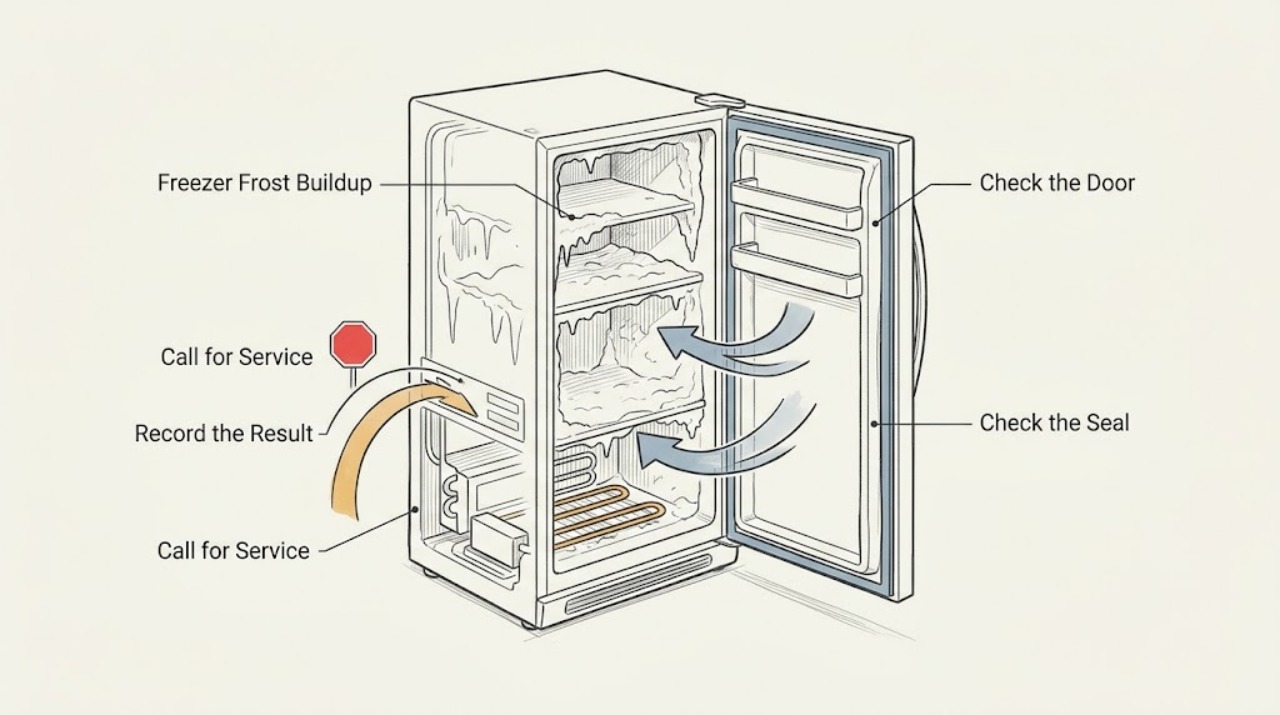
A small amount of frost on a package can be normal, but heavy frost on a GE freezer wall, around the opening, or over a vent usually means humid air is getting in, storage is preventing a seal, airflow is blocked, or the defrost system needs attention. Check that packages, shelves, baskets, and bins allow the door or drawer to close fully; inspect the gasket for gaps or damage; keep food away from the rear wall and vents; and consider recent frequent openings, warm uncovered food, or a high-humidity room. Follow the exact model manual for defrosting and never use a sharp tool to remove ice. If frost continues after these corrections, the fan is not running, or the frost pattern is concentrated on one area, stop relying on the freezer for temperature-sensitive food and arrange qualified service.
Work through in order
Diagnostic checks
Use only checks that match the exact appliance or system and its official guide.
-
Check 1
Map the frost pattern without touching the ice: note whether it is inside food packaging, outside packages, near the door or drawer opening, spread on a rear wall, or covering a vent, and confirm whether the model is frost-free or manual-defrost in its manual.
Expected result: Frost is limited to packages, concentrated at the opening, spread across a wall or vent, or expected for a manual-defrost design.
Next step: Continue with the matching door, load, and airflow checks. If the model is manual-defrost, use only its manual procedure rather than applying frost-free assumptions.
Why this matters
Why: Package crystals can reflect food moisture or normal humid-air entry, while wall or vent ice points more strongly to a sealing, loading, airflow, or defrost issue.
-
Check 2
Close the freezer door or drawer and inspect whether packages, shelves, baskets, or bins prevent full closure; then examine the accessible gasket for dirt, gaps, tears, splits, or sections pulled out of position.
Expected result: The door or drawer closes evenly with continuous gasket contact, or an obstruction, gap, damaged gasket, or alignment problem is visible.
Next step: Rearrange only accessible packages or storage parts and clean the gasket according to the model manual. If the gasket is damaged, the door is misaligned, or the gap persists, arrange model-specific service.
Why this matters
Why: A door that remains slightly open admits warm humid air that can freeze on the opening and walls; a continuous seal makes that air-leak path less likely.
-
Check 3
Review recent use for frequent or prolonged door openings, high humidity, a large warm or uncovered food load, or packages resting against the rear wall or keeping the door from seating.
Expected result: One or more moisture-increasing or storage-related conditions occurred recently, or the freezer has had ordinary use without a clear trigger.
Next step: Keep the door closed, cover food, and restore the intended storage layout. Observe whether new frost stops over the next several days. If it continues or returns quickly, arrange service.
Why this matters
Why: GE identifies warm humid air, warm food, high humidity, rear-wall contact, and door obstruction as causes of temporary frost or ice crystals; frost without those triggers is more concerning for a persistent fault.
-
Check 4
Inspect the interior airflow path for food packages touching the rear wall or covering vents, and verify that shelves, baskets, and door bins are seated as described in the model manual.
Expected result: A package or storage part blocks a vent or circulation path, or the vents and interior are clear.
Next step: Move only accessible items away from vents and the rear wall, then close the freezer and allow it to stabilize. If frost blocks the vents or the correct layout does not stop the buildup, arrange service.
Why this matters
Why: Blocked airflow can create localized frost and uneven temperature, while a misplaced shelf or bin can keep the door from sealing.
-
Check 5
Use the exact GE Owner's Manual to identify the model's defrost design and follow only its user-approved defrost or cleaning procedure; disconnect power before maintenance if the manual requires it.
Expected result: The model provides a user-accessible procedure, or the frost is too heavy or inaccessible for that procedure to be completed safely.
Next step: Complete only the documented user procedure. Stop if it requires panel removal, sealed-system access, or handling wiring, and arrange qualified service for inaccessible or recurring frost.
Why this matters
Why: Automatic-defrost models normally manage frost internally, while manual-defrost models need a model-specific process. A safe defrost can remove accumulated ice but does not establish why it formed.
-
Check 6
After the accessible corrections and any manual-approved defrost, keep the door closed and monitor the interior temperature, new frost formation, and fan sound from outside the cabinet during the model's stabilization period.
Expected result: The freezer maintains its temperature and no new wall frost forms, or the fan is silent, frost returns, or the temperature is unstable.
Next step: If the fault pattern persists or the fan does not run, stop relying on the freezer for temperature-sensitive food and arrange qualified GE service. Do not remove panels to reach the fan.
Why this matters
Why: Stable cooling with no new wall frost supports a temporary moisture or loading cause. A non-running fan, unusual one-wall frost pattern, recurrent buildup, or poor cooling suggests an internal cooling or defrost fault.
Use your observations
Decision map
Find the observation that best matches what you see, then follow the next safe action.
-
PATH 01Next step
What you see
Frost is limited to packages and the door or drawer seals normally.
Do this next
Treat it as possible food moisture or normal humid-air entry, cover food, limit openings, and monitor for new frost on the wall or vents.
-
PATH 02Next step
What you see
Frost is concentrated around the opening or a package, shelf, basket, or gasket prevents a complete seal.
Do this next
Correct only the accessible obstruction or cleaning issue and follow the model manual for alignment or gasket guidance. Arrange service if the seal remains uneven or damaged.
-
PATH 03Next step
What you see
Food or storage parts block vents or touch the rear wall.
Do this next
Rearrange the accessible interior to restore circulation and allow stabilization. Escalate if frost blocks the vents or returns after the layout is corrected.
-
PATH 04Next step
What you see
Heavy frost remains after door, humidity, loading, and airflow corrections.
Do this next
Use only the model's documented defrost path. If the design is automatic-defrost, the procedure is not user-accessible, or the frost returns, arrange qualified service.
-
PATH 05Next step
What you see
The fan is not running, the frost is heavily concentrated on one wall, cooling is unstable, or food is warming.
Do this next
Stop relying on the freezer for temperature-sensitive food and arrange qualified GE appliance service; do not open the cabinet or sealed refrigeration system.
Helpful context
Understand the symptom
Not every frost crystal means a failed freezer
Moisture in food can freeze inside a package, and warm humid room air can form crystals on the outside of a package after the door opens. The more concerning pattern is a thick layer on a frost-free wall, frost around the door or drawer opening, or ice that covers an air vent. Those patterns can affect sealing and circulation and deserve a structured check.
Protect the freezer while checking it
Limit door openings and move temperature-sensitive food to a known-safe cold appliance if the freezer is warming. Do not chip ice with a knife, screwdriver, or other pointed tool, and do not use a high-heat appliance inside the freezer. Avoid opening panels, handling refrigerant, or testing live wiring.
Use the correct defrost instructions
GE models differ: frost-free units normally defrost automatically, while manual-defrost or compact designs use a model-specific procedure. Check the Owner's Manual before changing the control, removing a panel, or initiating a defrost. Clearing visible ice without correcting air entry or a failed component only treats the symptom.
Only after diagnosis
Potential parts
- freezer door or drawer gasket
Only consider a gasket after inspection shows a persistent gap, tear, split, or failed seal and the exact model documentation or a qualified technician confirms that the gasket is the cause.
Confirm the exact GE model and manufacturer's fit information before ordering any component. - freezer evaporator fan component
Only consider a fan component when the freezer fan is confirmed not to run or airflow is abnormal after vents and frost are addressed, and a qualified technician identifies the fault.
Do not infer compatibility from appearance; use the exact model documentation and technician diagnosis. - defrost system component
Only consider a defrost component if frost returns after door, humidity, loading, and airflow causes are excluded and a qualified technician confirms a defrost-system fault.
Confirm the exact GE model and approved component information before replacement.
When checks do not resolve it
Need a professional?
A qualified GE technician should diagnose frost that returns after model-approved defrost and accessible corrections, a non-running freezer fan, an abnormal frost pattern, a door or gasket that cannot seal, or a freezer that warms while frost accumulates.
Common questions
FAQ
Is frost on food packages normal in a GE freezer?
A small amount of frost or ice crystals on or inside a package can be normal moisture. Heavy frost on a frost-free wall, around the opening, or over a vent is a reason to check the seal, loading, airflow, and defrost behavior.
Can a GE freezer door gasket cause frost buildup?
Yes. A dirty, damaged, misaligned, or obstructed gasket can allow humid air in or prevent the door or drawer from sealing. Check the accessible seal and follow the exact model instructions before arranging service.
Should I scrape frost off a GE freezer wall?
Do not use a knife or pointed tool. Follow the exact model manual for a user-approved defrost procedure. If the frost is heavy, inaccessible, or returns after defrosting, arrange qualified service.
Why does frost return after I clear my GE freezer?
Frost can return when humid air continues to enter, food or storage parts prevent sealing, vents are blocked, or the automatic defrost system or fan has a fault. If accessible corrections do not stop the pattern, service is needed.
Read the exact guide
Official sources
- Refrigerator - Frost or Ice Crystals on Food in FreezerGE Appliances · GE's official explanation of normal package crystals and frost caused by humid air, door obstructions, shelf placement, and warm food.
- Refrigerator - Interior MoistureGE Appliances · GE's official explanation of moisture from startup, frequent openings, incomplete closure, defrost cycles, and food moisture, including model-specific defrost guidance.
- Refrigerator & Freezer - Ice on Freezer WallGE Appliances · GE's official guidance for unexpected ice on a freezer wall, including humidity, door openings, warm food, rear-wall packages, gasket sealing, fan operation, and service.
- Refrigerator - Automatic Defrost SystemGE Appliances · GE's official description of automatic defrost operation and the service boundary for heavy frost or overly frequent defrosting.
- Refrigerator - Frost in FreezerGE Appliances · GE's official frost checks for door closure, gasket, alignment, leveling, and continued frost after simple corrections.
Community feedback
Share a repair observation
Share a plain-text repair observation. Accepted observations are published automatically; this page may take a moment to update.