
On this page
Start here
Quick answer
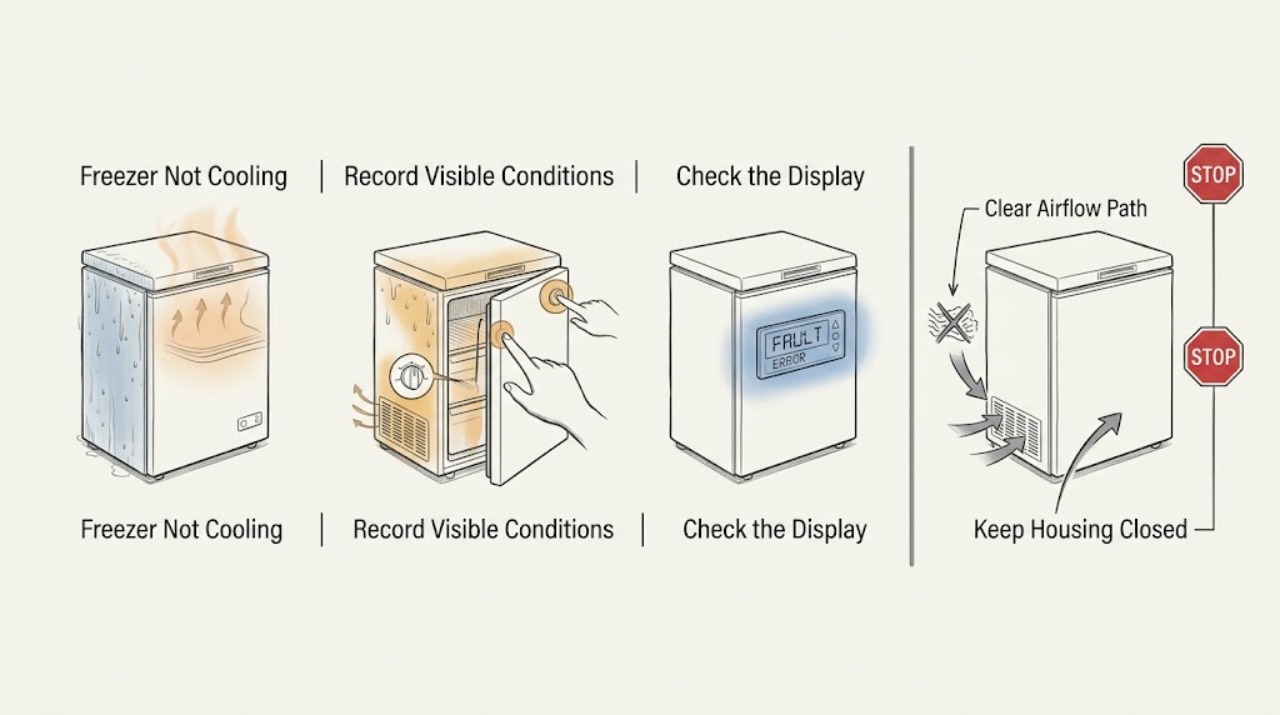
If a GE freezer is not cooling, protect the food first and separate a power or control problem from a blocked-airflow, frost, door-seal, or mechanical fault. Keep the door closed as much as practical, record the internal temperature if an appliance thermometer is available, and identify whether the freezer is an upright, chest, or refrigerator freezer compartment. From a dry position, check that the control is not OFF, that the door gasket closes evenly, and that packages are not blocking vents. Heavy frost, repeated clicking, no normal cooling cycle, a warm compressor area, or food that is thawing points beyond a simple setting or loading issue. Do not chip ice, open sealed refrigeration parts, handle wet electrical components, or keep operating a freezer that cannot protect food; arrange qualified GE service and follow official food-safety guidance for thawed items.
Before you begin
Safety first
- This article covers food protection, model identification, dry-access control and power observations, visible loading and door checks, and visible frost or installation observations only. Do not work near wet electrical parts, remove sealed panels, puncture the liner, test live circuits, handle refrigerant, or move a heavy appliance.
Work through in order
Diagnostic checks
Use only checks that match the exact appliance or system and its official guide.
-
Check 1
Keep the freezer door closed as much as practical. From a dry, stable position, check an appliance thermometer if one is already available, note whether food still has ice crystals, and record any recent outage, unplugging, move, installation, or large load of warm food.
Expected result: The freezer is at or below 0°F (-18°C), warmer than its normal setting, has no reliable thermometer reading, or food is soft, partially thawed, or fully thawed.
Next step: If food safety is in doubt, keep the door shut, separate packages carefully, and use FoodSafety.gov guidance: food with ice crystals or at or below 40°F (4°C) may be refrozen or cooked, while food that has thawed or was above the cited safety limit should be evaluated item by item and discarded when directed. Continue with the appliance checks only if the area is safe.
Stop if: Stop opening the freezer when food is rapidly warming or the unit is in a power or flooding hazard; do not taste food to decide whether it is safe.
Why this matters
Why: A normal measured temperature means the complaint may be an ice-maker or local airflow issue rather than total loss of cooling. A warm reading or thawing food confirms a cooling or power event; an outage history may explain the temperature without proving that the appliance itself has failed.
-
Check 2
Read the model and serial information, identify the freezer style, and check from a dry position that the temperature control is not OFF and that any display, interior light, or normal operating indicator responds. Verify the plug and breaker only when the cord, outlet, and floor are dry and accessible; use the exact owner's manual for model-specific control behavior.
Expected result: The control is OFF or was recently changed, the unit has no light or display, the breaker has tripped, the plug or outlet is visibly damaged, or the controls and indicators appear normal while the freezer remains warm.
Next step: Correct only an obvious control setting or a tripped breaker when safe, then allow the model's normal recovery period while keeping the door closed. If power is absent again, a cord or outlet is damaged, or the freezer remains warm with normal power, preserve the observations and request qualified service.
Stop if: Do not touch a wet or hot cord, remove covers, test live wiring, use an extension cord as a workaround, or reach through pooled water to unplug the freezer.
Why this matters
Why: An OFF control or a documented power interruption can explain the symptom and should be corrected only through the model's normal controls. No power indication can be a supply, cord, control, or wiring issue. Normal indicators with a warm cabinet leave airflow, frost, compressor, defrost, or sealed-system faults in consideration; GE lists these as service possibilities for upright and chest freezers.
-
Check 3
With the door open only briefly, move plainly accessible packages away from interior vents and the rear air path, check that a drawer, basket, ice bin, or tall package is not holding the door open, and inspect the gasket for a fold, tear, gap, or section that does not contact the cabinet evenly.
Expected result: A package or bin blocks a vent or door, the gasket is damaged or uneven, the door closes and seals normally, or the freezer is too empty or too full for the model's recommended loading pattern.
Next step: Remove only a plainly accessible obstruction, restore the gasket's position without tools, and return the controls to the model's recommended setting. Do not force the door or replace a gasket until the exact model and the cause of the gap are confirmed; reassess the temperature after the normal stabilization period described by the manual.
Stop if: Stop if the door, hinge, cabinet, or gasket is structurally damaged, if frost prevents the door from sealing, or if accessing the obstruction requires moving the appliance or removing a panel.
Why this matters
Why: Blocked airflow or an incomplete door seal can let the compartment warm or accumulate frost. A normally closing door and clear vents make those simple causes less likely but do not rule out a defrost, fan, control, compressor, or sealed-system fault. GE's cooling guidance specifically calls out food load, door closure, large containers blocking airflow, and gasket sealing.
-
Check 4
From the front and without removing panels, inspect the visible back wall, vents, and door edge for a thick or uneven frost layer. Check that the surrounding space and rear or side clearance match the owner's manual, and note whether the freezer is in a hot garage, direct sun, or an unusually cold area.
Expected result: Frost covers a back wall or vent, frost is concentrated near the door edge, there is little clearance, the installation area is outside the model's allowed range, or the interior and installation area look normal.
Next step: If the manual explicitly permits a manual defrost, follow only that model's procedure and protect the floor; otherwise request service for heavy, returning, or inaccessible frost. Restore only the clearance and loading conditions that the manual specifies, then monitor temperature without repeatedly opening the door.
Stop if: Do not chip, scrape, puncture, pry, or heat the ice; do not remove an evaporator cover or other panel as a user test, and do not move a heavy or built-in freezer to gain clearance.
Why this matters
Why: GE explains that warm external air entering through a poor seal can create frost, while restricted airflow and unsuitable installation conditions can reduce cooling. A thick or returning frost layer may also indicate a defrost or control fault; a normal visible frost condition does not rule out a hidden mechanical or sealed-system problem.
-
Check 5
After the safe external checks, listen from outside the cabinet for a normal cooling cycle and note whether the freezer repeatedly clicks, runs continuously without lowering the temperature, stays silent, or produces an unusual hot, burning, or electrical smell. Do not touch the compressor, fan, wiring, refrigerant tubing, or access panels.
Expected result: The freezer resumes cooling after a control, door, load, or clearance correction; it remains warm with normal power; it clicks and stops; it runs continuously; or there is an odor, smoke, sparking, or water near electrical parts.
Next step: Leave the freezer accessible for qualified diagnosis, keep the model and symptom timeline, and tell the technician whether food was thawing, how the controls were set, what frost was visible, and what sounds occurred. Follow food-safety guidance separately rather than trying to repair a sealed or electrical system.
Stop if: Stop using the freezer and isolate the area for smoke, sparks, a burning smell, a hot or damaged cord, active water near electrical parts, or any need to open a sealed system or test live voltage.
Why this matters
Why: Recovery after a safe correction supports a setting, load, door, or installation cause. Persistent warmth with normal power, repeated clicking, or continuous operation can involve a relay, fan, defrost control, compressor, wiring, or sealed cooling system; GE identifies several of these as service causes. Odor, smoke, sparking, water, or a hot damaged cord is an immediate safety boundary.
Use your observations
Decision map
Find the observation that best matches what you see, then follow the next safe action.
-
PATH 01Safety boundary
What you see
The freezer control is OFF, the breaker had tripped, or a recent outage or unplugging is confirmed and the cord and outlet are dry and undamaged.
Do this next
Use only the normal model-specific control and safe power steps, keep the door closed, and monitor the temperature through the normal stabilization period in the owner's manual.
Why this path and its safety boundary
Why it matters: The symptom may be a power or setting interruption, but restoring a control setting does not prove that the freezer's cooling system is healthy.
Safety stop: Arrange service if power drops again, the unit stays warm, the breaker trips repeatedly, or the cord or outlet is damaged; never bypass a protection device.
-
PATH 02Safety boundary
What you see
A package, drawer, or ice bin blocks a vent or door, or the gasket does not seal evenly, while the unit otherwise has power.
Do this next
Remove only the accessible obstruction, restore the gasket position without tools, close the door, and reassess after the model's normal recovery period.
Why this path and its safety boundary
Why it matters: Warm air entry or restricted circulation can make a GE freezer appear not to cool and can create frost.
Safety stop: Request service for a torn gasket, misaligned door, returning frost, damaged cabinet, or any obstruction that requires moving the freezer or removing a panel.
-
PATH 03Safety boundary
What you see
Thick frost covers the back wall or vents, frost returns after a model-approved defrost, or frost prevents the door from sealing.
Do this next
Follow an exact manual-defrost procedure only when the model permits it; otherwise schedule service and keep the door closed as much as practical while food safety is assessed.
Why this path and its safety boundary
Why it matters: The condition may involve warm-air entry, restricted airflow, or a defrost control fault; the frost pattern alone does not identify a failed part.
Safety stop: Do not chip or puncture ice, use a heater, remove an evaporator cover, or restart the unit while water can reach electrical parts.
-
PATH 04Safety boundary
What you see
The freezer is in an unusually hot or cold location, exposed to direct heat, or installed with less clearance than the model manual specifies.
Do this next
Restore only the clearance and installation conditions permitted by the manual without moving a heavy or built-in unit, then monitor temperature with the door closed.
Why this path and its safety boundary
Why it matters: Ambient conditions and restricted heat rejection can reduce cooling efficiency and can mimic a failing appliance.
Safety stop: Arrange service when the model's approved installation conditions are met but the freezer remains warm, or when correcting the location requires unsafe lifting or disconnection.
-
PATH 05Safety boundary
What you see
The freezer has normal power and an unobstructed, sealing door but remains warm, clicks repeatedly, runs continuously without cooling, or has no normal cooling cycle.
Do this next
Arrange qualified GE appliance service, leave the unit in the state that best preserves the symptom when safe, and provide the model, temperature history, frost pattern, sounds, and food condition.
Why this path and its safety boundary
Why it matters: A defrost control, relay, wiring, compressor, fan, or sealed-system fault is plausible and cannot be distinguished safely by an ordinary visual check.
Safety stop: Do not open panels, test live voltage, handle refrigerant tubing, replace a part based only on a sound, or keep food in a freezer that cannot maintain a safe temperature.
-
PATH 06Safety boundary
What you see
Food is thawing, the temperature is above the safe range, or there is smoke, sparking, a burning smell, a hot damaged cord, active water, or water near an outlet or electrical component.
Do this next
Keep the door closed when possible, use a safe accessible shutoff only if it can be reached without contacting water, move or discard food according to FoodSafety.gov guidance, and arrange prompt qualified service.
Why this path and its safety boundary
Why it matters: Food protection and immediate electrical or fire safety take priority over further troubleshooting.
Safety stop: Do not step into water, touch wet electrical parts, unplug through a puddle, taste thawed food, or restart the freezer to reproduce a symptom.
Helpful context
Understand the symptom
Start with food safety and the freezer type
A freezer that is warm can be a failed appliance, a recent power interruption, or a temperature-control and airflow problem. Keep the door closed while you gather information. Record the model and serial information, whether the unit is an upright freezer, chest freezer, or refrigerator freezer compartment, and whether food still contains ice crystals. A model-specific owner's manual matters because a self-defrost upright, manual-defrost chest freezer, and refrigerator freezer do not expose the same controls or serviceable parts. FoodSafety.gov says a full freezer can hold its temperature for approximately 48 hours, or about 24 hours when half full, when the door remains closed; food can be refrozen when it still has ice crystals or is at or below 40°F (4°C), but never taste food to judge safety.
A visible symptom narrows the next safe check
No light or display, an OFF control, or a recent power event sends the diagnosis toward power and controls. A running unit with a warm interior needs an airflow, door, load, ambient-temperature, condenser, frost, or sealed-system assessment. Frost covering a back wall or a vent can restrict circulation and can also signal warm air entering through a poor door seal or a defrost problem. GE notes that some freezer faults involve the defrost control, relay, wiring, or compressor, so a warm freezer with repeated clicking or no cooling should not be diagnosed by removing panels or testing live circuits.
Know when a homeowner check has ended
The safe user checks are limited to model identification, food and temperature observations, control position, dry-access power observations, door closure, visible loading and frost, and the clearance or ambient conditions described by the manual. Unplug before maintenance or cleaning only if the plug and outlet can be reached without contacting water; otherwise use a safe accessible shutoff and wait for service. Do not puncture the liner, use a sharp tool or electrical heater to remove ice, open the sealed refrigeration system, or keep a warm freezer running just to reproduce a symptom. Preserve the model information and what changed before service.
Safety boundary
Stop conditions
- Keep the door closed as much as practical when food is warming, and use official food-safety guidance rather than taste, smell, or appearance alone to decide whether thawed food is safe.
- Stop for smoke, sparks, a burning smell, a hot or damaged cord, active flooding, or water near an outlet, control, compressor wiring, or other electrical part.
- Do not chip, scrape, puncture, or heat ice; do not remove sealed panels, test live circuits, handle refrigerant tubing, or improvise a defrost repair.
- Do not move a heavy or built-in freezer, loosen pressurized connections, or reach through water to unplug the appliance.
- Arrange qualified GE service when a warm freezer remains warm after safe control, door, load, frost, and installation checks, or when repeated clicking, continuous running, or a hidden fault is present.
Only after diagnosis
Potential parts
- GE-compatible freezer door gasket
Consider this category only if inspection and diagnosis confirm a torn, deformed, or non-sealing gasket is admitting warm air and contributing to the loss of cooling or frost.
Confirm the exact GE model, door alignment, hinge condition, gasket profile, and manufacturer fit information before ordering or replacing a seal. - GE-compatible defrost control or sensor
Consider this category only after a qualified diagnosis links returning heavy frost or a failed defrost cycle to the control or sensor rather than a door seal or airflow obstruction.
Confirm the exact model, control design, wiring, and approved service procedure; do not infer compatibility from a similar-looking freezer. - GE-compatible evaporator or condenser fan assembly
Consider this category only if diagnosis confirms a failed fan or motor after the airflow path and frost condition have been assessed.
Confirm the exact GE model, fan location, connector, blade, and manufacturer fit information; fan access may require panel removal. - GE-compatible start relay or compressor component
Consider this category only if qualified testing confirms a starting or compressor fault; repeated clicking alone does not identify a specific part.
Use the exact model and qualified electrical diagnosis; do not test or replace a start device on an energized appliance.
When checks do not resolve it
Need a professional?
Arrange qualified GE appliance service when the freezer remains warm with normal power, heavy or returning frost is inaccessible, the door or gasket is damaged, the compressor or relay may be failing, repeated clicking occurs, the unit runs continuously without cooling, or a control, fan, defrost, wiring, or sealed-system diagnosis is needed. Request prompt service for food thawing, and isolate the area for smoke, sparks, burning odor, a hot cord, active water, or water near electrical parts.
Safety scope: This article covers food protection, model identification, dry-access control and power observations, visible loading and door checks, and visible frost or installation observations only. Do not work near wet electrical parts, remove sealed panels, puncture the liner, test live circuits, handle refrigerant, or move a heavy appliance.
Common questions
FAQ
Why is my GE freezer not cooling even though the light is on?
A working light does not prove that the cooling system is working. Check the control setting, door seal, blocked vents, load, frost, and installation conditions from a safe position. GE also lists defrost-control, relay, wiring, and compressor faults for upright and chest freezers; persistent warmth needs qualified service.
What temperature should a GE freezer reach?
FoodSafety.gov recommends keeping a freezer at or below 0°F (-18°C). Use an appliance thermometer when available and follow the exact GE model manual for control operation. A display setting alone does not confirm the actual cabinet temperature.
Can a blocked vent or overpacked GE freezer cause poor cooling?
Yes. Large packages can block the cold-air path, and an obstructed door or gasket can let warm air enter. Move only plainly accessible obstructions, keep vents clear as the manual shows, and request service if the door or gasket remains damaged or the freezer stays warm.
What does heavy frost mean in a GE freezer that is not cooling?
Heavy or uneven frost can restrict airflow and can result from warm air entering through a door seal; it can also indicate a defrost or control problem. Follow a manual-defrost procedure only when the exact manual permits it. Do not chip ice, use a heater, or remove a panel as a user test.
Is food safe if a GE freezer stops cooling?
Keep the door closed and evaluate food using FoodSafety.gov guidance. Food that still has ice crystals or is at or below 40°F (4°C) may be refrozen or cooked, while thawed food must be evaluated item by item; never taste food to test it.
When should I stop troubleshooting and call for GE freezer service?
Arrange service when safe control, door, load, frost, and installation checks do not restore cooling, or when the freezer clicks repeatedly, runs continuously without cooling, has a hidden frost or mechanical fault, or needs panel or sealed-system access. Isolate the area immediately for smoke, sparks, a burning smell, a hot cord, flooding, or water near electrical parts.
Read the exact guide
Official sources
- Upright & Chest Freezer - Not WorkingGE Appliances · Directly applies to a GE upright or chest freezer whose control lights work but the cabinet does not cool.
- Top-Freezer Refrigerator - Garage-Ready Models Not CoolingGE Appliances · Use for the frost, door-seal, ambient-temperature, and food-temperature branches when the GE appliance is a garage-ready top-freezer refrigerator; the exact model manual controls applicability.
- Food Safety During Power OutageFoodSafety.gov · Applies when a freezer is not cooling and food may have partially or completely thawed.
- Refrigerator - Not Cooling EnoughGE Appliances · Applies to GE refrigerator freezer compartments and related cooling symptoms where the unit runs but is not cool or not cool enough.
- Refrigerator and Freezer Troubleshooting and Support | GE AppliancesGE Appliances · Applies to identifying the exact GE freezer or refrigerator model and locating model-specific support and owner-manual guidance.
Community feedback
Share a repair observation
Share a plain-text repair observation. Accepted observations are published automatically; this page may take a moment to update.