
On this page
Start here
Quick answer
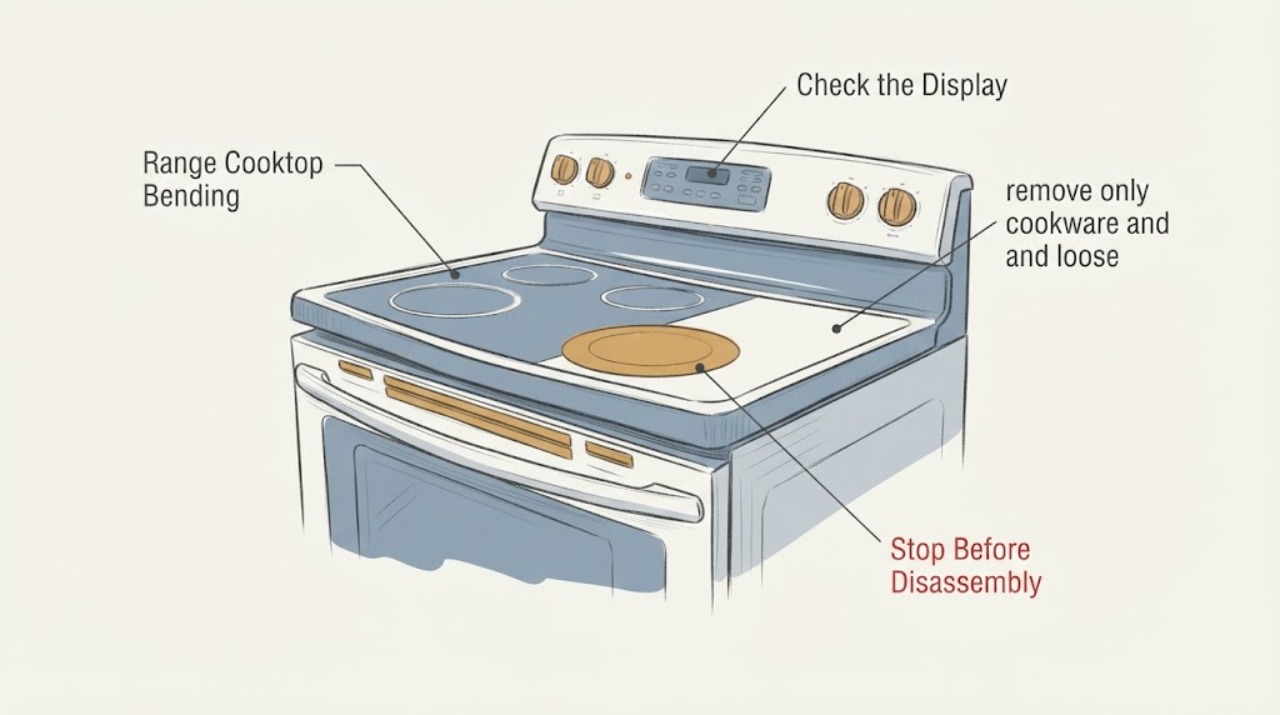
Do not press on, load, straighten, shim or heat a GE range cooktop that appears bent. With the range off and completely cool, determine whether the cooktop surface itself is cracked, pitted, lifting or visibly bowed, or whether only a removable pan, coil burner, drip pan or trim is out of position. GE says a cracked or pitted ceramic-glass cooktop needs service and that a range oven should not be used until the cooktop is repaired because the oven vents near the cooktop. GE also says a bent or damaged plug-in burner receptacle requires service. The exact model, fuel type and cooktop construction are needed before any part or reseating procedure can be selected.
Work through in order
Diagnostic checks
Use only checks that match the exact appliance or system and its official guide.
-
Check 1
Turn all controls off and let the GE range become completely cold. Do not press the cooktop to measure its deflection, place a heavy pan on it, or attempt to straighten, shim, glue or tape it.
Expected result: The surface is visibly cracked, pitted, lifting or unstable, or there is no visible damage and only a suspected bend.
Next step: For any crack, pit, lifting or movement, stop using the cooktop and oven and arrange service. If no damage is visible, continue only with a non-contact identity check and do not test the surface under load.
Why this matters
Why: A visibly damaged or unstable surface may not safely support cookware or contain heat. A suspected bend without visible damage cannot be classified by force-testing it.
-
Check 2
With the range cold, remove only cookware and loose removable pieces that are plainly accessible. View the surface from the side and note whether the apparent bend belongs to the glass or metal cooktop, a coil burner, a drip/reflector pan, a trim edge or the pan itself; do not lift the cooktop or reach under it.
Expected result: The cooktop surface itself is bowed or damaged, only a removable item is uneven, or the source cannot be separated visually.
Next step: If the surface itself is affected or the source is uncertain, keep the appliance out of service and give photos and model information to GE service. If only cookware is warped, set it aside and do not use it on the cooktop.
Why this matters
Why: A removable pan, burner or reflector can create an uneven appearance without proving a structural cooktop fault. A surface-level bow or damage remains model-specific and is not a user-straightening task.
-
Check 3
Inspect the cold cooktop surface without touching the suspected bend for a crack, chip, pit, sharp edge, lifted section or heat-discolored area. Do not clean across a damaged section or use a scraper to test it.
Expected result: A crack, pit, chip, lifted glass section or other surface damage is visible, or the surface appears intact.
Next step: For any glass damage, stop using both the cooktop and range oven and schedule repair. For an intact but visibly bowed or moving surface, do not resume cooking until the exact model is assessed.
Why this matters
Why: GE says cracked or pitted ceramic-glass surfaces need service. An intact-looking surface does not prove that the support, frame, burner or mounting is correct.
-
Check 4
Only if the exact appliance is confirmed as an electric plug-in-coil design, look at the cool, disconnected burner and reflector from above for obvious seating or orientation issues. Do not remove a hardwired element, open the cooktop or inspect a receptacle under the surface.
Expected result: A plug-in coil is visibly loose or a receptacle appears bent/damaged, or the cooktop uses a smooth-top, induction, gas-on-glass, hardwired or unknown design.
Next step: For a bent/damaged receptacle or any non-plug-in/unknown design, leave the range unused and arrange service. Use only the exact model manual for any permitted external reseating of a cool plug-in burner.
Why this matters
Why: GE says a loose plug-in burner may be addressed only with power off, but a bent or damaged receptacle requires service. The plug-in guidance cannot be transferred to other cooktop constructions.
-
Check 5
Record the complete GE model number and serial number if available, fuel type, cooktop construction, bend location, cold-versus-hot appearance, photos, and any crack, sparking, breaker trip, burning odor or uneven heating. Do not select a replacement top, support, burner or receptacle from a similar model.
Expected result: The exact model is available, or the label is missing/partial and the surface construction or affected support is uncertain.
Next step: Give the complete identity and observations to GE or qualified appliance service. Keep the cooktop and oven out of service when the surface is damaged, unstable, electrically abnormal or not safely identifiable.
Why this matters
Why: GE says range parts are generally model-specific. Without the exact identity, the source of the bend and the compatible repair cannot be verified.
Use your observations
Decision map
Find the observation that best matches what you see, then follow the next safe action.
-
PATH 01Next step
What you see
The ceramic-glass cooktop itself is cracked, pitted, chipped, lifting or visibly unstable.
Do this next
Stop using the cooktop and oven, keep people away from sharp or unstable areas, and arrange qualified GE service. Do not patch, clamp, drill or straighten the glass.
Why this path and its safety boundary
Why it matters: GE classifies cracked or pitted glass as a service condition and warns against using the cooktop; on ranges, the oven should also remain unused until the cooktop is repaired because of the vent path.
-
PATH 02Next step
What you see
The cooktop surface looks intact, but only a removable pan, coil burner or reflector appears uneven when the range is cold.
Do this next
Set aside warped cookware. For a confirmed plug-in coil design, use the exact manual for cold, disconnected reseating; if a receptacle is bent or the part is hardwired, arrange service.
Why this path and its safety boundary
Why it matters: The observation may be a cookware or removable-burner issue rather than a bent range surface, but the construction and model still control what can be reseated safely.
-
PATH 03Next step
What you see
The bend is accompanied by sparking, a breaker trip, burning-plastic odor, visible heat damage or a surface unit that ruptured.
Do this next
Turn the range off, disconnect power only by a safe accessible control or breaker, do not test it again, and arrange qualified appliance/electrical service. Use emergency help for smoke or flame.
Why this path and its safety boundary
Why it matters: GE documents those signs as possible surface-unit electrical failure symptoms, not as a cosmetic alignment problem.
-
PATH 04Next step
What you see
The cooktop construction or GE model is unknown, or the surface remains bowed after removable items are excluded.
Do this next
Do not lift the top or order a part. Photograph the label and surface, keep the range unused if it moves or appears damaged, and obtain model-specific service.
Why this path and its safety boundary
Why it matters: A smooth-top, induction, gas-on-glass, coil, metal or slide-in design can have different supports and service procedures; similar GE branding does not establish compatibility.
Helpful context
Understand the symptom
First identify what is actually bending
The word cooktop can mean the glass or metal surface, a plug-in coil burner, a reflector or drip pan, a trim piece, or the cookware. With the range off and cold, remove only cookware and other loose items that are plainly accessible. Look from the side without pressing down. A warped pan or loose removable burner does not prove that the range body is bent, while a surface that is cracked, pitted, lifting or moving under light contact should be treated as a service condition.
Glass damage changes the use decision
GE says a cracked or pitted ceramic-glass cooktop needs repair and recommends not using the cooktop until it is repaired. On a range, GE also recommends not using the oven until the cooktop is fixed because oven heat vents at the backsplash or rear of the oven onto the cooktop. Do not tape, glue, clamp, drill, bend back or cover a damaged surface.
A burner or receptacle is a separate branch
GE's electric-range guidance says a loose plug-in coil burner can be checked only with power disconnected, while a bent or damaged receptacle requires service. That guidance is for the applicable plug-in-burner design; it does not authorize opening a smooth-top, induction, hardwired, gas-on-glass or unknown-model range. Do not lift the cooktop or reach under it to find the cause.
Model and fuel type control the repair boundary
GE says nearly all range parts are specific to the exact model. Record the complete model number, serial number if available, fuel type, whether the cooktop is glass, metal or coil, where the bend is located, whether it is present when cold, and any crack, heat mark, sparking or odor. Do not order a replacement top, bracket or burner from a similar GE model.
When checks do not resolve it
Need a professional?
Arrange GE service before use if the cooktop glass is cracked, pitted, chipped, lifting or unstable; a burner receptacle is bent or damaged; the range sparks, trips a breaker or smells of burning plastic; the bend remains unexplained; or the exact model and cooktop construction are unknown.
Have this ready
- Complete GE model and serial numbers, fuel type, cooktop construction, photos taken while cold and without pressing the surface, bend location, whether it moves, any crack or pit, and any sparking, breaker trip, odor or heat mark.
Common questions
FAQ
Can I keep using a GE range if the cooktop is bent but not cracked?
Do not press or load a cooktop that visibly bows, moves or sits unstable. GE's published no-use guidance is specific to cracked or pitted glass, while an unexplained bend still needs model-specific assessment before use; do not assume an intact appearance proves the supports are safe.
Could the pan be bent instead of the GE cooktop?
Yes. Remove cookware only when the range is cold and compare the surface visually without pressing it. GE recommends flat-bottom cookware for smooth cooktops; a warped pan can create an uneven cooking appearance without proving a cooktop defect.
Can I lift the GE cooktop to see why it bends?
Not from this generic symptom. A smooth-top, induction, gas-on-glass, coil or hardwired range can have different construction and electrical risks. Keep the range off and use the exact model manual or qualified service instead of opening or lifting the top.
What if the bend is near a burner and the range sparks or smells burned?
Stop using the range and do not test it again. GE documents sparking, a tripped breaker and burning-plastic odor as possible surface-unit failure signs that require service; use emergency help for smoke or flame.
Read the exact guide
Official sources
- Electric Range & Cooktop - Surface Burners Not Heating WellGE Appliances · Opened GE's official support page. It covers loose plug-in burners, flat cookware, power-disconnection before maintenance and service; it is not a structural cooktop-bending diagnosis.
- Cooktop - Glass CrackedGE Appliances · Opened GE's official support page. It applies to ceramic-glass cooktop surfaces on cooktops or ranges, including radiant, induction and gas-on-glass; it does not define every non-glass cooktop or a generic bending repair.
- Range Surface Unit FailureGE Appliances · Opened GE's official support page. It describes possible open/short surface-unit behavior, sparks, breaker trips and burning-plastic odor, then directs the owner to service.
- Electric Range - Leveling the Plug-In BurnersGE Appliances · Opened GE's official support page. It is limited to plug-in burners and says a bent or damaged receptacle requires service.
- Range PartsGE Appliances · Opened GE's official range parts page. It says nearly all GE appliance parts are model-specific and gives model-label guidance.
Community feedback
Share a repair observation
Share a plain-text repair observation. Accepted observations are published automatically; this page may take a moment to update.