
On this page
Start here
Quick answer
Treat a GE gas-oven ignition problem as a gas and electrical safety issue, not as proof that the Glo-Bar itself has failed. With no gas odor, boom, flame rollout, or other emergency sign, confirm the bake or broil control, power, gas supply, and—only by the documented visual check—whether the oven igniter glows red when the oven is started. GE says no glow can reflect the Glo-Bar, control, or another electrical component, so do not test or replace parts by guesswork. If the oven still will not ignite, or there is unburned-gas odor or delayed ignition, stop using it and arrange qualified GE or gas-appliance service.
Before you begin
Safety first
- Do not light the oven manually, remove the oven bottom or control panel, measure energized wiring, bypass a safety device, or substitute an igniter from a similar GE model. Stop use and use gas-emergency guidance for unburned-gas odor or delayed ignition.
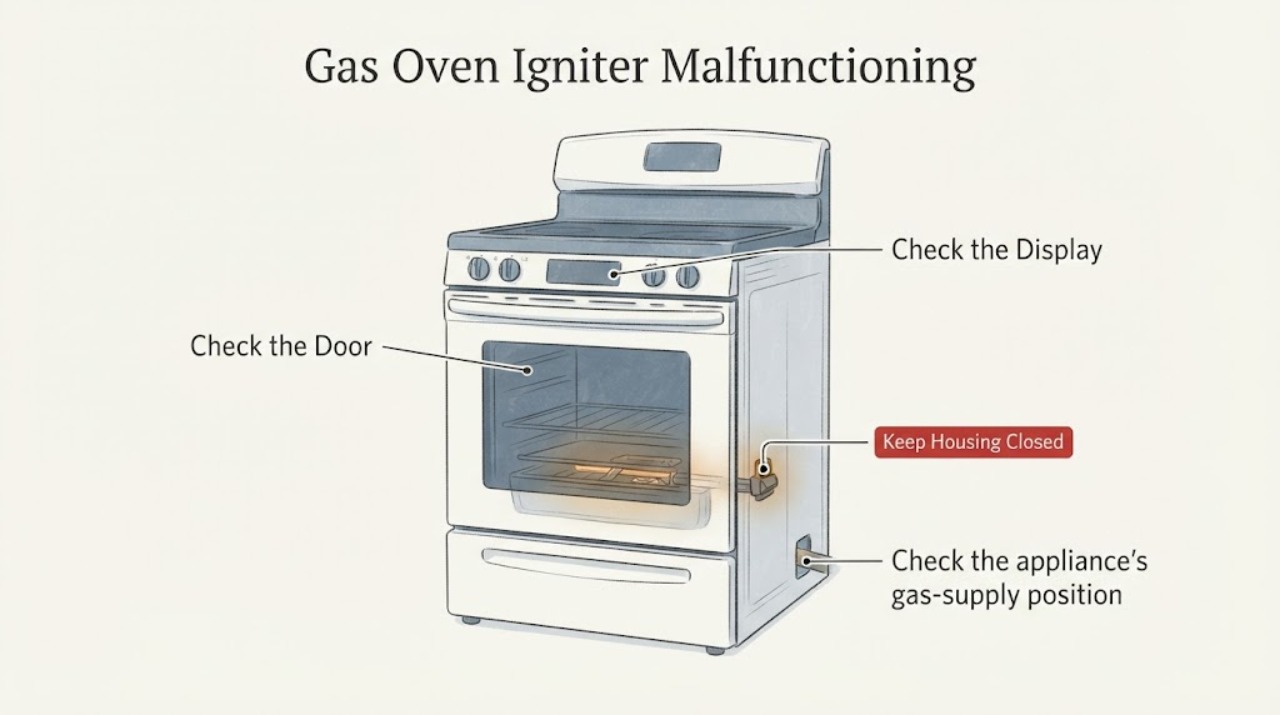
Work through in order
Diagnostic checks
Use only checks that match the exact appliance or system and its official guide.
-
Check 1
Before any ignition observation, ask whether there is a rotten-egg/unburned-gas odor, a boom, flame rollout, a blown-open door, or another abnormal flame event.
Expected result: A gas odor or delayed-ignition sign is present, or none is present.
Next step: If any danger sign is present, do not light the oven or touch switches/phones inside; clear the area, call the gas supplier or fire department from outside or a neighbor’s phone, and keep the appliance out of use. Continue only when no danger sign is present.
Why this matters
Why: GE treats unburned gas as abnormal and identifies a boom or blown-open door as delayed ignition requiring service or a gas professional.
-
Check 2
With no emergency sign, confirm the intended Bake or Broil function, correct knob positions, and household power using only the visible controls, breaker/fuse, and model installation instructions.
Expected result: The control is mis-set, a knob was reinstalled incorrectly, the breaker/fuse is off, or the settings and power appear correct.
Next step: Correct only the accessible setting or restore power according to the manual, then make one normal start attempt. If power repeatedly trips or controls remain wrong, stop and arrange service.
Why this matters
Why: A control or supply condition can prevent ignition without proving an igniter failure. Correct settings and power do not prove that internal ignition components are working.
-
Check 3
Check the appliance’s gas-supply position only as shown by the exact installation instructions; on a new installation, do not guess at an unclear regulator lever.
Expected result: The model instructions show the gas supply on, the supply is off/unclear, or the oven is new and the top burners work while the oven does not.
Next step: If the position is off or unclear, stop and have the installer or qualified gas-appliance service verify it. Do not adjust an unidentified regulator or gas connection yourself.
Why this matters
Why: GE says a gas supply or regulator condition can prevent the oven from heating even when top burners work. An unclear valve or regulator is an installation/service question, not a reason to open the range.
-
Check 4
Only if the oven is safe to start and there is no gas odor, select Bake, start it, open the door, and look toward the rear bottom for the red Glo-Bar glow described by GE; do not touch or dismantle anything.
Expected result: A red glow is visible, no glow is visible, or the oven produces an abnormal sound/odor while starting.
Next step: For no glow or no heat, stop the experiment and schedule service. For any abnormal sound or odor, stop immediately and use the gas-safety path. Never perform a live electrical test.
Why this matters
Why: A visible glow shows that the Glo-Bar is energized, but it does not prove the gas valve, flame, temperature control, or full ignition sequence is normal. No glow may involve the Glo-Bar, controls, or another electrical component. An abnormal sound or odor overrides the visual check.
-
Check 5
For a model with a self-clean latch or Sabbath Mode, compare the state with the exact owner manual; do not force a latch or invent a button sequence from another GE model.
Expected result: The latch is locked, Sabbath Mode may be active, or neither condition applies/has been confirmed.
Next step: Follow only the matching owner manual. If the oven still will not ignite, record the model, function, glow result, and any odor/noise and arrange qualified service.
Why this matters
Why: GE identifies an unlocked latch and model-specific Sabbath Mode as possible operating conditions. The absence of a confirmed mode does not diagnose the igniter.
-
Check 6
Give GE or qualified gas-appliance service the full model number, fuel type, Bake/Broil selection, burner behavior, visible glow result, breaker/power result, gas-supply observation, and any odor or delayed-ignition event.
Expected result: The oven still will not ignite, no glow was observed, the glow is present but no heat follows, or an abnormal ignition event occurred.
Next step: Keep the oven out of use and arrange GE/Bodewell or qualified gas-appliance service. Do not remove the oven bottom, bridge a safety device, replace an igniter without the exact manual, or test energized wiring.
Why this matters
Why: GE’s family guidance does not identify a compatible igniter, valve, control, or safe internal repair from the symptom alone.
Use your observations
Decision map
Find the observation that best matches what you see, then follow the next safe action.
-
PATH 01Next step
What you see
You smell unburned gas, hear a boom, see flame rollout, or the oven door blows open.
Do this next
Do not try to light the appliance or touch switches inside. Open doors/windows only if safe, clear the area, and call the gas supplier or fire department from outside or a neighbor’s phone.
Why this path and its safety boundary
Why it matters: This is a gas-safety or delayed-ignition condition, not a routine igniter-cleaning problem.
-
PATH 02Next step
What you see
The oven controls and power are correct, gas supply is confirmed by the exact installation instructions, and the Glo-Bar does not show the expected red glow.
Do this next
Stop user diagnosis and arrange qualified GE or gas-appliance service. Do not measure voltage or remove the igniter.
Why this path and its safety boundary
Why it matters: GE says the Glo-Bar, oven control, or another electrical component may be malfunctioning; the observation does not select one part.
-
PATH 03Next step
What you see
The Glo-Bar glows red, but the oven does not ignite or heat.
Do this next
Stop repeated start attempts and arrange service with the model number and glow result.
Why this path and its safety boundary
Why it matters: The igniter is energized, but the full ignition sequence is not proven; the gas valve, control, supply, or another component may need professional diagnosis.
-
PATH 04Next step
What you see
The top burners work but the gas oven does not, especially after a new installation.
Do this next
Have the exact installation instructions and gas-supply/regulator position checked by the installer or qualified service; do not reach into the appliance.
Why this path and its safety boundary
Why it matters: GE identifies a possible regulator or oven gas-supply condition in addition to the oven ignition path.
-
PATH 05Next step
What you see
The oven works after correcting a control, power, latch, or documented mode condition and there is no gas odor or abnormal sound.
Do this next
Monitor one normal cycle and keep the exact model manual with the appliance; arrange service if the ignition symptom returns.
Why this path and its safety boundary
Why it matters: The symptom was consistent with an operating-state or supply condition, so an igniter failure was not established.
Helpful context
Understand the symptom
“Igniter malfunctioning” describes a symptom, not a confirmed failed igniter. GE uses Glo-Bar igniters in gas ovens and says a missing red glow can reflect the Glo-Bar, oven controls, or other electrical components. The no-model scope supports safe external checks and a service handoff, but not an igniter part number or internal test.
Stop first for gas or delayed-ignition signs
Do not continue trying to light the oven if you smell unburned gas, hear a boom, see flame rollout, or the oven door blows open. GE says unburned gas is not normal, and its gas-safety guidance directs you to open doors or windows, avoid switches and phones inside, extinguish open flames, clear the area, and call the gas supplier or fire department from outside or a neighbor’s phone.
Confirm the requested oven function and power
If there is no gas odor or abnormal ignition event, confirm that the control is set to Bake or Broil as intended and that any knobs removed for cleaning are back in their correct positions. Check the household breaker or fuse and the range power connection only according to the installation and owner instructions; do not remove panels or probe wiring.
Check the gas supply without dismantling the appliance
GE says to verify that the gas shutoff is on using the installation instructions for the model. On a new gas-range installation, GE also notes that a regulator lever may have been jarred to OFF even while the top burners still work. Do not reach into the appliance or adjust an unclear regulator; use the exact installation instructions or service.
Use the Glo-Bar glow only as an observation
With the oven otherwise safe to observe and no gas odor, follow GE’s limited visual check: select Bake, start the oven, open the door, and look toward the back of the oven for a red glow. No glow means the ignition sequence needs service attention; it does not prove the Glo-Bar is the only failed component. Do not touch the burner, remove the oven bottom, measure voltage, or try to light the oven manually.
Use the exact model manual for model-specific states
A self-clean latch must be in the unlocked position on applicable ranges, and Sabbath Mode can change expected behavior on models that have it. These are model-specific checks. If the controls, latch, power, gas supply, and visual observation do not restore operation, provide the full model number and stop at the service boundary.
When checks do not resolve it
Need a professional?
Arrange GE/Bodewell or qualified gas-appliance service if the oven still will not ignite after the documented control, power, gas-supply, and visual checks, if the Glo-Bar does not glow, if it glows but no flame or heat follows, or if a boom, flame abnormality, persistent gas odor, or repeated breaker trip occurs. Gas odor or delayed ignition requires immediate stop-use and gas-professional/emergency handling.
Safety scope: Do not light the oven manually, remove the oven bottom or control panel, measure energized wiring, bypass a safety device, or substitute an igniter from a similar GE model. Stop use and use gas-emergency guidance for unburned-gas odor or delayed ignition.
Have this ready
- Full model and serial details, fuel type, Bake/Broil selection, whether top burners work, power/breaker result, gas-supply observation, whether the Glo-Bar glowed, and any gas odor, boom, flame rollout, or door movement.
Common questions
FAQ
Does no red glow prove the GE oven igniter is bad?
No. GE says no red glow may indicate a Glo-Bar, oven-control, or another electrical-component malfunction. Without the exact model and professional testing, the symptom does not select a replacement part.
Can I keep trying to start a GE gas oven that does not ignite?
Do not keep trying if you smell unburned gas, hear a boom, see flame rollout, or the door blows open. GE treats those as gas-safety or delayed-ignition conditions. Clear the area and use the gas-supplier or emergency path.
What can I check without opening a GE gas oven?
Confirm Bake or Broil, visible power/breaker status, gas supply only according to the exact installation instructions, and—when there is no gas odor or abnormal ignition—the visual red glow check described by GE. Do not measure voltage or remove panels.
Why do the surface burners work while the GE gas oven does not?
GE identifies a possible oven gas-regulator or oven-specific ignition condition on some new installations even when top burners work. Have the exact installation instructions and appliance checked by the installer or qualified service instead of adjusting an unclear regulator yourself.
Read the exact guide
Official sources
- Gas Range & Wall Oven - Oven Will Not Come OnGE Appliances · Opened GE official support guidance for a gas range or wall oven that will not come on. Used for controls, power, gas supply, visual Glo-Bar observation, latch/mode boundaries, and service; exact model manual governs model-specific states.
- Gas Range - Oven Does Not Heat, But The Burners HeatGE Appliances · Opened GE official support guidance for gas-range oven ignition/heating with working top burners. Used for regulator/new-installation context, controls, Glo-Bar observation, and service boundary; no model-specific part or internal procedure is claimed.
- If You Smell Gas in Your HomeGE Appliances · Opened GE official gas-safety guidance. Used only for emergency stop-use, evacuation, no-switch/no-phone-inside, and gas-supplier/fire-department direction.
- Gas Range - What is Normal Operation vs What Requires ServiceGE Appliances · Opened GE official gas-range guidance. Used for normal Glo-Bar cycling and gas-odor distinction, delayed-ignition warning signs, yellow-flame/service boundary, and qualified-service escalation.
Community feedback
Share a repair observation
Share a plain-text repair observation. Accepted observations are published automatically; this page may take a moment to update.