
On this page
Start here
Quick answer
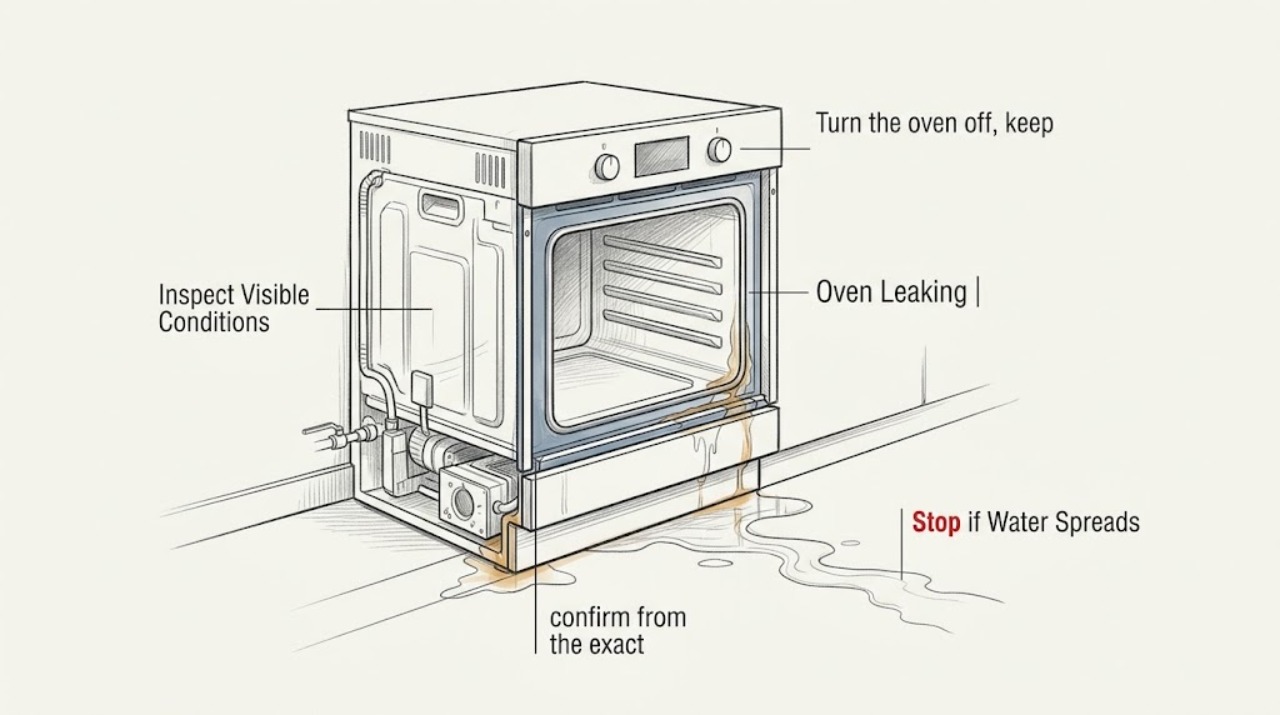
First identify what is leaking and where it appears. Water in or below the oven after a GE Steam Clean cycle can be expected because the cycle uses water and may leave moisture behind; wipe it up only when the oven is cool. Steam from the vent or moisture around the door can also be normal during cooking, especially with high-moisture food, but liquid running from the cabinet, a wet control area, damage to the door or cavity, or moisture that returns when the oven is cold needs service. A gas smell is not a liquid leak: do not ignite the oven, touch electrical switches, or search for the leak yourself; move away from the area and contact the gas supplier or emergency service using a safe route outside. Stop using the oven for smoke, fire, sparking, a strong gas odor, a door that will not close, liquid near energized controls, or any sign of overheating. Use the exact GE model manual for normal venting, cleaning, and service limits.
Work through in order
Diagnostic checks
Use only checks that match the exact appliance or system and its official guide.
-
Check 1
Turn the oven off, keep people away, and from a safe position classify the symptom as clear water, greasy or food liquid, steam or condensation, smoke, or a gas-like odor; do not touch a hot surface or use a flame to identify it.
Expected result: There is smoke, fire, sparking, a strong gas odor, a hot liquid near controls, a damaged door or cavity, or only cool clear moisture with no hazard sign.
Next step: For smoke or fire, leave the oven off and follow local emergency guidance. For gas odor, leave the area, avoid switches and flames, and contact the gas supplier from outside. For a cool, nonhazardous liquid, wait until the oven is fully cool and continue with the source check.
Stop if: Stop for gas odor, fire, smoke, sparking, scorching, liquid at energized controls, a broken door or liner, or any need to open panels.
Why this matters
Why: The substance and location determine the next safe path. Fire, gas, electrical, and burn hazards override routine cleaning checks.
-
Check 2
If the liquid appeared after Steam Clean, confirm from the exact GE manual that the appliance has that feature, note whether the cycle completed, and inspect the oven floor only after the oven is cool; do not add more liquid or cleaning chemicals.
Expected result: A Steam Clean cycle recently completed and a small amount of water remains on the floor, or liquid is present outside the cavity, in the door, around the controls, or after no Steam Clean cycle.
Next step: Wipe only accessible moisture from the cool cavity with a suitable cloth. If water reached the controls, cabinet, floor below the unit, or returns after drying, leave the oven off and arrange GE or qualified appliance service.
Stop if: Stop for water near controls or wiring, a wet cabinet, a cracked liner, a door that will not close, or a leak that continues while the oven is off and cool.
Why this matters
Why: Water remaining on the cavity floor after Steam Clean can be part of the documented process. Water outside the intended cavity or recurring liquid without that cycle points to a seal, door, vent, liner, drain path, or installation issue.
-
Check 3
After the oven is cool, identify the documented oven-vent location for the GE model and look for a moisture trail from the vent, condensation around the door glass, or liquid emerging from a different seam; do not block the vent or remove trim.
Expected result: Moisture is limited to the vent or door glass after cooking high-moisture food, or a liquid trail comes from the cabinet, lower drawer, side seam, or control area.
Next step: If moisture is limited to the documented vent or door-glass area and dissipates after cooling, wipe accessible surfaces and monitor. If liquid exits a seam, reaches cabinetry, or persists while cold, stop use and arrange service.
Stop if: Stop for moisture inside the control area, liquid on electrical parts, a vent obstruction, a loose or damaged door, or any need to disassemble the door or cabinet.
Why this matters
Why: GE describes vent steam and cooking condensation as possible normal operation. A liquid trail outside those paths suggests a component, installation, or seal problem that cannot be identified safely from appearance alone.
-
Check 4
Review what was cooked and which cleaning or cooking mode ran, including high-moisture food, a spill, Steam Clean, or another cycle; compare the observed quantity and location with the exact GE model instructions rather than assuming every liquid is a plumbing leak.
Expected result: The liquid matches a food spill or documented Steam Clean moisture, or it appears without a spill or cleaning cycle and collects under or behind the oven.
Next step: When the oven is cool, remove only loose food residue and wipe accessible interior moisture as directed by the manual. Do not pour water into vents, remove panels, or use a self-clean cycle to burn off an unknown liquid. Arrange service for recurring or external leakage.
Stop if: Stop for liquid under the appliance, moisture in insulation or controls, a chemical odor, a damaged liner, or any request to use an unapproved cleaner or water amount.
Why this matters
Why: Food and cleaning water can be sources inside the cavity, while repeated fluid below or behind the appliance suggests a separate leak path, drain issue, seal problem, or damage.
-
Check 5
If the oven is gas-powered and the symptom is an odor rather than visible liquid, do not light anything, do not operate electrical switches, and do not attempt a leak test; move to fresh air and contact the gas supplier or emergency service using a safe route outside.
Expected result: The odor is unburned-gas or rotten-egg-like, the oven has delayed ignition or a boom, the door moves unexpectedly, or the odor is only a brief combustion smell at startup and then disappears.
Next step: For unburned gas odor or delayed ignition, leave the appliance off and follow gas-supplier or emergency instructions. Do not return to test the burner. For a brief normal startup odor with no other symptom, use the exact model manual and arrange service if it persists or changes.
Stop if: Stop for unburned gas odor, delayed ignition, boom, flame outside the intended burner area, yellow or unstable flame, or any need to adjust gas pressure or fittings.
Why this matters
Why: GE says unburned gas odor in the home is not normal. Delayed ignition and door movement require service. A short startup combustion odor is different, but recurring or uncertain odor should be treated as unsafe.
-
Check 6
Record the complete GE model number, whether it is a range or wall oven, fuel type, cycle and cleaning mode, exact leak location, substance appearance, timing, photographs from a safe position, and whether moisture returns while the oven is cold.
Expected result: The moisture cleared after a documented cool-down and wipe, or the leak persists, reaches the cabinet or controls, returns without cooking, or is accompanied by a gas, smoke, heat, or electrical symptom.
Next step: If the cause is not clearly normal condensation or documented Steam Clean moisture, leave the oven off and arrange qualified appliance service. Provide the model and evidence so the technician can inspect the correct path without unsafe trial-and-error.
Stop if: Stop DIY work for door removal, panel removal, gas components, wiring, cavity repair, seal replacement requiring disassembly, or a leak that cannot be safely isolated.
Why this matters
Why: A repeatable external leak or any safety symptom needs diagnosis of the door, seal, vent, liner, steam-clean system, gas safety components, or installation; a one-time documented condensation pattern may be normal.
Use your observations
Decision map
Find the observation that best matches what you see, then follow the next safe action.
-
PATH 01Next step
What you see
An unburned-gas or rotten-egg-like odor, delayed ignition, boom, or unexpected door movement occurs.
Do this next
Arrange qualified service and follow the exact model guidance.
Why this path and its safety boundary
Why it matters: Do not ignite the oven or touch electrical switches. Move away, extinguish open flames only if safe without entering the odor area, and contact the gas supplier or emergency service from outside.
-
PATH 02Next step
What you see
A small amount of water remains on the cavity floor after a documented Steam Clean cycle, with no wet controls or cabinet.
Do this next
Arrange qualified service and follow the exact model guidance.
Why this path and its safety boundary
Why it matters: Wait until cool and wipe the remaining moisture as the exact GE manual directs. Do not add extra water or cleaner. Persistent external moisture needs service.
-
PATH 03Next step
What you see
Steam appears at the documented vent or temporary condensation forms around the door after cooking moisture-rich food and then clears.
Do this next
Arrange qualified service and follow the exact model guidance.
Why this path and its safety boundary
Why it matters: Treat it as a possible normal operating pattern, keep the vent clear, and monitor. Service is needed if liquid runs from another seam, enters controls, or persists while cold.
-
PATH 04Next step
What you see
Liquid collects below, behind, beside, or inside the control area, or returns without cooking or Steam Clean.
Do this next
Arrange qualified service and follow the exact model guidance.
Why this path and its safety boundary
Why it matters: Leave the oven off, keep nearby cabinetry dry if safe, document the location, and arrange qualified appliance service. Do not remove panels or pour water into vents.
-
PATH 05Next step
What you see
The door, glass, liner, seal, vent, control panel, or surrounding cabinet is damaged, excessively hot, scorched, or wet near electrical parts.
Do this next
Arrange qualified service and follow the exact model guidance.
Why this path and its safety boundary
Why it matters: Stop use and arrange service. Do not operate self-clean, force the door, or attempt a seal or panel repair without model-specific qualified instructions.
-
PATH 06Next step
What you see
The moisture fully clears after cooling and matches the exact manual's documented venting, condensation, or Steam Clean behavior.
Do this next
Arrange qualified service and follow the exact model guidance.
Why this path and its safety boundary
Why it matters: Monitor the next use without blocking the vent. Stop and request service if the quantity, location, odor, or timing changes.
Helpful context
Understand the symptom
A visible drip is not the same as normal steam
Look at the liquid before wiping it: clear water after Steam Clean, condensation around the door, and vapor at the vent have different explanations from greasy liquid, a wet control panel, or fluid appearing while the oven is cold. Do not touch a hot surface to identify it. Take a photograph from a safe position and wait for the oven to cool before checking the cavity floor or door area.
Steam and condensation can follow normal cooking
GE explains that food with substantial water content can create moisture and that vented steam may appear near the control panel. Moisture between door panes can also occur and should dissipate after cooking. Persistent liquid outside the intended vent path, moisture in the controls, or water that returns without cooking is not something to diagnose by removing the door or panels.
Steam Clean leaves a specific water pattern
On models with Steam Clean, GE directs the user to add water only when the oven is cool and notes that water may remain on the floor after the cycle. Wipe the remaining moisture after the cycle has ended and the oven is safe to touch. Do not add extra water, mix cleaners into the cycle, or run Steam Clean when the door, control panel, liner, or wiring area is wet or damaged.
Gas odor requires a separate emergency path
A gas odor is not a water leak and must not be confirmed with a flame or by operating controls. GE distinguishes a short combustion odor at startup from unburned gas odor and directs users with unburned gas odor to ventilate without touching electrical switches or open flames, then contact the gas supplier from outside. A gas oven with delayed ignition, a boom, door movement, or persistent odor needs qualified gas service.
Only after diagnosis
Potential parts
Only after exact-model inspection confirms a damaged or misaligned door path is allowing liquid or steam to escape abnormally; do not remove the door by guesswork.
Only when the model-specific diagnosis identifies an abnormal vent, cleaning-system, or liner path rather than normal condensation or documented Steam Clean water.
Only for a gas model after qualified gas-appliance service confirms a delayed-ignition, flame, or gas-safety fault; never test or adjust these parts at home.
When checks do not resolve it
Need a professional?
Liquid runs from the cabinet, below or behind the oven, into the controls, or returns while the oven is cold., The oven door, glass, seal, liner, vent, or surrounding cabinet is damaged, loose, scorched, or no longer closes correctly., Moisture or a leak persists after a documented Steam Clean cycle has ended and the oven has cooled., A gas odor is persistent, resembles unburned gas, or is accompanied by delayed ignition, a boom, unstable flame, or unexpected door movement., There is smoke, fire, sparking, unusual heat, a wet receptacle or control area, or any electrical symptom., Diagnosis would require removing panels or the door, working on gas fittings or ignition, opening wiring, altering a seal, or adding unapproved water or cleaner.
Common questions
FAQ
Why is water in the bottom of my GE oven?
If it follows a GE Steam Clean cycle, some water may remain on the cool oven floor and should be wiped up after the cycle. Water that appears below, behind, in the controls, or without Steam Clean needs service rather than more cleaning water.
Is steam around a GE oven door a leak?
Not necessarily. GE says cooking moisture can create condensation around the oven door and steam can come from the vent. It should clear after cooking; liquid running from a cabinet seam or moisture that returns while cold is a service symptom.
What should I do if my GE gas oven smells like gas?
Do not light the oven, touch electrical switches, or search for the leak. Move away and follow GE's gas-safety guidance by ventilating only when safe and contacting the gas supplier or emergency service from outside. Do not return to test the burner.
Can I run self-clean to remove water or a spill?
Do not use a cleaning cycle to investigate an unknown leak. When cool, wipe only accessible residue as the exact model manual allows. Do not add unapproved water or cleaner, and request service for liquid outside the cavity or a damaged liner or door.
When should I stop using a leaking GE oven?
Stop for gas odor, smoke, fire, sparks, scorching, unusual heat, liquid near controls, a damaged door or liner, persistent external leakage, or any need to remove panels, alter a seal, or work on gas or electrical parts. Arrange qualified service.
Read the exact guide
Official sources
- Gas Range - What is Normal Operation vs What Requires ServiceGE Appliances · Opened official GE support article; exact model and fuel conversion status control the applicable procedure.
- Contact Your Local Gas Company If You Smell GasGE Appliances · Opened official GE support article; emergency instructions from the local gas supplier and authorities take precedence.
- Range - Moisture Build-Up on Cooktop Surface or Around the DoorGE Appliances · Opened official GE support article; exact oven model and installation instructions take precedence.
- Range & Wall Oven - Steam or Smoke Near Control PanelGE Appliances · Opened official GE support article; vent location varies by range or wall-oven design.
- Range & Wall Oven - Steam CleanGE Appliances · Opened official GE support article; only models equipped with the documented Steam Clean option follow this path.
- Gas Range - Gas OdorsGE Appliances · Opened official GE support article; applies to gas cooking appliances and does not replace local emergency or gas-supplier instructions.
Community feedback
Share a repair observation
Share a plain-text repair observation. Accepted observations are published automatically; this page may take a moment to update.