
On this page
Start here
Quick answer
The GE PGS950SEF1SS is a Profile slide-in front-control double-oven gas range, so an upper-oven Bake failure with Broil still working is not an electric bake-element diagnosis by itself. First confirm that the upper cavity—not the lower oven—is selected, that Bake, temperature, and Start are correct, and that no self-clean latch or other mode is preventing operation. GE's gas-range guidance says conventional Bake uses the bottom bake burner and Broil uses only the top broil burner; therefore a working Broil does not prove that the upper Bake burner, ignition sequence, gas path, or control is healthy. Make one normal, supervised check only if there is no gas odor, smoke, sparking, or abnormal ignition. Do not open panels, probe wiring, touch hot burners, or choose a bake burner/igniter from the symptom alone.
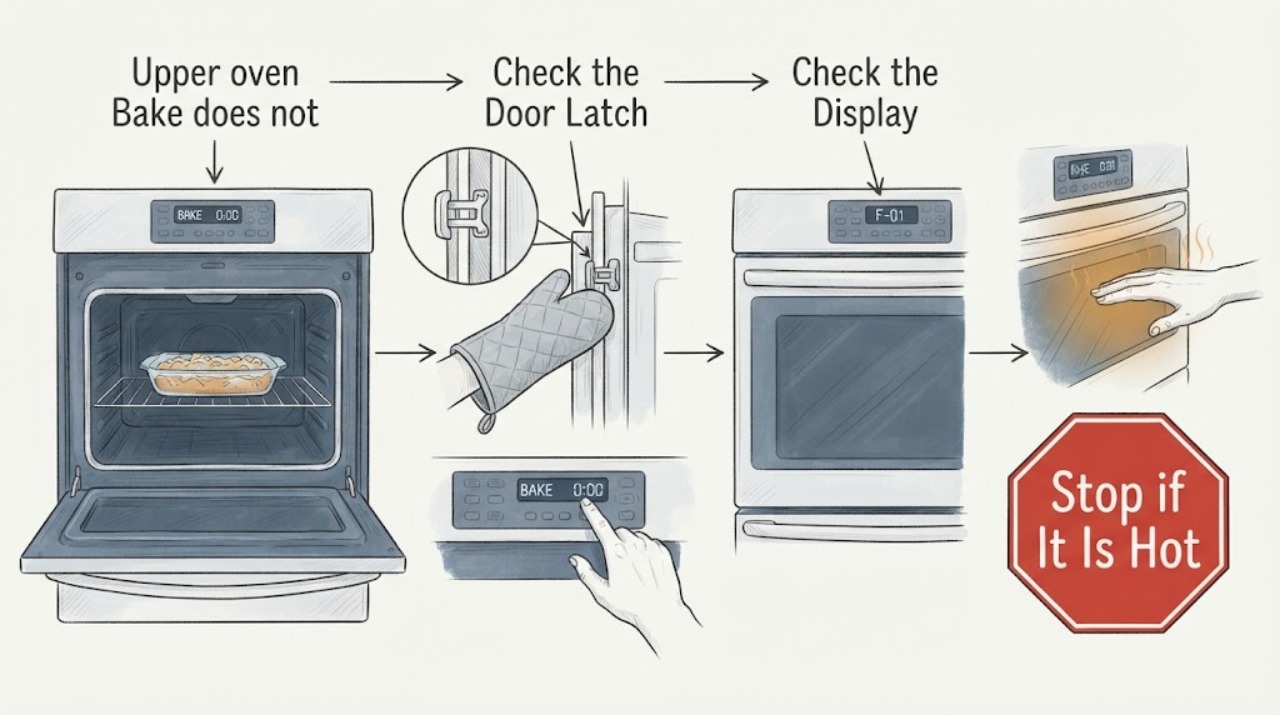
Work through in order
Diagnostic checks
Use only checks that match the exact appliance or system and its official guide.
-
Check 1
Read the rating/model label and record PGS950SEF1SS exactly. Confirm whether the failure is in the upper cavity, note whether the lower oven and surface burners work, and photograph the complete display before resetting anything.
Expected result: The label and upper/lower cavity are clear, the model is a different suffix, or the user is not sure which oven was selected.
Next step: Keep the exact model and selected cavity with the service record. Use only the controls and instructions that belong to that model; do not apply an electric-element procedure or a lower-oven conclusion to the upper oven.
Stop if: Stop if the model cannot be confirmed, a gas odor is present, or the appliance has visible damage; do not move the range or open a panel to find the label.
Why this matters
Why: GE's PGS950SEF1SS record identifies a gas double-oven range with separate upper and lower oven assemblies. A suffix or cavity mismatch can send the diagnosis to the wrong manual or burner path; working surface burners also do not prove that the oven will heat.
-
Check 2
With the upper oven cool, select the upper oven's normal Bake function, enter an ordinary temperature, press Start if the controls require it, and verify that the self-clean latch is fully unlocked. Note whether the display starts a Bake cycle, whether the lower oven was accidentally selected, and whether a special mode or fault is shown.
Expected result: Bake starts in the upper cavity, the wrong cavity/mode or missing Start caused the no-heat report, the latch is locked, or the correct command starts but the cavity remains cold.
Next step: Correct only the visible setting or latch condition described by the model instructions and make one normal test. If upper Bake still remains cold, do not keep cycling it; continue with external checks and service preparation.
Stop if: Do not force the latch, bypass a lock, enter a service mode, or continue a cycle with gas odor, smoke, delayed ignition, a boom, sparking, or abnormal flame.
Why this matters
Why: On a double oven, selecting the wrong cavity is a separate first-check failure. GE also lists incorrect Bake/Broil settings and a locked self-clean door as causes of an oven that appears not to work. A correct upper Bake command with no heat moves the case toward the gas ignition/power/service branch.
-
Check 3
From outside the appliance, check the house breaker/fuse status and whether the range display and interior light have power. If the appliance is newly installed, have the installer or a qualified person verify the gas shutoff/regulator and installation; do not pull the slide-in range or remove the storage drawer to inspect a connection.
Expected result: The display is dead, a breaker is tripped, the range is hardwired or the cord is inaccessible, the surface burners work while the oven does not, or all external power and gas conditions appear normal.
Next step: If a breaker was clearly tripped and there is no hazard, restore it once without opening anything. If it trips again, power is uncertain, the gas installation is unclear, or the range is hardwired, leave the oven off and arrange qualified appliance/electrical service.
Stop if: Do not repeatedly reset a breaker, open a live panel, move a gas range, alter wiring, or access a regulator without a qualified installer or technician.
Why this matters
Why: GE notes that surface burners can work while an oven does not, and that a regulator or installation condition can affect oven heating. A repeated breaker trip or uncertain gas/electrical access is not a homeowner part diagnosis.
-
Check 4
Only if there is no gas odor, smoke, delayed ignition, or other hazard, make one normal upper-Bake observation from a safe position as the GE instructions describe. Note whether the upper cavity shows a prompt, stable igniter glow and heat, no glow, delayed ignition, flame failure, or no warming; do not reach into the cavity or remove the oven bottom.
Expected result: Bake heats normally, there is no glow, ignition is delayed, the flame goes out, the oven remains cold while Broil works, or a boom/smoke/odor occurs.
Next step: If upper Bake remains cold, or the glow/ignition is abnormal, turn the oven off and arrange qualified gas-appliance service with the exact model, cavity, mode, and observation. Do not order a bake burner, igniter, relay, or control from this observation alone.
Stop if: Stop immediately for gas odor, delayed ignition, a boom, flame failure, smoke, sparking, or abnormal heat. Leave the area and contact the gas supplier or emergency services from a safe location when an unburned-gas hazard is suspected.
Why this matters
Why: GE says no Glo-Bar glow can indicate an igniter, on/off control, or another electrical malfunction, but a glow alone does not prove safe gas flow or identify a specific failed part. GE's mode explanation confirms that Bake and Broil call different burners, so Broil operation cannot rule out an upper Bake-path fault.
-
Check 5
If the upper oven warms but seems slow or uneven rather than completely cold, allow the model-specific preheat to finish once and record the set temperature, elapsed time, rack position, cookware, door openings, and actual food result. Do not compensate by leaving the gas oven on indefinitely.
Expected result: The oven reaches temperature after a normal preheat, loses heat when the door is opened or blocked, remains far below the setting, or repeatedly shuts down/ignites abnormally.
Next step: Use the owner's cooking guidance for rack and cookware placement. If the upper oven remains materially cold or unstable, stop testing and request model-specific diagnosis rather than changing hidden calibration or parts.
Stop if: Do not keep testing if the oven emits gas odor, smoke, sparking, burning smell, abnormal heat, or a repeated fault.
Why this matters
Why: Slow or uneven baking is different from no heat and can reflect normal cycling, preheat conditions, cookware, rack placement, or heat loss. A persistent large temperature problem or abnormal ignition needs service; it is not proof of a bake burner or thermostat failure.
-
Check 6
Prepare a service record with the exact model, upper/lower cavity, Bake and Broil results, display or fault text, breaker history, surface-burner status, ignition timing, and any odor, smoke, flame, or temperature observation. Do not repeat failed Bake cycles just to make a recording.
Expected result: The problem is repeatable with correct upper-Bake settings and no external installation explanation, or a safety symptom is present.
Next step: Keep the oven out of service and give the record to GE or a qualified gas-appliance technician. Ask for a model-specific diagnosis and safe repair scope; do not authorize a guessed cross-model part.
Stop if: Stop operation for gas odor, smoke, sparking, abnormal ignition, exposed wiring, repeated breaker trips, or a hot control area.
Why this matters
Why: A repeatable cavity-specific failure is enough to request a diagnosis, but it still does not identify which burner, igniter, regulator, wiring, or control is defective. Safety symptoms require immediate isolation rather than more data collection.
Use your observations
Decision map
Find the observation that best matches what you see, then follow the next safe action.
-
PATH 01Next step
What you see
The exact model is PGS950SEF1SS, the upper cavity is confirmed, and Bake begins heating after the correct cavity/mode/Start or latch condition is corrected.
Do this next
Monitor one normal cooking cycle. If upper Bake again stays cold, record the full sequence and use service rather than repeatedly resetting or entering special modes.
Why this path and its safety boundary
Why it matters: The original no-heat report was more consistent with selection or operating state than a proven failed Bake component.
-
PATH 02Next step
What you see
Upper Broil works, but correctly selected upper Bake remains cold or fails to ignite while surface burners and display remain available.
Do this next
Turn upper Bake off and arrange qualified gas-appliance service with the model and the exact cavity/mode result. Do not buy or replace a bake burner, igniter, relay, or board solely from this pattern.
Why this path and its safety boundary
Why it matters: GE's gas-range documentation uses separate top Broil and bottom Bake burners, so Broil working does not clear the selected cavity's Bake burner, ignition sequence, gas regulation, wiring, or control. The symptom narrows the branch but does not name a part.
-
PATH 03Next step
What you see
The display or surface burners are also dead, a breaker trips again, or power/gas installation access is uncertain.
Do this next
Leave the range off and use qualified appliance/electrical or gas-installation service. Do not move the range, open panels, alter wiring, or repeatedly reset a breaker.
Why this path and its safety boundary
Why it matters: The problem may involve house power, range wiring, controls, or gas installation rather than an isolated upper Bake path. A single reset cannot establish a repair.
-
PATH 04Next step
What you see
Bake produces a glow or brief heat but ignition is delayed, the flame fails, the oven stays far below temperature, or the issue recurs after a correct command.
Do this next
Turn the oven off and request qualified gas-appliance service. Provide the ignition timing, cavity, display, and temperature observations; do not relight, adjust, or remove a burner.
Why this path and its safety boundary
Why it matters: A glow or partial warming does not prove safe combustion or identify the failed component. Recurrence is a service diagnosis, not a reason to keep running high-temperature tests.
-
PATH 05Next step
What you see
Gas odor, a boom, repeated delayed ignition, smoke, sparking, abnormal heat, exposed wiring, or a repeated breaker trip occurs.
Do this next
Stop using the range. Leave the area for a suspected gas release and contact the gas supplier or emergency services from a safe location; for electrical smoke/sparking, isolate power only if it can be done without exposure and obtain qualified service.
Why this path and its safety boundary
Why it matters: This is a gas or electrical safety event, not an ordinary Bake-versus-Broil troubleshooting branch.
Helpful context
Understand the symptom
This model identity changes the first decision. PGS950SEF1SS is a gas double-oven range, not a generic electric wall oven. Confirm the upper cavity and its control selection before interpreting the result. On GE gas ranges, conventional Bake and Broil use different burners: Bake calls the lower burner in the selected cavity, while Broil calls the top burner. A successful Broil test therefore narrows the symptom but does not establish that the Bake burner, ignition, gas regulation, or control is good.
Keep the observation low-risk. Record which cavity, mode, temperature, and Start command were used, and whether the display shows a fault or the oven door is locked. A gas odor, delayed ignition, boom, flame failure, smoke, sparking, or abnormal heat is a stop condition—not a reason to keep comparing Bake and Broil. Do not remove the oven bottom, reach toward a burner or igniter, move the range, or test live wiring.
When checks do not resolve it
Need a professional?
Request model-specific service for persistent upper-oven Bake no-heat after the cavity and controls are confirmed, or immediately for abnormal ignition, gas, smoke, electrical, or repeated-breaker symptoms.
Have this ready
- Provide PGS950SEF1SS exactly, the country/market if known, upper versus lower cavity, Bake temperature and Start sequence, whether Broil and surface burners work, display/fault text, self-clean-latch state, breaker history, ignition timing, and any gas odor, flame, smoke, or temperature observation.
Common questions
FAQ
If Broil works, does that prove the Bake burner or igniter is bad?
No. GE says conventional gas Bake ignites the bottom bake burner and Broil ignites only the top broil burner. Broil working shows that one mode can heat; it does not identify the upper Bake burner, ignition, gas, wiring, or control fault.
Could I simply be using the wrong oven on this double range?
Yes, that is a safe first check. The PGS950SEF1SS model record identifies separate upper and lower oven assemblies. Confirm the upper cavity, Bake mode, temperature, Start command, and an unlocked self-clean latch before treating the result as a component failure.
Can I remove the oven bottom to watch the Bake burner?
Do not remove panels or the oven bottom as a homeowner diagnostic, and do not touch a burner or igniter. Limit the check to the normal controls and a safe observation from outside the cavity. No glow, delayed ignition, flame failure, or persistent no heat belongs with qualified gas-appliance service.
What information will help a technician diagnose the upper Bake failure?
Give the exact PGS950SEF1SS model, selected cavity, Bake and Broil results, surface-burner status, display or fault text, breaker history, whether a normal Start command was used, ignition timing, and any gas odor, flame, smoke, or temperature evidence. This supports diagnosis without guessing a part from the symptom.
Read the exact guide
Official sources
- FAQs | Ranges & OvensGE Appliances · GE range and oven control, preheat, temperature, and safety FAQ applicable at symptom level to PGS950SEF1SS.
- Gas Range - Convection Baking and RoastingGE Appliances · GE gas-range Bake and Broil burner-operation guidance applied to PGS950SEF1SS mode comparison.
- Gas Range - Oven Does Not Heat, But The Burners HeatGE Appliances · GE gas-range no-heat troubleshooting for PGS950SEF1SS symptom-level checks.
- Model Search | PGS950SEF1SSGE Appliances · GE Appliances exact model identity for PGS950SEF1SS: Profile Series 30-inch slide-in front-control double-oven gas range, with upper and lower oven assemblies.
Community feedback
Share a repair observation
Share a plain-text repair observation. Accepted observations are published automatically; this page may take a moment to update.