
On this page
Start here
Quick answer
First identify whether this is a GE electric oven or a gas oven, then confirm the selected Bake or Broil function, temperature, Start command, self-clean latch, and any model-specific Sabbath mode. If the display is dead, a breaker is tripped, the power cord is loose, or the breaker trips again, stop and arrange qualified appliance service rather than repeatedly resetting it. For an electric oven, with power fully isolated and the oven cool, you may visually inspect the lower bake element for a crack or break; do not touch wiring or work inside a live appliance. For a gas oven, surface burners working does not prove that the oven ignition path is healthy: a normal red-hot igniter is a visual clue, but no glow, delayed ignition, a boom, gas odor, or an abnormal flame requires service. Stop immediately for gas smell, smoke, burning-plastic odor, sparking or arcing, exposed wiring, repeated breaker trips, or a door that cannot close. Do not bypass controls, relight a failed ignition system, adjust a burner, or replace a part by appearance alone.
Before you begin
Safety first
- Do not use the oven for gas odor, delayed ignition, boom, flare-up, smoke, burning-plastic odor, sparking or arcing, exposed wiring, repeated breaker trips, or visible element damage. Do not bypass controls, adjust gas parts, relight a failed ignition system, probe live circuits, or replace a part without model-specific diagnosis.
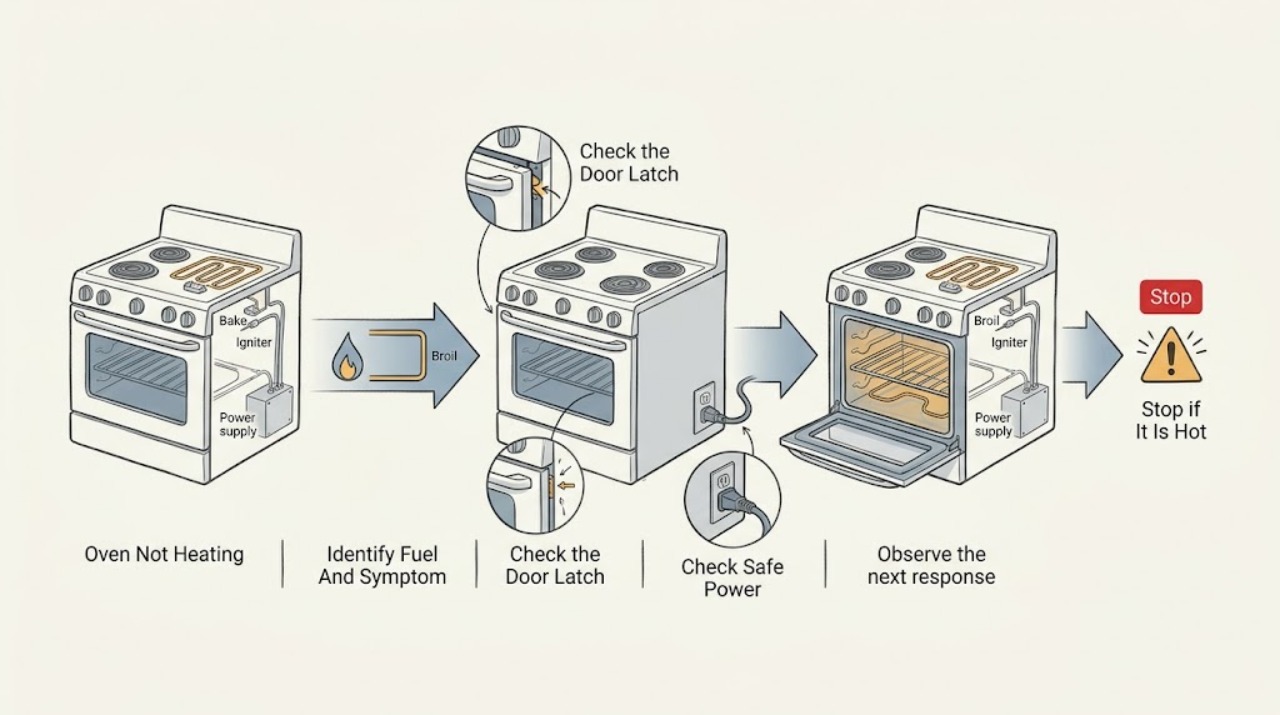
Work through in order
Diagnostic checks
Use only checks that match the exact appliance or system and its official guide.
-
Check 1
Identify whether the GE appliance is an electric oven or a gas oven, and record whether the display, interior light, and surface burners (if present) work. Do not remove panels or move a gas range to inspect its connection.
Expected result: The display is live, the surface burners work or do not work, the appliance is fully dead, or the fuel type is uncertain.
Next step: Use the model manual or rating information to choose the electric or gas branch. If there is a gas odor, smoke, electrical smell, exposed wiring, or immediate danger, stop and follow the emergency stop branch.
Stop if: Do not move a gas appliance, open a cabinet, or investigate an unknown fuel system with a flame or live measurement.
Why this matters
Why: A working display or surface burner does not prove that the oven heating circuit or gas ignition path is healthy. A fully dead appliance points first to power or control conditions, while uncertain fuel identity requires the model documentation before further checks.
-
Check 2
With the oven cool, select the model-supported Bake or Broil function and a normal temperature, press Start if the controls require it, and check that a self-clean latch is unlocked and Sabbath mode is not active when the model has those features.
Expected result: The oven starts a normal cycle, the controls were mis-set, the latch was locked, Sabbath mode was active, or the oven still does not heat after a correct command.
Next step: Correct only the settings or latch position described by the model manual and make one normal test. If it remains cold, stop repeated cycling and continue to the appropriate power or element/igniter check.
Stop if: Do not force a latch, bypass a control lock, or keep running a cycle with smoke, gas odor, sparking, or abnormal noise.
Why this matters
Why: A wrong function, missing Start command, lock, or special mode can make an otherwise healthy oven appear not to heat. A correct command with no heat moves the diagnosis to power and fuel-specific components.
-
Check 3
For a non-gas-smell situation, check the house breaker or fuse status and the range power cord only as the model installation instructions permit. Before any visual maintenance check, turn the appliance circuit off or remove the fuse and verify the oven is cool.
Expected result: The breaker or fuse is normal, a breaker is tripped, the cord is visibly loose when safely accessible, the oven is hardwired, or the breaker trips again after reset.
Next step: If the model instructions make it safe and the trip was isolated, restore power once and test normally. If it trips again, remains dead, or power access is unclear, keep the oven off and arrange qualified appliance service.
Stop if: Do not repeatedly reset a breaker, open a live panel, probe terminals, alter wiring, or continue after an electrical smell or visible damage.
Why this matters
Why: A tripped circuit can prevent heating even when a light or clock works, but a repeated trip indicates an electrical or component fault. A hardwired wall oven or inaccessible cord is not a homeowner inspection point.
-
Check 4
Only for an electric GE oven, after power is fully isolated and the oven is cool, make a visual inspection of the user-accessible lower bake element for a crack, break, rupture, or scorch mark. Do not touch terminals, wiring, or the element sheath.
Expected result: The bake element is intact, visibly cracked or broken, ruptured or scorched, or cannot be safely accessed without removing panels.
Next step: If visibly failed, leave the oven unused and provide a photo and full model to qualified service for the correct part and repair. If intact or inaccessible, continue no further inside the appliance and request diagnosis.
Stop if: Do not energize a visibly failed element, pull it from the rear, test resistance on an uncertain circuit, or replace it by appearance alone.
Why this matters
Why: GE identifies a cracked or broken bake element as a replacement/service condition. A spark, rupture, burning-plastic odor, or breaker trip can indicate a failed or shorted element; an intact appearance does not prove the element or control is good.
-
Check 5
If the electric oven has no visible damage, power is stable, and there is no smoke, odor, or sparking, make one supervised Bake test from a safe position. Observe whether the lower bake element heats or glows in the model's normal cycle without opening the door repeatedly.
Expected result: The element heats and cycles, the oven remains cold, only the broil element heats, the element sparks, or a burning odor appears.
Next step: If it heats but temperature remains abnormal, verify full preheat and cookware/rack conditions once. If it stays cold or shows a fault, stop using the oven and arrange service.
Stop if: Stop immediately for arcing, smoke, a burning-plastic smell, a breaker trip, exposed wiring, or a ruptured element; do not repeat the test.
Why this matters
Why: GE explains that the bake element normally glows red when heating, while elements cycle and broil behavior varies by model. No heat, sparking, or odor indicates a component or electrical fault rather than normal cycling.
-
Check 6
Only for a GE gas oven with no gas odor, smoke, or abnormal ignition history, select Bake and observe the oven Glo-Bar igniter from the normal safe viewing position described by GE. Do not reach into the oven, adjust the burner, or remove a panel.
Expected result: The igniter shows a normal red glow and the burner lights promptly, there is no glow, ignition is delayed, the flame goes out, or a boom or gas odor occurs.
Next step: For no glow or any abnormal ignition, turn the oven off without further testing and arrange qualified gas-appliance service. For a prompt stable light but no heat, service is still needed to assess burner, gas supply, sensor, or control causes.
Stop if: Do not relight a failed burner, hold a valve open, use a match, repeat a delayed ignition, or open the door after suspected gas accumulation.
Why this matters
Why: GE says no red glow can indicate a Glo-Bar, control, or other electrical malfunction. A glow alone does not prove gas flow or safe combustion; delayed ignition, a boom, flame failure, or gas odor is an immediate stop condition.
-
Check 7
If the oven warms but cooking is slow or uneven and no safety symptom is present, allow the model's full preheat, avoid frequent door openings, and verify that foil, pans, and racks are not blocking heat circulation. Compare results only after a normal preheat.
Expected result: The oven reaches usable heat after full preheat, temperature varies within normal cycling, or the oven remains cold or far below the selected function.
Next step: If heat is present but results remain wrong, use the exact model manual for calibration or request service. If there is no heat, return to the electric-element or gas-ignition service branch.
Stop if: Do not calibrate around a failed element or gas fault, cover the entire rack with foil, or run the oven with smoke, odor, sparking, or a door that will not close.
Why this matters
Why: GE says elements cycle on and off and that measurement can be affected by door openings, thermometer placement, cookware, and rack position. Remaining cold after a normal cycle is not explained by normal temperature cycling.
-
Check 8
Stop and prepare a service handoff for any gas odor, delayed ignition, boom, flame failure, smoke, burning-plastic odor, sparking or arcing, visible element damage, repeated breaker trip, exposed wiring, or persistent no-heat condition after the permitted checks.
Expected result: A clear hazard is present, or the oven remains cold even though settings, power, and the safe visible checks appear normal.
Next step: Keep the oven out of service and contact qualified appliance service. If gas is suspected, leave and contact the gas supplier or emergency services from outside; give the technician the model, fuel type, symptoms, and observations.
Stop if: Do not continue cooking, open panels, test live circuits, adjust gas components, bypass controls, or repeat an unsafe ignition or electrical test.
Why this matters
Why: The remaining cause may be an element, igniter, burner, sensor, thermostat, control, wiring, latch, gas supply, or another model-specific issue. These cannot be selected safely from a generic symptom or repaired by bypassing a safety device.
Use your observations
Decision map
Find the observation that best matches what you see, then follow the next safe action.
-
PATH 01Safety boundary
What you see
Bake or Broil, temperature, Start, self-clean latch, or a model-specific Sabbath mode was incorrect and no safety symptom is present.
Do this next
Correct the setting using the model manual and make one normal supervised test.
Why this path and its safety boundary
Why it matters: The oven may not have been commanded to heat rather than having a failed heater.
Safety stop: Stop for gas odor, smoke, burning smell, sparking, repeated breaker trips, or abnormal ignition.
-
PATH 02Safety boundary
What you see
An electric oven is dead, a breaker or fuse is abnormal, power is uncertain, or the breaker trips again.
Do this next
Leave the oven off and arrange qualified appliance or electrical service, especially after a repeat trip or visible damage.
Why this path and its safety boundary
Why it matters: Power supply, wiring, controls, or a shorted heater may be involved; a single reset cannot establish a repair.
Safety stop: Do not open a live panel, probe terminals, alter wiring, or reset repeatedly.
-
PATH 03Safety boundary
What you see
An electric bake element is cracked, broken, ruptured, sparking, or fails to heat during a safe supervised test.
Do this next
Stop using the oven and have the full model and element observation assessed by qualified service before replacement.
Why this path and its safety boundary
Why it matters: GE identifies a failed element as a no-heat/service condition; sparking or burning odor can indicate a short or rupture.
Safety stop: Do not energize, touch, pull, or replace the element from an uncertain or live circuit.
-
PATH 04Safety boundary
What you see
A gas oven has no igniter glow, no prompt ignition, a flame failure, a boom, or persistent no heat while surface burners may still work.
Do this next
Turn the oven off and arrange qualified gas-appliance service without attempting a relight or adjustment.
Why this path and its safety boundary
Why it matters: The oven's igniter, control, burner, gas supply, or other ignition component may be faulty; surface burners do not clear the oven fault.
Safety stop: Do not use a match, hold a valve open, repeat delayed ignition, or open the door to inspect suspected accumulated gas.
-
PATH 05Safety boundary
What you see
Unburned-gas odor, hissing, repeated delayed ignition, a flare-up, or gas flowing without prompt safe combustion is suspected.
Do this next
Leave immediately, avoid switches, flames, and phones in the area, and contact the gas supplier or emergency services from a safe location. Keep the oven out of service until cleared.
Why this path and its safety boundary
Why it matters: Treat the situation as a gas emergency rather than a normal no-heat diagnosis.
Safety stop: Do not operate the oven, move the range, open the door to investigate, or re-enter until the responsible authority says it is safe.
-
PATH 06Safety boundary
What you see
The oven warms but appears slow or uneven, with no gas, electrical, smoke, or element-failure symptom.
Do this next
Allow a full model-specific preheat, correct visible cookware or rack issues, and use the manual's temperature guidance. Request service if the oven remains far below temperature.
Why this path and its safety boundary
Why it matters: Normal cycling, incomplete preheat, cookware, rack position, door openings, or heat loss may affect results; this differs from no heat.
Safety stop: Do not continue testing if a safety symptom appears or compensate for a failed heater by raising the temperature indefinitely.
-
PATH 07Safety boundary
What you see
The oven remains cold after correct settings, stable power, and the permitted visual checks, or the fault cannot be safely classified.
Do this next
Keep the oven out of service and arrange qualified GE appliance diagnosis with the full model and recorded observations.
Why this path and its safety boundary
Why it matters: A sensor, thermostat, control, wiring, latch, burner, element, igniter, or model-specific issue remains possible and cannot be selected by symptom alone.
Safety stop: Do not disassemble the appliance, bypass a safety device, or substitute an unverified part.
Helpful context
Understand the symptom
Start by separating a setting problem from a heating fault
An oven that is not heating may actually be waiting for a Start command, set to the wrong function, locked by a self-clean latch, or operating in a model-specific Sabbath mode. A temperature that seems low is also different from no heat: GE explains that elements cycle on and off during normal baking and that preheating uses a model-dependent sequence. Confirm the symptom without repeatedly opening the door or deliberately running an unsafe cycle. If the oven is completely cold after a normal preheat attempt, continue with the fuel-specific checks below.
Electric and gas ovens need different observations
For an electric GE oven, the lower bake element may show a crack or break when power is disconnected and the oven is cool. During a normal bake cycle, the bake element commonly glows red when it is heating, although the broil element can cycle differently. For a gas GE oven, surface burners can work while the oven does not; GE points to the oven controls, gas supply, and Glo-Bar igniter as separate checks. Looking for the igniter's red glow is only an observation from a safe position, not permission to remove a burner or adjust the gas system.
A failed element or ignition sequence changes the stop decision
A visible crack, break, sparking, or burning-plastic odor at an electric element is not a normal preheat variation. GE says an element can short against its sheath, trip a fuse or breaker, stop heating, or spark briefly and recommends not using the oven when the element fails. In a gas oven, no igniter glow, delayed ignition, a boom, a flame that goes out, or gas odor can indicate a failure in ignition, controls, gas supply, or combustion. Do not repeat a delayed start or open a gas oven door to investigate accumulated gas.
Power isolation is a boundary, not a repair instruction
GE's consumer guidance says to remove power before inspecting an electric bake element or doing maintenance, and to check the breaker, fuse, or cord only with the circuit disconnected as applicable. A wall oven or range may be hardwired, and a clock or light can remain on while the heating circuit has another fault. Only perform a cold, visual check that the model instructions explicitly make user-accessible. Do not remove panels, probe live terminals, bypass a thermal fuse or control, or reset a breaker that trips again.
Do not mistake slow preheat for zero heat
If the oven eventually warms but cooks slowly or unevenly, check that it was fully preheated, that the cookware and rack position allow heat circulation, and that the door gasket is not torn. GE notes that elements cycle during baking, temperature readings vary with door openings and thermometer placement, and a bake element may malfunction. Do not use a recipe result alone to condemn a component; if a normal preheat never produces heat, or the bake element does not heat as expected, stop using the oven and arrange model-specific service.
Gas odor and combustion symptoms override every ordinary check
If you smell unburned gas, hear an unexplained hiss, see a delayed ignition, experience a boom or flare-up, or see a flame go out while gas may still be flowing, stop. Do not operate switches, use a flame, relight the oven, open the door to look for the cause, or repeat the cycle. Leave the area and contact the gas supplier or emergency services from a safe location. The gas range and oven should remain out of service until the responsible authority or a qualified gas-appliance technician says it is safe.
Give service the exact symptom instead of a guessed part
For a service call, record the full GE model, electric or gas fuel type, selected function, set temperature, whether the display and surface burners work, whether the breaker tripped, what the bake element looked like with power isolated, whether a gas igniter glowed, and whether there was an odor, spark, smoke, or delayed ignition. A technician can then distinguish settings, supply power, heating element, igniter, burner, sensor, control, latch, wiring, and other model-specific causes. Do not order a bake element, igniter, thermostat, or control solely because it is commonly associated with a no-heat symptom.
Only after diagnosis
Potential parts
- electric oven bake element
Consider this category only when an electric oven's power-isolated visual inspection or qualified diagnosis confirms a cracked, broken, ruptured, or failed bake element.
Confirm the full GE model, element shape, terminals, wattage, and manufacturer fit information; do not order by appearance alone or work on a live circuit. - gas oven Glo-Bar igniter
Consider this category only after a qualified diagnosis links no glow, weak ignition, or a failed ignition sequence to the igniter rather than the control, gas supply, burner, or wiring.
Confirm the full GE model, fuel type, igniter specification, and installation procedure; gas ignition work and combustion safety require qualified service.
When checks do not resolve it
Need a professional?
Safety scope: Do not use the oven for gas odor, delayed ignition, boom, flare-up, smoke, burning-plastic odor, sparking or arcing, exposed wiring, repeated breaker trips, or visible element damage. Do not bypass controls, adjust gas parts, relight a failed ignition system, probe live circuits, or replace a part without model-specific diagnosis.
Common questions
FAQ
Why does my GE oven not heat even though the burners work?
Surface burners and the oven use different heating and ignition paths. For an electric model, check the correct function and, with power isolated, inspect the bake element for a crack or break. For a gas model, the Glo-Bar, burner, controls, or gas supply can fail while the surface burners still work. Persistent no heat requires model-specific service.
What can I safely check on a GE electric oven that is not heating?
Confirm Bake or Broil, temperature, Start, an unlocked self-clean latch, and any model-specific Sabbath mode. With the oven cool and its power fully isolated, you may make a visual check of an accessible lower bake element for a crack or break. Do not open panels, touch wiring, or test a live circuit.
What does a red glow mean on a GE gas oven igniter?
GE uses a red-glowing Glo-Bar as a visual clue during a gas-oven check. No glow may indicate an igniter, control, or electrical problem, but a glow does not prove safe gas flow or combustion. Delayed ignition, a boom, flame failure, or gas odor means stop and arrange qualified gas service.
Can I keep using a GE oven if the bake element sparks?
No. GE says a failed element can rupture, spark, trip a breaker, stop heating, or produce a burning-plastic odor, and recommends not using the oven when an element fails. Leave it off and arrange qualified service; do not repeat the test or touch the element.
Why is my GE oven slow to heat but not completely cold?
Elements cycle during normal operation, and preheat time, door openings, cookware, rack position, foil, and heat loss can affect results. Allow a full model-specific preheat and correct visible circulation issues once. If the oven remains far below temperature or a heater does not operate, arrange service.
What should I do if my GE gas oven smells like gas while it is not heating?
Treat unburned-gas odor or hissing as an emergency. Do not operate switches, use a flame, relight the oven, open the door to investigate, or repeat the cycle. Leave and contact the gas supplier or emergency services from a safe location. Keep the appliance out of service until cleared.
When should I call service for a GE oven that is not heating?
Arrange service for persistent no heat after correct settings and permitted checks, a failed or visibly damaged element, no gas-oven igniter glow, a breaker that trips again, an inaccessible component, or any need to open panels. Stop immediately for gas odor, delayed ignition, a boom, smoke, burning-plastic odor, sparking, arcing, or exposed wiring.
Read the exact guide
Official sources
- Range & Wall Oven - Oven Temperature Is Not CorrectGE Appliances · GE Appliances temperature guidance for ranges and wall ovens; model-specific manual instructions control calibration.
- Gas Range Delayed Ignitions - Tests and Examinations of RangesU.S. Consumer Product Safety Commission · CPSC engineering report about gas-range ignition hazards; it does not diagnose a particular GE oven or replace local emergency guidance.
- Electric Range - Oven Doesn't Heat But Burners Do HeatGE Appliances · GE Appliances support guidance for electric ranges; the exact model manual and qualified service control a specific appliance.
- Range & Wall Oven - Oven Will Not Come OnGE Appliances · GE Appliances support guidance for ranges and wall ovens; exact model installation and owner documentation control safe access.
- Range & Wall Oven - Oven Heating Element FailureGE Appliances · GE Appliances support guidance for ranges and wall ovens; service diagnosis is required for a particular element or circuit.
- Gas Range - Oven Does Not Heat, But The Burners HeatGE Appliances · GE Appliances support guidance for gas ranges; model-specific manuals and qualified gas service control installation and repair.
- Electric Range & Wall Oven - Bake and Broil Element OperationGE Appliances · GE Appliances operation guidance; element behavior varies by model and selected function.
Community feedback
Share a repair observation
Share a plain-text repair observation. Accepted observations are published automatically; this page may take a moment to update.