
On this page
Start here
Quick answer
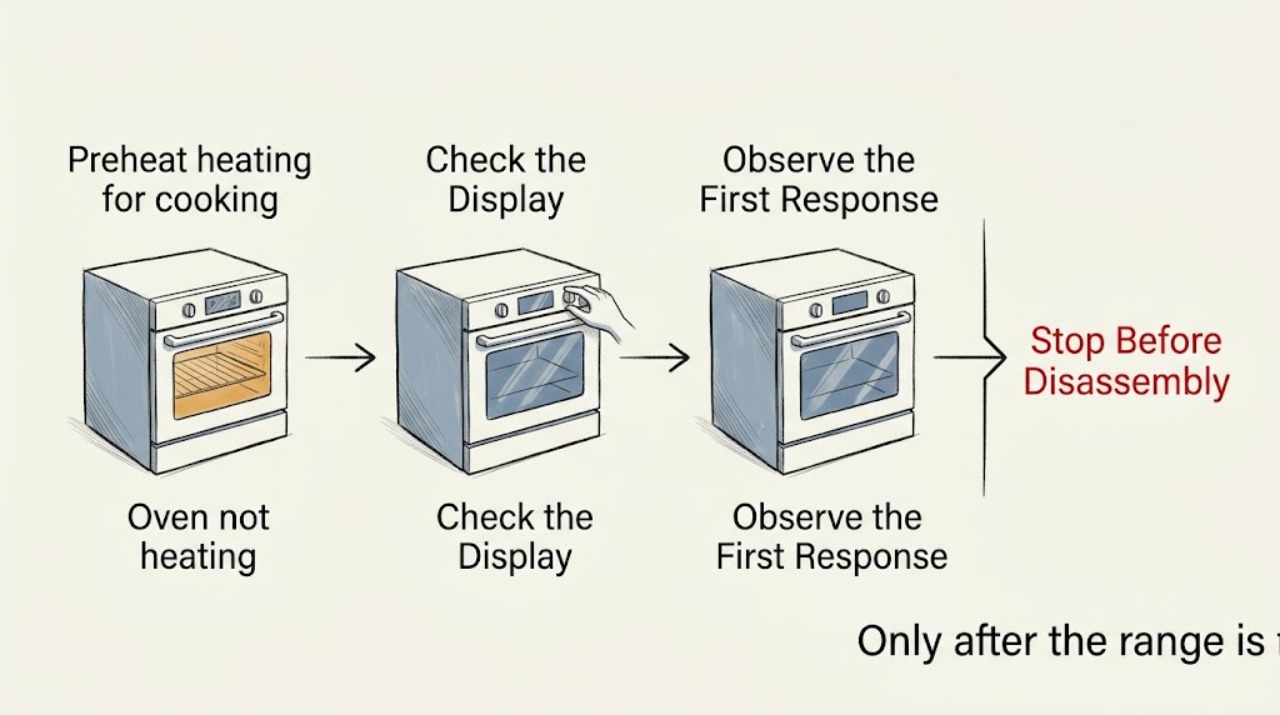
Treat a GE Spectra JBP68H0D1CC oven that made a loud pop, released smoke, and then stopped heating as an electrical or fire-safety event, not as ordinary slow preheating. Turn the oven controls off and do not reset the range, re-energize it, or run another Bake test. If smoke, flames, sparking, a strong burning odor, or visible damage is still present, leave the area and obtain emergency help from a safe location. If the event has stopped, keep the range out of use, note the breaker and control status only from a safe position, and arrange qualified appliance or electrical service; do not remove panels or guess at a heating element, control, or wiring repair.
Work through in order
Diagnostic checks
Use only checks that match the exact appliance or system and its official guide.
-
Check 1
Turn the oven and cooktop controls to Off from the normal user position and stop using the range. Do not press Bake again, reset the appliance to see whether it recovers, open a panel, or reach behind the range.
Expected result: Smoke, flames, sparking, a strong burning odor, abnormal heat, or a damaged control or cord remains present; or the event has ended and the range is quiet.
Next step: For active smoke, flames, or dangerous heat, leave the area and contact emergency help from a safe location. Otherwise leave the range unused and continue only with safe external documentation for qualified service.
Why this matters
Why: Continuing smoke, heat, or visible electrical damage is an active hazard. Even when the smoke stops, the preceding pop and smoke mean that a later successful start would not prove the range is safe.
-
Check 2
From a safe standing position, note whether the display, clock, interior light, and cooktop controls are still operating, and whether the range's breaker or fuse appears tripped. Do not cross smoke or heat to reach the panel, pull the range forward, or repeatedly reset protection.
Expected result: The controls are fully dead, only some functions work, the breaker or fuse is tripped, or the controls appear normal even though the oven no longer heats.
Next step: Leave a tripped breaker or fuse in its present safe state rather than repeatedly restoring power. Give the control and breaker observations to qualified appliance or electrical service without opening the range.
Why this matters
Why: A dead or partly powered range can involve the supply, wiring, control, or a shorted load; a working clock or cooktop does not clear the oven heating circuit. A normal-looking control panel after a smoke event does not establish a safe repair.
-
Check 3
Only after the range is cool and there is no smoke or odor, look from the front and sides at user-visible areas for soot, melted plastic, a scorch mark, or a visibly damaged cord or receptacle. Do not remove the storage drawer, lift the cooktop, move the range, or remove a rear cover for this check.
Expected result: A scorch, melted area, damaged cord or receptacle, exposed wiring, or no external damage is visible.
Next step: Keep the range out of use in either case. Photograph only what is safely visible and provide it with the complete model number to the service technician; do not buy a replacement part from appearance alone.
Why this matters
Why: Visible damage confirms that the event needs professional inspection but does not identify which internal part caused it. No visible damage does not rule out an internal short, failed element, control, or terminal connection.
-
Check 4
Record the exact model and serial information from the rating label without moving the range, along with the selected function, approximate temperature, timing of the pop, where smoke appeared, breaker behavior, and which functions still work. Do not reproduce the event to obtain more information.
Expected result: The full model is available; only a partial or unreadable model is available; or the event details are uncertain.
Next step: Give the full model and event record to qualified appliance or electrical service. If the model cannot be confirmed, ask the technician to verify the rating label and platform before any component is ordered or replaced.
Why this matters
Why: GE's parts guidance says a complete model number is needed to select the applicable model and parts list. A partial identity or an assumed JBP68 variant can lead to the wrong manual or part, while an uncertain event history should be treated conservatively.
Use your observations
Decision map
Find the observation that best matches what you see, then follow the next safe action.
-
PATH 01Next step
What you see
Smoke, flames, sparking, strong burning odor, abnormal heat, or visible electrical damage is still present, or the area cannot be approached safely.
Do this next
Leave immediately, avoid switches and the appliance, and contact emergency services or the responsible electrical authority from a safe location. Do not re-enter or reset the range until it is cleared.
Why this path and its safety boundary
Why it matters: This is an active fire or electrical safety situation, not a preheat diagnosis. GE identifies sparking, breaker trips, and burning-plastic odor as possible failure results that require service.
-
PATH 02Next step
What you see
The event has stopped, but the breaker is tripped, the display is dead or partly dead, a scorch mark is visible, or the oven remains cold.
Do this next
Keep the range de-energized when safely possible and arrange qualified appliance or electrical service. Do not reset protection repeatedly, open the rear panel, or perform live measurements.
Why this path and its safety boundary
Why it matters: The pattern is consistent with a power, wiring, control, or heating-load fault, but it does not distinguish an element from a terminal, control, or another internal failure.
-
PATH 03Next step
What you see
The event has stopped and no external damage is visible, but the oven no longer heats or the cause of the pop and smoke is uncertain.
Do this next
Do not run another Bake or Broil cycle to confirm the symptom. Provide the complete model and event record to qualified service and let the technician identify the failed circuit before parts are selected.
Why this path and its safety boundary
Why it matters: A quiet range or working clock does not clear an internal electrical or heating fault. The safety event overrides the normal no-heat workflow's supervised test.
Helpful context
Understand the symptom
Why this is not a normal preheat delay
A short delay or cycling sound can occur during normal heating, but a loud pop followed by smoke and loss of heat is a different pattern. GE's range failure guidance documents sparking, a tripped breaker, and a burning-plastic odor as possible results of an electrical element failure and directs the owner to service. That does not prove whether the oven element, control, terminal, or wiring failed on this exact model, so the event should not be used to select a part.
When checks do not resolve it
Need a professional?
Keep the GE range out of use and arrange qualified appliance or electrical service after any loud pop followed by smoke and loss of heat, even if the display or cooktop still works. Seek emergency help from a safe location for continuing smoke, flames, sparking, strong burning odor, exposed wiring, dangerous heat, or suspected fire. Do not reset the range to test it, remove covers, perform live measurements, or order an element or control before the complete model and failure circuit are verified.
Common questions
FAQ
Can I reset the breaker once to see whether the oven works again?
Not for this event pattern. A reset after a loud pop and smoke can re-energize a damaged load without identifying the fault. Leave the range out of use and have the event assessed by qualified service.
Does a working clock prove the oven is safe?
No. A clock or cooktop can remain powered while the oven heating circuit, control, terminal, or wiring has a fault. The smoke and pop require a professional inspection regardless of which other functions still operate.
Read the exact guide
Official sources
- GE Appliance Parts - Accessing Parts List or DiagramGE Appliances · GE model-specific parts lookup and the requirement to use the complete model number before selecting a parts list.
- User Manual & Care for JBP68HHCC | GE AppliancesGE Appliances · Opened JBP68-family support reference showing a GE 30-inch free-standing electric range and model-specific manual support; it is not used to assert a suffix-specific part or procedure for JBP68H0D1CC.
- Range Surface Unit FailureGE Appliances · GE range electrical failure symptoms and service boundary; it documents rupture, sparking, breaker trips, and burning-plastic odor but does not diagnose the assigned oven model's internal component.
- Range - No Power; Not Coming OnGE Appliances · GE range external power-status guidance and the limit of model-specific service support; used here only for safe observation of controls and breaker status, not for a post-smoke reset.
Community feedback
Share a repair observation
Share a plain-text repair observation. Accepted observations are published automatically; this page may take a moment to update.