
On this page
Start here
Quick answer
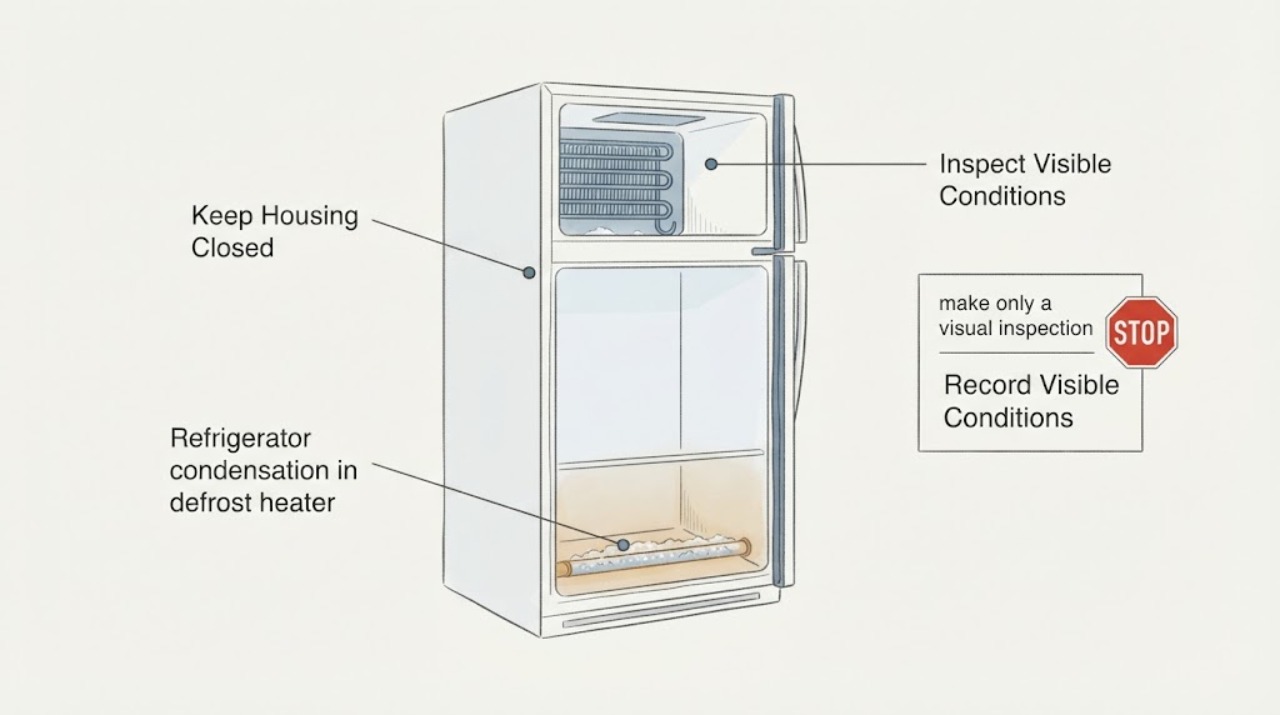
GE identifies WR51X10055 as a refrigerator defrost-heater assembly, but this number is a part number rather than the refrigerator's full appliance model. GE's opened refrigerator manual says that during a defrost cycle, water dripping onto the heater can make a hissing or sizzling sound, so visible meltwater around an energized defrost heater can be part of normal defrosting. That statement does not prove that moisture inside a sealed heater tube is normal. Stop the defrost work, disconnect power only when safe, let the area cool, and arrange model-matched service if the tube is cracked, cloudy, wet at its terminals, scorched, or the actual refrigerator model and heater fit cannot be confirmed.
Before you begin
Safety first
- Do not energize an exposed or wet heater, open a sealed heater tube, bridge a thermostat or defrost control, pull electrical terminals, or perform owner electrical measurements. Stop immediately for a cracked tube, exposed conductor, scorching, burning odor, water at electrical connections, repeated breaker operation, or water that reaches the cabinet wiring.
Work through in order
Diagnostic checks
Use only checks that match the exact appliance or system and its official guide.
-
Check 1
Stop the defrost inspection and record the complete refrigerator model from the rating label, along with WR51X10055 if that is the marking on the heater. Confirm whether the part is the GE refrigerator defrost-heater assembly and whether the refrigerator is still connected to power.
Expected result: The refrigerator model is known and the component is identified as WR51X10055, or only the part number is known and the appliance model or component identity is uncertain.
Next step: If the appliance model is uncertain, stop comparing tubes or ordering parts and obtain the exact model documentation. If the identity is confirmed, continue only with the power-off, cool, external observations below.
Why this matters
Why: GE identifies WR51X10055 as a refrigerator defrost-heater assembly but directs users to the appliance model to confirm fit. A part number alone cannot establish that the installed heater belongs in the refrigerator or that the observed tube construction is correct.
-
Check 2
With the refrigerator disconnected from power only when it is safe to do so, observe where the moisture is: on the surrounding evaporator or pan, on the outside of the heater while frost is melting, inside a sealed tube, or at a connector or terminal. Do not touch the heater while it may be hot and do not energize it to reproduce the observation.
Expected result: Meltwater is visibly contacting the outside of the heater during defrost, or moisture appears trapped inside the tube or around an electrical connection.
Next step: For ordinary external meltwater with no damage, allow the defrost cycle to finish and keep the area dry afterward. For internal-looking moisture, terminal wetness, or uncertainty, leave power off and arrange qualified appliance service.
Why this matters
Why: GE's manual supports water dripping onto the heater as a normal defrost-cycle event that may hiss or sizzle. It does not support treating moisture inside a sealed heater tube or at its electrical connection as the same harmless event.
-
Check 3
After the area is cool and power is isolated, make only a visual inspection for a cracked or broken tube, clouding, scorch marks, melted supports, exposed conductors, loose connectors, or water that remains after the surrounding frost has melted. Do not remove the heater, pull terminals, or perform electrical measurements as an owner check.
Expected result: The tube and supports are intact and dry after defrost, or there is a crack, persistent internal clouding or moisture, scorching, exposed conductor, loose connector, or repeated frost that does not clear.
Next step: Keep the refrigerator powered off for visible damage, wet terminals, or exposed conductors and arrange qualified service. Do not select a heater or thermostat replacement until the actual refrigerator model and the complete defrost circuit are confirmed.
Why this matters
Why: An intact dry assembly with normal external defrost water does not prove the heater is electrically healthy, but visible damage or persistent moisture moves the problem beyond a normal condensation question. Repeated frost can also reflect a defrost-system fault that the tube appearance alone cannot identify.
-
Check 4
After a normal, dry visual result, monitor the refrigerator through its normal operation without opening the evaporator area again. Note whether cooling returns, frost accumulates abnormally, water reaches the drain pan, or the heater area shows the same internal-looking moisture on a later defrost event.
Expected result: Cooling and defrost drainage remain normal with no visible damage, or frost, water, odor, heat damage, or moisture inside the tube returns.
Next step: Arrange service for recurring or combined symptoms and provide the refrigerator model, heater marking, location of moisture, and whether it appeared during or after defrost. Do not keep opening the sealed heater to watch it operate.
Why this matters
Why: A single observation of external meltwater is consistent with the manual's normal defrost description. Recurrence of internal-looking moisture or a cooling/defrost symptom means the normal-water explanation is insufficient and the system needs model-specific diagnosis.
Use your observations
Decision map
Find the observation that best matches what you see, then follow the next safe action.
-
PATH 01Next step
What you see
The actual refrigerator model is confirmed, the heater tube and terminals are intact and dry, and the only observation is meltwater contacting the outside of the heater during defrost.
Do this next
Allow the cycle to finish and monitor for normal cooling and drainage. Do not replace the heater solely because external defrost water touched it.
Why this path and its safety boundary
Why it matters: This matches GE's documented normal defrost event: water can drip onto the heater and produce a hissing or sizzling sound.
-
PATH 02Next step
What you see
Moisture appears trapped inside a sealed heater tube, remains at a connector after the area is cool, or the tube is cracked, cloudy, scorched, or physically damaged.
Do this next
Keep power off and arrange qualified appliance service using the exact refrigerator model and heater marking. Do not energize, bridge, or replace the component based only on the visual observation.
Why this path and its safety boundary
Why it matters: The opened GE sources do not establish internal tube moisture or damaged insulation as a normal defrost event, and the part appearance alone cannot distinguish heater, wiring, or control failure.
-
PATH 03Next step
What you see
Only WR51X10055 is known, the refrigerator model cannot be read, or the appliance has recurring frost, poor cooling, water overflow, odor, or wet electrical parts.
Do this next
Stop the inspection, protect food as needed, keep away from wet electrical areas, and obtain the exact model manual or qualified appliance service. Use a plumber only if the problem is separately traced to a house-side water line.
Why this path and its safety boundary
Why it matters: The part number does not establish appliance compatibility or identify the source of a broader defrost-system symptom; wet electrical parts or recurring water also exceed safe owner observation.
Helpful context
Understand the symptom
Separate defrost water from moisture inside the heater
During defrost, frost melts and water can contact the heater. GE documents that external water contact can produce normal hissing or sizzling. That is different from seeing moisture trapped inside a sealed heater tube or finding wetness at an electrical terminal; the opened GE material does not establish the latter as normal.
WR51X10055 is not the refrigerator model
WR51X10055 is the identifier for the replacement defrost-heater assembly. GE tells shoppers to search by the refrigerator's appliance model to confirm a fit. Record the refrigerator model from its rating label before treating this part number as a compatible replacement or diagnosing the defrost system.
When checks do not resolve it
Need a professional?
Arrange qualified appliance service when moisture is inside the heater tube or at its terminals, when the tube is damaged, when the actual refrigerator model cannot be matched to the WR51X10055 part, or when recurring frost, poor cooling, drainage trouble, or water overflow accompanies the observation.
Safety scope: Do not energize an exposed or wet heater, open a sealed heater tube, bridge a thermostat or defrost control, pull electrical terminals, or perform owner electrical measurements. Stop immediately for a cracked tube, exposed conductor, scorching, burning odor, water at electrical connections, repeated breaker operation, or water that reaches the cabinet wiring.
Have this ready
- Provide the complete GE refrigerator model, the heater marking WR51X10055, a photo of the moisture location, whether the observation occurred during active defrost or after power-off thawing, any sound or odor, and any recurring frost or cooling symptom.
Common questions
FAQ
Is water touching a GE refrigerator defrost heater normal?
GE's manual says water dripping onto the heater during a defrost cycle can cause a hissing or sizzling sound. That describes external meltwater during defrost; it does not confirm that moisture trapped inside a sealed heater tube is normal.
What is WR51X10055?
GE lists WR51X10055 as a refrigerator defrost-heater assembly. It is a part identifier, not a substitute for the refrigerator's full appliance model, which GE says should be used to confirm fit.
Should I run the defrost heater to see whether the condensation returns?
No. Do not energize a heater that appears wet, damaged, or internally fogged just to reproduce the observation. Leave inspection of the defrost circuit and any replacement decision to qualified service after the actual refrigerator model is confirmed.
Read the exact guide
Official sources
- Refrigerator Defrost Heater Assembly - WR51X10055 - GE AppliancesGE Appliances · Directly applicable to the assigned part identity: GE lists WR51X10055 as a refrigerator defrost-heater assembly and says the refrigerator appliance model must be searched to confirm fit.
- GE Refrigerator Owner's Manual 49-6997GE Appliances · Applicable to the general GE refrigerator defrost-cycle behavior documented in the opened manual; exact refrigerator model instructions still control.
Community feedback
Share a repair observation
Share a plain-text repair observation. Accepted observations are published automatically; this page may take a moment to update.