
On this page
Start here
Quick answer
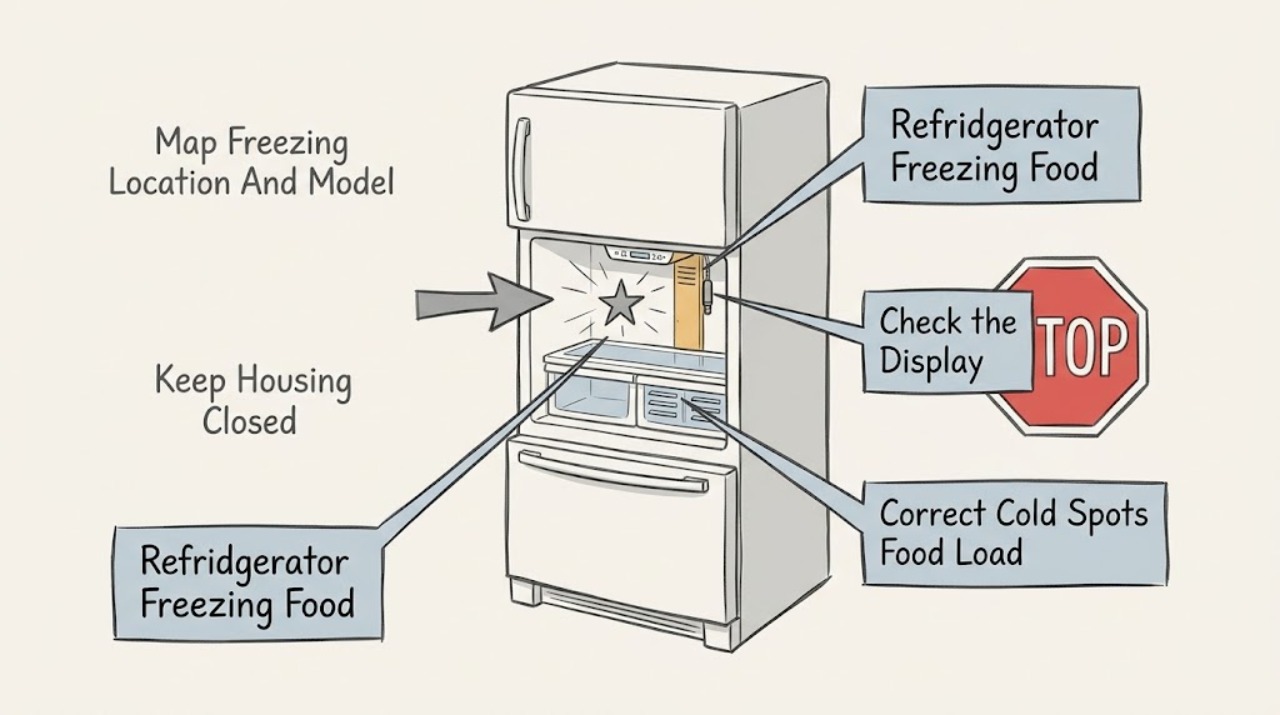
First identify where the food freezes and record the GE model and refrigerator style. For a fresh-food compartment, GE's style-specific guidance generally targets about 37–42°F in the fresh-food section and 0–8°F in the freezer, but the exact owner's manual controls. If settings are colder than the model's normal or midpoint setting, move them warmer by the model's documented one-step/one-degree adjustment and allow about 24 hours for stabilization. Then move delicate food away from the coldest locations: the rear of a top-freezer's top shelf, a side-by-side damper/vent, the bottom of a lightly loaded compartment, or a blocked ceiling sensor on applicable older French-door bottom-freezer models. Set an adjustable crisper, deli, or snack drawer warmer when its contents freeze, and keep vents and the door seal clear. If food still freezes after correct settings, normal load, unobstructed airflow, and a full stabilization period—or if temperatures swing, a control/damper stays abnormal, or a sensor needs access—arrange qualified GE refrigerator service. Do not remove covers, bypass controls, or replace a sensor, damper, or control board based on food location alone.
Before you begin
Safety first
- The owner may record the model, check settings, move food away from documented cold spots, inspect accessible door closure and gasket condition, clear accessible airflow, and make model-documented adjustments. Qualified service must handle internal sensors, dampers, fans, controls, wiring, sealed-system components, refrigerant, and any cover removal or electrical testing.
Work through in order
Diagnostic checks
Use only checks that match the exact appliance or system and its official guide.
-
Check 1
Record the complete GE model number and identify the style: top-freezer, bottom-freezer/French-door, side-by-side, or another configuration. Map the freezing pattern—rear of the top shelf, beside an air vent, door bin, crisper/deli drawer, water reservoir area, or the whole fresh-food compartment—and note whether the freezer itself is unusually cold or iced.
Expected result: Only one cold spot or drawer freezes, food freezes near an air inlet, the whole fresh-food section freezes, or the problem is actually a frozen water tank/no dispenser flow or heavy freezer frost.
Next step: Use the branch that matches the pattern and keep the exact model manual available. Do not move food into a suspected damaged area or run diagnostic modes to reproduce freezing.
Stop if: Stop and arrange service for smoke, burning odor, sparking, a hot or damaged cord, water near electrical parts, repeated breaker trips, or any need to remove a cover.
Why this matters
Why: A localized pattern makes food placement, a drawer setting, or a damper path more likely. Whole-compartment freezing makes a temperature-control, sensor, or cooling-control issue more important. A water-dispenser or heavy-frost complaint needs its own model-specific path and should not be folded into a generic food-freezing diagnosis.
-
Check 2
Check both fresh-food and freezer controls against the exact GE owner's manual. If the setting is colder than the model's normal or midpoint setting, make only the documented warmer adjustment; on electronic actual-temperature models, use the displayed target rather than assuming dial-number direction. Measure the compartments if possible and allow about 24 hours after a change before judging the result.
Expected result: The fresh-food temperature is within the model's target, below it, or still falling after 24 hours; the freezer is also unusually cold; or the refrigerator has just been installed or adjusted.
Next step: Leave the controls at the model's documented normal setting during stabilization and limit frequent door openings. If freezing persists, continue with the location, airflow, sensor, and seal checks rather than making large repeated adjustments.
Stop if: Do not turn a control to an undocumented extreme, place a thermometer or object against a vent to block it, or open the control housing.
Why this matters
Why: An overly cold setting or an uncompleted stabilization period can explain freezing without a failed part. Freezing with correct settings after a full stabilization period, especially in both sections, makes a control, sensor, damper, or cooling-system diagnosis more likely.
-
Check 3
Reposition delicate food away from the model's cold-air entry and cold spots without blocking airflow. For a top-freezer, avoid the back half of the top shelf; for many side-by-side models, avoid the damper side wall; for a bottom-freezer/French-door model, keep the ceiling thermistor clear by about 6 inches only when the model has the documented dome-shaped sensor. Set an adjustable crisper, deli, or snack drawer warmer when its contents freeze, and keep a lightly loaded compartment reasonably stocked.
Expected result: Freezing stops after food is moved, after a drawer is made warmer, after the sensor is cleared, or it continues despite correct placement and adequate load.
Next step: Keep the corrected layout during the 24-hour stabilization period and record which shelf or drawer changes temperature. If a sensor or air tower is inaccessible or the pattern does not improve, arrange service.
Stop if: Do not cover an air vent, tape over a sensor, force a drawer, or reach behind an air tower or liner.
Why this matters
Why: A response to repositioning or a warmer drawer setting supports a local air-distribution or load issue. Continued freezing throughout the same zone with clear airflow shifts attention to the model's sensor, damper, or controls.
-
Check 4
Check from the outside that packages, bins, ice, or shelves are not preventing either door or drawer from closing. Inspect the visible gasket for a gap, tear, pull-out, or uneven contact, and check that tall containers are not pressed against internal air outlets. Verify the refrigerator has the model's required surrounding clearance; if maintenance or condenser cleaning is listed for this model, unplug first and follow only the manual.
Expected result: A door does not seal, a gasket is damaged or loose, an item blocks an air path, the installation clearance is inadequate, or all accessible seals and air paths are normal.
Next step: Remove only an obvious obstruction, reseat a gasket that is merely pulled from its retainer if the exact GE instructions allow it, and allow the temperature to stabilize. Replace a torn gasket or correct a model-specific installation issue through the approved part/service path.
Stop if: Do not force the door, reshape hinges, remove inner panels, use heat on a gasket unless the exact GE instructions allow it, or clean near electrical parts while connected.
Why this matters
Why: Door closure and airflow affect temperature consistency, but a gasket issue does not by itself prove why fresh food is freezing. A normal seal and clear airflow make the settings, cold-spot, sensor, damper, and service branches more important.
-
Check 5
After the settings, placement, load, seal, and stabilization checks, compare the remaining pattern with the exact GE manual. If only a drawer or dispenser reservoir freezes, verify that the adjustable drawer is not set coldest while less than half full; if the entire fresh-food section freezes, document measured temperatures, cold spots, door behavior, and any visible frost. Do not remove a sensor, damper, liner, or control to inspect it.
Expected result: The drawer/reservoir recovers after a warmer setting and normal load, the whole section remains below target, freezing returns quickly, or an internal component would need access to identify the cause.
Next step: Arrange qualified GE refrigerator service for persistent or whole-section freezing. Give the technician the model, style, settings, measured temperatures, shelf/drawer pattern, stabilization time, and gasket/airflow findings.
Stop if: Do not bypass temperature controls, manually hold a damper open, disconnect sensors, alter refrigerant, or continue using the refrigerator if an electrical or water hazard is present.
Why this matters
Why: A drawer/load response supports a local setting and cold-air-transfer explanation. Persistent whole-section freezing or a need for internal access can involve a thermistor, damper, fan, control, or sealed-system issue; food location cannot select the failed part.
Use your observations
Decision map
Find the observation that best matches what you see, then follow the next safe action.
-
PATH 01Safety boundary
What you see
Food freezes only at the back of a top-freezer's upper shelf, beside a side-by-side air inlet/damper, or near another identifiable cold-air entry.
Do this next
Move delicate items away from the cold spot without blocking the vent, keep the model's normal settings, and observe through a full stabilization period. Service is needed if all areas freeze or the cold-air path behaves abnormally.
Why this path and its safety boundary
Why it matters: The cold-air path and food position are more likely than a whole-compartment temperature failure. GE identifies the top-freezer rear top shelf and many side-by-side damper-side locations as cold spots.
Safety stop: Do not cover, tape, or mechanically adjust an air vent or damper.
-
PATH 02Safety boundary
What you see
The fresh-food control is colder than the model's normal/midpoint setting, or freezing began immediately after startup or a temperature change and less than about 24 hours has passed.
Do this next
Use the exact manual's normal setting, make only the documented warmer adjustment, and allow about 24 hours before reassessing. If the measured temperature remains below target afterward, arrange service.
Why this path and its safety boundary
Why it matters: A setting or incomplete temperature stabilization is more likely than a confirmed component fault. Control-number direction differs between dial, dual-control, and electronic models.
Safety stop: Do not make repeated extreme adjustments or leave the control at an undocumented setting.
-
PATH 03Safety boundary
What you see
Only a crisper, deli, snack drawer, bottom area, or water-reservoir area freezes, especially when the drawer is set coldest, lightly loaded, or the applicable ceiling thermistor is blocked.
Do this next
Set the adjustable drawer warmer or to its model-normal position, maintain a reasonable load, move items away from the documented sensor, and monitor after stabilization. Persistent freezing needs model-specific service.
Why this path and its safety boundary
Why it matters: Low food load, drawer setting, cold air settling, or a blocked sensor is more likely. GE's six-inch sensor clearance applies only to models with the documented dome-shaped sensor, not every GE refrigerator.
Safety stop: Do not block or alter the sensor, force a drawer, or access tubing or controls behind the liner.
-
PATH 04Safety boundary
What you see
A door or drawer is held open by a package, the gasket has a visible gap or tear, tall containers block an air path, or the installation does not meet the model's clearance instructions.
Do this next
Remove the obstruction, restore the accessible gasket only as the model instructions permit, clear airflow, and allow stabilization. Replace a damaged gasket or request service if the seal/leveling issue remains.
Why this path and its safety boundary
Why it matters: The refrigerator cannot maintain its intended air circulation and temperature consistently. This may contribute to abnormal cold spots, but it does not identify a damper or control failure by itself.
Safety stop: Do not force the door, remove interior panels, or work near electrical parts while powered.
-
PATH 05Safety boundary
What you see
The whole fresh-food section remains below the model's target or food continues freezing after correct settings, a full stabilization period, clear cold-air paths, reasonable load, and normal door sealing.
Do this next
Keep the settings at the model's documented normal range, protect food, and arrange qualified GE refrigerator service with the measured temperatures and pattern. Stop immediately for an electrical or water hazard.
Why this path and its safety boundary
Why it matters: A refrigerator control, sensor/thermistor, damper or air tower, fan, or sealed cooling issue is more likely. The symptom does not safely identify which component failed.
Safety stop: Do not bypass controls, hold a damper open, replace internal parts by guesswork, or alter the sealed system.
Helpful context
Understand the symptom
The location of the frozen food is the first clue
Food frozen only at the rear of a top shelf, beside a damper, at the bottom of a lightly loaded compartment, or inside one adjustable drawer points to cold-air distribution or a local setting. Food frozen throughout the fresh-food compartment, or a measured temperature that keeps dropping below the model's target, needs a broader control and service assessment.
GE temperature numbers are model- and control-dependent
GE uses dial, dual-control, and electronic-control refrigerators. Its general guidance places the fresh-food compartment around 37–42°F and the freezer around 0–8°F, but the meaning of a higher or lower control number depends on the model. Use the exact owner's manual and wait for stabilization after any adjustment.
Keep internal repairs out of an owner-level check
An external temperature reading and food-position change cannot identify whether a damper, thermistor, control, fan, or sealed cooling system is at fault. Keep food and water away from electrical areas, unplug before any manual-authorized cleaning, and stop for a hot or damaged cord, burning odor, leaking water near electrical parts, or repeated breaker operation. Do not remove covers or bypass a control.
Only after diagnosis
Potential parts
- model-matched door gasket
Consider only when the exact style and model show a torn, split, loose, or persistently nonsealing gasket after the accessible closure checks.
GE gasket shape and installation vary by top-freezer, side-by-side, and French-door models; food freezing alone is not evidence for a gasket replacement. - model-matched temperature sensor or thermistor
Consider only after qualified diagnosis confirms an inaccurate or failed sensor, especially when the whole fresh-food section freezes despite correct settings and placement.
The six-inch clearance guidance applies to documented dome-shaped sensors on applicable models; sensor location and part fit are model-specific. - model-matched damper or air-tower assembly
Consider only after service confirms abnormal cold-air delivery or a damper/air-tower fault rather than a food-placement or control-setting issue.
Air paths differ by refrigerator style and model; do not block or replace a damper based only on a cold spot. - model-matched temperature control or control board
Consider only when qualified service confirms a control fault after the model's settings, stabilization, airflow, and sensor checks.
A control board cannot be selected safely from a generic freezing symptom and requires model-specific diagnosis.
When checks do not resolve it
Need a professional?
Arrange qualified GE refrigerator service when food continues freezing after the exact model's normal settings, a full stabilization period, corrected placement/load, clear air paths, and normal door sealing; when the whole fresh-food compartment is below target, temperatures swing, a damper or sensor needs access, or a water reservoir repeatedly freezes. Stop using the appliance and seek appropriate appliance/electrical service for smoke, burning odor, sparking, a hot or damaged cord, water near electrical parts, or repeated breaker trips. Do not remove covers, bypass controls, or alter the sealed system.
Safety scope: The owner may record the model, check settings, move food away from documented cold spots, inspect accessible door closure and gasket condition, clear accessible airflow, and make model-documented adjustments. Qualified service must handle internal sensors, dampers, fans, controls, wiring, sealed-system components, refrigerant, and any cover removal or electrical testing.
Common questions
FAQ
Why is my GE refrigerator freezing food in the fresh-food section?
Start with the temperature setting and the location of the frozen food. GE identifies cold spots near freezer-fed air inlets, a low food load, drawer settings, and a blocked applicable temperature sensor as possible contributors. Use the exact model's normal setting, move delicate food away from the cold-air path, and allow about 24 hours after an adjustment.
What temperature should a GE refrigerator and freezer be?
GE's general guidance places the fresh-food section around 37–42°F and the freezer around 0–8°F, with exact targets and control behavior depending on the model. Use the owner's manual rather than assuming every dial or display uses the same direction or range.
Why does my GE refrigerator freeze food only on the top shelf or near the vent?
Cold air enters the fresh-food section from the freezer. GE identifies the rear of a top-freezer's upper shelf and the damper side of many side-by-side models as colder locations. Move delicate food away from that path without blocking the vent; persistent freezing outside the cold spot needs service.
How long should I wait after changing the GE refrigerator temperature?
GE says a refrigerator averages about 24 hours to stabilize after startup or a temperature change, and frequent door openings or a light load can extend that time. Leave the control at the model's documented normal setting during stabilization and reassess with a temperature measurement.
Can a GE refrigerator drawer setting cause freezing?
Yes. GE says an adjustable drawer set coldest with less than half a load can transfer cold air to a water reservoir or tubes, and its style-specific guidance says a freezing crisper, deli, or snack drawer should be set warmer. Use the exact model's drawer instructions and do not access tubing or controls behind the liner.
When should I call for GE refrigerator service because food is freezing?
Call when the whole fresh-food compartment remains below the model's target, freezing continues after correct settings, placement, load, airflow, door sealing, and a full stabilization period, or an internal sensor/damper/control needs access. Stop immediately for smoke, burning odor, sparking, a hot or damaged cord, water near electrical parts, or repeated breaker trips.
Read the exact guide
Official sources
- Refrigerator - Adjusting Temperature ControlsGE Appliances · GE dial, dual-control, electronic, bottom-freezer, top-mount, and side-by-side control behavior
- Refrigerator - Temperature Stabilization PeriodGE Appliances · GE refrigerator stabilization time after startup or temperature adjustment
- Bottom Freezer Refrigerator - Freezer Drawer Not Sealing ProperlyGE Appliances · GE bottom-freezer/French-door drawer obstruction, basket seating, gasket contact, and service boundary
- Top Freezer Refrigerator - Too Cold, Freezing FoodGE Appliances · GE top-freezer fresh-food temperature, coldest shelf location, and warmer-control guidance
- Top Freezer Refrigerator - Adjusting or Replacing the Door GasketsGE Appliances · GE top-freezer gasket inspection, power-disconnect, damage, and model-specific service guidance
- Refrigerator - Not Cooling EnoughGE Appliances · GE refrigerator door closure, gasket, airflow, clearance, electrical maintenance, and service boundary
- Bottom Freezer Refrigerator Food FreezingGE Appliances · GE bottom-freezer thermistor obstruction and top-shelf freezing pattern
- Bottom Freezer Refrigerator - Too Cold, Freezing FoodGE Appliances · GE bottom-freezer fresh-food temperature, food load, drawer, and ceiling sensor guidance
- Refrigerator - Preventing Freeze-Up of Water Storage TankGE Appliances · GE refrigerator adjustable-drawer setting, low food load, and water-reservoir/tube freezing
- Refrigerator - Too Cold, Freezing FoodGE Appliances · GE refrigerator fresh-food freezing as a style-dependent problem and links to top-, bottom-, and side-by-side guidance
- Side-by-Side Refrigerator - Too Cold, Freezing FoodGE Appliances · GE side-by-side fresh-food temperature, door-bin, produce/deli, food-load, and damper cold-spot guidance
Community feedback
Share a repair observation
Share a plain-text repair observation. Accepted observations are published automatically; this page may take a moment to update.