
On this page
Start here
Quick answer
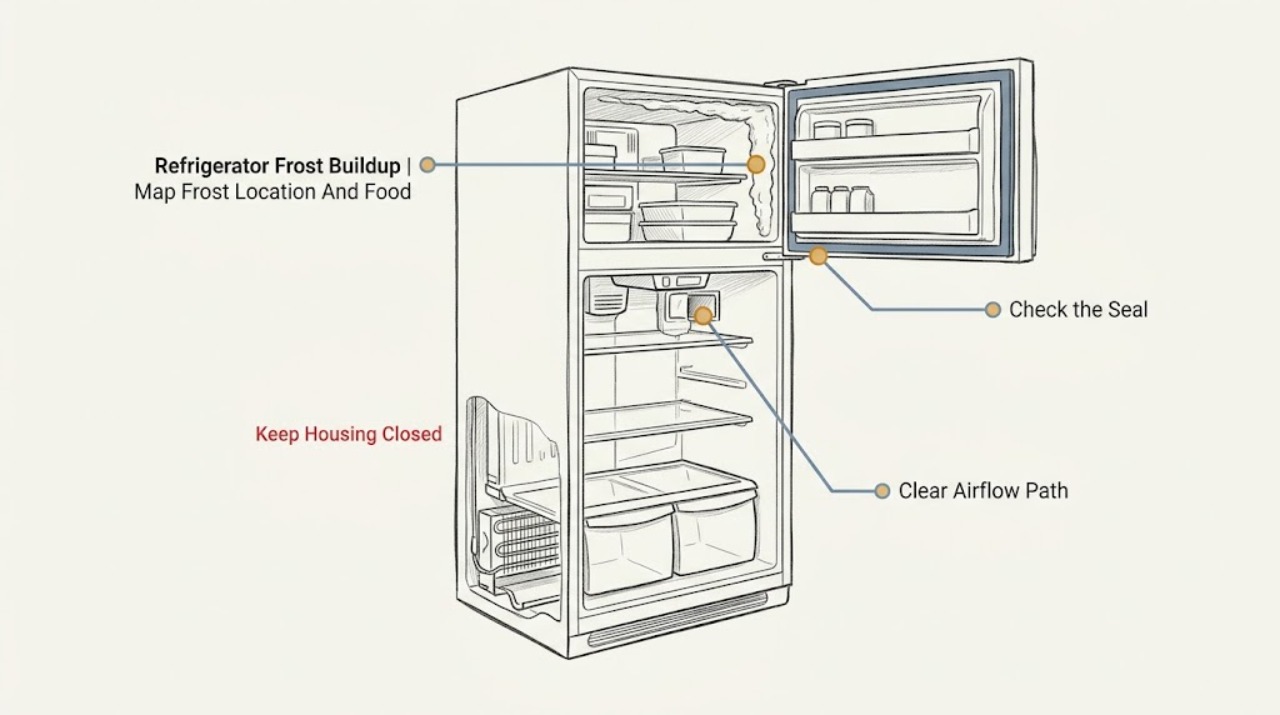
On a GE frost-free refrigerator, first map the frost: a light film on packages after humid weather or frequent door opening can be an air-intrusion or loading issue, while a growing sheet on the freezer wall, a blocked air duct, ice on the freezer floor, or water below the refrigerator needs a different branch. Make sure packages are not touching the rear wall or holding the door open, verify the door closes, inspect the gasket for a cut or gap, and check that a freezer drawer or basket is seated. Clean the gasket only with the model-safe method and wipe loose frost gently; do not chip, scrape, puncture, or heat the sealed system. If frost keeps returning after the door and loading corrections, the freezer fan is not running, food is warming, or a bottom-freezer has ice or water on its floor, arrange qualified service because GE identifies fan, automatic-defrost, and drain problems as service conditions. Keep the refrigerator closed while assessing it and stop for a damaged gasket, exposed wiring, refrigerant-line damage, water near electrical parts, or any unsafe temperature or food condition.
Before you begin
Safety first
- The user may inspect visible packages, baskets, door closure, gasket seating, external water, and accessible loading or airflow obstructions, and clean a sound gasket according to the exact manual. Qualified personnel must handle evaporator covers, fans, heaters, defrost controls, drain access requiring disassembly, sealed-system tubing, refrigerant work, live electrical diagnosis, and repairs near water or wiring.
Work through in order
Diagnostic checks
Use only checks that match the exact appliance or system and its official guide.
-
Check 1
Keep the freezer door closed as much as practical and record where frost or ice is accumulating: on packages, the rear wall, shelves, an air duct, the floor, or around a drawer. Also note whether the fresh-food and freezer compartments are holding temperature and whether water is present inside or on the floor outside.
Expected result: Frost is a light film on packages; a sheet covers the rear wall; frost surrounds an air outlet; ice or water is on the freezer floor; or food is warming along with the frost.
Next step: Use the door-and-loading branch for package or wall frost, the airflow branch for a blocked duct or warming freezer, and the drain/service branch for floor ice or water.
Stop if: Stop handling the appliance for water near electrical parts, exposed wiring, food-safety concerns, a damaged door or gasket, or any need to chip ice.
Why this matters
Why: A light package film can follow humidity or normal door use. A wall sheet, blocked duct, warming food, or floor ice shifts the concern toward a sealing, airflow, fan, defrost, or drain problem rather than ordinary frost within a package.
-
Check 2
Inspect the freezer door or drawer closure without force. Remove only packages, racks, baskets, or shipping material that visibly hold it open; check that a drawer basket is seated, the gasket lies in its groove, and the gasket contacts the frame evenly. Look for cuts, tears, gaps, or an uneven door.
Expected result: A package or basket was blocking closure; the gasket is displaced but undamaged; the gasket is cut or torn; the door is uneven or does not touch the frame evenly; or no closure problem is visible.
Next step: Correct only the visible loading or seating issue and close the door once. Clean a sound gasket using the manufacturer's care instructions; arrange gasket, alignment, leveling, or installer service when a gap or damage remains.
Stop if: Do not force the door, stretch or cut the gasket, bend hinges, dismantle a drawer, or continue if the door cannot seal or the frame is damaged.
Why this matters
Why: A closure obstruction, displaced gasket, misalignment, or leveling issue can let humid room air enter and create recurring frost. A damaged gasket or persistent gap is a sealing repair or installation issue, not a temperature-control adjustment.
-
Check 3
With the freezer door open briefly, look for packages pressed against the rear wall or blocking a freezer air duct or outlet. Leave the model's air passages clear and avoid loading warm food against the wall; do not remove an interior panel or try to reach the evaporator fan.
Expected result: A package was against the rear wall or blocking an air path; frost is concentrated near one outlet; the freezer fan is not audible when the model normally runs; or airflow and loading appear normal.
Next step: Reposition only the visible package obstruction and monitor for several days with normal door use. If the fan is not running, food is warming, or frost returns despite clear loading, arrange service.
Stop if: Do not remove the evaporator cover, insert tools into a fan or duct, or touch ice near wiring or a heater.
Why this matters
Why: GE lists rear-wall contact and blocked air ducts as contributors to frost or temperature problems. A fan that is not running can prevent normal air circulation and is a service condition; an apparently clear path does not prove the fan or evaporator is healthy.
-
Check 4
After correcting a clear door, humidity, or loading issue, wipe only loose surface frost with a dry towel if the model instructions permit and return the control to the model's normal or slightly warmer documented setting. Do not chip, scrape, puncture, or apply an improvised heat source to the ice.
Expected result: The frost stops growing and clears over the following days; frost continues to thicken; food warms; or ice reappears quickly at the same wall, duct, floor, or drain area.
Next step: If the frost clears, return to normal use while keeping the seal and air path clear. If it persists or food warms, leave the unit operating only as needed for food protection and arrange qualified refrigerator service.
Stop if: Do not use a sharp tool, puncture the liner, remove evaporator parts, or continue if a refrigerant line may have been damaged.
Why this matters
Why: GE says frost from corrected door or humidity causes should go away in a few days. Continued or rapidly recurring frost makes a gasket, fan, automatic-defrost, evaporator, or drain fault more likely and cannot be selected by appearance alone.
-
Check 5
If ice or water is on the freezer floor, under a full-width bottom drawer, or on the floor in front of the refrigerator, identify the refrigerator layout and stop before removing an interior panel. Absorb accessible water safely, keep the door closed, and use the exact model instructions only for user-accessible care.
Expected result: A bottom-freezer has ice or water on its floor; water appears under the fresh-food drawer; a side-by-side has a documented drain-access procedure; or there is no floor ice or water.
Next step: Arrange qualified service for a bottom-freezer floor or under-drawer ice/water pattern, or for any leak that returns. Do not assume melting the visible ice fixes the drain or defrost system.
Stop if: Stop for water near electrical components, a wet receptacle, exposed wiring, refrigerant-line damage, or any need to dismantle the freezer.
Why this matters
Why: GE links these patterns to a defrost drain that may be clogged. Bottom-freezer drain access requires disassembly and service; a water leak near electrical parts raises the urgency even if frost is also present.
Use your observations
Decision map
Find the observation that best matches what you see, then follow the next safe action.
-
PATH 01Safety boundary
What you see
Frost is mainly on packages or a small area after frequent door opening, humid conditions, a warm load, or a package that held the door slightly open; the gasket closes evenly and temperatures remain normal.
Do this next
Reposition the load, close the door fully, reduce unnecessary openings, and monitor for several days. Arrange service if the frost spreads, remains heavy, or temperatures change.
Why this path and its safety boundary
Why it matters: Humid room air entering during door use is more likely than an automatic-defrost failure. GE says this frost should diminish after the cause is corrected.
Safety stop: Do not scrape or chip the frost, and stop for a damaged seal, warming food, water near electrical parts, or a door that cannot close.
-
PATH 02Safety boundary
What you see
The gasket has a cut, tear, displaced section, or uneven contact, or a drawer, basket, package, or unlevel cabinet prevents the freezer from closing and sealing.
Do this next
Correct only visible loading or gasket seating issues. Use the model's installation instructions for permitted alignment or leveling; arrange gasket or installer service for a persistent gap or damaged seal.
Why this path and its safety boundary
Why it matters: Continuous air leakage is more likely than normal frost. On French-door and bottom-freezer designs, GE specifically ties an uneven drawer gasket or unseated basket to freezer frost.
Safety stop: Do not bend the door, stretch the gasket, remove hinges, or run the refrigerator with a door that will not seal.
-
PATH 03Safety boundary
What you see
Frost is concentrated at a rear wall or air outlet, packages block an air duct, the freezer fan is not running as expected, or food is warming with the frost.
Do this next
Clear only visible package obstructions and monitor once. Arrange service for a non-running fan, warming food, a blocked passage behind a panel, or frost that returns with normal loading.
Why this path and its safety boundary
Why it matters: Blocked circulation or a fan fault is more likely; GE lists a non-running freezer fan as a service reason when frost persists.
Safety stop: Do not remove evaporator covers, reach into the fan, or touch ice around wiring or a heater.
-
PATH 04Safety boundary
What you see
Heavy frost returns across a freezer wall after door and loading checks, the refrigerator defrosts too often, or ice or water collects on a bottom-freezer floor or under a fresh-food drawer.
Do this next
Arrange qualified refrigerator service and provide the frost location, temperature trend, layout, water location, and time since the last clearing. Do not disassemble or improvise a drain repair.
Why this path and its safety boundary
Why it matters: An automatic-defrost, evaporator, or drain issue is more likely than a simple humidity event. GE says heavy frost or frequent defrosting requires a technician, and bottom-freezer drain access requires disassembly.
Safety stop: Do not chip ice, puncture the liner, heat the evaporator, open sealed-system tubing, or continue with water near electrical parts.
-
PATH 05Safety boundary
What you see
The liner or tubing may have been punctured during ice removal, refrigerant-line damage is suspected, the refrigerator is warming despite normal closure and airflow, or frost is accompanied by unsafe water or electrical damage.
Do this next
Stop using the affected function, protect food according to its temperature and time, and arrange qualified refrigerator or sealed-system service. Use an electrician for a damaged household electrical supply.
Why this path and its safety boundary
Why it matters: This is not a user defrosting or gasket adjustment problem. GE says a punctured sealed system needs service, and warming food or electrical damage can require prompt appliance attention.
Safety stop: Do not re-puncture, braze, recharge, scrape, or operate near exposed wiring, a wet receptacle, smoke, or a damaged refrigerant line.
Helpful context
Understand the symptom
The location of the frost changes the diagnosis
A frost-free GE freezer should not develop a persistent sheet of ice on its wall. Frost limited to packages or a small area after humid conditions can follow warm air entering through a door that was opened often or left slightly ajar. Frost across a wall, blocked freezer air path, a fan that is not running, or a floor covered with ice points toward a more substantial airflow, defrost, or drain problem.
Start with closure and loading, not a part guess
GE's model-specific guidance focuses first on a package, rack, basket, or drawer that prevents the seal from closing. A torn gasket, uneven door, unseated freezer basket, or refrigerator that is not level can admit humid air continuously. Correct only visible loading and closure issues; do not bend the door or force a gasket into place.
Defrost and drain work has a service boundary
Automatic defrost melts frost from the evaporator and sends the water to a drain pan. GE says heavy frost, ice accumulation, or defrosting too often needs a technician. For bottom-freezer models, ice or water on the freezer floor can mean a clogged drain tube, whose access requires disassembly. Never use a sharp object to chip ice: puncturing a sealed refrigerant line changes the job into sealed-system service.
Safety boundary
Stop conditions
- Stop immediately for water near electrical parts, a wet or damaged receptacle, exposed wiring, smoke, burning odor, abnormal heat, or a repeated electrical trip.
- Do not chip, scrape, puncture, or pry frost or ice, and do not use an improvised heat source against the liner, evaporator, drain, or sealed system.
- Do not remove evaporator covers, defrost heaters, fans, drain tubing, wiring, or sealed-system tubing; bottom-freezer drain access requiring disassembly is service work.
- Do not bend doors, force drawers, stretch gaskets, bypass a door switch, or operate with a door that cannot seal.
- If frost persists after safe external closure, loading, and airflow checks, or food is warming, arrange qualified service rather than repeatedly clearing the ice.
Only after diagnosis
Potential parts
- model-matched freezer door or drawer gasket
Consider only when inspection confirms a torn gasket or persistent uneven contact after visible packages, basket seating, leveling, and alignment issues are addressed.
Confirm the exact GE model and door or drawer configuration; do not infer fit from refrigerator appearance alone. - model-matched evaporator or freezer fan assembly
Consider only when qualified diagnosis confirms the freezer fan is not running or is mechanically faulty after visible airflow obstructions are excluded.
Fan access and design vary by GE refrigerator layout; do not remove the evaporator cover as a user check. - model-matched automatic-defrost component
Consider only after qualified diagnosis links recurring wall frost or overly frequent defrosting to a defrost sensor, heater, control, or related component rather than door air leakage.
The frost pattern does not identify a heater, sensor, or control; verify the exact model and service documentation. - model-matched defrost drain or drain-heating component
Consider only when qualified diagnosis confirms a recurring floor-ice or water pattern caused by the defrost drain or its related system.
Bottom-freezer drain access may require disassembly; do not order or install a drain component based only on visible floor ice.
When checks do not resolve it
Need a professional?
Arrange qualified GE refrigerator service when frost remains heavy after door, gasket, loading, and humidity checks; the freezer fan is not running; food is warming; a bottom-freezer has ice or water on its floor or under the fresh-food drawer; the refrigerator defrosts too often; or a drain, evaporator, defrost, sealed-system, or internal wiring fault is suspected. Use an electrician for a wet, hot, loose, damaged, or repeatedly tripping household supply. Stop immediately for water near electrical parts, exposed wiring, smoke, burning odor, a damaged door or gasket, a punctured liner or refrigerant line, or food that may no longer be safe. Provide the exact model, refrigerator layout, frost location and extent, door and gasket observations, fan behavior, temperature trend, water location, and what external corrections were attempted.
Safety scope: The user may inspect visible packages, baskets, door closure, gasket seating, external water, and accessible loading or airflow obstructions, and clean a sound gasket according to the exact manual. Qualified personnel must handle evaporator covers, fans, heaters, defrost controls, drain access requiring disassembly, sealed-system tubing, refrigerant work, live electrical diagnosis, and repairs near water or wiring.
Common questions
FAQ
Is frost in a GE refrigerator freezer normal?
A small film on packages can follow humidity or frequent door opening, but GE says ice accumulating on the wall of a frost-free freezer is not expected. Check closure, gasket, loading, and rear-wall contact; persistent or heavy frost needs service evaluation.
Why does my GE freezer keep building frost on the back wall?
GE lists high humidity, frequent door openings, a warm food load, packages resting against the rear wall, and packages holding the door open. A damaged gasket or freezer fan that is not running can also keep the frost from clearing after those causes are corrected.
How do I remove frost from a GE refrigerator?
Correct the visible door or loading cause and follow the exact model's care or manual-defrost instructions. Do not chip, scrape, or puncture the ice; GE warns that a damaged refrigerant line requires service. Bottom-freezer drain or evaporator access is not a routine user repair.
What does ice on the floor of a GE bottom freezer mean?
GE says ice or water on a bottom-freezer floor, in front of the freezer, or under a full-width fresh-food drawer can indicate a clogged defrost drain. Access requires disassembly on bottom-freezer models, so arrange service instead of removing panels or forcing the ice out.
Could a GE freezer fan cause frost buildup?
Yes. GE lists a freezer fan that is not running as a service reason when frost persists. You can clear only visible package or air-duct obstructions; do not remove the evaporator cover or reach into the fan. Warming food or recurring frost needs qualified diagnosis.
Read the exact guide
Official sources
- Refrigerator - Water on FloorGE Appliances · Applies to GE refrigerators with water in front of the appliance; drain access and repair steps vary by model.
- Bottom Freezer Refrigerator - Freezer Drawer Not Sealing ProperlyGE Appliances · Applies specifically to GE French-door or bottom-freezer refrigerators with a freezer drawer.
- Refrigerator - Frost in FreezerGE Appliances · Applies to GE refrigerator freezers with frost on shelves, packages, or walls; model-specific adjustment instructions govern.
- Refrigerator - Automatic Defrost SystemGE Appliances · Applies to full-sized GE refrigerators with timed or adaptive automatic defrost; cycle details vary by model.
- Refrigerator - Puncture in the Sealed SystemGE Appliances · Applies when manual frost removal could damage a GE refrigerator sealed refrigerant line.
- Refrigerators Top-mount no-frost Owner’s ManualGE Appliances · Applies directly to the older GE refrigerator model family covered by this manual; use only as conditional background for other GE models.
- Bottom Freezer Refrigerator - Clogged Drain Tube, Ice on Freezer FloorGE Appliances · Applies specifically to GE bottom-freezer refrigerators with automatic defrost.
- Refrigerator & Freezer - Ice on Freezer WallGE Appliances · Applies to GE frost-free refrigerator or freezer models with unexpected ice on a freezer wall; exact layout and fan access vary.
- Refrigerator, Freezer and Standalone Ice Maker - Care and Cleaning of Interior and GasketGE Appliances · Applies to GE refrigerators, freezers, and standalone ice makers; follow the exact model manual for removal or replacement.
Community feedback
Share a repair observation
Share a plain-text repair observation. Accepted observations are published automatically; this page may take a moment to update.