
On this page
Start here
Quick answer
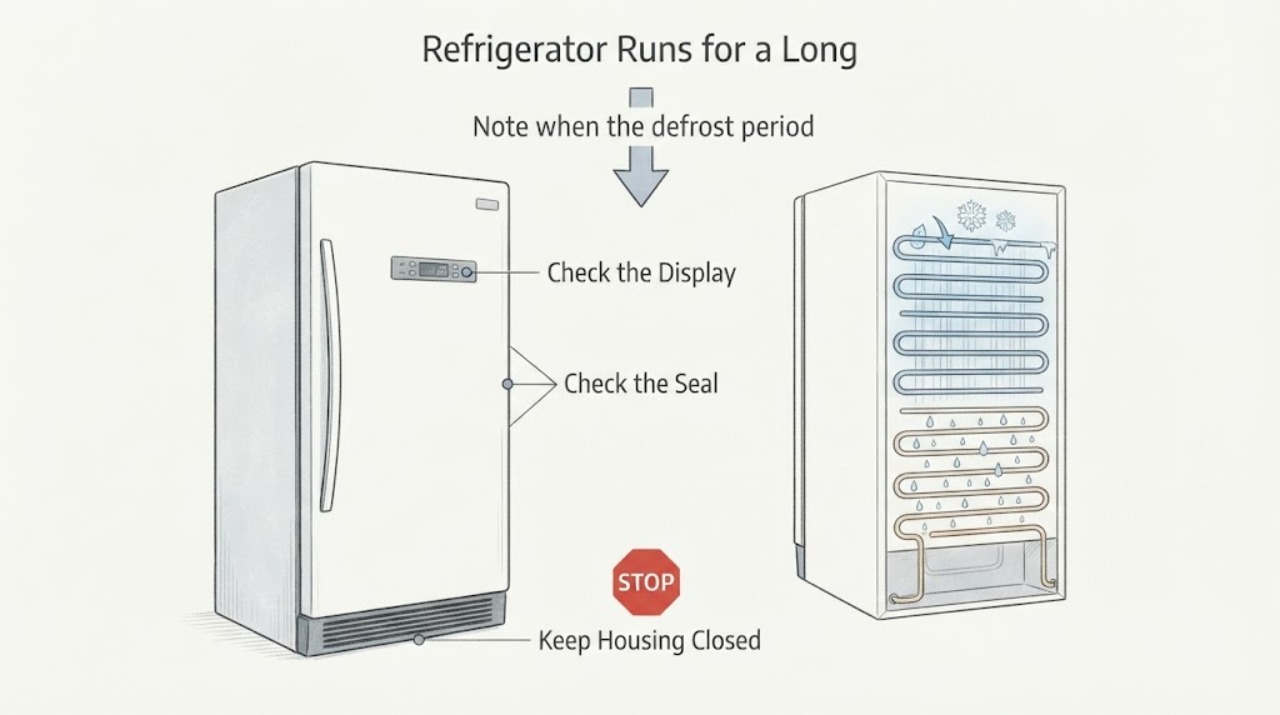
A GE refrigerator can run for a long time after defrost because the compressor and fans are off during defrost and then must bring the compartments back to their target temperatures. GE says full-size refrigerators commonly run 80% to 90% of the time, and its automatic-defrost guidance says a defrost cycle is usually about 25–45 minutes. Do not judge the run time alone: check whether the freezer and fresh-food temperatures recover, the doors seal, vents are clear, and the condenser is clean. If temperatures remain out of range, frost returns heavily, the unit never cycles off, or the defrosting is unusually frequent, stop guessing at a timer or sensor and arrange service for the exact model.
Work through in order
Diagnostic checks
Use only checks that match the exact appliance or system and its official guide.
-
Check 1
Note when the defrost period ends and whether the compressor and fans resume. Do not repeatedly unplug or force a reset while observing the cycle.
Expected result: The appliance is silent only during a roughly 25–45 minute defrost period and then cooling resumes, or it stays silent far longer, cycles abnormally, or never resumes.
Next step: If cooling resumes, continue with temperature and airflow checks. If it does not resume or the appliance repeatedly remains in defrost-like behavior, arrange service for the exact model instead of adjusting a timer or control blindly.
Why this matters
Why: GE says the compressor and fans do not run during defrost and that the cycle is usually 25–45 minutes. A normal return to cooling makes a long recovery run plausible; failure to resume or an unusually extended no-run period needs service assessment.
-
Check 2
Measure the fresh-food and freezer temperatures with the doors closed as much as practical, then allow up to 24 hours after any control change before judging recovery.
Expected result: Temperatures return to the model settings and remain stable, or the fresh-food section stays warmer than about 34–42°F or the freezer is outside GE’s general -5–8°F range after stabilization.
Next step: If temperatures are stable, monitor rather than replacing a part from run time alone. If they remain out of range, protect perishable food and schedule service with the model number and measured temperatures.
Why this matters
Why: GE says temperature controls need about 24 hours to stabilize and publishes those general ranges. Stable temperatures with a long run can be normal; failure to recover means the run-time complaint is accompanied by a cooling problem.
-
Check 3
Inspect only the accessible door seals, door closure, freezer air vents, interior light behavior, and the condenser area described for the model; keep hands and tools away from fans, wiring, and refrigerant tubing.
Expected result: A package holds a door open, a gasket is dirty or damaged, a freezer vent is blocked, the light stays on, or the condenser is dirty; or none of these conditions is present.
Next step: Correct only the accessible condition described by the exact owner manual, then allow the refrigerator to stabilize. If no external condition is found and temperatures remain abnormal, move to service rather than opening panels.
Why this matters
Why: GE lists door openings, damaged or dirty gaskets, blocked freezer vents, dirty condenser coils and an interior light that stays on as factors that increase run time. These observations can explain long operation without proving a failed component.
-
Check 4
Record whether the long run happens only after defrost or also during ordinary cycles, whether frost or ice returns, and whether the refrigerator maintains food-safe temperatures; include the exact model from the rating plate.
Expected result: The refrigerator recovers and holds temperature with no heavy frost, or run time remains excessive together with warming, heavy frost, repeated defrosting, or other new symptoms.
Next step: For abnormal temperature, heavy frost, repeated defrosting, or a cycle that never returns to normal, keep the unit operating only as needed to preserve diagnostic evidence and schedule qualified service. Do not replace a defrost heater, thermostat, timer, fan, or sealed-system part based on this symptom alone.
Why this matters
Why: A run-time complaint without a temperature or frost problem can fall within GE’s normal operating range. GE says heavy frost/ice or defrosting too often requires a technician; warming or repeated abnormal cycles make the issue more than a normal recovery run.
Use your observations
Decision map
Find the observation that best matches what you see, then follow the next safe action.
-
PATH 01Next step
What you see
The compressor resumes after defrost, temperatures return to the model settings within the stabilization period, and there is no heavy frost or repeated failed defrost.
Do this next
Continue monitoring with the doors closed and the exact model settings recorded. Seek service only if temperature, frost, noise, or cycle behavior later changes.
Why this path and its safety boundary
Why it matters: The observed long run is consistent with recovery plus GE’s expected high compressor duty cycle; run time alone does not establish a failed component.
-
PATH 02Next step
What you see
The refrigerator runs long while a door is not sealing, a vent is blocked, the interior light stays on, the condenser needs the model-approved cleaning, or the appliance has a large warm load or frequent door openings.
Do this next
Remove the accessible obstruction or correct the loading/closure condition according to the exact manual, then allow temperatures to stabilize before judging the result.
Why this path and its safety boundary
Why it matters: GE identifies these conditions as factors that increase run time, so the symptom may be an airflow, heat-load, or closure issue rather than a defrost-control failure.
-
PATH 03Next step
What you see
The compressor runs for long periods but temperatures do not recover, food is warming, or heavy frost/ice returns after defrost.
Do this next
Protect perishable food, document temperatures and frost timing, and arrange qualified service with the exact model. Do not open the sealed system or replace a sensor, heater, timer, fan, or control board speculatively.
Why this path and its safety boundary
Why it matters: Long operation is now paired with a cooling or defrost symptom. GE’s general guidance calls for service when heavy frost/ice or defrosting too often is present; the symptom does not identify which internal part failed.
-
PATH 04Next step
What you see
The refrigerator remains without compressor/fan operation well beyond the expected defrost interval or repeatedly never returns to cooling.
Do this next
Use the exact model manual and qualified service. Do not force a timer, enter an unverified diagnostic mode, or bypass a defrost control.
Why this path and its safety boundary
Why it matters: GE states that the compressor and fans are off during defrost but that automatic defrost is typically about 25–45 minutes; a persistent no-run state is outside that general pattern.
Helpful context
Understand the symptom
Why the compressor may run after defrost
GE says the compressor and fans are off during automatic defrost while a heater melts frost, and that the cycle is usually 25–45 minutes. Once cooling resumes, the refrigerator has to recover from that warm interval. GE also says compressors are designed to run 80%–90% of the time, so a long recovery run is not by itself proof of a failed defrost part or sealed system.
Use temperature recovery to decide whether it is a fault
The useful question is whether the compartments return to safe, stable temperatures and then cycle normally for that model. GE recommends waiting 24 hours after startup or a control adjustment before judging the temperature. Without a model number, do not borrow a diagnostic mode, timer setting, sensor value, or component diagnosis from another GE refrigerator.
When checks do not resolve it
Need a professional?
Arrange qualified GE appliance service when temperatures do not recover, heavy frost or ice returns, defrosting is unusually frequent, the compressor/fans never resume after the expected defrost interval, or the refrigerator repeatedly runs without maintaining temperature. Provide the model number, temperature readings, defrost timing, frost observations, door/gasket findings, and any recent control changes.
Common questions
FAQ
Is it normal for a GE refrigerator to run for a long time after defrost?
It can be. GE says the compressor and fans stop during defrost and that refrigerators are designed to run much of the time, commonly 80%–90%. Judge the recovery by stable temperatures and normal cycling, not by one long run alone.
How long should I wait before deciding the temperature has recovered?
GE recommends waiting 24 hours after startup or a temperature-control adjustment before judging stabilization. Keep the doors closed as much as practical and record the actual fresh-food and freezer temperatures.
Does a long run prove the defrost timer or thermostat is bad?
No. GE lists normal high run time, door openings, dirty or damaged gaskets, blocked vents, condenser condition and food load among possible contributors. A long run plus warming, heavy frost or repeated defrosting needs model-specific service diagnosis.
Read the exact guide
Official sources
- Refrigerator or Freezer - Normal Run TimeGE Appliances · Opened GE Appliances support article. It lists warm loads, door openings, gaskets, blocked freezer vents, condenser condition and an interior light that remains on as run-time factors; it gives general fresh-food/freezer ranges and a support route. It is not model-specific.
- Refrigerator - Does Not Run or CoolGE Appliances · Opened GE Appliances support article. It gives external checks for light/power and controls, distinguishes defrost no-run behavior, warns that post-outage compressor protection is automatic, and directs unresolved symptoms to service. It is family-level guidance because the task has no model.
- Refrigerator - Adjusting Temperature ControlsGE Appliances · Opened GE Appliances support article. It recommends normal or midpoint settings and waiting 24 hours after startup or an adjustment; it explains that control roles vary by refrigerator style, so the exact owner manual remains controlling when no model is supplied.
- Refrigerator - Normal Cycle TimesGE Appliances · Opened GE Appliances support article. It states that the motor stops during defrost, restarts afterward, and that refrigerators may run 80%–90% of the time or approach 100% in hot, humid conditions. It does not identify an internal failure for an unnamed model.
- Refrigerator - Automatic Defrost SystemGE Appliances · Opened GE Appliances support article. It explains that the defrost heater operates while the compressor and fans do not, gives the usual 25–45 minute range, describes timed/adaptive defrost, and directs heavy frost or overly frequent defrosting to a technician. It is family-level guidance because no model was assigned.
Community feedback
Share a repair observation
Share a plain-text repair observation. Accepted observations are published automatically; this page may take a moment to update.