
On this page
Start here
Quick answer
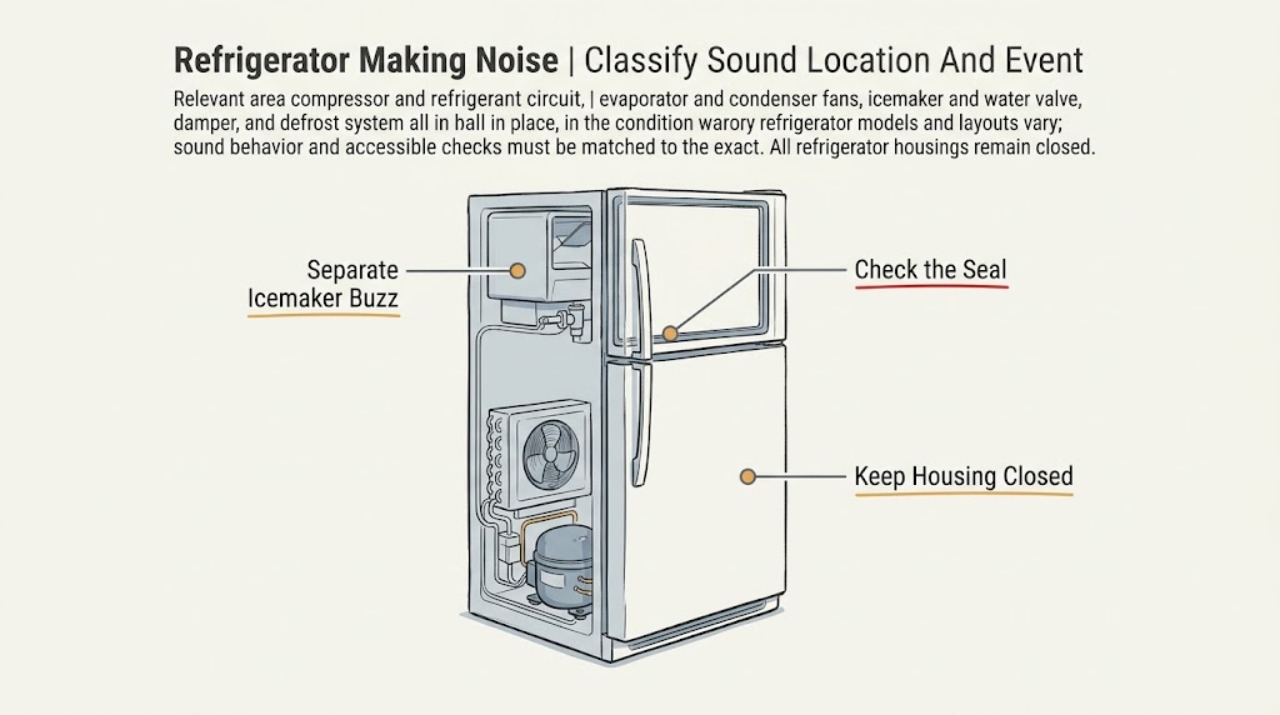
Many GE refrigerator sounds are normal: refrigerant can gurgle or knock, fans can change speed, the defrost timer or temperature control can click, an icemaker can hum while filling or thump as cubes drop, and a new door gasket can whistle or squeak briefly. First record where and when the sound occurs—freezer, fresh-food section, underneath, water dispenser, icemaker, or plumbing—and whether cooling is normal. A fan-blade impact from the freezer, a new persistent tapping, a harsh compressor sound, or a noise that remains after safe external checks needs service. A buzzing every 10–15 minutes often means an icemaker is ON while its water supply is OFF; turn the icemaker OFF until water is connected, using the model's control. Pipe banging when the valve opens is household water hammer and usually needs a plumber. Do not remove panels, probe wiring, touch fans, or move a built-in refrigerator; stop for smoke, burning odor, sparks, a hot cord or outlet, water near electrical parts, or repeated breaker trips.
Before you begin
Safety first
- Do not remove rear or internal panels, touch fans, heaters, compressors, valves, or wiring, pull a built-in refrigerator, bypass controls, or perform live tests. Stop for smoke, burning/electrical odor, sparks, abnormal heat, a hot or damaged cord or outlet, water near electrical parts, or repeated breaker trips.
Work through in order
Diagnostic checks
Use only checks that match the exact appliance or system and its official guide.
-
Check 1
From outside the refrigerator, identify the sound as hum, buzz, rattle, click, gurgle, knock, hiss, crackle, whistle, fan strike, or water-line bang. Record whether it occurs in the freezer, fresh-food compartment, underneath, at the dispenser, during icemaker filling, after a door closes, during defrost, or after a power interruption.
Expected result: The sound follows cooling or defrost, a fan, an icemaker/dispenser call, a door transition, the water valve, or appears as a new harsh mechanical/electrical sound.
Next step: Continue with the branch matching the pattern and exact model. Stop without reproducing the sound for smoke, odor, sparks, abnormal heat, water near electrical parts, a hot/damaged power connection, or a repeated breaker trip.
Why this matters
Why: GE's documented normal list covers many cooling, defrost, icemaker, dispenser, and door sounds. A sound's location and timing narrow the mechanism; a freezer fan-blade impact, unexplained new tapping, or electrical/mechanical symptom is not cleared by the normal list.
-
Check 2
If the sound is an intermittent buzz, hum, rattle, or vibration near the icemaker or water valve, note its interval and whether the icemaker is enabled. Check only the model's visible icemaker control or feeler-arm setting and the accessible external water supply; do not remove the icemaker or test the valve.
Expected result: The sound lasts about 5–10 seconds every 10–15 minutes, the icemaker is ON with water turned off, the sound occurs during normal filling, or it is a brief XWF/XWFE-related valve sound on a model that uses that filter.
Next step: If water is not connected, turn the icemaker OFF using the exact model control. If water is connected and the sound is new, harsh, leaking, or persists with the icemaker OFF, arrange service; do not open the water valve or wiring.
Why this matters
Why: GE says a recurring 10–15-minute buzz can be the icemaker calling for water while its supply is off, while brief fill or isolation-valve sounds can be normal. The repeated no-water pattern is not evidence of a failed motor.
-
Check 3
If the sound is a whistle or squeak at the door, observe whether the refrigerator is new and whether the sound occurs only as the gasket seals. Inspect only visible gasket seating and door contact; do not adjust hinges, remove the gasket, or press against the door to defeat the seal.
Expected result: The sound is limited to a new door and fades after a few days, or it persists, occurs on an older refrigerator, or is accompanied by a door that does not close or a cabinet that warms.
Next step: Keep the gasket and door path clean and unobstructed according to the manual. Arrange service for a persistent whistle, misalignment, damaged gasket, or cooling change; do not apply an unapproved lubricant or alter hinges.
Why this matters
Why: GE says a new gasket can whistle or squeak while it becomes pliable. Persistence, poor closure, or warming is not explained by that short break-in behavior and may need model-specific service.
-
Check 4
For a gurgle, boiling sound, drip, crackle, hiss, click, or fan-speed change, note whether it follows compressor operation, a defrost period, temperature adjustment, or a door opening. Check cooling and temperature only through the model's display or controls; do not touch coils, heaters, fans, or refrigerant lines.
Expected result: The sound follows refrigerant circulation, defrost-water dripping, evaporator cooling after defrost, timer/control switching, or fan response to door openings, while temperatures remain normal.
Next step: Monitor a normal cycle using the exact manual. Arrange service if the noise is newly severe, the fan sounds like it is hitting something, cooling changes, or the sound cannot be matched to a documented operating event.
Why this matters
Why: GE lists refrigerant circulation, defrost water, evaporator cooling, timers, temperature controls, and responsive fans as normal sound sources. A new persistent sound, fan strike, cooling loss, frost, or temperature alarm changes the diagnosis.
-
Check 5
If there is a loud bang or knock, listen from outside to determine whether it travels through the supply line when the refrigerator icemaker or dispenser calls for water. Check only for an obvious external pipe or cabinet contact; do not disconnect the water line or alter a household valve.
Expected result: The bang occurs exactly when the water valve opens or closes and is heard in the plumbing, or it is a cabinet/internal impact unrelated to water use.
Next step: Arrange qualified plumbing help for water hammer. For an internal or persistent cabinet impact, stop moving parts or covers and arrange qualified refrigerator service; do not test valve pressure yourself.
Why this matters
Why: GE identifies a water-line bang caused by household water pressure as water hammer and says it often requires a plumber. A cabinet or internal impact follows a different appliance-service path.
-
Check 6
With the refrigerator stationary, inspect only visible contact points, flooring, leveling condition, and nearby objects that could vibrate against the cabinet. If the model is freestanding and the manual permits it, use a dry, safe position to check that the unit is stable; do not pull a built-in unit or remove a rear cover to reach a fan.
Expected result: The cabinet or a nearby object vibrates, the refrigerator is unstable, the noise comes from underneath like something contacting a fan, or no external source is visible.
Next step: Remove only a loose nearby object and correct visible stability as the manual permits. Do not open the rear or touch a fan; arrange service for an underneath fan-like sound, a hidden obstruction, or persistent vibration.
Stop if: Stop for smoke, burning/electrical odor, sparks, abnormal heat, water near electrical parts, a damaged cord/outlet, or repeated breaker trips.
Why this matters
Why: A visible contact or leveling issue can amplify normal compressor or fan vibration. GE says a sound underneath like a card against bicycle spokes may indicate an obstruction at a condenser fan on applicable older/non-NeverClean models, but accessing that area requires unplugging and model-specific care; a large air-divider strip requires service.
-
Check 7
Record the exact model, sound description, location, interval, cooling/temperature result, icemaker and dispenser state, door/gasket condition, water-use timing, visible vibration, and any safe audio recording. Provide the sequence to qualified GE refrigerator service or a plumber; do not order a fan, compressor, valve, icemaker, or control from the sound alone.
Expected result: The sound remains after safe external checks, is a freezer fan strike, becomes harsh or newly persistent, is accompanied by cooling loss, leaking, a control fault, or an electrical warning.
Next step: Stop using the refrigerator for a safety hazard and obtain qualified appliance or electrical service. Use a qualified plumber for water hammer, and protect food only if doing so does not require touching a hazard.
Stop if: Do not remove panels, pull a built-in refrigerator, touch fans or heaters, probe wiring, bypass controls, or repeatedly reset a tripping breaker.
Why this matters
Why: A fan, compressor, defrost, valve, icemaker, water-line, control, or electrical diagnosis may be needed. GE's normal-sound articles do not establish a universal part or safe internal repair path.
Use your observations
Decision map
Find the observation that best matches what you see, then follow the next safe action.
-
PATH 01Next step
What you see
The sound follows refrigerant circulation, defrost, timer/control switching, fan response, or normal icemaker cube drop and cooling remains stable.
Do this next
Monitor the pattern and use the exact Owner's Manual. Arrange service if the sound changes, becomes harsh or persistent, or is joined by cooling loss, leak, frost, or a control symptom.
Why this path and its safety boundary
Why it matters: GE's documented normal operating sounds are more likely than a failed component.
-
PATH 02Next step
What you see
A buzz, rattle, or vibration repeats about every 10–15 minutes and the refrigerator icemaker is ON while its water supply is OFF or not connected.
Do this next
Turn the icemaker OFF using the model's documented control until water is connected. Arrange service if the sound continues with the icemaker OFF or water supply restored.
Why this path and its safety boundary
Why it matters: The icemaker water valve calling for water is more likely than a failed compressor or motor. GE recommends turning the icemaker OFF when no water is supplied.
-
PATH 03Next step
What you see
A new refrigerator door whistles or squeaks only while the gasket seals and the sound fades, or an older/persistently noisy door does not close correctly.
Do this next
Keep the door path unobstructed and follow the manual. Arrange service for persistent whistle/squeak, damaged gasket, misalignment, or any cooling change.
Why this path and its safety boundary
Why it matters: Short gasket break-in is more likely in the first pattern; persistent noise, poor closure, or warming needs a model-specific door or gasket assessment.
-
PATH 04Next step
What you see
A bang occurs when the icemaker or dispenser calls for water and the sound is transmitted through the household water line.
Do this next
Arrange qualified plumbing help. Do not disconnect the refrigerator line, alter the valve, or open the refrigerator to test the water system.
Why this path and its safety boundary
Why it matters: Household water hammer is more likely than an internal refrigerator failure; GE says high water pressure in the connected line can cause it.
-
PATH 05Safety boundary
What you see
A freezer sound resembles a fan blade hitting something, a new tapping or harsh mechanical sound persists, cooling changes, or smoke, odor, sparks, abnormal heat, water near electrical parts, or breaker trips occur.
Do this next
Stop use for a hazard and arrange qualified appliance or electrical service. For a non-hazardous persistent fan or internal sound, leave panels closed and provide the recorded symptom sequence.
Why this path and its safety boundary
Why it matters: A fan obstruction, compressor/cooling, control, water, or electrical fault may be involved. GE identifies a freezer fan-blade impact as abnormal and does not support an owner-level live diagnosis.
Safety stop: Do not remove covers, touch fans, probe wiring, pull a built-in refrigerator, or repeatedly reset a breaker.
Helpful context
Understand the symptom
Use sound location and timing, not loudness alone
GE does not publish a universal refrigerator decibel rating, and different models use different fans, icemakers, dispensers, filters, and cooling layouts. A sound from the freezer during defrost or fan operation is a different path from a bang in the household water line or a vibration under the cabinet. Record the sound, location, duration, cycle event, and any change in cooling or dispensing before deciding whether it is abnormal.
Icemaker and plumbing noises have their own pattern
A refrigerator icemaker can hum or buzz when its valve opens, and cubes can make a loud drop into the bucket. If the icemaker is ON with no water connected, GE documents recurring buzzing or rattling and recommends turning it OFF until water is available. A bang that travels through the water line when the valve opens is water hammer, not necessarily a refrigerator motor problem. Keep these paths separate from a freezer fan strike or compressor symptom.
Do not turn a listening check into an energized repair
Limit owner checks to sounds heard from outside, visible leveling or contact, accessible door and gasket condition, the model's icemaker setting, and external water-dispenser or supply observations. Do not remove rear covers, touch condenser or evaporator fans, probe wiring, bypass a door switch, pull a built-in refrigerator, or perform live electrical testing. Stop for smoke, burning or electrical odor, sparks, abnormal heat, a hot or damaged cord or outlet, water near electrical parts, or repeated breaker trips; leave the unit off and obtain qualified appliance or electrical service.
When checks do not resolve it
Need a professional?
Call qualified refrigerator service for a fan-blade impact, persistent new or harsh noise, cooling loss, abnormal frost, leak, control symptom, or unexplained internal sound after safe external checks. Call a qualified plumber for water hammer. Stop immediately for smoke, burning or electrical odor, sparks, abnormal heat, a hot/damaged cord or outlet, water near electrical parts, or repeated breaker trips.
Safety scope: Do not remove rear or internal panels, touch fans, heaters, compressors, valves, or wiring, pull a built-in refrigerator, bypass controls, or perform live tests. Stop for smoke, burning/electrical odor, sparks, abnormal heat, a hot or damaged cord or outlet, water near electrical parts, or repeated breaker trips.
Have this ready
- Exact refrigerator model, sound description and location, interval and cycle timing, cooling/temperature result, icemaker/dispenser state, door/gasket condition, water-use timing, visible vibration, and a safe recording from outside the cabinet.
Common questions
FAQ
What GE refrigerator noises are normal?
GE lists refrigerant gurgling or knocking, fan-speed changes, defrost and temperature-control clicks, icemaker fill and cube-drop sounds, dispenser sounds, and some new-gasket whistles as normal possibilities. Match the sound and timing to the exact model; a new harsh sound, fan strike, cooling loss, or hazard needs service.
Why does my GE refrigerator buzz every few minutes?
GE says an icemaker that is ON while its water supply is OFF can buzz or rattle about every 10–15 minutes as it calls for water. Turn the icemaker OFF using the exact model control until water is connected. If the buzz continues with the icemaker OFF, arrange service.
Why does my GE refrigerator make a banging sound when dispensing water?
A bang that travels through the water line when the refrigerator valve opens or closes is household water hammer. GE says high household water pressure can cause this and that it often requires a plumber. Do not disconnect the water line or alter the valve yourself.
Is a GE refrigerator door whistle a problem?
On a new refrigerator, GE says a tight gasket can whistle or squeak while it becomes more pliable, and the sound should stop after a few days. If it persists, the door does not close, or the cabinet warms, arrange model-specific service rather than adjusting the hinges yourself.
What if the noise sounds like a fan hitting something?
GE identifies a freezer sound like a fan blade striking something as abnormal and recommends service. Keep the panels closed and do not touch the fan. Stop immediately for smoke, burning or electrical odor, sparks, abnormal heat, water near electrical parts, or repeated breaker trips.
Read the exact guide
Official sources
- Refrigerator - Unusual NoisesGE Appliances · GE refrigerators; access and repair steps are model- and installation-specific
- Refrigerator - Buzzing NoiseGE Appliances · GE refrigerator models with the described icemaker, dispenser, or XWF/XWFE filter features
- Refrigerator - Water Hammer / Banging NoiseGE Appliances · GE refrigerators connected to household water supply; plumbing correction is site-specific
- Refrigerator - Normal Sounds and Noises MadeGE Appliances · GE refrigerators; exact sound profile and features vary by model
- Refrigerator - Doors WhistlingGE Appliances · New GE refrigerators with a tightly sealing door gasket; persistent symptoms may require service
- Refrigerator & Freezer - Decibel LevelGE Appliances · GE refrigerators and freezers; no universal decibel threshold is provided
Community feedback
Share a repair observation
Share a plain-text repair observation. Accepted observations are published automatically; this page may take a moment to update.