
On this page
Start here
Quick answer
If a GE washer-dryer combo is not draining, first allow a normal short pause, then check the drain hose for kinks or a blockage and confirm the household standpipe or drain can accept water. Use the owner's manual to determine whether your model has an accessible pump filter; do not assume every combo has the same access. On the GE Profile UltraFast Combo, not draining and Fault Code 18 are listed signs of a clogged pump, and GE gives a shallow-pan-and-towels procedure for its accessible filter. If the tub remains full and the unit only hums, water leaks, the door stays locked with water inside, a hose or filter cannot be accessed safely, or the problem remains after the model-directed check, stop and arrange qualified appliance service.
Before you begin
Safety first
- This article covers waiting through a normal short pause, external hose and household-drain observation, and model-directed pump-filter cleaning with controlled water collection when an access door exists. Do not force the door, open an inaccessible filter, remove the cabinet, test live parts, bypass a lock, or improvise a pump repair.
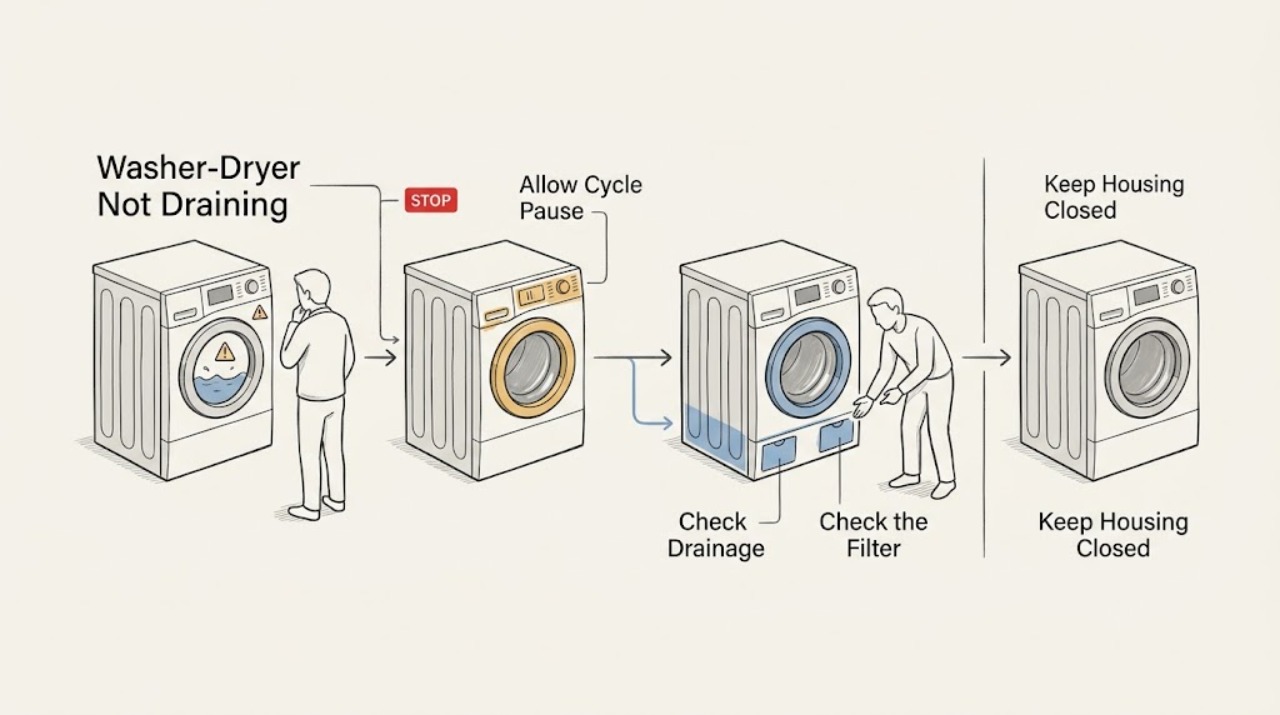
Work through in order
Diagnostic checks
Use only checks that match the exact appliance or system and its official guide.
-
Check 1
If the combo has paused during a drain stage but shows no hazardous symptom, wait a few minutes without advancing a manual dial or repeatedly pressing controls; keep the door closed while water may remain inside.
Expected result: The unit resumes and drains; the pause continues with standing water; or the controls show a code, locked door, or other abnormal state.
Next step: If water remains or the unit only hums after the pause, stop the cycle and continue with the hose, household drain, and model-specific filter checks only if safe.
Stop if: Do not force the door, manually advance a dial through the pause, or continue a cycle with leaking water or an electrical hazard.
Why this matters
Why: GE notes that pauses of up to a few minutes can be normal on many front-load models. A pause that ends with drainage is different from a full tub that remains still, while a code or locked door changes the path to model-specific troubleshooting and safety.
-
Check 2
With the unit stopped, inspect the visible drain hose for a kink, pinch, flattening, or obvious blockage and check from a safe position whether the standpipe, utility sink, or household drain is backing up; do not pull a full hose from a water-filled unit without a way to control the water.
Expected result: The hose is kinked or blocked; the hose route looks normal but the household drain backs up; the drain accepts water; or the drain connection is inaccessible or uncertain.
Next step: Correct only an obvious external hose kink without stressing the connection. If the household drain will not accept water, arrange a plumber; if the route is normal but the combo remains full, continue only with the exact model's pump-filter instructions.
Stop if: Stop for flooding, sewage or contaminated water, a loose connection, a hose that cannot be controlled, or any need to reach behind the appliance.
Why this matters
Why: A restricted hose or household drain can prevent a good pump from emptying the combo. A drain that backs up points toward plumbing service, while a normal route and accepting drain move attention toward the model's pump filter or appliance-side fault.
-
Check 3
Use the owner's manual to determine whether the exact GE washer-dryer combo has a front pump-filter access door; if it does, switch the unit off, prepare a shallow pan and towels, and open the filter slowly only as the model instructions describe.
Expected result: The model has an accessible filter; the filter contains lint or a small object; the filter is clear; or the model has no user-accessible filter or the water cannot be controlled.
Next step: For an accessible model, clean and refit the filter exactly as the manual directs, then try the appropriate drain operation once. If there is no access door, water remains uncontrolled, the filter is damaged, or drainage does not return, arrange service.
Stop if: Do not remove a filter without a container and towels, force the cap, reach into the pump housing, or use a filter procedure from another model.
Why this matters
Why: GE says the Profile UltraFast Combo filter captures debris and lists not draining as a clogged-pump sign. Debris at an accessible filter can explain slow or failed drainage, but a clear filter or inaccessible design does not prove the pump is good or bad.
-
Check 4
Record the exact display message and the water state before trying another drain or wash cycle, including whether a GE Profile Combo shows Fault Code 18, the door remains locked, or the unit only hums.
Expected result: Fault Code 18 or a pump-related message is shown; the tub is full and the unit hums; the door remains locked with water; or no code is displayed.
Next step: Provide the exact code, water level, sound, and filter or hose result to service. Do not keep restarting a full tub or force the door.
Stop if: Stop immediately for a leak, electrical odor, smoke, unusual heat, exposed wiring, or water near electrical equipment.
Why this matters
Why: On the GE Profile UltraFast Combo, Fault Code 18, a full or wet load, a locked door, and no draining are listed signs of a clogged pump. GE's front-load guidance specifically routes a full tub that only hums to service. No code does not rule out a blocked hose, filter, pump, or plumbing issue.
-
Check 5
After the visible hose and household drain are normal and any accessible filter has been correctly cleaned and refitted, run the exact model's drain or drain-and-spin operation once while observing from outside.
Expected result: The water drains fully; drainage improves but remains slow; the pump hums without moving water; the code returns; or water remains and the door stays locked.
Next step: If the unit does not drain fully, stop using it and arrange qualified appliance service with the code, water level, hose route, filter result, and sound.
Stop if: Do not run repeated cycles, leave the combo unattended, or open the door against a lock while water remains.
Why this matters
Why: Full drainage supports a cleared external restriction, while slow or absent drainage after the model-directed check keeps the appliance-side pump path in question. Humming with a full tub and a returning code are not safe reasons to repeat cycles.
-
Check 6
Collect the model, exact display, water level, drain-hose and household-drain observations, filter-access result, filter debris, door state, sound, and any leak before requesting service.
Expected result: The evidence points to an external hose or plumbing restriction; an accessible filter obstruction; a full tub that hums; a returning code; or a persistent no-drain condition with no clear external cause.
Next step: Keep the combo off when water remains or the symptom repeats, and give the complete record to a qualified appliance technician or plumber as appropriate.
Stop if: Do not disassemble the cabinet, test live components, bypass the door lock, or replace a pump as a user-level diagnosis.
Why this matters
Why: These observations select plumbing, filter, or appliance-service paths without proving a pump, motor, control, or hose replacement is needed. A clear filter and normal household drain still leave appliance-side diagnosis for a technician.
Use your observations
Decision map
Find the observation that best matches what you see, then follow the next safe action.
-
PATH 01Safety boundary
What you see
Is there flooding, sewage or contaminated water, a leak near electrical equipment, smoke, odor, unusual heat, or exposed wiring?
Do this next
Leave the combo off, keep clear of the hazard, and arrange prompt qualified appliance, plumbing, or electrical service as appropriate.
Why this path and its safety boundary
Safety stop: Do not open a water-filled filter or restore power near water.
-
PATH 02Safety boundary
What you see
Does the unit resume draining after a normal short pause, or does the tub remain full?
Do this next
If it drains, monitor the cycle. If the tub remains full or the unit only hums, stop and arrange service.
Why this path and its safety boundary
Safety stop: Do not force a locked door or manually advance a cycle dial.
-
PATH 03Safety boundary
What you see
Is the drain hose kinked or blocked, or does the household drain back up?
Do this next
Correct only an obvious external kink without stressing the connection; arrange plumbing service when the household drain will not accept water.
Why this path and its safety boundary
Safety stop: Use the exact model's manual to determine whether a pump filter can be accessed safely.
-
PATH 04Safety boundary
What you see
Does the exact model have an accessible pump filter, or does a GE Profile Combo show Fault Code 18?
Do this next
For an accessible filter, use a shallow pan and towels and follow the model procedure. Treat Fault Code 18 and a returning no-drain condition as service evidence if cleaning does not restore drainage.
Why this path and its safety boundary
Safety stop: Do not borrow another model's filter procedure; arrange service for a persistent no-drain condition.
-
PATH 05Safety boundary
What you see
Does water remain after the hose, household drain, and applicable model-directed filter check?
Do this next
Stop using the combo, do not force the door, and request qualified appliance service with the full observations.
Why this path and its safety boundary
Safety stop: If drainage returns fully, monitor the next ordinary cycle and stop if the code, slow drain, hum, leak, or locked-door symptom returns.
Helpful context
Understand the symptom
Treat a washer-dryer combo as a model-specific front-load system
A combo that will not drain may be waiting between stages, blocked at the hose or household drain, obstructed at an accessible pump filter, or experiencing a pump fault. GE's guidance differs by model: a GE Profile UltraFast Combo has a documented pump-filter procedure, while other models may require the owner's manual or service because no user-accessible filter is provided.
A locked door and standing water change the safety decision
Do not force the door when water remains in the drum. GE lists a door that stays locked with clothes inside among signs of a clogged pump on the Profile UltraFast Combo. If the unit hums with a full tub, leaks, or cannot be safely isolated, leave it off and arrange service rather than opening hoses or a filter without a controlled way to catch water.
Drain-path checks come before pump conclusions
Check the visible hose route and household drain before calling the pump defective. A kinked hose, blocked standpipe, incorrect installation, or a clog upstream can produce the same symptom. Follow the installation instructions for the exact model; the observed water level and whether the household drain accepts water help the technician choose the next path.
Only after diagnosis
Potential parts
- drain pump filter or filter cap
Consider this category only if the exact model has the documented access door and the filter or cap is damaged after safe inspection, rather than merely because the combo is not draining.
Confirm the exact GE model and manufacturer's fit information; do not substitute a filter or cap from another combo. - drain pump assembly
Consider this category only when the hose, household drain, and applicable filter are clear but the appliance still leaves water or only hums, and qualified testing confirms a pump fault.
Confirm exact model-specific fit and electrical requirements with qualified service; no-drain symptoms alone do not establish pump failure. - drain hose
Consider this category only when inspection confirms a kinked, split, collapsed, or otherwise damaged hose that cannot be corrected by safe repositioning.
Confirm the exact model, routing, connection, and manufacturer's installation requirements before any replacement.
When checks do not resolve it
Need a professional?
Stop and arrange qualified service if the tub remains full, the unit only hums, the door stays locked with water, the household drain backs up, the hose or filter cannot be accessed safely, Fault Code 18 or another code returns, drainage remains slow after the model-directed filter check, or there is a leak, sewage or contaminated water, electrical odor, smoke, unusual heat, exposed wiring, or repeated failure. Do not force the door, remove a filter without controlled water collection, open the cabinet, test live components, or bypass a safety device.
Safety scope: This article covers waiting through a normal short pause, external hose and household-drain observation, and model-directed pump-filter cleaning with controlled water collection when an access door exists. Do not force the door, open an inaccessible filter, remove the cabinet, test live parts, bypass a lock, or improvise a pump repair.
Common questions
FAQ
Why is my GE washer-dryer combo not draining?
Check for a normal short pause, then inspect the visible drain hose and household drain. If the exact model has an accessible pump filter, follow its manual procedure with controlled water collection. A full tub that hums, a returning code, or persistent no-drain needs service.
What does Fault Code 18 mean on a GE Profile UltraFast Combo?
GE lists Fault Code 18 among signs of a clogged pump on the GE Profile UltraFast Combo. Follow the documented pump-filter procedure if your exact model has the access door; if drainage does not return, arrange qualified service.
Can I clean the pump filter on any GE washer-dryer combo?
No. GE says to use the owner's manual to determine whether the exact model has a manually accessible pump filter. Do not open an inaccessible filter or borrow another model's procedure.
What if the GE combo is full of water and only hums?
Leave it off and do not force the door. GE's front-load guidance routes a full tub that only hums to service. Report the water level, sound, display, hose route, household drain, and filter result to the technician.
When should I stop troubleshooting a GE washer-dryer drain problem?
Stop for flooding, a leak near electrical equipment, contaminated water, smoke, odor, unusual heat, exposed wiring, a locked door with water, a repeated code, a full tub that hums, or any need to remove the cabinet or access an uncontrolled filter.
Read the exact guide
Official sources
- Support for GE Washers and DryersGE Appliances · GE washers, dryers, and combo support, troubleshooting, manuals, and qualified service
- Front Load Washer - Cleaning a Pump FilterGE Appliances · GE front-load washers with a bottom-front pump-filter access cover
- Front Load Washer - Will Not Drain or Drains SlowlyGE Appliances · GE front-load washer drain hose, household plumbing, filter, pause, and service guidance applicable to front-load combo diagnostics
- GE Profile™ UltraFast Combo Washer/Dryer - Cleaning the Pump FilterGE Appliances · GE Profile UltraFast Combo Washer/Dryer pump filter and clogged-pump guidance
Community feedback
Share a repair observation
Share a plain-text repair observation. Accepted observations are published automatically; this page may take a moment to update.