
On this page
Start here
Quick answer
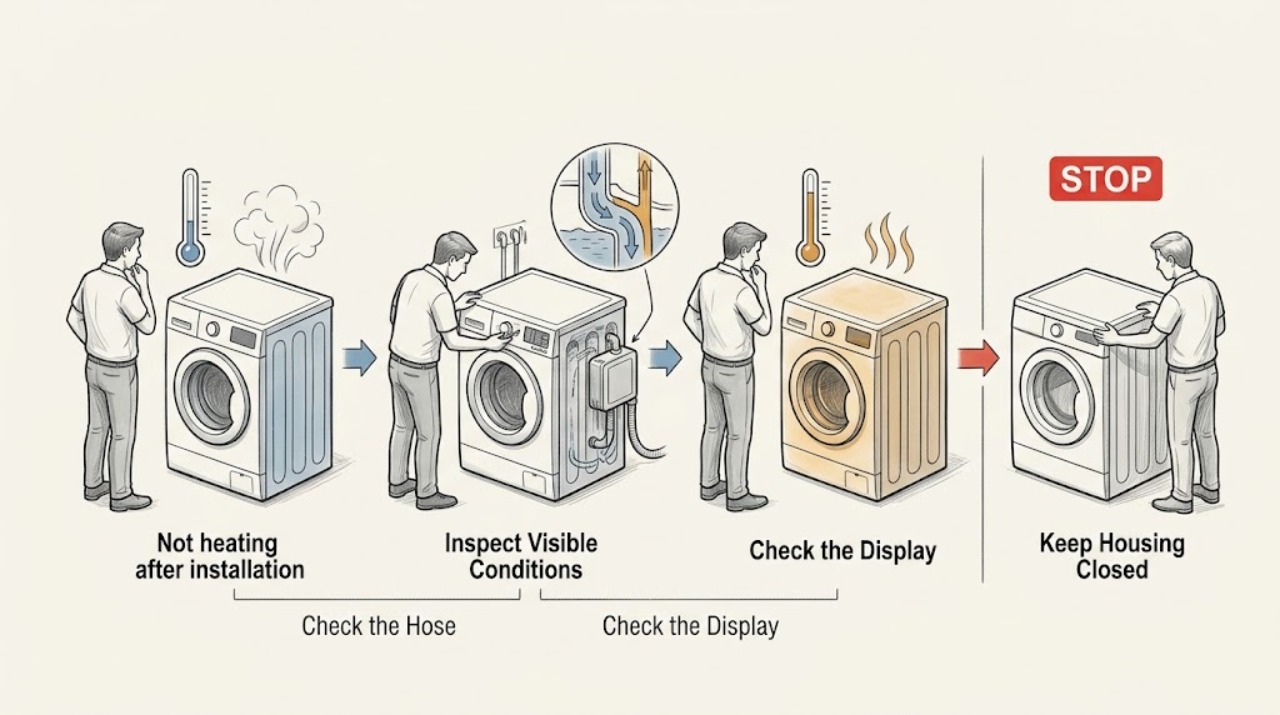
The GE GFW148SSMWW is a front-load washer, and a cold-feeling load does not by itself prove that the washer cannot heat. GE says HOT water depends on the household hot-water supply, WARM is a mix of hot and cold water, and the first installation checks are that both supply valves are open and the hoses are not reversed at the H and C inlets. Check the temperature during the program's initial fill, not only on the clothes after a cold rinse or at the end of the cycle. If the hot and cold hoses were reversed, correct that installation issue only from a stable, dry position or call the installer. If the household hot tap is hot, the hoses match H/C, and a comparable hot selection still has no hot inlet while cold fills normally, stop treating it as normal mixing and request GE or qualified appliance service. For a newly installed unit, keep the model, installation date, photos, and installer or retailer record; do not open the cabinet or assume an internal heater or replacement valve without model-specific diagnosis.
Work through in order
Diagnostic checks
Use only checks that match the exact appliance or system and its official guide.
-
Check 1
Record the exact model as GE GFW148SSMWW, the installation date, the selected cycle and temperature, whether the washer fills and runs normally, and when the water seems cold. Observe from outside during the initial fill rather than judging only the clothes at the end.
Expected result: The complaint is only that final laundry feels cool, or the selected hot/warm program has no hot water during its initial fill while cold fills normally.
Next step: If the initial fill matches the selected path, consult the exact cycle guidance before calling it a heating fault. If the hot fill is absent, continue with the external valve and hose check.
Stop if: Do not use skin contact with water as a temperature measurement and do not start another load if there is a leak, smoke, electrical odor, damaged cord, or uncontrolled heat.
Why this matters
Why: A cool final result can reflect a cold rinse or the program's temperature management; a repeatable missing hot fill is a different observation that points toward the hot supply or washer inlet path.
-
Check 2
From a stable, dry position, confirm both household supply valves are open and compare each hose marking with the washer's rear inlet: hot supply to H/HOT and cold supply to C/COLD. Do not disconnect a pressurized, leaking, corroded, or inaccessible connection.
Expected result: A valve is closed, the hoses are reversed, a hose is kinked or damaged, or both valves and H/C connections are correct and dry.
Next step: Correct only an obvious valve or hose-label issue without moving an unstable washer; otherwise preserve the connection and use the installer or GE service route. Do not remove inlet screens unless the exact manual authorizes it.
Stop if: Stop for a leaking or corroded fitting, water on electrical parts, a valve that will not close, a kinked hose under tension, or any need to pull the washer across a wet floor.
Why this matters
Why: A closed valve or reversed pair can create a temperature complaint without proving a failed washer component. Correct external installation makes a persistent one-sided fill problem more significant.
-
Check 3
Compare the household hot faucet with the washer's selected hot fill using the normal controls and a safe, supervised observation. Note whether the hot tap is hot, whether cold fills normally, and whether HOT and WARM behave differently from COLD; do not run a high-temperature cycle as a heater test.
Expected result: The household hot supply is also cool, or the household hot supply is hot but the washer's hot-selected initial fill remains absent while cold fills normally.
Next step: For a household-wide hot-water issue, arrange water-heater or plumbing assessment. For a washer-only missing hot path after correct installation, keep the appliance arrangement unchanged and request GE or qualified appliance service.
Stop if: Do not access fuel, combustion, electrical water-heater parts, washer wiring, or internal valves; stop for gas odor, scalding water, a water-heater leak, smoke, or electrical symptoms.
Why this matters
Why: A cool hot tap points toward the home's water-heating or supply system. A hot tap with one missing washer temperature path points toward an inlet screen, valve assembly, connection, control, or another model-specific washer diagnosis.
-
Check 4
If the exact program includes a documented elevated-temperature or steam function, verify its requirements in the GFW148SSMWW manual and record whether it completes normally after the external supply and hose checks. Do not infer an internal heater from a cycle label or use an unsafe load.
Expected result: The program behaves as documented, or it remains cold, aborts, displays a fault, produces unusual steam or odor, or cannot stop normally.
Next step: For a documented-cycle failure, stop using that function and provide GE or the installer the model, cycle, selected temperature, supply results, and safe photographs. Continue only as the exact manual permits and only if no safety symptom remains.
Stop if: Stop immediately for scalding risk, steam outside the expected path, burning or electrical odor, smoke, a leak, uncontrolled heat, or a cycle that will not stop through normal controls.
Why this matters
Why: Normal completion makes a gross temperature-path failure less likely. A repeatable documented-cycle failure after correct supplies supports model-specific service, but does not identify a universal heating element, sensor, or valve part.
-
Check 5
For a newly installed washer, preserve the model label, installation date, hose-connection photos, selected cycle, fill-phase observation, household hot-water result, and any display or completion behavior before contacting the installer, retailer, GE registration/support, or qualified service.
Expected result: Correcting a reversed hose changes the initial-fill temperature, the household hot supply is normal but the washer-only hot path remains absent, or the problem remains ambiguous.
Next step: Use the installation or warranty/service route with the evidence and request a model-specific assessment. Do not buy a replacement valve, sensor, or heater based only on a cool load or a single cycle.
Stop if: Keep the washer out of service for leaks, smoke, burning odor, damaged cord, exposed wiring, abnormal heat, or any unsafe water/electrical condition.
Why this matters
Why: A change after correcting the connection supports an installation path. A washer-only repeat failure after correct external connections needs diagnosis under the exact model record; ambiguity is not a reason to open the cabinet.
Use your observations
Decision map
Find the observation that best matches what you see, then follow the next safe action.
-
PATH 01Next step
What you see
The hoses are reversed or a valve is closed, and the temperature complaint began immediately after the GFW148SSMWW was installed.
Do this next
Correct only the visible external connection from a stable dry position or have the installer correct it, then verify the initial fill under the intended setting. Preserve photos and installation records.
Why this path and its safety boundary
Why it matters: The installation path is more likely than an internal heating failure; a same-model installation report shows how reversed hoses can make the selected temperatures appear wrong.
-
PATH 02Next step
What you see
The initial hot fill is present, but clothes feel cool at the end or a later rinse is cold, while the program completes normally.
Do this next
Compare only the fill phase required by the selected cycle and follow the exact manual; do not replace a valve or heater from final garment temperature alone.
Why this path and its safety boundary
Why it matters: The observation does not establish a failed heater. The program may mix temperatures or use a cooler rinse, and GE says WARM depends on incoming supplies and HOT depends on household hot water.
-
PATH 03Next step
What you see
The household hot tap is hot, the H/C hoses are correct and dry, cold fills normally, but a comparable hot selection still has no hot initial fill or a documented elevated-temperature cycle repeatedly fails.
Do this next
Stop using the suspect high-temperature function and request GE or qualified appliance service through the exact model support/installation route, especially while the new-installation record and warranty path are available.
Why this path and its safety boundary
Why it matters: The installation and household supply checks did not explain a washer-only temperature-path failure. An inlet screen, valve, sensor, control, or model-specific heating path may need diagnosis, but the symptom does not identify one part.
-
PATH 04Next step
What you see
A leak, smoke, burning or electrical odor, damaged cord, exposed wiring, uncontrolled heat, scalding risk, or a cycle that will not stop appears during any temperature check.
Do this next
Stop the cycle through normal controls if safe, keep clear, isolate power only from a safe dry location, close water only if safely reachable, and obtain qualified appliance, electrical, plumbing, or emergency help as appropriate.
Why this path and its safety boundary
Why it matters: This is a water, electrical, or burn hazard rather than an ordinary temperature-setting question.
Helpful context
Understand the symptom
Do not judge heating from the final clothes temperature
GE's exact support entry identifies the GFW148SSMWW as a 2.4 cu. ft. front-load washer with steam and provides the model manual and service route. GE's temperature guidance says HOT is limited by the home's hot-water supply and WARM is a hot-and-cold mix. A same-model installation report describes hot and cold hoses being reversed, then a cold-feeling result after the hoses were corrected; the owner later confirmed hot water during the fill. For this new-installation complaint, observe the water entering during the selected program's initial fill and record the setting before treating cool clothes or a final rinse as a failed heater.
Separate hose installation from temperature management
Both supply valves should be open, and GE marks the washer inlets H for HOT and C for COLD. A reversed pair can make the control selection appear wrong even when the washer itself is operating. If the hoses are correctly connected and HOT and WARM still feel similar, remember that WARM intentionally mixes incoming supplies and may vary with the household water temperature. If the home's hot faucet is also cool, the washer is receiving that household condition rather than demonstrating an internal washer fault.
When a new installation needs service
If the household hot tap is hot, the hoses match H/C, the selected program is one that should request hot water, and the initial hot fill is still absent while cold fills normally, the visible installation explanation is no longer sufficient. GE's model page provides the installation instructions, registration, manual, and service entry; use that path or the installer/retailer process while the installation record is available. Do not open the cabinet, assume this model has a universal internal heater, or order an inlet valve or sensor from temperature symptoms alone.
When checks do not resolve it
Need a professional?
Have this ready
- Full model GFW148SSMWW, installation and delivery date, exact cycle and temperature, whether the observation was during initial fill or final rinse, H/C hose and valve photographs, household hot-faucet result, whether cold fills normally, any display or completion behavior, and the installer or retailer record.
Common questions
FAQ
Why does my new GE GFW148SSMWW seem cold after a hot wash?
Check the initial fill rather than the clothes at the end. GE says HOT depends on incoming household hot water and WARM mixes hot and cold; a same-model installation report found that reversed hoses and a cooler final phase made the result look like a heating failure even though hot water was present during the fill. If hot is absent during the correct fill phase, continue with the H/C and supply checks.
How should the GFW148SSMWW hoses be connected?
GE's temperature guidance says both hot and cold supply valves should be open and the hose connections should not be reversed; the washer inlets are marked H for HOT and C for COLD. Correct only an obvious external connection from a stable dry position, or use the installer/service route for a leaking, corroded, or inaccessible connection.
Does the GE GFW148SSMWW have a failed internal heater if HOT is not hot?
Not from that observation alone. First confirm the selected cycle, the initial fill phase, household hot-water supply, and H/C hose connections. If those are correct and the washer-only hot path still fails or a documented elevated-temperature function repeatedly fails, request model-specific GE service rather than assuming a heater or ordering a part.
What should I do if this happened immediately after installation?
Keep the model label, installation date, connection photos, selected cycle, fill-phase observation, and installer or retailer record. GE's exact model support and installation pages provide the manual, installation instructions, registration, and service route. Use those channels while the new-installation record is available, and do not open the washer cabinet yourself.
Read the exact guide
Official sources
- User Manual & Care for GFW148SSMWWGE Appliances · Official GE owner center for the exact GFW148SSMWW model; it identifies the washer as a front-load steam model and links the owner's manual, registration, and service options.
- Washer - Water Temperature ConcernsGE Appliances · Official GE washer guidance used for symptom-level checks across GE washers; exact cycle behavior and any internal heating feature remain model-specific.
- New GE washing machine, temperature problemsReddit r/appliancerepair · Exact Reddit post about a newly installed GE GFW148SSMWW; used only as an anecdotal same-model observation about reversed hoses and checking the initial fill, not as a universal technical rule.
- Installation for GFW148SSMWWGE Appliances · Official GE installation page for the exact model; it links the model's installation instructions and service/registration path but does not authorize cabinet-level repair.
Community feedback
Share a repair observation
Share a plain-text repair observation. Accepted observations are published automatically; this page may take a moment to update.