
On this page
Start here
Quick answer
A bang or rattle in the pipes when a GE washer stops filling is usually water hammer in the household plumbing: the washer valve closes and the moving water force makes supply pipes move. GE says this is not, by itself, a problem with the washer and recommends a professional plumber for the root cause and solution. Stop the cycle if there is a leak or violent movement, turn off the washer’s water faucets from a dry safe position, and record whether the sound comes from the wall pipes, the fill hoses or the washer cabinet and whether it occurs exactly when filling stops. Do not install a check valve, open the washer valve, pull it away from the wall or adjust plumbing pressure as a DIY repair. A qualified plumber handles water hammer, loose building pipes and pressure; GE appliance service handles a washer-side leak, damaged hose, control or valve concern after water is safely isolated.
Before you begin
Safety first
- Do not move the washer through water, open the cabinet, disconnect hoses while wet, add a check valve, adjust building pressure, open walls or repeat cycles to reproduce a violent bang. Water near power requires leaving the area and qualified electrical help.
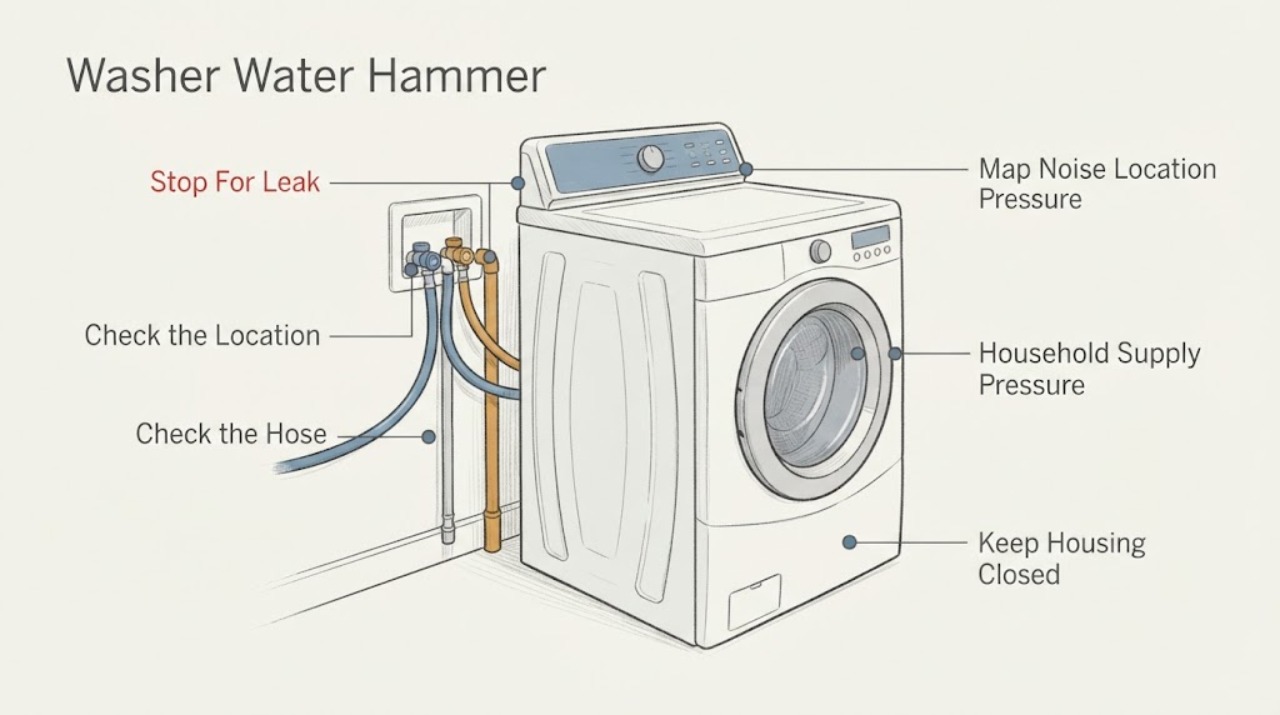
Work through in order
Diagnostic checks
Use only checks that match the exact appliance or system and its official guide.
-
Check 1
Stop the washer if a hose leaks, a pipe moves violently, water sprays, the floor is wet near the outlet, or the bang is severe; do not reach behind the appliance through water.
Expected result: There is a leak, wet electrical access, violent movement or only an isolated sound with no leak.
Next step: From a dry safe position, close the washer’s hot and cold water faucets; obtain qualified help if the valves or power cannot be reached safely.
Why this matters
Why: Water and electricity or a failing connection create a safety issue; a sound alone does not identify a washer failure.
-
Check 2
From a safe stationary position, note whether the bang is in the wall/ceiling pipes, at the flexible inlet hoses, or inside the washer, and whether it occurs as filling stops.
Expected result: The sound is synchronized with valve closure in the pipes, comes from a hose connection, or has no clear timing/location.
Next step: Use the household-plumbing branch for pipe noise and the appliance-service branch for washer-side evidence; do not open the washer.
Why this matters
Why: GE’s water-hammer guidance applies to inlet-pipe banging at valve closure; another location needs separate washer or installation assessment.
-
Check 3
Only with the washer off and the floor dry, look at the visible hot and cold fill hoses for kinks, abrasion, loose connections or hose movement; do not pull the washer or disconnect a hose.
Expected result: A hose or connection is visibly damaged/loose, or the hoses appear intact while the wall pipes bang.
Next step: Close both water faucets and arrange appliance service for a damaged washer-side connection; arrange plumbing service for building-pipe noise.
Why this matters
Why: Visible hose damage is an appliance installation/service concern; wall-pipe banging still fits GE’s household plumbing water-hammer explanation.
-
Check 4
Record whether noise happens during filling, exactly when the washer stops filling, or during drain/spin; do not advance or restart cycles repeatedly to reproduce it.
Expected result: The bang occurs as fill stops, while water pressure is changing, or during a different cycle stage.
Next step: For fill-stop pipe noise, use a plumber; for a washer-side noise or leak at another stage, use the exact model service path.
Why this matters
Why: GE ties water hammer to the closing water valve and identifies other washer noise stages as separate concerns.
-
Check 5
Do not install an aftermarket check valve, pressure device or pipe support based only on the sound, and do not adjust household pressure without a plumber.
Expected result: A proposed fix involves a check valve, pressure adjustment or opening a wall/washer component.
Next step: Document the sound and have a qualified plumber determine the appropriate building-side remedy.
Why this matters
Why: GE says check valves are not recommended because they may restrict flow, and root cause requires plumbing assessment.
-
Check 6
If the washer will remain unused while the cause is investigated and the water faucets are reachable from a dry safe area, close both supply faucets; do not touch wet electrical parts.
Expected result: The faucets can be safely reached, or water/power access is unsafe.
Next step: Leave the washer off and contact a plumber or appliance service according to the observed source; use an electrician if water reached the outlet or cord.
Why this matters
Why: Isolating water limits leak risk, but it does not repair water hammer or prove which system is at fault.
-
Check 7
Give the professional the full GE model number, washer type, noise timing/location, water-pressure changes, hose condition and any leak history.
Expected result: The bang persists, the building pipes move, a hose leaks, or the source remains unclear.
Next step: Use a qualified plumber for household water hammer/pressure/pipe support, and GE appliance service for washer-side faults after safe water isolation.
Why this matters
Why: Water hammer, loose building pipes, supply pressure and washer-side parts require different professionals; no model-neutral internal diagnosis is supported.
Use your observations
Decision map
Find the observation that best matches what you see, then follow the next safe action.
-
PATH 01Next step
What you see
The bang occurs in the inlet pipes exactly as the washer stops filling, with no washer-side leak.
Do this next
Keep the washer use limited if the movement is severe and arrange a qualified plumber to find the root cause and remedy.
Why this path and its safety boundary
Why it matters: GE identifies this pattern as likely water hammer in household plumbing and water pressure, not a washer defect.
-
PATH 02Next step
What you see
A flexible fill hose or its washer/faucet connection leaks, moves or is visibly damaged.
Do this next
Close both water faucets from a dry position and arrange appliance service or qualified installation help; do not disconnect the hose while wet.
Why this path and its safety boundary
Why it matters: The evidence is on the washer-side water connection, not enough to diagnose the washer valve or a building-pipe fault.
-
PATH 03Next step
What you see
The sound is a high-pitched squeal/whistle during filling and changes with the supply valves.
Do this next
Do not tune pressure yourself; arrange a plumber, especially if other fixtures also show pressure/noise symptoms.
Why this path and its safety boundary
Why it matters: GE says excessive household water pressure may cause this type of fill noise and recommends plumbing assessment if it persists.
-
PATH 04Next step
What you see
The noise occurs during drain/spin or while the washer cabinet moves, not as filling stops.
Do this next
Stop if there is a leak or violent movement and use the exact model service guidance; do not label it water hammer without the fill-stop timing.
Why this path and its safety boundary
Why it matters: That is not the direct water-hammer pattern described by GE and may be a separate hose, leveling, load or appliance issue.
-
PATH 05Next step
What you see
A check valve or generic pressure device is proposed as the fix.
Do this next
Do not install the device as a guess; have a qualified plumber inspect pressure, pipe support and the building-side water system.
Why this path and its safety boundary
Why it matters: GE says check valves are not recommended for washer fill hoses because they may restrict flow; the correct water-hammer remedy depends on plumbing assessment.
Helpful context
Understand the symptom
Locate the sound before naming a part
The phrase water hammer describes a sound, not a failed washer component. Note whether the bang is at the wall or ceiling pipes, the flexible hot/cold hoses behind the washer, or inside the washer cabinet, and whether it happens as filling stops or at another stage. GE’s direct water-hammer guidance places a bang at the inlet pipes during valve closure in household plumbing and water pressure.
Use a dry-position external check
If there is no leak and the floor and electrical access are dry, observe one normal fill from a safe position only if the exact sound can be heard without moving the washer. Do not reach behind it or deliberately cycle the appliance to reproduce a violent bang. If the sound is severe, stop the cycle and close the accessible hot and cold washer faucets.
Keep washer and building plumbing responsibilities separate
A hose that visibly jumps, leaks or has a damaged connection is an appliance-side installation/service concern. A bang that travels through the wall, ceiling or house piping when the washer valve closes is a plumbing and pressure concern. GE recommends a plumber for water hammer and loose pipes; it does not support replacing the washer valve from that sound alone.
Do not add an unverified flow device
GE says check valves are not recommended for its washer fill hoses because they can restrict water flow and prevent intended operation. Do not add one as a generic water-hammer cure. The building’s pressure, pipe support and any water-hammer control need assessment by a qualified plumber, while the exact washer manual controls model-specific hose work.
When checks do not resolve it
Need a professional?
Request a qualified plumber for water hammer that occurs in wall/ceiling/inlet pipes when filling stops, for loose or rattling building pipes, or for suspected pressure problems. Request GE appliance service for a leaking/damaged washer-side hose or connection, control/valve concern or unresolved washer-side noise after water is safely isolated.
Safety scope: Do not move the washer through water, open the cabinet, disconnect hoses while wet, add a check valve, adjust building pressure, open walls or repeat cycles to reproduce a violent bang. Water near power requires leaving the area and qualified electrical help.
Have this ready
- Provide the exact model, top/front/compact/unitized type, noise location, timing relative to valve closure, whether other fixtures show the same bang, hose condition, and any water leak or wet electrical access.
Common questions
FAQ
Is water hammer a problem with the GE washer?
Usually not when the bang is in the inlet pipes exactly as the washer stops filling. GE says this pattern is related to household plumbing and water pressure and recommends a professional plumber for the root cause.
Should I install a check valve on the washer hose?
No as a generic fix. GE says check valves are not recommended because they may restrict water flow and prevent the washer from operating as intended. Have a plumber assess the water system instead.
What if the fill hose itself bangs or leaks?
With the washer off and the floor dry, record the visible hose/connection condition and close both water faucets. Do not pull the washer or disconnect wet hoses; arrange qualified appliance or installation service.
Can high water pressure cause washer filling noise?
GE says excessive household water pressure can cause squealing or whistling during filling and recommends a plumber if adjusting the supply valves does not correct it. Do not change building pressure yourself.
Read the exact guide
Official sources
- Water Systems - Causes of Water HammerGE Appliances · Direct GE water-system article used for the general professional-plumber boundary; no appliance-specific fix inferred.
- Washer - Noise Heard When Filling with WaterGE Appliances · Direct GE support article for fill noise; used for water-pressure and loose-pipe distinction and service boundary.
- Washer - Pipes Rattling or BangingGE Appliances · Direct GE support article for banging/rattling inlet pipes when washer filling stops; no model is supplied.
- Washer - Inlet Fill HosesGE Appliances · Direct GE support page used for hose locations, model-specific installation, hose age and the warning that check valves are not recommended.
Community feedback
Share a repair observation
Share a plain-text repair observation. Accepted observations are published automatically; this page may take a moment to update.