
On this page
Start here
Quick answer
A light, short-lived frost film can follow humid air entering a refrigerator, a recent warm load, or a normal defrost cycle. Persistent or thick frost usually begins with a door that is not sealing, blocked vents or overpacking, incorrect temperature settings, or a refrigerator operating outside the conditions for which its exact model was designed. Gladiator's official appliance catalog lists garage-ready upright refrigeration, while its current all-refrigerator product page warns that contents may freeze in cold locations; identify the model and compartment before applying any setting. Keep the door fully closed, move packages away from the gasket and vents, clean and dry the gasket, and follow the exact manual for temperature and defrosting. If frost returns after a complete manual-approved thaw and the door, airflow, and settings are correct, or if food is warming, water is leaking, the compressor runs abnormally, or the cord or outlet is hot, stop and arrange qualified service. Do not chip frost with a sharp object, apply open or concentrated heat, remove panels, or perform live electrical or sealed-system tests.
Before you begin
Safety first
- The owner may identify the model and frost location, correct accessible loading and closure obstructions, clean and dry the gasket, restore visible airflow, compare settings and ambient conditions with the exact manual, and perform only a documented safe thaw. Qualified personnel must handle panels, wiring, defrost components, fan, sensor, compressor, drain, refrigerant, and live diagnosis.
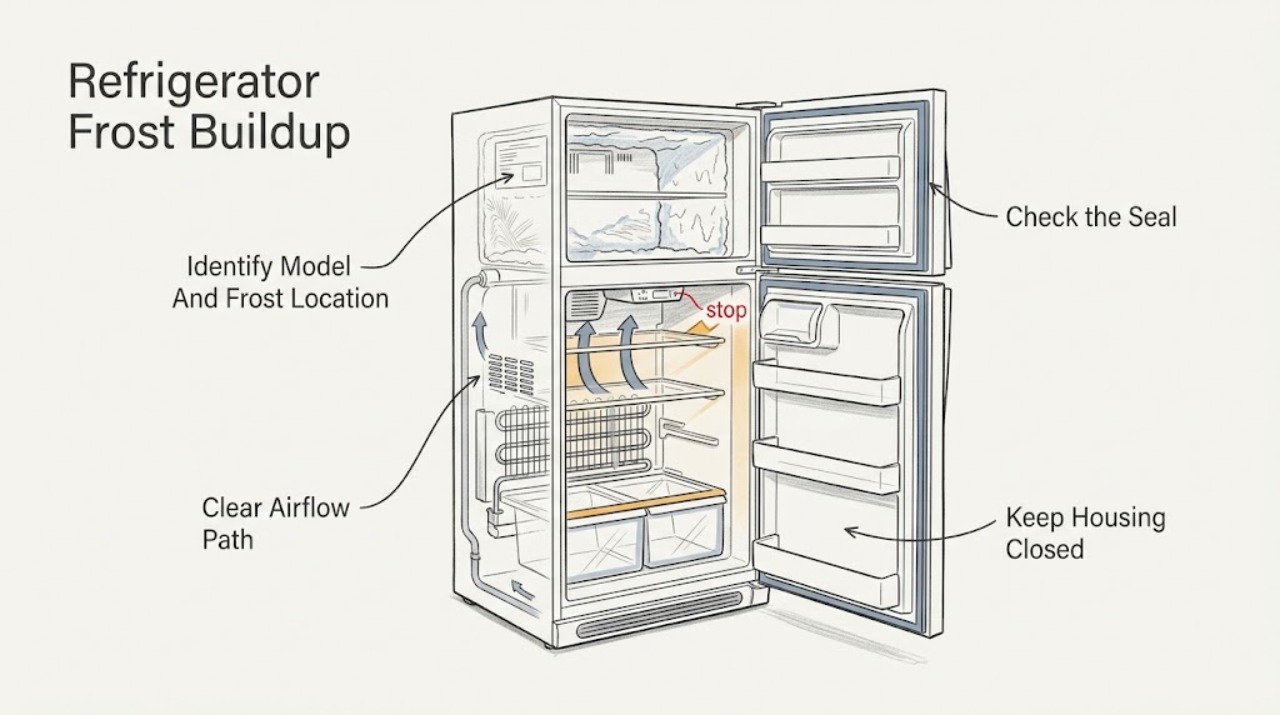
Work through in order
Diagnostic checks
Use only checks that match the exact appliance or system and its official guide.
-
Check 1
Record the complete Gladiator model and serial information and identify whether frost is on the rear wall, near an air vent, around a drawer or shelf, on the door edge, or across an entire compartment. Note whether the unit is an all refrigerator, an upright freezer, or another layout and whether food is warming or freezing.
Expected result: Frost is a thin isolated film; frost is thick or covers a broad panel; it is concentrated beside a gasket or vent; or the compartment temperature is also abnormal.
Next step: Use the matching Gladiator manual to confirm compartment type and temperature guidance, then continue with the gasket and airflow checks. Do not select a defrost procedure from another model.
Stop if: Stop for smoke, sparks, a burning odor, a hot cord or outlet, water near electrical parts, or any need to remove a panel.
Why this matters
Why: A brief thin film can be moisture from door use or a normal cycle. Broad or rapidly returning frost, a localized edge pattern, or abnormal compartment temperature makes sealing, airflow, settings, or defrost performance more likely and makes the exact model important.
-
Check 2
Inspect the complete door or drawer perimeter without removing the gasket. Move containers, shelves, or packages that prevent closure; wipe the gasket with mild soap and water, dry it, and check for a torn, folded, compressed, or visibly detached section. Close the door gently and confirm the gasket contacts the cabinet all around.
Expected result: A package blocks closure; the door or drawer is not fully closed; the gasket has dirt or a gap; or the gasket seals evenly with no obstruction.
Next step: Correct only the accessible obstruction or cleaning issue and monitor the frost pattern after the model's stabilization period. Do not glue, stretch, heat, or remove the gasket without the exact manual.
Stop if: Stop if the door is bent, the hinge or liner is damaged, the gasket cannot contact the cabinet, or the correction would require removing hardware or panels.
Why this matters
Why: A closure gap admits humid air and can create frost along one edge or near a corner. A clean, continuous seal makes a door-leak explanation less likely and shifts attention toward loading, settings, ambient conditions, or an internal cooling or defrost fault.
-
Check 3
With the refrigerator operating normally, inspect only the visible interior vents and rear-wall area. Move food away from vents and leave the clearance specified by the Gladiator manual; cover liquids and let hot food cool before storage. Do not force food against a frosted panel or block the return-air path.
Expected result: A vent is covered, the cabinet is overpacked, warm or uncovered food was recently loaded, or the visible airflow path is clear and loading is reasonable.
Next step: Restore the documented spacing and observe whether frost stops growing as the compartment stabilizes. If the vent is inaccessible because of heavy ice, use the manual-approved thaw path rather than scraping it open.
Stop if: Do not use sharp tools on ice, remove an air duct, or reach behind a fan cover; stop if food safety is compromised by a warming compartment.
Why this matters
Why: Blocked airflow and added moisture can create localized frost and temperature swings. If the path is open and moisture sources are controlled but frost keeps growing, a user-loading explanation becomes less likely.
-
Check 4
Compare the displayed or dial setting and the room location with the exact Gladiator manual. Note recent power interruption, a large warm load, high humidity, frequent door opening, and whether the appliance is in a cold garage. Use the model's recommended setting and allow its stated stabilization time after a change.
Expected result: The setting is at an extreme, the garage is near or below the model's limit, the door has been opened often, or the location and setting match the manual.
Next step: Move temperature-sensitive contents to a safe appliance if temperatures are abnormal, then correct only the documented setting or location issue. If frost persists with conditions within the manual, use the service branch.
Stop if: Do not operate outside the model's permitted environment, bypass a temperature control, or continue if food is unsafe, the cabinet is wet near electrical parts, or the cord or outlet is hot.
Why this matters
Why: Ambient conditions and moisture load can produce temporary frost or freezing, while a wrong setting can maintain an abnormal temperature. Gladiator specifically warns that its all-refrigerator contents may freeze in cold locations, but that warning is not a universal threshold for other models.
-
Check 5
If the exact manual permits owner defrosting, turn the refrigerator off, disconnect power, remove food, and let the frost melt by the documented method. Dry the interior and floor, restore the gasket and airflow corrections, then observe one normal cooling period without opening panels or trying to accelerate the thaw with concentrated heat.
Expected result: Frost does not return; a light film returns only after humid door use; frost quickly reappears in one area; the fan or compressor behavior is abnormal; or water fails to drain after thawing.
Next step: Keep the unit in service only when temperatures and frost remain normal. For recurrence or abnormal operation, keep it off as needed and provide the model, frost location, thaw result, temperature, and door and airflow observations to qualified service.
Stop if: Do not chip ice, puncture the liner, remove covers, make live measurements, or repeatedly restart a unit with abnormal frost, heat, odor, or electrical symptoms.
Why this matters
Why: Recovery after a manual-approved thaw supports moisture, loading, or airflow as the original contributor. Rapid recurrence or abnormal fan, compressor, or drain behavior makes a defrost, sensor, fan, drain, or sealed-system issue more likely.
Use your observations
Decision map
Find the observation that best matches what you see, then follow the next safe action.
-
PATH 01Safety boundary
What you see
The frost is thin and short-lived, follows a humid day, frequent opening, or warm uncovered food, and clears or stops growing after normal use resumes.
Do this next
Minimize door-open time, cover liquids, cool hot food before loading, and keep the gasket and vents clear. Monitor the same location rather than repeatedly thawing it.
Why this path and its safety boundary
Why it matters: Moisture entering during ordinary use is more likely than a failed defrost system.
Safety stop: Arrange service if the film becomes thick, returns continuously, or is accompanied by warming, leaking, or a damaged seal.
-
PATH 02Safety boundary
What you see
Frost is concentrated along one door or drawer edge, a package prevents full closure, or the gasket has a visible gap, dirt, fold, or damaged section.
Do this next
Remove the obstruction, clean and dry the gasket, and confirm full contact as the model manual allows. Keep food clear of the door and arrange service if the gap or alignment remains.
Why this path and its safety boundary
Why it matters: Humid air entering through an imperfect closure is more likely than a control or compressor issue.
Safety stop: Do not heat, glue, stretch, or remove the gasket or hinge; stop if the door or liner is damaged.
-
PATH 03Safety boundary
What you see
Frost is near a vent or across a loaded section, vents are blocked, the cabinet is overpacked, or the garage condition is outside the model guidance; the pattern improves after spacing or location correction.
Do this next
Restore documented clearances, correct the setting or location, and allow the model's stabilization time. Do not apply a current all-refrigerator temperature warning to an unidentified Gladiator model.
Why this path and its safety boundary
Why it matters: Restricted airflow or ambient conditions are more likely than an internal defrost part.
Safety stop: Stop if temperatures remain unsafe, food is warming, or correcting clearance requires moving a heavy appliance or opening panels.
-
PATH 04Safety boundary
What you see
After a complete manual-approved thaw, a sound gasket, clear vents, reasonable loading, and model-correct settings, frost quickly returns in the same area or the fan, drain, or temperature behavior is abnormal.
Do this next
Keep the refrigerator off or limit use as needed to protect food and arrange qualified Gladiator appliance service. Supply the model, frost map, temperature readings, thaw method, recurrence time, and visible water or airflow observations.
Why this path and its safety boundary
Why it matters: A defrost, sensor, fan, drain, door-alignment, or sealed cooling problem becomes more likely; frost alone cannot identify the component.
Safety stop: Do not remove interior panels, bypass a defrost control, perform live tests, or order a heater, sensor, fan, or control from frost appearance alone.
-
PATH 05Safety boundary
What you see
Frost is accompanied by a hot cord or outlet, smoke, sparks, burning odor, water near electrical parts, a leak, repeated protective-device trips, or food warming or freezing unpredictably.
Do this next
Disconnect power only when safe, protect or relocate food, and arrange qualified appliance or electrical service. Do not keep cycling the refrigerator to see whether the frost clears.
Why this path and its safety boundary
Why it matters: The condition exceeds a user frost correction and may involve electrical, water, control, or cooling faults.
Safety stop: Do not reconnect a wet or damaged unit, touch wiring, remove covers, or use a sharp tool or strong heat on the frost.
Helpful context
Understand the symptom
Confirm which Gladiator refrigerator you have
Gladiator's official catalog lists garage-ready upright refrigeration, and its product pages distinguish an all refrigerator from an upright freezer. A patch on the back wall of an all-refrigerator, frost around a freezer vent, and frost on food or a drawer do not prove the same fault. Read the model label and identify the compartment, then use that model's Owner's Manual for the permitted temperature range and defrost behavior.
Humidity enters through the door and becomes frost
The opened manufacturer frost guidance says frequent or prolonged openings, a door that is blocked open, warm or uncovered food, and a gasket that does not make full contact let moisture into the cold compartment. A thin film after a humid day or a recent warm load can be temporary. Thick frost in one area, a gap around the gasket, or frost that grows continuously points toward a seal, alignment, airflow, or defrost issue instead of ordinary condensation.
Airflow and the garage environment change the pattern
Blocked vents or tightly packed food can create moisture pockets and uneven cooling. Keep a small gap around vents and the back wall as the exact manual allows. Gladiator markets garage-ready refrigeration, but its all-refrigerator page still warns about freezing contents in cold locations; do not assume that a cold garage makes every frost pattern normal. Compare the observed room condition with the model's instructions instead of forcing the coldest setting.
Thaw only within the manufacturer's safe boundary
If the manual permits a user defrost, turn the refrigerator off, disconnect power, protect food, and let the ice melt naturally or by the documented method. Do not puncture the liner, use a knife or screwdriver, aim a heat gun at plastic or tubing, or remove an internal panel. If frost returns after a complete thaw with a clean gasket, open vents, correct settings, and a level cabinet, the defrost, sensor, fan, drain, or sealed cooling system needs qualified diagnosis.
Safety boundary
Stop conditions
- Stop and disconnect power only when safe for smoke, sparks, burning odor, a hot or damaged cord or outlet, or water near electrical parts.
- Do not chip or puncture frost, use a knife or screwdriver, apply concentrated heat, or damage the liner or refrigeration tubing.
- Do not remove interior or rear panels, perform live electrical tests, bypass a defrost or temperature control, or work on the compressor or sealed system.
- Protect or relocate food if the refrigerator is warming, freezing unpredictably, or cannot complete a normal cooling cycle.
- Do not apply a temperature range, defrost procedure, or part fit from another Gladiator model; use the exact Owner's Manual and model support information.
When checks do not resolve it
Need a professional?
Arrange qualified Gladiator appliance service when frost rapidly returns after a complete manual-approved thaw, when the door cannot seal or align, when the fan, drain, temperature control, or compressor behavior is abnormal, or when temperatures remain unsafe. Stop immediately for smoke, sparks, burning odor, a hot or damaged cord or outlet, water near electrical parts, a leak, repeated protective-device trips, or food-temperature loss. The owner may identify the model, correct accessible loading or gasket obstructions, clean and dry the gasket, restore visible airflow, compare settings and ambient conditions with the exact manual, and perform only a documented safe thaw. Internal defrost, fan, sensor, control, compressor, drain, wiring, and sealed-system work requires qualified service.
Safety scope: The owner may identify the model and frost location, correct accessible loading and closure obstructions, clean and dry the gasket, restore visible airflow, compare settings and ambient conditions with the exact manual, and perform only a documented safe thaw. Qualified personnel must handle panels, wiring, defrost components, fan, sensor, compressor, drain, refrigerant, and live diagnosis.
Common questions
FAQ
Is a small amount of frost in a Gladiator refrigerator normal?
A thin, short-lived film can result from humid air, door openings, warm food, or a normal cycle. Persistent, thick, or rapidly returning frost is different. Check the exact model's gasket, airflow, setting, ambient conditions, and permitted defrost method before assuming a component has failed.
Can a cold garage cause frost or freezing in a Gladiator refrigerator?
It can change the diagnosis. Gladiator describes its appliances as garage-ready, but the opened all-refrigerator page also warns that contents may freeze in cold locations. Use the exact model's environmental guidance; do not treat one product's cold-location warning as a universal temperature limit.
What should I check first for frost buildup?
Identify the model and frost location, make sure the door or drawer closes fully, clean and dry the gasket, move food away from vents, avoid overpacking and uncovered warm food, and compare the setting and room condition with the manual. If frost returns quickly after a permitted thaw, arrange service.
Is it safe to remove Gladiator refrigerator frost with a knife or heat gun?
No. Disconnect power and use only the exact manual's safe defrost method; do not puncture the liner, scrape with a sharp object, or direct concentrated heat at the cabinet or tubing. Panels, wiring, defrost parts, fans, compressors, and sealed cooling systems require qualified service.
Read the exact guide
Official sources
- What's Normal Condensation or FrostWhirlpool Product Help · Official Whirlpool refrigeration guidance used only for general frost mechanisms; it is not presented as a Gladiator model manual and the exact Gladiator instructions control.
- Appliances - Garage Refrigerators & Freezers | GladiatorGladiator · Official Gladiator appliance catalog used to establish the brand's garage-ready refrigeration product line; model-specific controls and frost procedures are not inferred from the catalog.
- Garage Refrigerator | 17.8 Cu. Ft. Garage-Ready Fridge | GladiatorGladiator · Official product page for Gladiator's 17.8-cu-ft all refrigerator; its cold-location warning is model-specific and is not a universal environmental limit for every Gladiator refrigerator.
- Frosting in the Freezer Section - Quad DoorWhirlpool Product Help · Official Whirlpool freezer frost guidance used for general refrigeration checks; exact Gladiator refrigerator layout and manual instructions may differ.
Community feedback
Share a repair observation
Share a plain-text repair observation. Accepted observations are published automatically; this page may take a moment to update.