
On this page
Start here
Quick answer
First determine whether both sections are warm, only the refrigerator section is warm, or the unit is in a control state that leaves lights on but cooling off. On the opened Gladiator manual for the GARF30FDGB/GAFZ30FDGB family, hold the documented TEMP SETTING control for 3 seconds to turn cooling on or off; the interior light can still operate when cooling is off. Then check that vents are not blocked, the door and gasket close fully, the unit is not beside a heat source or in an unsuitable garage environment, and a large recent load or frequent door opening is not delaying recovery. If your model's manual permits condenser cleaning, unplug the unit, clean only the accessible grille/coil area with a soft vacuum attachment, and replace the grille before restoring power. Allow the model's stabilization time—Gladiator documentation gives roughly 6–8 hours or longer after first start and 24 hours after a control change in the opened family manual. If both sections remain warm after these external checks, or if there is burning odor, damaged wiring, repeated tripping, unusual clicking, or a sealed-system symptom, stop and arrange qualified appliance service.
Before you begin
Safety first
- The owner may observe section temperatures, consult the exact manual, verify a normal outlet, clear accessible vents and door obstructions, and clean an accessible condenser only when the manual permits and power is disconnected. Electrical, fan, compressor-start, control, sealed-system, and inaccessible base work require qualified service.
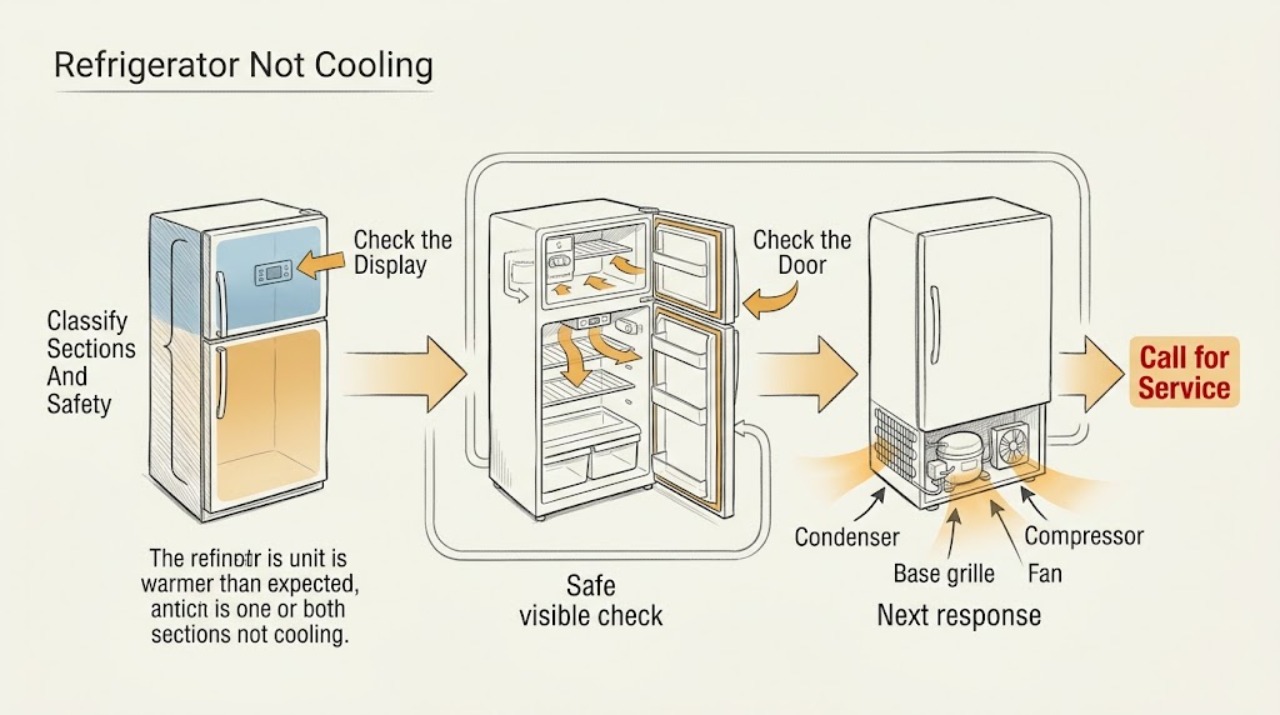
Work through in order
Diagnostic checks
Use only checks that match the exact appliance or system and its official guide.
-
Check 1
Record whether the refrigerator section, freezer section, or both are warm. Note whether the interior light and control panel respond, whether the unit is newly installed or recently unplugged, and whether there is smoke, burning odor, a hot or damaged cord, water near electrical parts, repeated breaker trips, or sharp abnormal noise.
Expected result: Both sections are warm; only the refrigerator section is warm; lights work but cooling is absent; the unit is recovering after installation or power; or an electrical/physical hazard is present.
Next step: Stop and isolate the appliance safely for smoke, burning odor, hot/damaged wiring, water near electrics, or repeated trips. Otherwise follow the matching control, airflow, and recovery checks without opening the cabinet.
Stop if: Do not touch wet electrical connections, repeatedly reset a breaker, or remove panels to listen for the compressor or fan.
Why this matters
Why: A two-section problem points to a shared cooling state, power, heat-rejection, or internal system issue. A single-section problem makes airflow or compartment-specific control more likely. Lights do not prove that cooling is enabled. Hazards make continued operation unsafe.
-
Check 2
Confirm the plug is in the required grounded outlet and the outlet has power using only a normal, safe household check. Read the exact Gladiator manual to confirm the temperature control is on and the cooling function is enabled; on the opened GARF30FDGB/GAFZ30FDGB manual, cooling is toggled with a 3-second TEMP SETTING hold. Do not apply that sequence to another model without its manual.
Expected result: The outlet is dead or the breaker is tripped; cooling was intentionally turned off; the control is set normally; or the control layout is different or unclear.
Next step: Correct only a safe household supply or exact-manual cooling setting. If the circuit trips again, the outlet is hot/damaged, or the control remains unclear, stop and arrange electrical or appliance service as appropriate.
Stop if: Do not use an extension cord or adapter, open the outlet, enter service mode, or repeatedly cycle the cooling control.
Why this matters
Why: No supply prevents cooling. Cooling-off or a model-specific demo/showroom state can leave lights operating while the compressor and fans do not cool. A normal control state moves the investigation to airflow, environment, and recovery rather than another button sequence.
-
Check 3
Inspect accessible interior vents and the base grille area for packages or furniture blocking airflow. Confirm the door closes without a package obstruction and the gasket contacts the cabinet around its perimeter. Note a large recent grocery load, frequent long openings, a heat source nearby, or a room/garage temperature outside the exact model's design guidance.
Expected result: A vent or grille is blocked; the door or gasket does not seal; a large warm load or frequent openings occurred; the unit is beside a heat source or in a hot/cold garage; or no external issue is visible.
Next step: Remove only accessible obstructions, close the door, improve the surrounding clearance within the installation instructions, and allow recovery. Arrange service for a damaged gasket, inaccessible ventilation issue, or persistent warmth.
Stop if: Do not block vents to force cold air elsewhere, reshape or replace a gasket without model fitment, or move a heavy built-in/garage unit while connected.
Why this matters
Why: Blocked airflow, poor sealing, warm loads, door use, and environmental heat can raise cabinet temperature or lengthen recovery. A clear, sealed, appropriately located unit with both sections warm makes a shared internal cooling fault more plausible.
-
Check 4
If the exact Gladiator manual identifies an accessible condenser and base grille, unplug the refrigerator, remove only the grille as shown, and use a vacuum with a soft or extended attachment to remove visible dust from the grille and accessible coil surface. Replace the grille before restoring power. Do not bend fins, spray liquid, reach into a fan, or perform this step if the model manual does not permit owner access.
Expected result: The grille/coil area was visibly dusty and can be cleaned; it is already clear; the coil is inaccessible; or there is oil, damaged wiring, a hot component, or another abnormal condition.
Next step: Refit the grille, restore power only when the area is dry and safe, and allow the documented recovery time. Arrange qualified service for inaccessible, damaged, oily, or persistently warm conditions.
Stop if: Do not remove internal covers, spray the condenser, touch the compressor or fan, or use compressed air or a tool that can damage the coil or wiring.
Why this matters
Why: Dust and blocked heat rejection can reduce cooling performance in models for which the manual permits this cleaning. Inaccessibility or damage moves the problem to service; cleaning cannot establish a compressor, fan, or sealed-system diagnosis.
-
Check 5
After one documented control adjustment or an accessible cleaning, leave the setting unchanged and record the time. For the opened Gladiator family manual, initial cooling can take about 6–8 hours or longer and a control change should be given 24 hours to stabilize; the exact model manual controls. Monitor both compartments and protect perishable food while waiting.
Expected result: Cooling returns; one section remains warm; both sections remain warm; the compressor or fan repeatedly clicks/starts and stops; or the unit cannot maintain a safe food temperature.
Next step: If cooling does not return within the exact manual's recovery period, keep food safe and arrange qualified Gladiator/Whirlpool appliance service. Provide the model, section temperatures, control state, timing, and external findings.
Stop if: Do not keep changing settings, repeatedly unplug/replug, add refrigerant, or open the sealed or electrical system.
Why this matters
Why: Recovery after startup, a warm load, or an adjustment differs from persistent no-cooling. Persistent two-section warmth or repeated start attempts after external checks can involve an internal control, fan, compressor-start, or sealed-system fault that cannot be identified safely by sound alone.
Use your observations
Decision map
Find the observation that best matches what you see, then follow the next safe action.
-
PATH 01Safety boundary
What you see
The lights work but both refrigerator and freezer sections remain warm, and cooling is off, in demo/showroom state, or the control/power state is not yet confirmed.
Do this next
Use the exact manual to enable cooling and verify a normal outlet. If both sections remain warm after recovery, arrange service.
Why this path and its safety boundary
Why it matters: A shared cooling state or power/control issue is more likely than a refrigerator-compartment-only airflow problem; model-specific controls must be verified.
Safety stop: Do not use a control sequence from another Gladiator or Whirlpool model and do not open the rear cabinet.
-
PATH 02Safety boundary
What you see
The freezer is cold but the refrigerator section is warm, with packages near vents or a crowded/blocked airflow path.
Do this next
Clear accessible vents, move packages away from the air path, close the door promptly, and reassess after stabilization. Service a persistent one-section temperature fault.
Why this path and its safety boundary
Why it matters: Compartment airflow or loading is more likely than a complete cooling-system failure.
Safety stop: Do not remove an evaporator cover, force air through a blocked vent, or alter a damper or fan.
-
PATH 03Safety boundary
What you see
The refrigerator was newly started, recently adjusted, or loaded with many warm items, and there is no electrical hazard.
Do this next
Leave the setting unchanged, minimize door openings, and monitor for the model-documented period. Protect food and call service if cooling does not return.
Why this path and its safety boundary
Why it matters: Normal recovery is still possible. The opened Gladiator family manual gives 6–8 hours or longer after first start and 24 hours between setting changes; room temperature and door use affect the result.
Safety stop: Do not make repeated colder adjustments or store perishable food in a cabinet that remains warm.
-
PATH 04Safety boundary
What you see
The unit is in a hot or unsuitable location, near a heat source, has blocked base/airflow clearance, or the accessible condenser area is dusty on a model that permits cleaning.
Do this next
Restore the installation clearance and clean only the accessible condenser area as the exact manual permits. Reassess after stabilization; service persistent warmth or inaccessible coil conditions.
Why this path and its safety boundary
Why it matters: Heat rejection and surrounding conditions can explain poor cooling or long recovery without proving an internal component failure.
Safety stop: Do not move a heavy unit unsafely, remove internal covers, or spray or scrape the condenser.
-
PATH 05Safety boundary
What you see
Cooling is enabled, the external supply and airflow/door conditions are normal, accessible condenser cleaning is complete if allowed, and both sections remain warm or repeatedly start and stop.
Do this next
Stop owner troubleshooting, protect food, and arrange qualified Gladiator/Whirlpool appliance service with the exact model and timing record.
Why this path and its safety boundary
Why it matters: An internal control, fan, compressor-start, or sealed-system fault remains possible; no part can be identified safely from this symptom pattern alone.
Safety stop: Do not open the electrical or sealed system, test energized components, add refrigerant, or keep resetting power.
Helpful context
Understand the symptom
Start with the cooling state, not the outside temperature
A Gladiator unit can have an illuminated interior light while its cooling function is off on the opened GARF30FDGB/GAFZ30FDGB family manual. Conversely, a warm cabinet immediately after first startup or a large warm load may still be recovering. Check the display/control state and measure or compare the compartment temperatures before deciding that a compressor has failed.
Airflow and heat rejection are owner-level checks only when accessible
Keep internal vents clear of packages, allow the base and surrounding area to breathe, and keep the door seal contacting the cabinet. The opened Gladiator manuals also describe condenser-coil cleaning with the unit unplugged and the base grille removed, but do not turn that into a universal procedure for every Gladiator model. If the coil or grille is not accessible as the exact manual shows, leave it to a technician.
One warm compartment is a different branch from two warm compartments
If the freezer is cold but the refrigerator section is warm, look first at the model's vents, loading, and door pattern; if both sections are warm, cooling-off/demo state, power, heat rejection, or an internal cooling fault becomes more plausible. Do not remove an evaporator cover or test a fan, compressor, relay, or refrigerant circuit to distinguish those branches.
Safety boundary
Stop conditions
- Stop immediately for smoke, burning odor, sparking, a hot or damaged cord or plug, water near electrical parts, exposed wiring, or repeated breaker trips.
- Do not open the rear cabinet, touch the compressor, fan, relay, wiring, refrigerant tubing, or sealed system, and do not perform live electrical tests.
- Do not use a model-unverified cooling/demo sequence, block vents, bend coil fins, spray the condenser, or add refrigerant.
- If both sections remain warm after the exact model's recovery period and permitted external checks, protect perishable food and arrange qualified appliance service.
Only after diagnosis
Potential parts
- door gasket or airflow/grille component
Consider only when the exact model and inspection confirm a damaged gasket, grille, or other accessible part after external temperature and loading checks.
Gladiator refrigerator parts are model-specific. A warm cabinet alone does not prove gasket or grille failure; do not glue, stretch, or substitute a part. - temperature control, fan, compressor-start, or sealed-system component
Consider only after qualified diagnosis confirms persistent no-cooling with cooling enabled and external airflow, door, condenser, and recovery conditions correct.
Internal control, fan, compressor-start, and sealed-system parts require exact model fitment and qualified service. Do not order or replace one from the symptom alone.
When checks do not resolve it
Need a professional?
Arrange qualified Gladiator/Whirlpool appliance service when cooling remains off after the exact model control is enabled, when both sections stay warm after the documented recovery period, when the compressor or fan repeatedly starts and stops, or when a condenser, gasket, vent, or base condition is inaccessible or damaged. Contact a qualified electrician for a hot, damaged, wet, sparking, or repeatedly tripping outlet or circuit. Provide the exact model, section temperatures, control state, installation or power-restoration timing, door/gasket and airflow findings, and any sounds or hazards.
Safety scope: The owner may observe section temperatures, consult the exact manual, verify a normal outlet, clear accessible vents and door obstructions, and clean an accessible condenser only when the manual permits and power is disconnected. Electrical, fan, compressor-start, control, sealed-system, and inaccessible base work require qualified service.
Common questions
FAQ
Why is my Gladiator refrigerator warm even though the light is on?
On the opened GARF30FDGB/GAFZ30FDGB family manual, the interior light can operate when the cooling function is off. Check the exact model's cooling control first, then vents, door seal, condenser access, environment, and recovery time. If both sections remain warm, arrange service.
How long does a Gladiator refrigerator take to cool after starting?
The opened Gladiator family manual says the compressor may run constantly and initial cooling may take about 6–8 hours or longer, depending on room temperature and door openings. After a temperature-control change, it says to wait 24 hours before judging the result. Use your exact model manual for the controlling guidance.
Can dirty condenser coils make a Gladiator refrigerator stop cooling?
Dust and restricted heat rejection can reduce cooling performance on models whose manuals permit condenser cleaning. Unplug the unit and follow the exact Gladiator manual for an accessible grille/coil cleaning. If the condenser is inaccessible or the refrigerator remains warm afterward, arrange service rather than removing internal covers.
Why is the freezer cold but the refrigerator section is warm?
That pattern makes a blocked compartment vent, crowded loading, or an airflow issue more likely than a complete loss of cooling. Clear accessible vents and move packages away from the air path, then allow stabilization. Do not remove an evaporator cover or change a damper or fan yourself.
Read the exact guide
Official sources
- Tips for Properly Setting the Controls - Product HelpWhirlpool Corporation · Supports one-change-at-a-time measurement and stabilization reasoning; the exact Gladiator control labels remain model-specific.
- Gladiator All Refrigerator and Upright Freezer Use and Care Guide (GARF30FDGB / GAFZ30FDGB)Gladiator GarageWorks / Whirlpool Corporation · Directly supports that named Gladiator model family and is used conditionally for owner-accessible condenser and troubleshooting instructions.
- Gladiator Refrigerator/Freezer Owner's Manual (GARF30FDGB / GAFZ30FDGB family)Gladiator / Whirlpool Corporation · Directly supports the identified Gladiator family manual; the article uses its 3-second cooling control, temperature, and timing details conditionally because no model was assigned.
- Not Cooling - Product HelpWhirlpool Corporation · Supports general refrigeration checks relevant to the Whirlpool-hosted Gladiator documentation; model-specific condenser access and controls remain governed by the Gladiator manual.
- Not Cooling - Both Sections - Side by Side Refrigerator - Product HelpWhirlpool Corporation · Supports the symptom distinction between one-section and both-section warmth and the model-specific cooling-off/demo caveat; it is not a Gladiator parts manual.
Community feedback
Share a repair observation
Share a plain-text repair observation. Accepted observations are published automatically; this page may take a moment to update.