
On this page
Start here
Quick answer
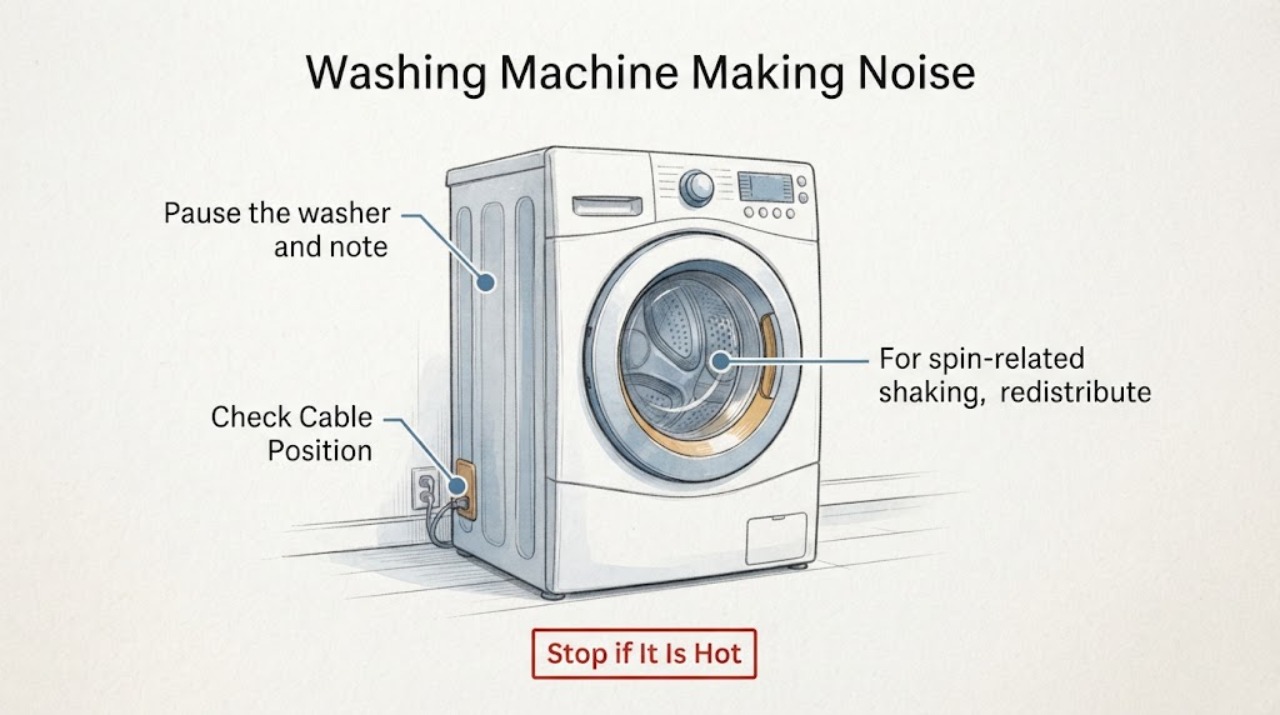
Pause the Haier washer and identify when the sound occurs: only during high-speed spin, while draining, or whenever the drum moves. A load that is off-center, an unlevel floor, or transport bolts left after installation can cause shaking and knocking. Coins or other objects can rattle in the drum or pump, while grinding, squealing, or a repeated metallic impact that remains with an empty drum can indicate a suspension, bearing, motor, belt, or other mechanical fault. Stop immediately for violent movement, metal-on-metal scraping, a leak, burning odor, sparks, or a breaker trip. Do not open panels or tighten internal parts yourself.
Work through in order
Diagnostic checks
Use only checks that match the exact appliance or system and its official guide.
-
Check 1
Pause the washer and note the exact cycle moment and sound: wash agitation, drain, low-speed tumble, or high-speed spin. Wait until the drum stops, then check for violent movement, cabinet walking, a leak, a burning odor, smoke, sparks, or a breaker trip.
Expected result: The sound is a shake or knock only during spin, a rattle during drain, a scrape or grind whenever the drum moves, or an abnormal electrical or water symptom is present.
Next step: If any hazard is present, stop, keep clear, and arrange service. Otherwise continue with the load and installation checks while the drum is stopped.
Stop if: Stop immediately for violent shaking, walking, metal scraping, uncontrolled leaking, burning odor, smoke, sparks, or a tripped breaker.
Why this matters
Why: Spin-only movement points first toward balance or leveling; a drain-only rattle points toward the pump or a loose object; persistent mechanical noise points toward a rotating or suspension component. Hazard symptoms override all routine checks.
-
Check 2
With power off and the drum stopped, remove the laundry and inspect pockets, the door seal, and the visible drum openings for coins, keys, pins, bra wires, hard decorations, or other loose objects. Close zippers and hooks and use a wash bag for small items on future loads.
Expected result: A loose object is visible at the opening, the noise disappears with the load removed, or the drum still makes the same scrape or rattle when empty.
Next step: Remove only an object that is plainly reachable without tools or force. If an object is trapped behind the drum or the noise persists empty, stop and request service.
Stop if: Do not reach into a moving drum, disassemble the drum, or use tools through perforations; stop if the object cannot be safely retrieved.
Why this matters
Why: Haier identifies hard objects and clothing hardware as sources of drum noise. If the empty drum still makes the same mechanical sound, the load is less likely to be the cause and a technician should inspect the machine.
-
Check 3
For spin-related shaking, redistribute the laundry evenly after the drum stops. Remove a single bulky item or reduce an overloaded load, then check from the outside that the washer stands firmly on a solid, level floor and does not rock.
Expected result: The load is bunched, overloaded, or a single blanket or heavy item is present; the cabinet rocks, shifts, or sits on an unstable surface.
Next step: Redistribute or reduce the load and correct only an obvious external stability issue as the model permits. If the machine still bangs, walks, or vibrates strongly, stop and arrange service.
Stop if: Stop for violent movement, a damaged cabinet, a damaged door, or any leak that appears during the attempt.
Why this matters
Why: Haier links excessive or unbalanced loads and an uneven or unstable position with shaking and noise. A stable, level installation reduces this branch, but it does not explain a persistent empty-drum grind.
-
Check 4
If the washer is new or was recently moved, check the installation paperwork and the rear exterior for transport bolts or stabilizers that should have been removed. Do not lift the appliance or remove a rear cover unless the exact model instructions and safe handling support it; otherwise have the installer or technician correct the installation.
Expected result: The washer is newly installed or relocated and transport hardware may still be fitted, or the hardware has already been removed and the noise began later.
Next step: Have remaining transport hardware removed with power disconnected and the machine safely handled according to the model manual. If no hardware remains, continue to drain and mechanical checks.
Stop if: Do not operate with transport hardware installed, remove heavy covers alone, or work on the machine while energized or connected to water.
Why this matters
Why: Haier states that transport bolts protect a front-load washer during movement and should be removed before use. Leaving them in place can cause severe vibration and noise; a later-onset sound is less likely to be explained by installation hardware alone.
-
Check 5
If the sound occurs during draining or the washer leaves water behind, inspect the drain hose from the outside for a kink, crimp, or incorrect insertion. If the model has an accessible pump filter, clean it only by the model's instructions with power removed and water safely contained.
Expected result: The hose is kinked or pushed too far into the standpipe, the accessible filter is clogged, or the noise is a rattle or hum from the pump area.
Next step: Correct only an obvious external hose issue or the model-permitted filter procedure. If the pump remains noisy, drainage is poor, or water cannot be safely contained, stop and request service.
Stop if: Do not open a filter with uncontrolled water, reach into the pump, or continue if water reaches electrical parts or the pump becomes unusually hot.
Why this matters
Why: Haier says a washer may fail to spin when it cannot drain and specifically calls out a pump filter, drain-hose restriction, and siphoning condition. A drain-related sound should not be treated as a bearing or belt diagnosis without clearing this branch.
-
Check 6
After the low-risk checks, compare the sound with an empty, manually stopped drum only as far as the model permits: note whether there is roughness, grinding, squealing, repeated metal impact, or excessive side-to-side movement. Do not run a hazardous test to make the sound louder.
Expected result: The empty drum still grinds or squeals, has noticeable play or impact, or the noise changes with motor speed and remains after load, level, transport, and drain causes are ruled out.
Next step: Stop using the washer and provide the technician the cycle, load, sound pattern, and checks completed. Do not remove panels, adjust internal tension, or tighten internal parts.
Stop if: Stop immediately for metal-on-metal scraping, severe drum movement, a loose or damaged drum, burning odor, smoke, sparks, or a breaker trip.
Why this matters
Why: Haier identifies worn bearings, suspension, motor, transmission, and belt issues as professional-repair possibilities. These observations justify diagnosis, not a particular replacement part; the symptom alone cannot distinguish the failed component safely.
Use your observations
Decision map
Find the observation that best matches what you see, then follow the next safe action.
-
PATH 01Next step
What you see
The noise is a shake or knock only with a bunched, overloaded, or bulky load.
Do this next
Redistribute or reduce the load after the drum stops, then check external stability and leveling.
-
PATH 02Next step
What you see
The washer rocks or the floor is unstable or unlevel.
Do this next
Correct only the external placement or leveling permitted by the model instructions; stop if movement remains strong.
-
PATH 03Next step
What you see
The washer is new or was moved and transport bolts or stabilizers remain.
Do this next
Have the installation corrected with power removed and safe handling; do not continue normal cycles with the hardware installed.
-
PATH 04Next step
What you see
The sound occurs during drain and a hose restriction or accessible pump-filter obstruction is found.
Do this next
Correct only the external hose routing or model-permitted filter issue and stop if drainage or pump noise persists.
-
PATH 05Next step
What you see
Coins or other hard objects are visible at the door seal or drum opening.
Do this next
Remove only plainly reachable objects without tools or force; request service for anything trapped behind the drum.
-
PATH 06Next step
What you see
Grinding, squealing, repeated metal impact, or abnormal drum play remains after safe external checks.
Do this next
Stop using the washer and have a technician diagnose bearings, suspension, motor, drive, or other internal components.
-
PATH 07Next step
What you see
There is violent shaking, a leak, burning odor, smoke, spark, or a breaker trip.
Do this next
Stop immediately, disconnect power and water only if safe and dry, and arrange qualified appliance or electrical help.
Helpful context
Understand the symptom
Match the sound to the part of the cycle
A short click or water movement can be part of normal operation, but a new or worsening sound needs a pattern. Note whether it begins during wash agitation, drain, or spin; whether the drum is full or empty; and whether the cabinet moves. A sound that appears only with one heavy load suggests balance, while a persistent grinding or squealing sound with no laundry warrants service.
Start with low-risk checks
Stop the cycle, wait for the drum to stop, and keep hands clear of moving parts. Empty pockets and remove visible loose objects from the door seal or drum opening. Check the load, the washer's external stability, and the drain hose. Do not reach through the drum, remove the rear cover, or work on a pump, motor, belt, bearing, or suspension system.
New installation needs a separate check
If the noise began immediately after installation or relocation, transport bolts or stabilizers may still be fitted. Haier's removal instructions require power to be removed and access to the rear of the machine; because this can involve covers and a heavy appliance, use the model manual or the installer/technician if the hardware is not plainly accessible.
When to stop
Do not keep running a machine that walks, bangs violently, scrapes metal, leaks, smells of burning, sparks, or trips a breaker. Disconnect power and water only from a safe, dry position, then arrange qualified appliance service or an electrician for an electrical symptom.
Safety boundary
Stop conditions
- Stop for violent shaking, walking, repeated banging, or a damaged cabinet or door; wait until the drum stops before moving anything.
- Stop for metal-on-metal scraping, a loose drum, a grinding or squealing sound that persists empty, or excessive side-to-side movement.
- Stop for a leak, water near electrical parts, uncontrolled filter water, burning odor, smoke, sparks, or a breaker that trips again.
- Do not remove panels, access the pump, adjust a belt, inspect bearings, tighten internal parts, or lift the machine without qualified help and model-specific instructions.
- Do not keep testing a washer that produces a hazardous symptom; disconnect power and water only from a safe, dry position and arrange service.
Only after diagnosis
Potential parts
- drain pump or pump filter assembly
Consider only when the noise occurs during drain, the external hose is clear, and a technician confirms the pump or filter assembly is at fault.
Confirm the complete model and manufacturer fit information before ordering any part. - suspension or shock absorber component
Consider only when strong movement or repeated spin knocks remain with a balanced load and level installation and a technician confirms a worn suspension component.
Suspension designs vary by model; do not infer fit or replacement from noise alone. - bearing or drive component
Consider only when grinding, squealing, metal impact, or abnormal drum play persists empty and a technician identifies the internal source.
A belt, bearing, motor, or transmission cannot be selected safely without model-specific diagnosis and fit confirmation.
When checks do not resolve it
Need a professional?
Call a qualified appliance technician if noise persists with a normal load after external leveling, load balance, transport-hardware, visible-object, and drain checks, or if the empty drum grinds, squeals, impacts, or has unusual play. Provide the cycle, load, sound location, installation age, water behavior, and any visible damage. Treat violent movement, leaks near electrics, burning odor, smoke, sparks, and repeated breaker trips as urgent.
Common questions
FAQ
Why does my Haier washer make a loud noise only during spin?
Check for an unbalanced or bulky load, an overloaded drum, and an unstable or unlevel installation. If the washer still bangs, walks, or vibrates strongly with a balanced load, stop and request service.
Could a coin or other object cause a Haier washer to rattle?
Yes. Haier advises emptying pockets and securing hard clothing hardware. Remove only an object that is plainly reachable with power off; a trapped object or an empty-drum rattle needs service.
When does washer noise suggest a bearing or suspension problem?
Grinding, squealing, repeated metal impact, or unusual drum movement that remains with an empty drum after balance, level, transport, and drain checks should be diagnosed by a technician. Noise alone cannot identify the exact part.
Can a blocked drain pump cause a noisy Haier washer?
A drain-related rattle or hum can occur with a restricted hose or pump filter, and Haier notes that a washer may also fail to spin if it cannot drain. Check only the external hose or model-accessible filter procedure and stop if water is uncontrolled.
Read the exact guide
Official sources
- Haier - Top Load and Compact Washer Does Not SpinHaier Appliances · Haier washer drain path, pump filter, and drain-hose checks
- About the abnormal noise of top-load washing machineHaier India · Haier washing-machine abnormal noise, load, placement, and rotating-component guidance
- How to dismantle the transportation bolts-FL washing machineHaier Saudi Arabia · Haier front-load washer transport-bolt removal and power-isolation guidance
- Strong vibration while spinningHaier Malaysia · Haier washer spin vibration, stable placement, and load-balance checks
- What to do if the noise in drum?Haier India · Haier washing-machine drum noise, foreign objects, balance, suspension, and bearing guidance
Community feedback
Share a repair observation
Share a plain-text repair observation. Accepted observations are published automatically; this page may take a moment to update.