
On this page
Start here
Quick answer
Photograph the display and record the exact model before clearing anything. Do not use a generic Hisense code list: the official HSAA16FS and HSAP16FB dishwasher manuals document F11, F12, F40, F41, F42, F43, F45, F54, F56, and F65 for those manual families, but another model may use different codes or actions. For an F12 shown on either of those manuals, the model-specific external checks are the water tap and inlet-hose filter; for F11, the manual points to a water-outlet/drain condition. F40, F41, F42, F43, F45, F56, and F65 are service-directed in those manuals. F54 is an overfill warning: turn off the water supply and follow the exact manual's water-shutoff instruction before disconnecting power. If water is escaping, the door will not latch, the heater or electrical system is implicated, or the code returns after an approved check, stop the cycle and arrange qualified Hisense service. Do not open the control, pump, heater, or wiring compartments.
Before you begin
Safety first
- This article covers recording the code, model-matched external inlet/drain checks, and water-supply isolation for documented overfill conditions. It does not authorize internal component replacement, live testing, control or safety bypass, or work in the heater, pump, valve, sensor, wiring, or circulation compartments.
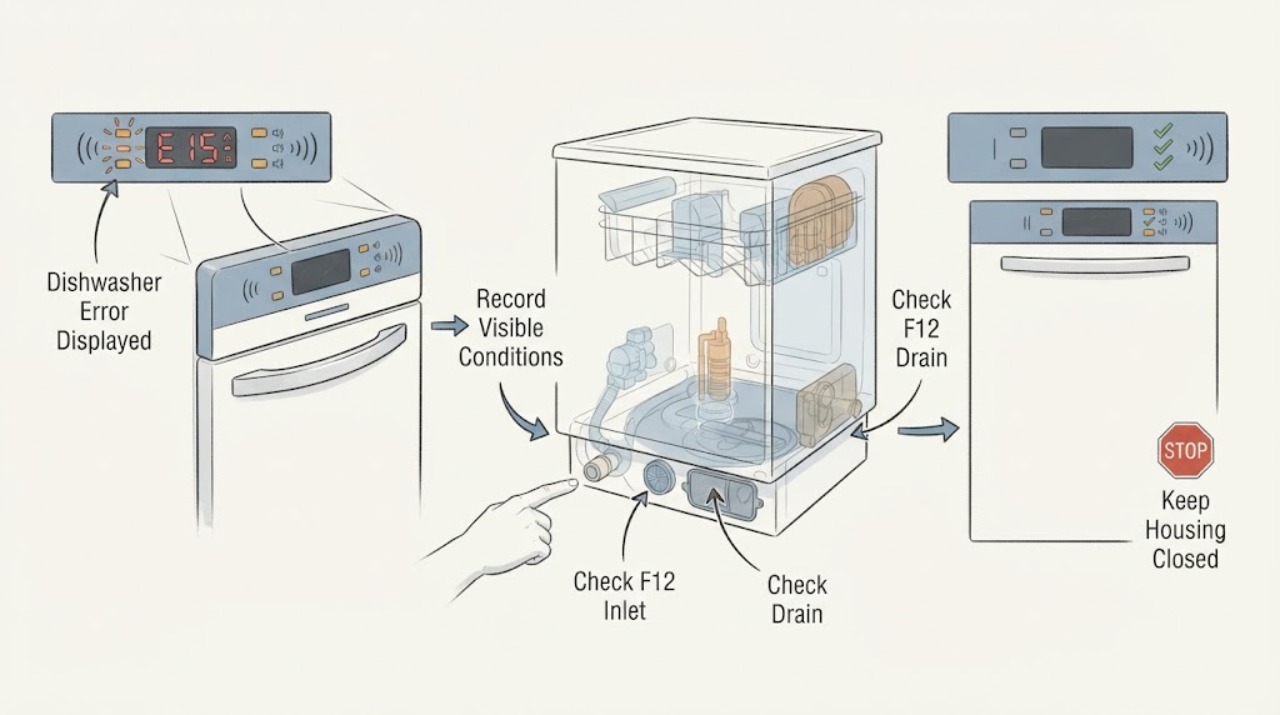
Work through in order
Diagnostic checks
Use only checks that match the exact appliance or system and its official guide.
-
Check 1
Photograph the entire display and record the exact code, flashing indicators, buzzer behavior, model, serial number, region, selected program, and whether water remains in the tub. Do not clear the message yet.
Expected result: The code is legible and appears in the exact manual, the display is only a status/lock indication, or the code is missing from the manual.
Next step: Use only the exact-manual branch. If the code is unlisted or the model cannot be confirmed, keep the record and contact Hisense rather than using a generic code table.
Stop if: Do not repeatedly reset, start another program, or guess at a code meaning.
Why this matters
Why: A code is meaningful only when paired with the exact model documentation; a status indication or unlisted code requires a different support path.
-
Check 2
Only for a confirmed HSAA16FS or HSAP16FB manual showing F12, turn the machine off, turn off the water supply, unplug as the manual directs, and inspect the external inlet-hose filter and gasket. Do not open the inlet valve or control housing.
Expected result: The water tap was closed, the external filter was blocked, the gasket was out of position, the hose was loose, or all external inlet conditions were correct.
Next step: Clean and refit only the model-documented external filter and gasket, restore the connection without leaks, and follow the exact manual's test direction. Contact service if F12 returns.
Stop if: Do not remove the hose under pressure, bypass the valve, or run the dishwasher with a leaking connection.
Why this matters
Why: The documented external conditions can restrict water entry; a correct external path with a returning F12 is not proof of a user-replaceable valve.
-
Check 3
Only for a confirmed manual that maps F11 to water-outlet fault, turn off and unplug the dishwasher, remove standing water safely, and inspect the filter and accessible drainage-pump stop only as that manual describes. Use care around broken glass or sharp debris.
Expected result: Water remains, the filter is blocked, debris is visible at the documented access point, the pump stop or filter was not seated, or the accessible drain path is clear.
Next step: Remove only loose, accessible debris, refit every documented stop and filter, and stop if the code returns or water remains. Do not access sealed pump or wiring areas.
Stop if: Do not put hands into standing water with power connected, use force on the pump, or continue a cycle with uncontrolled leakage.
Why this matters
Why: A documented accessible blockage can cause a water-outlet fault; a clear path, sharp debris, a damaged pump stop, or a returning F11 needs service diagnosis.
-
Check 4
For a confirmed HSAA16FS or HSAP16FB manual showing F54, stop the dishwasher and turn off the water tap before disconnecting power, following the manual's explicit sequence. Look for external water only after the supply is isolated.
Expected result: The tub or floor is overfilled, water is escaping, the supply tap is now off, or no visible water is present but F54 returns.
Next step: Keep the water supply off, follow the exact manual's service direction, and arrange qualified repair for any recurrence or leak.
Stop if: Do not remove the plug before the supply tap is off when the manual gives that warning, and do not restart to test an overfill.
Why this matters
Why: F54 is an overfilling-water condition in these exact manuals; continued filling can cause an external leak, and the code does not identify a safe DIY valve or level-sensor replacement.
-
Check 5
For F40, F41, F42, F43, F45, F56, F65, an unlisted code, or a code that returns after the permitted external check, leave the machine in the safest state specified by the exact manual and arrange Hisense or qualified dishwasher service.
Expected result: The code identifies leakage, heater, NTC, water level, diverter, circulation, communication, or another internal condition, or no exact manual match exists.
Next step: Provide the code photograph, model, serial number, water state, program, and prior checks to service. Keep water or power off when leakage or electrical/heater risk is present.
Stop if: Do not open the control or base, perform live tests, bypass a door or water-level system, or substitute parts from another model.
Why this matters
Why: These codes do not authorize a consumer to diagnose or replace internal valves, heaters, sensors, pumps, diverters, controls, or wiring.
Use your observations
Decision map
Find the observation that best matches what you see, then follow the next safe action.
-
PATH 01Safety boundary
What you see
The model and region are confirmed, the displayed code appears in that exact Hisense manual, and the manual provides a limited external check.
Do this next
Follow only the manual's documented check for the matching code, record the result, and contact service if the code persists.
Why this path and its safety boundary
Why it matters: The code can be interpreted only within that manual's model family; the permitted check may narrow the cause but does not prove a failed internal part.
Safety stop: Do not import a code definition, reset sequence, or part diagnosis from another Hisense model.
-
PATH 02Safety boundary
What you see
A confirmed HSAA16FS/HSAP16FB manual shows F11 with remaining water or F12 with an inlet condition, and no uncontrolled leak or electrical hazard is present.
Do this next
Use the exact unplugged, water-isolated procedure, refit documented parts, and stop if the code returns or water cannot be controlled.
Why this path and its safety boundary
Why it matters: The manuals support an accessible drain/filter or inlet tap/filter check, respectively; a returning code indicates service rather than a generic pump or valve replacement.
Safety stop: Do not work with connected power in standing water or remove pressurized plumbing.
-
PATH 03Safety boundary
What you see
A confirmed HSAA16FS/HSAP16FB manual shows F54 or water is filling beyond the normal level.
Do this next
Turn off the water tap first, follow the manual's power-isolation instruction, and arrange qualified service.
Why this path and its safety boundary
Why it matters: The exact manuals identify overfilling and prioritize shutting off the supply to prevent an external leak; the cause may involve a water-level or inlet system that needs service.
Safety stop: Do not remove the plug before the tap is off when the manual gives that instruction, and do not run another cycle.
-
PATH 04Safety boundary
What you see
The code is F40, F41, F42, F43, F45, F56, F65, unlisted in the exact manual, recurrent after an allowed check, or accompanied by a door, heater, electrical, or uncontrolled-water symptom.
Do this next
Keep the dishwasher in a safe off state, isolate water or power as appropriate, and contact Hisense or qualified appliance service with the evidence packet.
Why this path and its safety boundary
Why it matters: The manuals route these conditions to service, and the lack of an exact code match prevents a reliable diagnosis.
Safety stop: Do not bypass safety systems, open internal compartments, perform live tests, or guess at parts.
Helpful context
Understand the symptom
Capture the display and model identity
Before pressing reset or switching programs, photograph the whole panel and write down every letter, number, dash, flashing light, buzzer pattern, and whether water remains in the tub. Find the model and serial number on the rating plate. Hisense's support pages route manuals and help by exact model, and the HSAA16FS/HSAP16FB manuals themselves are separate model families. A code copied from a different model is not a diagnosis.
Do not merge error-code tables across models
The two official Hisense manuals reviewed here use the same F-code family, but that evidence applies only to HSAA16FS and HSAP16FB. A built-in North American model such as HUI66360XCUS has its own product-support page and downloadable documents. Use the exact manual for the appliance in front of you; if the displayed code is not in that manual, record it and contact Hisense rather than borrowing a meaning from a search result.
F12: water-inlet fault, only where the manual says so
For HSAA16FS or HSAP16FB when the exact manual shows F12, confirm that the water tap is open and inspect the external filter at the inlet hose for blockage. The manuals provide an unplug-and-water-shutoff sequence before removing the hose filter and require the gasket and connection to be refitted. Do not infer a failed inlet valve from this check, and do not apply the F12 meaning to an unverified model.
F11: water-outlet or drain path
For those same manual families, F11 is a water-outlet fault. If water remains after a program, first turn the machine off and remove the plug as the manual directs. Only if the exact manual permits it, remove the filter, scoop out standing water, and inspect the accessible drainage-pump area for debris such as glass; refit the pump stop and filter. A blocked pump, sharp debris, a persistent code, or water that cannot be safely removed is a service boundary.
F54 and other service-directed codes
The manuals define F54 as overfilling water and instruct the owner to turn off the water tap; they also warn not to remove the plug until the supply tap is off to avoid an external leak. F40, F41, F42, F43, F45, F56, and F65 are respectively valve leakage, heater, NTC, water-level, diverter, circulation, and communication faults in these manuals and are directed to service. Do not replace a valve, heater, sensor, diverter, pump, or control based on the code alone.
Separate a code from a status or control lock
A flashing status light, an open-door indication, child lock, delayed start, or a panel that was pressed too soon after closing may not be the same as a fault code. The HSAP16FB troubleshooting section distinguishes panel/door conditions from error messages and says an error message is cleared differently depending on the code; F54 is an exception in that manual family. Follow the displayed manual instructions, not a guessed reset sequence.
Escalate with a complete evidence packet
Give Hisense or a qualified dishwasher technician the model, serial number, region, exact display, photograph, program and options, water level, whether the door latched, and what happened immediately before the code. Hisense support pages provide model-specific documents and contact routes. Keep the water supply off and the dishwasher unplugged whenever the exact manual calls for it or the code involves leakage, heater, electrical, or uncontrolled filling.
Safety boundary
Stop conditions
- Turn off the water supply and stop for uncontrolled filling, external leakage, a damaged hose, or an F54 overfill condition; follow the exact manual's power-isolation sequence.
- Do not open the control, base, heater, valve, sensor, pump, diverter, circulation, or wiring compartments or perform live electrical tests.
- Do not bypass the door lock, water-level system, overflow protection, or any safety control, and do not use a generic reset or error-code table.
- Use only the exact model and region manual; F11-F65 meanings and clearing behavior cited here are limited to the HSAA16FS and HSAP16FB manual families.
- Arrange qualified service for F40, F41, F42, F43, F45, F56, F65, any unlisted or recurrent code, or any code with heater, electrical, door, or uncontrolled-water symptoms.
When checks do not resolve it
Need a professional?
Contact Hisense or qualified dishwasher service when the exact model manual does not list the code, the code returns after its permitted external check, or the code concerns inlet-valve leakage, heater, NTC sensor, water level, diverter, circulation, communication, door safety, or uncontrolled filling. For F54 in the HSAA16FS/HSAP16FB manuals, turn off the water tap before following the manual's power-isolation instruction. Do not open internal compartments or bypass safety systems.
Safety scope: This article covers recording the code, model-matched external inlet/drain checks, and water-supply isolation for documented overfill conditions. It does not authorize internal component replacement, live testing, control or safety bypass, or work in the heater, pump, valve, sensor, wiring, or circulation compartments.
Read the exact guide
Official sources
- Hisense HSAA16FS Dishwasher User's Operation ManualHisense · Official Hisense-hosted manual for the HSAA16FS model family; its F-code meanings and reset/service instructions must not be generalized to another dishwasher.
- Hisense UK TroubleshootingHisense UK · Official Hisense UK support route; it does not provide a universal dishwasher error-code table.
- Hisense HUI66360XCUS 24-inch Top Control Built-in Dishwasher — SupportHisense USA · Official Hisense USA support page for HUI66360XCUS; it establishes model-specific documentation but does not make HSAA16FS/HSAP16FB code meanings universal.
- Hisense HSAP16FB Dishwasher User's Operation ManualHisense · Official Hisense-hosted manual for the HSAP16FB model family; its F-code meanings and clearing instructions must not be generalized to another dishwasher.
Community feedback
Share a repair observation
Share a plain-text repair observation. Accepted observations are published automatically; this page may take a moment to update.