
On this page
Start here
Quick answer
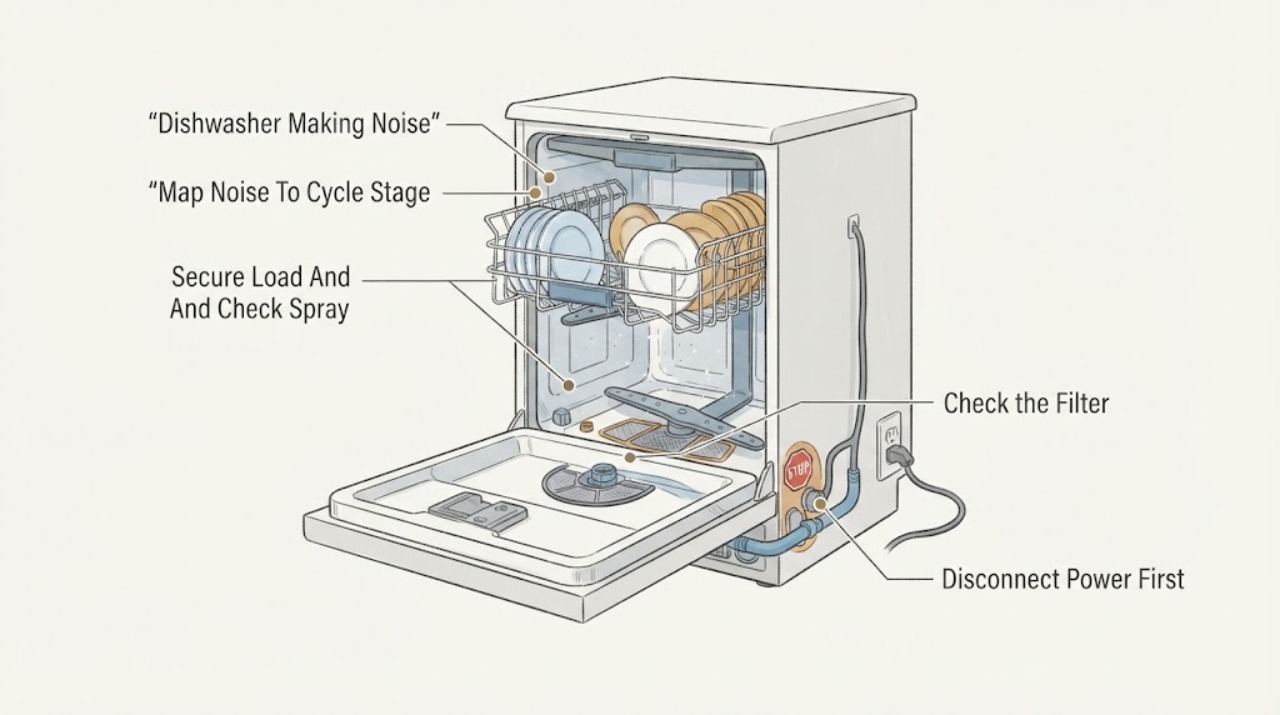
First locate when and where the noise occurs: loading or rack movement, filling, washing, draining, drying, or the entire cycle. On the opened Hisense dishwasher manual, a rattling sound is associated with dishes that are not secure or spray arms that cannot rotate; with power disconnected and the tub cool, rearrange the load and spin the spray arms by hand only as the manual permits. Check that filters and the drain-pump stop are correctly fitted and that no glass or other sharp debris is visible in the accessible pump area. A low, repeating sound that follows a documented pump or spray phase may be operation-related, but a new grinding, scraping, clacking, loud vibration, continuous whirring, leak, burning odor, smoke, or breaker trip is not a reason to keep testing. Shut off water and power as appropriate for a leak or overflow, and leave pump, motor, heater, wiring, mounting, and control repairs to qualified service. Hisense's quiet-mode and sound-level claims are model-specific, so do not use a generic noise threshold as a diagnosis.
Before you begin
Safety first
- The user may power off and unplug, secure the load, check spray-arm clearance, clean accessible filters and model-permitted pump debris, and inspect external contact. Qualified personnel must handle cabinet access, pumps, motors, heaters, controls, wiring, mounting, live testing, overflow faults, and electrical or water connections.
Work through in order
Diagnostic checks
Use only checks that match the exact appliance or system and its official guide.
-
Check 1
Without placing hands inside a running dishwasher, record whether the noise occurs during filling, circulation/washing, draining, drying, or the entire program. Note if it is a rattle, scrape, grind, click, hum, whine, or continuous whir, and whether the machine still fills, washes, drains, and finishes.
Expected result: The sound follows one stage; changes when the load is different; is present with an empty tub; continues after the program should end; or appears with standing water, a leak, an error, heat, smoke, or a breaker trip.
Next step: For load or spray-stage clues, switch off and unplug before inspecting dish placement and spray-arm clearance. For draining clues, continue with the filters and pump-area check. For persistent mechanical or electrical symptoms, stop and arrange service.
Stop if: Stop immediately for smoke, burning odor, sparks, scorching, a hot cord or plug, exposed wiring, a leak reaching electrical parts, violent vibration, or a breaker that trips again.
Why this matters
Why: A stage-linked or load-linked sound points first to dishware, racks, spray-arm clearance, water flow, or the drain path. A sound independent of the load or accompanied by a safety or performance symptom makes a pump, motor, mounting, heater, control, or installation fault more likely.
-
Check 2
Turn off the dishwasher, disconnect electrical power, and allow hot dishes and water to cool. Remove or reposition only accessible items that can rattle, check that racks sit correctly, and confirm that the spray arms can rotate freely by hand without forcing them. Do not run the machine with a loose glass, oversized dish, utensil, or arm that scrapes the rack.
Expected result: A dish, utensil, rack, or detergent-lid area is loose or in the arm's path; an arm is blocked or its holes/bearing area contains debris; the arm is damaged or will not rotate; or the load and arms are clear.
Next step: Secure the load and clean accessible spray-arm openings only as the exact manual allows, then refit any removed arm firmly. If an arm is cracked, loose, or still scrapes with an empty tub, leave the dishwasher off and arrange model-specific service.
Stop if: Stop for a cracked spray arm, sharp glass, a loose rack or door part, a blade-like edge, a jammed arm that requires force, or any need to reach into a running machine or remove a cover.
Why this matters
Why: A sound that disappears after securing the load supports contact or rack movement. A blocked or damaged arm can create scraping and poor wash performance. A clear load with a noise that persists points away from simple dish placement and toward water circulation, mounting, or mechanical service.
-
Check 3
With the dishwasher off, unplugged, and the tub cool, remove and clean the coarse and fine filters as the exact manual directs. Confirm that the filter handle and the model-specific colored or yellow drain-pump stop are seated. If the manual permits access, scoop out standing water and visually remove only loose debris such as glass from the accessible pump area with a tool, never bare fingers; refit every stop and filter before reconnecting power.
Expected result: The filters are blocked or incorrectly fitted; the pump stop is missing; broken glass or other debris is visible; the drain hose is kinked or blocked; or the accessible drain path is clear but the pump still whirs, grinds, or leaves water.
Next step: Correct only the accessible filter, stop, hose, or loose-debris issue documented by the exact manual. If the noise or standing water remains, keep the dishwasher unplugged; for overflow symptoms, shut off the water supply as the manual directs and contact service.
Stop if: Stop for sharp debris that cannot be removed safely, water near electrical components, a missing pump stop, a leak, an overflow warning, a pump that continues after power-off, or any need to dismantle the pump or base.
Why this matters
Why: Filter, pump-stop, hose, or debris problems can cause drain restriction and repeated pump noise. A clear and correctly reassembled drain path with persistent noise, standing water, or a pump that will not stop makes pump, overflow protection, control, or installation service more likely.
-
Check 4
Once power is disconnected, inspect the visible front, adjacent cabinets, toe-kick area, racks, and floor for contact or loose external trim. Note whether the noise is a cabinet rattle or whole-unit vibration and whether the dishwasher was recently installed, moved, or adjusted. Do not pull a built-in unit out, loosen mounting hardware, or adjust feet unless the exact installation instructions and a qualified installer make that procedure safe.
Expected result: The cabinet or toe-kick touches another surface; the unit rocks or the noise changes when an adjacent panel is touched; a rack or external panel is loose; or the dishwasher is stable and the noise comes from inside the tub or base.
Next step: Remove only obvious external contact or loose removable items without disturbing the built-in installation. If the unit is unstable, mounting is loose, or internal vibration persists, stop and use an authorized installer or qualified appliance technician.
Stop if: Stop for a unit that can tip, a damaged cabinet, water or electrical exposure, loose mounting that requires pulling the dishwasher, or any attempt to operate while a panel or fastener is removed.
Why this matters
Why: External contact or an installation/mounting issue can amplify otherwise ordinary pump or water sounds. A stable installation with an internal scrape, grind, or vibration makes a spray-arm, pump, motor, or bearing-related fault more likely; the sound alone cannot identify the part.
-
Check 5
After safe external checks, record whether the sound returns with a correctly loaded empty tub, whether cleaning and draining remain normal, and whether any code, leak, heat, odor, smoke, or electrical trip occurs. Do not remove the door, bottom cover, pump, motor, heater, wiring, or control, and do not perform live measurements.
Expected result: The noise disappears after the load or accessible drain path is corrected; it returns with an empty tub; it is a harsh grind or scrape; a pump runs continuously; the dishwasher leaks or overfills; or an error code, burning odor, smoke, abnormal heat, or breaker trip accompanies it.
Next step: If the sound is gone and the machine completes normally, monitor it and retain the exact model manual. Otherwise keep it out of service and provide the technician the sound recording, cycle stage, code, load, water level, and checks already completed.
Stop if: Stop immediately for smoke, sparks, flame, burning odor, abnormal heat, repeated breaker trips, uncontrolled filling, overflow, a leak near electrical parts, or a pump/motor that remains on after the documented shutoff procedure.
Why this matters
Why: Resolution after a documented load or maintenance correction supports an accessible cause. Recurrence with an empty tub or any water, mechanical, or electrical warning makes a pump, circulation motor, mounting, heater, sensor, control, or wiring problem possible and unsafe to diagnose by continued operation.
Use your observations
Decision map
Find the observation that best matches what you see, then follow the next safe action.
-
PATH 01Safety boundary
What you see
The noise is a rattle or scrape during washing, changes with the load, and inspection finds a loose dish, rack interference, or spray arm that cannot rotate freely.
Do this next
Power off and unplug, secure the dishes, clear the arm path, and clean or refit the accessible spray arm as the exact manual allows. Reassess only after every loose or sharp item is secure.
Why this path and its safety boundary
Why it matters: Contact between dishware/racks and a moving spray arm is more likely than an internal motor failure.
Safety stop: Do not run with a cracked arm, sharp glass, loose rack, or an arm that still scrapes or jams after the permitted cleaning.
-
PATH 02Safety boundary
What you see
The sound appears during draining or persists with standing water, a clogged filter, a missing pump stop, debris, a kinked hose, or an overflow indication.
Do this next
Disconnect power, close the water supply for an overflow/leak condition, and correct only the filter, pump-stop, hose, or loose-debris issues documented by the exact manual. Contact service if the pump remains noisy or water remains.
Why this path and its safety boundary
Why it matters: A restricted drain path or pump-area debris is more likely, but continuous whirring, overflow protection, or persistent grinding can require pump or control service.
Safety stop: Do not reach into sharp debris, run without filters or the pump stop, bypass overflow protection, or dismantle the pump or base.
-
PATH 03Safety boundary
What you see
The noise is a cabinet buzz or whole-unit vibration, changes when an adjacent surface is touched, or began after installation, movement, or rack adjustment.
Do this next
With power off, remove only obvious external contact and secure removable load items. If the built-in unit rocks or mounting/feet need adjustment, use the exact installation guide or a qualified installer rather than pulling it out.
Why this path and its safety boundary
Why it matters: External contact, loose removable trim, rack movement, or installation/mounting may be amplifying the sound.
Safety stop: Stop for a tipping or unstable dishwasher, a loose mounting bracket, a leak, a damaged cabinet, or any need to operate with panels or fasteners removed.
-
PATH 04Safety boundary
What you see
The sound is low and repeating, follows a documented washing or draining stage, changes with water flow, and there is no rattling load, leak, error, heat, odor, or electrical symptom.
Do this next
Compare the sound with the exact model manual and prior operation, keep the load and filters correctly fitted, and monitor whether it changes or worsens. A new or escalating sound should be evaluated by service.
Why this path and its safety boundary
Why it matters: A stage-linked operating sound may be normal for that exact dishwasher, but Hisense's published quiet feature and dBA value are model-specific and do not prove that every sound is normal.
Safety stop: Stop for a harsh mechanical sound, continuous pump operation, poor cleaning or draining, vibration, leak, code, burning odor, smoke, abnormal heat, or breaker trip.
-
PATH 05Safety boundary
What you see
The noise returns with an empty tub after load, spray-arm, filter, and external checks, or it accompanies a leak, overflow, code, motor stoppage, burning odor, smoke, abnormal heat, or repeated breaker trip.
Do this next
Keep the dishwasher disconnected when unsafe and contact Hisense or qualified appliance service. Provide the exact model, a recording, cycle stage, location, water level, code, installation history, and safe checks completed.
Why this path and its safety boundary
Why it matters: A circulation or drain pump, motor, heater, mounting, sensor, control, wiring, or water-inlet fault is possible; the sound does not identify a safe replacement part.
Safety stop: Do not operate to reproduce the noise, remove covers, perform live tests, bypass protection, or work on the pump, motor, heater, wiring, or control yourself.
Helpful context
Understand the symptom
Timing is more useful than loudness alone
A noise that begins when the spray arms should rotate, changes with the load, or appears only during drain is a different clue from a grinding sound that persists with an empty tub. Note the program, stage, duration, location, whether the sound changes when the racks are removed, and whether the dishwasher still cleans, drains, and finishes. Hisense does not publish one noise diagnosis that applies to every model.
Rattling often starts with the load or spray-arm clearance
The opened Hisense manual specifically links a rattling sound during dishwashing with dishes that are not correctly placed or spray arms that are not rotating. Large bowls, utensils, or a loose glass can contact a moving arm. With the machine off and unplugged, secure the dishes and turn the accessible spray arms only as directed by the exact model guide; never reach into moving parts during a cycle.
Filters and the pump area can change the sound
Hisense manuals describe coarse and fine filters, a drain-pump stop, and an accessible pump area. A blocked filter or debris such as broken glass can affect drainage and produce a repeated pump sound. The safe user boundary is power disconnected, standing water removed as the manual permits, and only clearly accessible debris addressed; a pump that continues to whir, leaks, or remains noisy after cleaning needs service.
Quiet ratings are model information, not a repair test
The HUI66360XCUS product page describes 44 dBA operation and a Quiet program. That gives an identity and feature reference for one model, not a universal threshold for all Hisense dishwashers. Use the exact model's manual and compare the sound with the dishwasher's prior behavior; a sudden change, harsh mechanical sound, vibration, leak, or electrical symptom matters more than an invented decibel cutoff.
Safety boundary
Stop conditions
- Stop immediately for smoke, sparks, flame, burning odor, scorching, abnormal heat, a hot or damaged cord or plug, violent vibration, or a breaker that trips again.
- For overflow, uncontrolled filling, or water near electrical components, shut off the water supply and disconnect power as the exact manual directs; contact service.
- Unplug before cleaning filters, spray arms, or the pump area. Treat broken glass and sharp debris as a cut hazard and do not reach into it with bare fingers.
- Do not run without correctly fitted filters or the model-specific drain-pump stop, bypass door or overflow protection, or repeatedly operate to reproduce a harsh noise.
- Do not remove covers, perform live tests, or service the circulation pump, drain pump, motor, heater, controls, wiring, mounting, or water-inlet components as a home repair.
Only after diagnosis
Potential parts
- model-matched spray arm, rack, filter, or drain-pump stop
Consider only when inspection confirms a cracked or missing accessible part after the exact manual identifies it and the noise or restriction is localized there.
Confirm the complete Hisense model and revision; spray arms, filters, rack parts, and pump stops are not interchangeable by appearance or dishwasher width. - model-matched drain or circulation pump, motor, heater, mounting, sensor, control, or wiring component
These parts are relevant only after qualified diagnosis of recurring internal noise, poor circulation or drainage, overflow, code, overheating, or electrical symptoms; noise alone does not identify a part.
Internal water, mechanical, and electrical parts require qualified service and exact model identification; do not order a generic pump or open the base.
When checks do not resolve it
Need a professional?
Contact Hisense or qualified service when a noise persists with an empty, correctly loaded tub; returns after the spray arms, filters, pump stop, and accessible drain path are correctly serviced; or is accompanied by standing water, a leak, overflow protection, an error code, poor washing or draining, violent vibration, motor stoppage, burning odor, smoke, abnormal heat, or a breaker trip. Shut off the water supply and disconnect electrical power as appropriate for an overflow or leak, following the exact model manual. The user may power off and unplug, secure dishware and racks, check spray-arm clearance, clean accessible filters and permitted pump-area debris, and inspect external contact. Cabinet, pump, motor, heater, control, wiring, mounting, and live electrical work belong to qualified personnel.
Safety scope: The user may power off and unplug, secure the load, check spray-arm clearance, clean accessible filters and model-permitted pump debris, and inspect external contact. Qualified personnel must handle cabinet access, pumps, motors, heaters, controls, wiring, mounting, live testing, overflow faults, and electrical or water connections.
Common questions
FAQ
Why is my Hisense dishwasher rattling?
Hisense's manual points first to dishes that are not secure or spray arms that cannot rotate. Turn the machine off and unplug it, secure the load, and check arm clearance. If it rattles with an empty tub or has a harsh scrape, leak, or poor cleaning, arrange service.
Can a blocked filter make a Hisense dishwasher noisy?
A blocked filter or debris in the drain-pump area can restrict drainage and lead to repeated pump sounds. With power disconnected and the tub cool, clean and refit the coarse and fine filters and the model-specific pump stop as directed. Persistent noise or standing water needs service.
Is a quiet humming sound from a Hisense dishwasher normal?
A low sound that follows a washing or draining stage may be an operating sound, but the exact model and prior behavior matter. Hisense advertises a 44 dBA HUI66360XCUS model and a Quiet program; that is not a universal limit. A new, harsh, continuous, or worsening sound should be checked.
What should I do if the drain pump keeps making noise?
If the sound continues with standing water or after the program ends, unplug the dishwasher, check only the accessible filters, pump stop, hose, and loose debris allowed by the exact manual, and close the water supply for an overflow or leak. Do not dismantle the pump; call service if it persists.
When is a Hisense dishwasher noise dangerous?
Stop for smoke, sparks, a burning odor, abnormal heat, violent vibration, a damaged cord, overflow, a leak near electrical parts, or a repeated breaker trip. Disconnect power when safe, shut off the water for an overflow, and use qualified service for internal pumps, motors, heaters, controls, wiring, or mounting.
Read the exact guide
Official sources
- Hisense 24" Top control Built-in Dishwasher SupportHisense USA · Applies directly to HUI66360XCUS and supports the need to select the exact model's manual; it is not a universal repair procedure.
- Hisense HUI66360XCUS Dishwasher User ManualHisense USA · Directly applies to HUI66360XCUS; it is a model-specific reference and not a universal noise codebook for all Hisense dishwashers.
- HUI6220XCUS Owners ManualHisense USA · Directly applies to HUI6220XCUS; use conditionally for similar Hisense dishwashers only after checking the exact model manual.
- Hisense 24" Top control Built-in DishwasherHisense USA · Applies directly to HUI66360XCUS; its 44 dBA and Quiet claims must not be generalized to other models.
Community feedback
Share a repair observation
Share a plain-text repair observation. Accepted observations are published automatically; this page may take a moment to update.