
On this page
Start here
Quick answer
Stop the program and first distinguish a normal small amount of water in a filter sump from water covering the tub floor. If the dishwasher is still filling, overflowing, or shows a water-level fault, close the water tap before disconnecting power; otherwise turn it off and unplug it before opening the door, removing the filter, or scooping water. Record the full model and any code. Hisense's opened HSAA16FS dishwasher manual identifies a water-outlet fault as a path to the 'water remains' checks: a clogged or incorrectly fitted filter, debris in the drainage pump, or a missing pump stop. It instructs the user to remove the filter, scoop out tub water, and inspect the pump only as that model's manual permits. Hisense's official cleaning guidance also says the bottom filter catches food debris and can block drainage. Check only accessible filter and visible drain-route issues, refit every part correctly, and do not force the door or run repeated cycles to test a blockage. If water remains after the exact model checks, the pump or hidden hose needs access, the machine leaks, or an overflow/fault condition recurs, leave it off and arrange qualified service; do not remove built-in panels or perform live tests.
Before you begin
Safety first
- The user may identify the model, close the water tap for active filling, unplug safely, clean and refit a model-permitted filter, remove standing water, and inspect only a model-permitted accessible pump stop or visible hose route. Qualified service must handle built-in movement, hidden plumbing, pump, check valve, sensor, control, wiring, base access, overflow protection, and live tests.
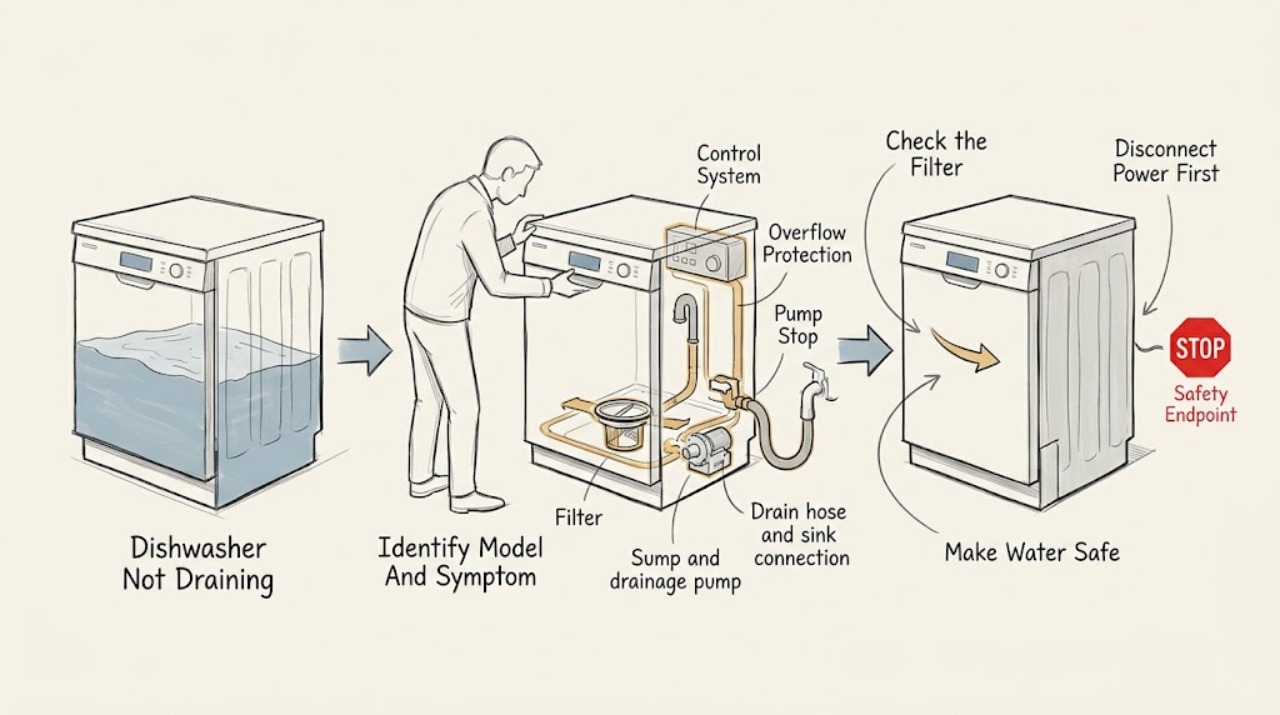
Work through in order
Diagnostic checks
Use only checks that match the exact appliance or system and its official guide.
-
Check 1
Stop the dishwasher and note whether it is still filling, overflowing, or merely holding water after the program. If water is actively entering or a water-level/overflow fault is present, close the dishwasher water tap first; then isolate power from a dry, safe position.
Expected result: Filling continues, an overflow alert appears, water is near the outlet or cord, the floor is wet, or the tub contains only residual standing water after a completed program.
Next step: Keep the water tap closed and appliance isolated for active-fill, overflow, or wet-electrical conditions. For ordinary standing water, continue only after power is off and the machine is safe to open.
Stop if: Do not repeatedly reset an overflow fault, touch wet electrical connections, or restore power while water is near the electrical supply.
Why this matters
Why: Active filling or overflow can cause flooding and electrical danger. The HSAA16FS manual says its overflow guard can pump out and turn off the water supply, and says the water tap must be turned off before unplugging in the relevant overfill condition.
-
Check 2
Record the complete model or product code, the exact display or light pattern, the program used, and when the water remained. Compare the code only with that model's Hisense manual.
Expected result: The manual identifies a water-outlet fault such as F11, an overfill fault such as F54, another code, or no code at all.
Next step: Follow the exact model's drain and safety instructions. If the code is not documented for the exact appliance, do not borrow a meaning from another Hisense dishwasher; use qualified support.
Stop if: Do not clear a code by repeated cycles or use an online code list that does not identify the exact model.
Why this matters
Why: On the cited HSAA16FS manual, F11 is a water-outlet fault and F54 is overfilling water; another Hisense model can use different codes or terminology. The drain phase and code together are more useful than the word 'not draining' alone.
-
Check 3
With the dishwasher off, unplugged, and the tub safe to access, remove the filter only as the exact manual describes. Empty visible food debris, rinse the filter, and refit it fully so its edges seal and any locking ring reaches its stop.
Expected result: The filter is clogged, incorrectly seated, damaged, or clean and correctly locked; water begins to clear or remains unchanged after the accessible filter check.
Next step: If a clear, correctly seated filter resolves the standing water, run one model-approved short check only after reassembly. If water remains, continue to the drain-path branch rather than adding detergent or running repeated full cycles.
Stop if: Do not operate without the filter, force a stuck filter, use drain chemicals, or reach into an unseen pump opening.
Why this matters
Why: Hisense's cleaning guidance says the bottom filter catches food debris that can block drains. The HSAA16FS manual warns that an incorrectly fitted filter can contribute to water remaining and that the machine must not be used without its filter.
-
Check 4
If the exact manual permits it, scoop standing water out with power isolated and inspect only the accessible pump cover or pump stop. The cited HSAA16FS manual describes a yellow pump stop at the bottom drain and permits turning the pump wheel by hand to remove visible sharp debris; do not apply that step to a different model without matching instructions.
Expected result: Visible food, glass, or another obstruction is present, the pump stop or cover is missing or cannot be refitted, the accessible area is clear, or the pump cannot be reached without cabinet access.
Next step: Remove only visible debris as the exact manual allows, refit the pump stop and filter correctly, and stop if any part is damaged or missing. For hidden access, a clear pump area with no drainage, or uncertainty, arrange service.
Stop if: Wear appropriate hand protection for accessible sharp debris, do not reach blindly, remove hidden panels, or power the pump while exposed.
Why this matters
Why: On the cited model, debris in the drainage pump or a missing pump stop can leave water in the tub. Sharp debris and a missing seal or cover create injury, leak, or further damage risk; a clear accessible area does not prove that the pump or motor is healthy.
-
Check 5
From the sink side or other accessible position, inspect the visible drain hose and its connection for a kink, sharp bend, crushing, loose connection, or blockage. Do not slide a built-in dishwasher forward to reach hidden plumbing.
Expected result: The visible hose is kinked, crushed, loose, or blocked; the sink or trap connection is obstructed; or the visible route is clear but water remains.
Next step: Correct only a visible, model-permitted routing issue with power and water safely isolated. If the connection is hidden, the hose remains blocked, or water returns, keep the dishwasher off and arrange qualified service.
Stop if: Do not disconnect hidden plumbing, pull out a built-in unit, pour chemicals into the drain, or run a leak test with panels removed.
Why this matters
Why: A visible routing or connection problem can restrict pump-out, while a clear external route with standing water shifts suspicion to a hidden hose, pump, check valve, or control. Installation details vary by model and configuration.
-
Check 6
After an accessible correction, refit the filter and every pump cover, confirm the door closes normally, and run no more than one model-approved short program while remaining nearby. Stop if the drain phase is reached and the water does not move or a leak appears.
Expected result: The tub drains normally, drains slowly, leaves the same water level, leaks beneath or around the door, or displays a water-outlet or overfill fault again.
Next step: Use the result branch below. For persistent or recurring failure, turn off the water tap as appropriate, isolate power safely, and arrange qualified service.
Stop if: Do not run repeated cycles to force a pump, leave the dishwasher unattended, or continue with a leak, active fill, smoke, odor, or electrical symptom.
Why this matters
Why: One successful drain after a correctly fitted filter or visible hose correction supports an accessible obstruction. Slow or failed drain after the checks, recurrence, or a leak indicates an internal or installation fault rather than a reason to keep cycling.
-
Check 7
Stop owner troubleshooting when the filter, model-permitted pump-stop check, and visible drain route are clear but the dishwasher still does not drain, or when the fault requires pump, check-valve, wiring, control, base, or built-in plumbing access.
Expected result: Water remains after the exact checks, the pump only hums or is silent, the water-outlet fault returns, the overflow guard activates, or the cause is beneath the cabinet.
Next step: Leave the dishwasher out of use and arrange qualified Hisense appliance service, providing the model, code, program phase, water level, filter/pump-stop observation, and visible hose condition.
Stop if: No cabinet disassembly, live electrical testing, pump bypass, sensor bypass, or deliberate overflow test.
Why this matters
Why: A drain pump, hidden hose or valve, water-level sensor, control, or installation fault remains possible. The external water level cannot safely identify which internal component has failed.
Use your observations
Decision map
Find the observation that best matches what you see, then follow the next safe action.
-
PATH 01Safety boundary
What you see
Water remains after the cycle and the filter is visibly clogged or incorrectly seated, with no active filling or electrical hazard.
Do this next
With power isolated, clean and refit the filter exactly, then perform one model-approved drain check. Escalate if the water level does not change.
Why this path and its safety boundary
Why it matters: Food debris or filter fit is more likely than an immediate pump failure. Hisense's cleaning guidance specifically links filter buildup with blocked drainage.
Safety stop: Do not run without the filter or force a filter that will not lock.
-
PATH 02Safety boundary
What you see
The filter is clear, but the exact model manual identifies a removable pump stop and visible debris is found in the accessible drain area.
Do this next
Remove only visible obstruction as the exact manual permits, refit the stop and filter, and stop if the pump wheel is damaged, inaccessible, or still will not drain.
Why this path and its safety boundary
Why it matters: On the cited HSAA16FS model, pump debris or a missing stop can cause a water-outlet fault and standing water; that access path is not universal across Hisense dishwashers.
Safety stop: Do not reach blindly, power an exposed pump, or substitute a cover or stop from another model.
-
PATH 03Safety boundary
What you see
The filter and accessible sump are clear, but the visible drain hose is kinked, crushed, loose, or blocked at the sink-side connection.
Do this next
Correct only the visible routing or connection issue with power and water safely isolated. Arrange service for hidden plumbing, recurring blockage, or a built-in unit that would need movement.
Why this path and its safety boundary
Why it matters: An external drain-route restriction is more likely than a filter obstruction, although hidden hose or pump problems remain possible if the route looks clear.
Safety stop: Do not pull out the dishwasher, disconnect hidden hoses, or pour drain chemicals into the machine.
-
PATH 04Safety boundary
What you see
The model-permitted filter and drain-path checks are clear, but water remains, the pump is silent or only hums, or the applicable water-outlet fault returns.
Do this next
Leave the dishwasher off and arrange qualified service; provide the exact model and observations instead of selecting a pump or control from the symptom alone.
Why this path and its safety boundary
Why it matters: An internal drain pump, check valve, hose, motor, level sensor, control, or wiring fault is more likely than a routine filter issue. The cited manual routes a persistent F11 water-outlet fault to service.
Safety stop: No live testing, base-panel removal, pump bypass, or repeated program restarts.
-
PATH 05Safety boundary
What you see
The dishwasher continues filling, shows an applicable overfill or water-level fault, leaks onto the floor, or water reaches the cord, outlet, or hidden base.
Do this next
Close the water tap, isolate power only from a dry safe position, keep the dishwasher off, and arrange qualified appliance or electrical service without moving the built-in unit.
Why this path and its safety boundary
Why it matters: This is an immediate water and electrical stop condition, not a safe drain-path experiment. On the cited model, F54 overfilling invokes the overflow guard and requires the water supply to be turned off.
Safety stop: Do not remove the plug before shutting off the supply in an active overfill, reset repeatedly, tilt the unit, or restore power while wet.
Helpful context
Understand the symptom
Start with the amount and timing of the water
A little water at the filter or sump may be part of the dishwasher's design; water covering the tub floor after the program is a drain symptom. Note whether the water appeared after washing or only after drain, whether the pump made a hum, whether the hose or sink connection overflowed, and whether a code appeared. The HSAA16FS manual is useful evidence for its own F11/F54 behavior, not a universal Hisense code table.
Filter and pump checks are model-dependent
Hisense's official cleaning guidance places the filter at the bottom of the tub and explains that food debris can block drainage. The cited HSAA16FS manual goes further and permits a carefully bounded pump-stop inspection after the water is scooped out. Other Hisense dishwashers may have a different filter, pump cover, or self-cleaning arrangement, so do not remove a part simply because it looks similar.
Keep overflow and built-in risks separate
An overflow or uncontrolled fill is a water-supply stop condition, not an ordinary drain obstruction. On the cited model, the overflow guard can pump out and shut off water, and the manual warns about the order of water shutoff and power isolation. Do not pull out or tilt a built-in dishwasher, remove a base panel, or recreate a leak to see whether the pump runs.
Safety boundary
Stop conditions
- If filling continues, an overfill or water-level fault appears, or water reaches the floor or electrical supply, close the water tap first and isolate power only from a dry safe position.
- For ordinary standing water, turn off and unplug before opening the door, removing the filter, scooping water, or inspecting an accessible pump area; keep hands protected from sharp debris.
- Use the complete Hisense model manual for filter, pump-stop, hose, and error-code instructions. Do not apply HSAA16FS F11/F54 meanings or pump access to another model without evidence.
- Do not pull out or tilt a built-in dishwasher, remove hidden panels, use drain chemicals, bypass overflow protection, power an exposed pump, or perform live electrical tests. Persistent no-drain faults require qualified service.
Only after diagnosis
Potential parts
- dishwasher filter or pump stop
Consider this category only when the exact model's manual identifies the part and it is clogged, damaged, missing, or cannot refit after a confirmed drain-path symptom.
Confirm the complete model and the exact filter/stop design before ordering. Do not operate without a correctly fitted filter or pump stop. - drain hose or sink-connection seal
Consider this category only when an accessible hose or connection is visibly kinked, cracked, loose, or leaking and the exact model permits replacement.
Drain routing and connection sizes vary by model and installation. Hidden plumbing and built-in movement require qualified service. - drain pump or check valve
Consider this category only after the model-permitted filter, pump-stop, and visible drain-route checks are clear but the machine still leaves water or the applicable water-outlet fault returns.
Do not choose a pump from the symptom alone. Verify exact model fit and have qualified service handle internal access and electrical testing. - water-level sensor, control, or wiring
Consider these categories only when qualified diagnosis finds a recurring water-level, overflow, communication, or drain-control fault after accessible causes are excluded.
Protection and control circuits are model-specific and must not be bypassed or tested live by the user.
When checks do not resolve it
Need a professional?
Arrange qualified Hisense appliance service when water remains after the exact model's filter and accessible drain-path checks, an applicable water-outlet fault returns, the pump is silent or only hums, a hidden hose or pump requires access, or an overflow guard or water-level fault recurs. Stop immediately for active filling, flooding, water near electrical parts, smoke, burning odor, a hot or damaged cord, or a leaking built-in unit; use qualified electrical help for the supply hazard.
Safety scope: The user may identify the model, close the water tap for active filling, unplug safely, clean and refit a model-permitted filter, remove standing water, and inspect only a model-permitted accessible pump stop or visible hose route. Qualified service must handle built-in movement, hidden plumbing, pump, check valve, sensor, control, wiring, base access, overflow protection, and live tests.
Common questions
FAQ
Why is my Hisense dishwasher not draining?
Start with the exact model and program phase. With power safely isolated, check the accessible filter, then only the pump cover or stop that the model manual permits, followed by the visible drain hose and sink connection. Hisense's official guidance links food debris in the bottom filter to blocked drains. If water remains after those checks or a water-outlet fault returns, arrange qualified service.
What does F11 mean on a Hisense dishwasher?
In the opened HSAA16FS manual, F11 is a water-outlet fault and points to the water-remaining checks. Confirm the complete model before applying that meaning to another Hisense dishwasher; a persistent fault is routed to service.
Can I remove the water from a Hisense dishwasher myself?
For ordinary standing water, the cited manual permits turning the machine off and unplugging it, removing the filter, and scooping water from the tub before its model-specific blockage check. Use that procedure only if it matches your exact model, keep clear of sharp debris, and stop if water is near electrical parts or the machine is actively filling.
Can a clogged Hisense dishwasher filter cause standing water?
Yes. Hisense's official cleaning guidance says the bottom filter catches food debris and that buildup can block drainage. Turn off and unplug the dishwasher, rinse and refit the filter exactly as the model manual describes, and arrange service if the water level does not change.
What should I do if my Hisense dishwasher is overflowing while it will not drain?
Close the dishwasher water tap immediately, then isolate power only from a dry safe position. The cited HSAA16FS manual says its overflow guard can pump water out and shut off water, and it lists F54 for overfilling. Do not reset repeatedly, pull out the built-in unit, or restore power while wet; arrange qualified service.
Read the exact guide
Official sources
- How to clean your dishwasherHisense UK · Official Hisense UK cleaning guidance for dishwasher care; use its general filter mechanism with the exact model manual for removal, access, and program details.
- C06010336-D-12456604-WD16-E720Xi User Manual (HSAA16FS)Hisense · Specific Hisense HSAA16FS dishwasher manual. F11, F54, pump-stop access, and drainage details are model-specific examples and must not be generalized to an unidentified Hisense dishwasher.
Community feedback
Share a repair observation
Share a plain-text repair observation. Accepted observations are published automatically; this page may take a moment to update.