
On this page
Start here
Quick answer
Grey bits that appear after replacing the Hotpoint FML 942 door seal should not be dismissed as normal break-in or used to prove a bearing failure. First stop the washer, unplug it from a dry safe position, photograph and save a sample, and compare the bits with the new seal and any visible rub mark around the seal lip or drum opening. Soft, elastic pieces matching the seal, a folded or displaced lip, a scrape witness, a door that no longer closes evenly, or any water leak points to an installation/contact problem and warrants stopping rather than forcing another cycle. Dry lint, detergent residue, or old laundry debris without rubber transfer is a different observation, but the accessible area should be cleaned only as the exact FML 942 manual permits; Hotpoint's manual says to unplug for maintenance, use a soft cloth with lukewarm soapy water on outer rubber parts, and avoid solvents or abrasives. The official FML 942 manual does not authorize diagnosing bearings or refitting a seal from appearance alone. If fragments continue, the door seal is damaged, the drum is visibly off-center, the washer leaks, or the drum makes harsh mechanical noise, leave it off and arrange qualified Hotpoint service.
Before you begin
Safety first
- Do not run another cycle to reproduce the debris, force or rapidly spin the drum, remove the seal retaining band, open the cabinet, access bearings or the spider, test energized parts, or use solvents, abrasives, adhesive, or a near-model seal.
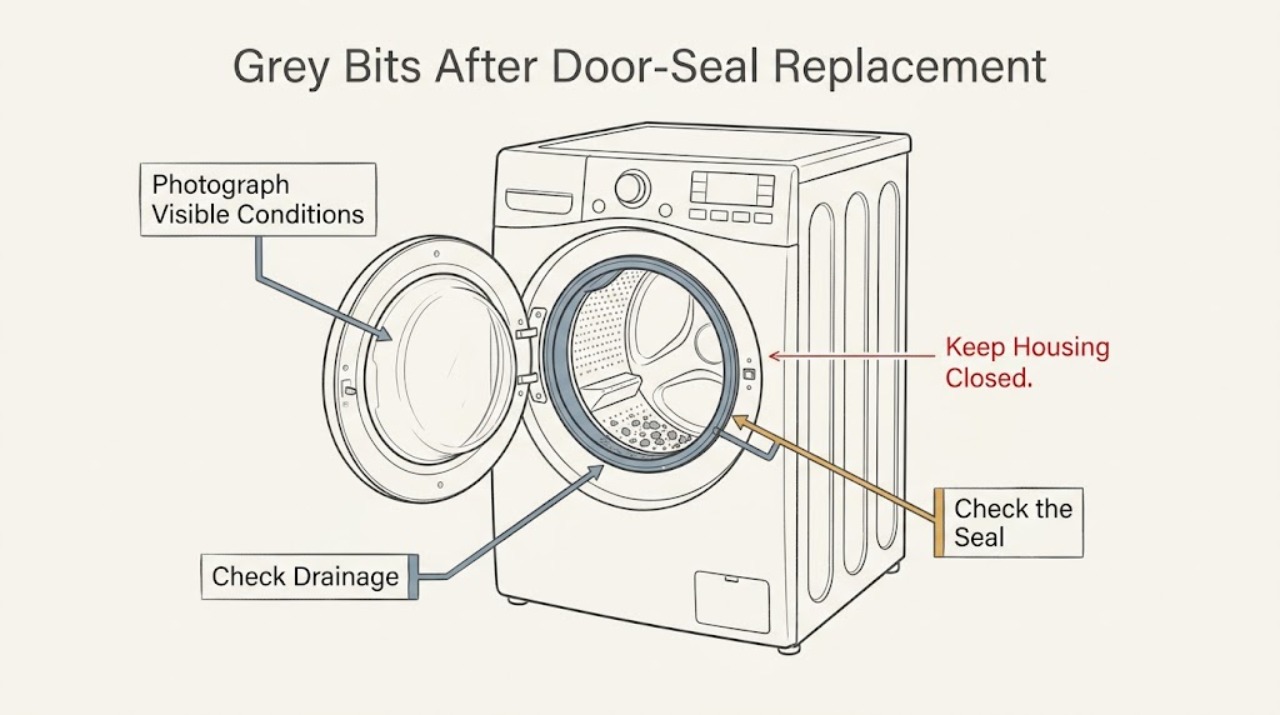
Work through in order
Diagnostic checks
Use only checks that match the exact appliance or system and its official guide.
-
Check 1
Stop the washer and unplug it from a dry, safe position before handling the fragments. Photograph the complete model/serial label, the new seal, each fragment, and the door-seal lip and drum opening. Save a representative piece in a clean bag and record whether fragments appeared immediately after replacement, after a particular cycle, or only after the drum moved.
Expected result: The label reads FML 942 with a matching regional suffix, the bits are soft/elastic and the same color as the new seal, the bits are lint-like or hard residue, or the model suffix or source is uncertain.
Next step: Keep the washer off while the source is uncertain. Use the exact FML 942 manual only after confirming the model/region; if the label differs or the sample resembles the replacement seal, arrange qualified diagnosis rather than trying another cycle.
Stop if: Do not force the drum, scrape the seal, remove the retaining band, open the cabinet, or run a cycle to reproduce the debris.
Why this matters
Why: Material, timing, and complete identity determine whether the next check is seal-contact inspection, accessible cleaning, or a stop for model-specific service. A grey color by itself cannot distinguish rubber wear from laundry or detergent residue.
-
Check 2
With power isolated and the door open, inspect only the visible front and inner folds of the seal and the accessible drum lip using a light. Look for a folded edge, a seal bead outside its groove, a shiny or rough rub track, a nick, a missing drainage opening, trapped fabric, or a fragment caught at the opening. Do not pull the seal out or touch the hidden retaining hardware.
Expected result: A fold, displaced edge, matching rub mark, damaged rubber, trapped fabric, or blocked/missing visible drainage opening is present, or the seal and drum lip look intact with no contact witness.
Next step: If the seal is displaced, damaged, rubbing, or the door no longer closes evenly, leave the washer off and have the installer or qualified Hotpoint provider correct the exact model. If no witness is visible, continue with material classification without forcing the drum.
Stop if: Do not reseat the seal by force, remove clamps, insert tools behind the rubber, or substitute a different seal or adhesive.
Why this matters
Why: A visible contact witness makes installation fit, alignment, or trapped material more likely than an unexplained internal bearing conclusion. An intact visible edge does not prove the hidden seal fit or drum support is correct.
-
Check 3
Compare the sample with the replacement seal without stretching or tearing either one. Note whether it is rubbery and smears or flexes like the seal, a dry textile/lint fiber, a detergent-like flake or sludge, or a hard foreign object. Wipe only the accessible door opening and outer rubber surface with a soft cloth and lukewarm soapy water if the exact manual and the appliance condition permit it; dry it fully.
Expected result: The sample is elastic and matches the seal, is dry lint or fabric, is residue that wipes away without abrasion, or remains unidentified or hard/sharp.
Next step: For rubber-like, sharp, or unidentified material, keep the washer off and request service. For plainly accessible non-rubber residue, remove only what the manual permits, do not use solvents or abrasives, and stop if new fragments or a leak appears.
Stop if: Do not use a knife, abrasive pad, solvent, bleach, adhesive, sandpaper, or a high-temperature cycle to dissolve or test the material.
Why this matters
Why: A rubber-like sample after replacement keeps installation/contact in the decision path. Dry lint or removable surface residue may be external debris, but an unidentified or sharp fragment could be damaging the seal or drum and should not be chased with cleaning.
-
Check 4
Inspect the floor, door, and lower front edge for water or a damp trail without moving the washer. Check whether the door closes on its own without an unusual gap and whether the fragments are concentrated on one side of the seal. Do not open the lower panel or disconnect hoses to investigate a leak.
Expected result: There is water, a persistent damp trail, an uneven door gap, one-sided seal damage, or no leak and an even door closure.
Next step: For any leak, damaged seal, or uneven closure, keep the washer unplugged and close the water tap if safely reachable; arrange qualified service. If dry and even, do not assume the bits are harmless—use the sample and contact history for the next decision.
Stop if: Do not run another load, force the door shut, tilt the washer, pull it away from the wall, or work around water near electrical parts.
Why this matters
Why: Water or one-sided contact changes the issue from harmless debris to a seal/installation or water-path repair condition. No visible leak does not certify the replacement, especially if rubber fragments continue.
-
Check 5
Record the drum and washer symptoms without a deliberate reproduction test: note whether there is a new harsh scrape, grinding, repeated impact, abnormal vibration, or a visibly off-center drum, and whether the problem began only after the seal replacement. Do not spin the drum hard, reach through the seal, or remove a panel to inspect bearings or the spider.
Expected result: The washer has only isolated non-rubber debris and no new sound, or fragments are accompanied by scraping, grinding, abnormal vibration, a visibly off-center drum, or a returning leak.
Next step: Keep the washer off and provide the sample, photos, model suffix, replacement history, and symptom timing to qualified Hotpoint service. Do not order a bearing or seal solely from the debris or sound.
Stop if: Do not open the cabinet, remove the drum, test energized parts, or continue cycles to determine whether the noise worsens.
Why this matters
Why: A new mechanical symptom alongside debris makes continued operation more risky, but it still does not identify a bearing, spider, drum, or seal component from outside. Hotpoint's manual treats a noisy machine and a damaged door seal as service concerns and instructs owners not to access internal mechanisms for repair.
-
Check 6
Use Hotpoint's official manual lookup with the complete model/12NC and compare the replacement seal's documented fit and installation instructions for the exact regional variant. If the replacement was fitted by a service or installer, ask them to inspect the seal seating, retaining arrangement, door alignment, and drum clearance rather than replacing another part by guesswork.
Expected result: The manual and part identity match the complete FML 942 variant, only a near-model result is available, or the source remains uncertain after the replacement.
Next step: Use only the matching documentation or have a qualified provider verify the installation. Keep the washer out of service when fragments continue, the seal rubs, or model/fitment cannot be confirmed.
Stop if: Do not fit another seal, retaining ring, clamp, bearing, or drum part based on appearance or a near-model listing.
Why this matters
Why: Hotpoint's official resources use model identity to locate manuals and warn that parts must be verified for the appliance. A near-model seal or incomplete FML 942 identity cannot establish that the installation is correct.
Use your observations
Decision map
Find the observation that best matches what you see, then follow the next safe action.
-
PATH 01Next step
What you see
The bits are soft and elastic like the replacement seal, a fold or displaced bead is visible, or there is a matching rub mark, uneven door gap, or one-sided seal damage.
Do this next
Do not run another cycle or force the seal into place. Leave the washer unplugged and have the exact FML 942 installation checked by the installer or qualified Hotpoint service.
Why this path and its safety boundary
Why it matters: Installation fit, seal contact, or trapped material is more likely than ordinary laundry debris. The observation still does not prove which seal component or mechanical part is wrong.
-
PATH 02Next step
What you see
The fragments are dry lint or removable non-rubber residue, the seal and drum lip have no visible rub witness, the door closes evenly, and there is no leak or new mechanical noise.
Do this next
Remove only accessible residue with the exact manual's gentle cleaning method, dry the area, and monitor one normal load only if no safety symptom remains. Stop if grey bits recur or the seal begins to rub.
Why this path and its safety boundary
Why it matters: Accessible residue or laundry debris is more likely than active rubber wear, but the timing after replacement means the seal and model fit should still be documented. This pattern does not justify a bearing diagnosis.
-
PATH 03Next step
What you see
Fragments continue after the accessible area is clean, the sample is hard or unidentified, or the model suffix/region or replacement fit cannot be confirmed.
Do this next
Keep the washer off, preserve the sample and photographs, retrieve the matching Hotpoint documentation, and arrange qualified service rather than forcing a new cycle or ordering by appearance.
Why this path and its safety boundary
Why it matters: The evidence does not support calling the material harmless or selecting a compatible seal, clamp, bearing, or other part. The exact FML 942 variant and installation need professional review.
-
PATH 04Next step
What you see
The debris is accompanied by water, a damaged or leaking seal, a door that no longer closes evenly, harsh scraping or grinding, abnormal vibration, or a visibly off-center drum.
Do this next
Stop using the washer, close the water tap if safely reachable, unplug from a dry position, and arrange qualified Hotpoint service. Do not diagnose a bearing or continue testing to reproduce the debris.
Why this path and its safety boundary
Why it matters: This is a seal, water, or mechanical stop condition. Hotpoint's exact manual treats leaks, noise, and a damaged door seal as troubleshooting/service concerns and does not authorize internal self-repair.
Helpful context
Understand the symptom
The timing after a door-seal replacement is important, but it is not a diagnosis. A grey fragment may be a piece of the replacement rubber, residue left around the seal or drum lip, textile or detergent debris, or material created by rubbing. The useful first split is material plus contact evidence: does it look and feel like the new seal, and is there a matching scuff or displaced edge? Do not keep running the washer to see whether more pieces appear, and do not infer a bearing or spider fault from the color alone.
The official manual is for the GB FML 942 variant and the Hotpoint product record identifies a UK FML 942 G model. Confirm the complete nameplate suffix and region before using any procedure or ordering a seal. Until the identity and fit are confirmed, use only the low-risk inspection and stop boundaries below; a visually similar door seal or a near-model installation is not proof of compatibility.
Only after diagnosis
Potential parts
- model-matched door seal
Consider this only if the complete regional variant and a qualified inspection confirm that the installed seal is wrong, damaged, displaced, or rubbing; grey bits alone do not prove a seal defect.
Confirm the complete model suffix, 12NC/market, seal geometry, and installation method with Hotpoint or a qualified provider before ordering.
When checks do not resolve it
Need a professional?
Request qualified Hotpoint service for rubber-like fragments, visible seal contact or damage, a leak, recurring debris, uncertain FML 942 variant/fitment, or any new noise or vibration. Isolate water and power from a dry safe position for a leak or electrical hazard.
Safety scope: Do not run another cycle to reproduce the debris, force or rapidly spin the drum, remove the seal retaining band, open the cabinet, access bearings or the spider, test energized parts, or use solvents, abrasives, adhesive, or a near-model seal.
Have this ready
- Provide the complete model and serial/12NC label, country or region, replacement seal source and installation date, photographs of the seal and rub area, a preserved fragment, cycle timing, door-closure and leak observations, and any sound or vibration recording made without deliberate reproduction.
Common questions
FAQ
Are grey bits normal after replacing a Hotpoint FML 942 door seal?
Do not assume they are normal. If the bits are soft and rubber-like, match the new seal, or appear with a rub mark or displaced edge, stop the washer and have the installation checked. Dry lint or removable non-rubber residue without a leak or rub witness is a different branch, but recurring debris still needs review.
Could the grey pieces prove that the bearings are bad?
No. The fragments and their timing do not identify bearings, a spider, the drum, or the seal by themselves. New grinding, abnormal vibration, a visibly off-center drum, or seal contact warrants qualified service without opening the washer.
Can I keep running the washer to see whether more pieces appear?
No. Preserve a sample and photos instead. Repeated cycles can worsen contact or a leak and do not establish the cause. Use only a gentle accessible inspection with power isolated and stop for rubber transfer, a rub mark, water, noise, or vibration.
What cleaner should I use on the FML 942 seal?
The official FML 942 manual says to unplug for maintenance and permits a soft cloth with lukewarm soapy water for outer rubber components; it warns against solvents and abrasives. Do not use bleach, solvent, abrasive pads, adhesive, or a chemical cycle to dissolve unidentified fragments.
Read the exact guide
Official sources
- Instructions for useHotpoint · Exact FML 942 GB/English manual; use only when the complete model and region match the assigned FML 942 identity.
- Freestanding Washing Machine Hotpoint FML 942 G UKHotpoint · Official UK product record used to show that FML 942 has a regional suffix; it does not establish that every FML 942 variant shares identical seal fitment.
- Hotpoint Appliance ManualsHotpoint · Official lookup guidance for confirming the complete FML 942 suffix and regional documentation before using a procedure or selecting a part.
Community feedback
Share a repair observation
Share a plain-text repair observation. Accepted observations are published automatically; this page may take a moment to update.