
On this page
Start here
Quick answer
A noisy ice maker is often making a water-fill, circulation, or ice-drop sound, but a new scrape, grinding sound, repeated buzz, or noise with poor ice production needs diagnosis. Stop the cycle, note when the sound occurs, check that the unit is level and has clearances, and inspect only accessible filter and bin areas. Keep it unplugged and arrange service for electrical odor, leaking water, a jammed cutter, or a noise that persists after these checks.
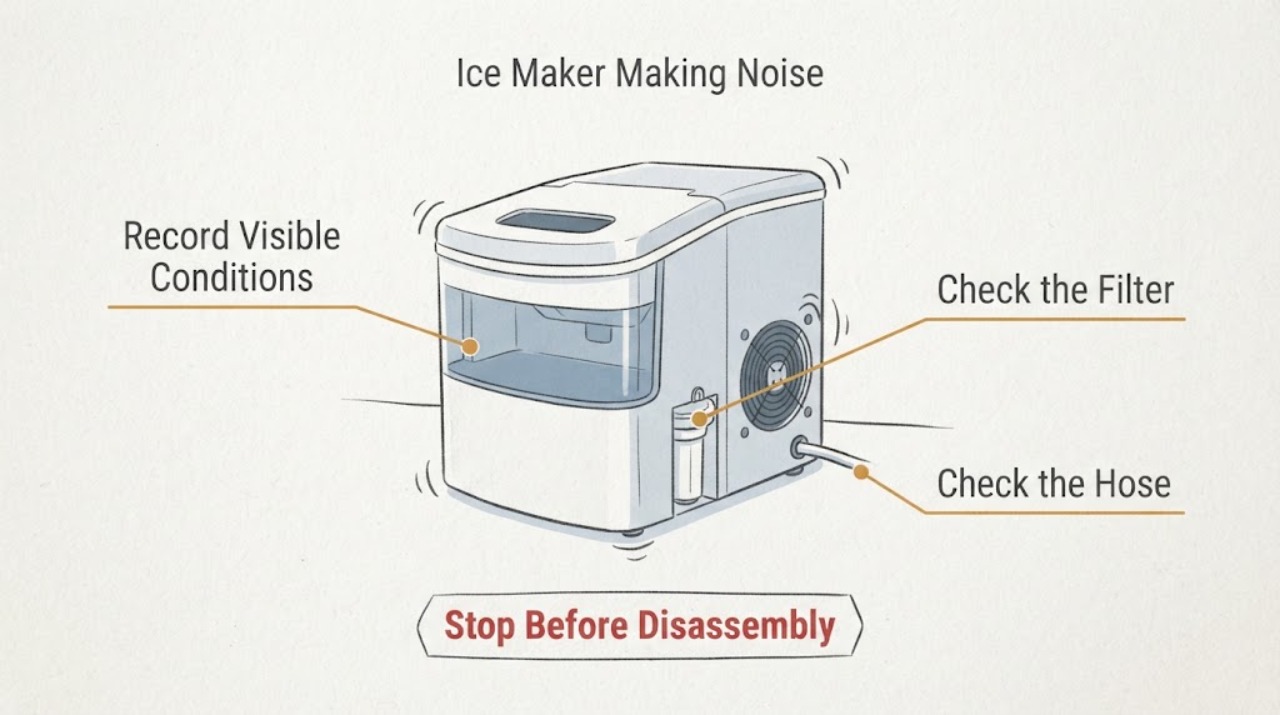
Work through in order
Diagnostic checks
Use only checks that match the exact appliance or system and its official guide.
-
Check 1
Turn the ice maker off and record when the noise occurs: during fill, while circulating, as cubes fall, or continuously.
Expected result: The sound is brief and tied to fill or ice release, or it continues between cycles and changes with no ice movement.
Next step: Continue only with the accessible checks below if there is no leak, odor, heat, or sharp mechanical sound; otherwise leave it off for service.
Stop if: Do not run a leaking, sparking, smoking, or grinding unit.
Why this matters
Why: Brief cycle-linked sounds can be normal; continuous or worsening noise needs the filter, water path, level, and internal mechanism separated.
-
Check 2
With power off, check that the ice bin is seated, no cube is wedged at the ejector or cutter area, and the accessible filter is installed and clean; remove only loose ice you can reach without tools.
Expected result: A visible cube or loose bin is corrected, or the area is clear and the same noise remains.
Next step: Refit the bin/filter and make one supervised test; do not probe the cutting grid or remove covers.
Stop if: Stop if the obstruction is trapped, parts are damaged, or the sound becomes violent.
Why this matters
Why: A bin or ice obstruction can create tapping or repeated motor effort; an unchanged empty area points toward water supply, leveling, or internal service.
-
Check 3
Check from outside that the unit stands level and does not touch a wall or cabinet; confirm the water supply is fully open and the hose is not kinked.
Expected result: The cabinet rocks, contact is present, fill is weak, or the unit is level with normal water flow.
Next step: Correct only external contact, leveling allowed by the manual, or a kinked hose, then test once.
Stop if: Do not alter plumbing or remove panels to chase a noise.
Why this matters
Why: Vibration, restricted fill, or pressure-related buzzing can amplify normal operation; a stable unit with persistent mechanical noise needs service diagnosis.
-
Check 4
After one correction, run a brief supervised cycle and compare the sound with ice production and leaks.
Expected result: The noise disappears or remains a short normal cycle sound, versus returning continuously, louder, or with poor ice production.
Next step: Keep records and arrange qualified appliance service if it returns or ice production changes.
Stop if: Stop immediately for burning smell, electrical damage, water reaching electrics, or seized movement.
Why this matters
Why: A lasting normal cycle pattern supports continued observation; recurrence with poor production or rough movement is not established as normal.
Use your observations
Decision map
Find the observation that best matches what you see, then follow the next safe action.
-
PATH 01Next step
What you see
The sound is a short splash, fill hiss, or thump exactly when water enters or ice drops.
Do this next
Keep the bin and filter maintained, observe one cycle, and call service if the character changes or persists between cycles.
Why this path and its safety boundary
Why it matters: This matches common operating events described for freestanding ice makers, provided production and safety are normal.
-
PATH 02Next step
What you see
Buzzing continues outside the fill cycle or ice production is weak.
Do this next
Check the accessible filter, hose, supply, and level once; arrange service if the buzz remains.
Why this path and its safety boundary
Why it matters: A filter, water-supply/pressure, or mechanical condition is more likely than a single normal drop sound.
-
PATH 03Next step
What you see
Scraping or grinding remains with the bin clear and the unit level.
Do this next
Leave the unit off and give a technician the recording and cycle stage.
Why this path and its safety boundary
Why it matters: The cause may be inside the cutter, motor, fan, or ice path and cannot be identified safely by sound alone.
-
PATH 04Next step
What you see
Noise is joined by a leak, burning odor, sparks, or abnormal heat.
Do this next
Disconnect power or water only if safe and seek qualified or urgent assistance; do not restart it.
Why this path and its safety boundary
Why it matters: The situation has an electrical, water, or mechanical safety risk.
Helpful context
Understand the symptom
What to check first
Listen from outside the cabinet and classify the sound before touching anything: water rushing or splashing during fill, a brief thump as ice releases, a motor or fan hum, a buzz that continues, or scraping/grinding. The Whirlpool guidance identifies several water and ice-drop sounds as normal operating noises, while filter, pressure, leveling, and maintenance conditions can change the sound. A sound alone does not identify an internal motor or pump fault.
When checks do not resolve it
Need a professional?
Arrange qualified appliance or electrical service when the safe external checks do not resolve the symptom. Provide the exact model and what you observed; do not open sealed, gas, high-voltage, or refrigerant systems yourself.
Common questions
FAQ
Are all ice-maker noises a failure?
No. Water movement, fill, and ice-drop sounds may be normal when brief and cycle-linked. Persistent, worsening, scraping, or production-changing sounds need service.
Should I remove the cutter cover to find the noise?
No. Use only accessible bin and filter checks with power off. A trapped cube or internal mechanism should be handled by qualified service.
What information should service receive?
Give the model, a short recording, the cycle stage, whether the bin/filter was clear, and whether ice production or leaks changed.
Read the exact guide
Official sources
- Buzzing Noise - Freestanding Ice MakerWhirlpool · Whirlpool freestanding ice makers
- Freestanding Ice Maker NoisesWhirlpool · Whirlpool freestanding ice makers
Community feedback
Share a repair observation
Share a plain-text repair observation. Accepted observations are published automatically; this page may take a moment to update.