
On this page
Start here
Quick answer
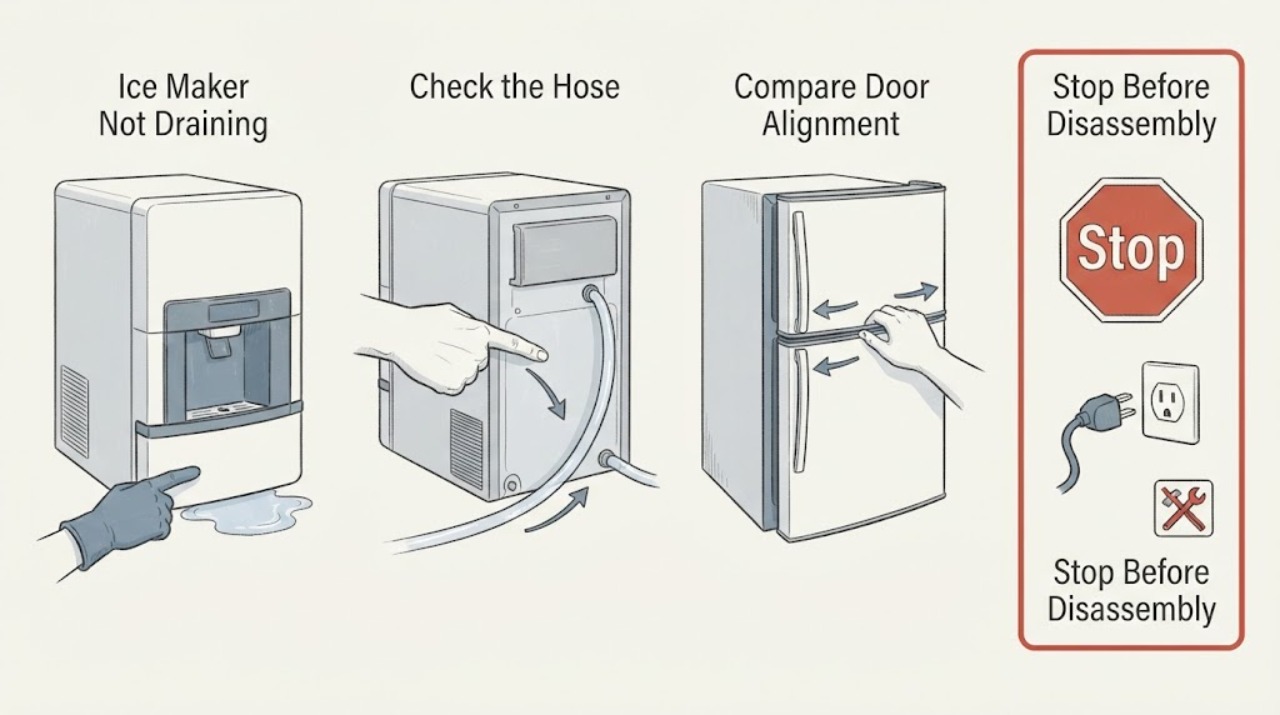
An ice maker that is not draining is usually a drain-path problem until proven otherwise. Identify whether it uses gravity or a pump, then inspect the accessible hose for alignment, twists, blockage and incorrect routing. Whirlpool routes external plumbing problems to a qualified plumber and persistent appliance faults to service.
Work through in order
Diagnostic checks
Use only checks that match the exact appliance or system and its official guide.
-
Check 1
Identify the drain type and where the drain hose ends from the manual or installation.
Expected result: The system is gravity-drained, pump-assisted, or unknown.
Next step: Use model installation instructions before moving the unit.
Why this matters
Why: These systems have different routing requirements.
-
Check 2
Inspect the accessible hose for kinks, twists, low points and alignment over the drain.
Expected result: The hose is kinked or misaligned, or appears correctly routed.
Next step: Correct only visible routing and monitor one drain cycle.
Why this matters
Why: Whirlpool identifies routing as a direct cause of drain problems.
-
Check 3
Check for backup at the drain outlet without opening plumbing or removing a pump.
Expected result: The outlet accepts water, backs up, or the pump does not move water.
Next step: Call a qualified plumber for external backup and appliance service for a persistent pump fault.
Why this matters
Why: External restriction differs from an appliance pump fault.
Use your observations
Decision map
Find the observation that best matches what you see, then follow the next safe action.
-
PATH 01Next step
What you see
Water drains after a visible hose kink or alignment issue is corrected.
Do this next
Secure it per the manual and monitor recurrence.
Why this path and its safety boundary
Why it matters: Drain routing was likely the cause.
-
PATH 02Next step
What you see
The appliance drain is clear but the household drain backs up.
Do this next
Arrange plumbing service.
Why this path and its safety boundary
Why it matters: The restriction is outside the ice maker.
-
PATH 03Next step
What you see
The hose is correct and clear but the unit still will not drain.
Do this next
Stop owner troubleshooting and arrange appliance service.
Why this path and its safety boundary
Why it matters: A pump, internal passage or control issue remains possible.
Helpful context
Understand the symptom
An ice maker that is not draining is usually a drain-path problem until proven otherwise. Identify whether it uses gravity or a pump, then inspect the accessible hose for alignment, twists, blockage and incorrect routing. Whirlpool routes external plumbing problems to a qualified plumber and persistent appliance faults to service.
Use the exact model manual for controls, access, cleaning and any code interpretation. Stop when a check reaches wiring, pressure, microwave high-voltage or another internal service boundary.
When checks do not resolve it
Need a professional?
Provide the exact model, observed symptom, any code or sound, and which safe checks changed it.
Common questions
FAQ
Can a kinked hose stop an ice maker working?
Yes. Whirlpool says an incorrectly routed or kinked drain hose can cause drain and intermittent-power problems.
Should any hose be used?
Use the hose specified by the model installation instructions.
Read the exact guide
Official sources
- Not Draining - Ice MakerWhirlpool · ice maker drain troubleshooting
- Installing the Drain Hose - Product Help | WhirlpoolWhirlpool · ice maker drain installation
Community feedback
Share a repair observation
Share a plain-text repair observation. Accepted observations are published automatically; this page may take a moment to update.