
On this page
Start here
Quick answer
A small, thin, even frost layer or brief moisture can be normal, especially after frequent door openings, warm or uncovered food, a humid room, or a recent load. Heavy, localized, or recurring frost is more useful diagnostically: check that the door closes fully, the gasket is clean and contacting the cabinet, food is not blocking the vents, and the controls match the exact Inglis owner’s guide. Inglis’s official troubleshooting identifies blocked vents, frequent openings, humidity, packaging, incorrect controls, and normal self-defrost droplets as relevant refrigerator conditions. If frost returns after a complete natural defrost, the cabinet is not holding temperature, water accumulates, or the pattern points behind a panel, keep the appliance off as appropriate and arrange model-specific service. Do not chip ice with a knife or use a hair dryer, heat gun, open flame, or other direct heat; unplug or switch off only from a dry, safe position and follow the exact manual’s defrost instructions.
Before you begin
Safety first
- The owner boundary is model identification, visual frost mapping, accessible door/gasket/load/vent checks, and only manual-approved external cleaning or natural defrost. Internal panels, fans, heaters, drains, thermostats, controls, wiring, compressor, refrigerant, and energized testing belong to qualified service.
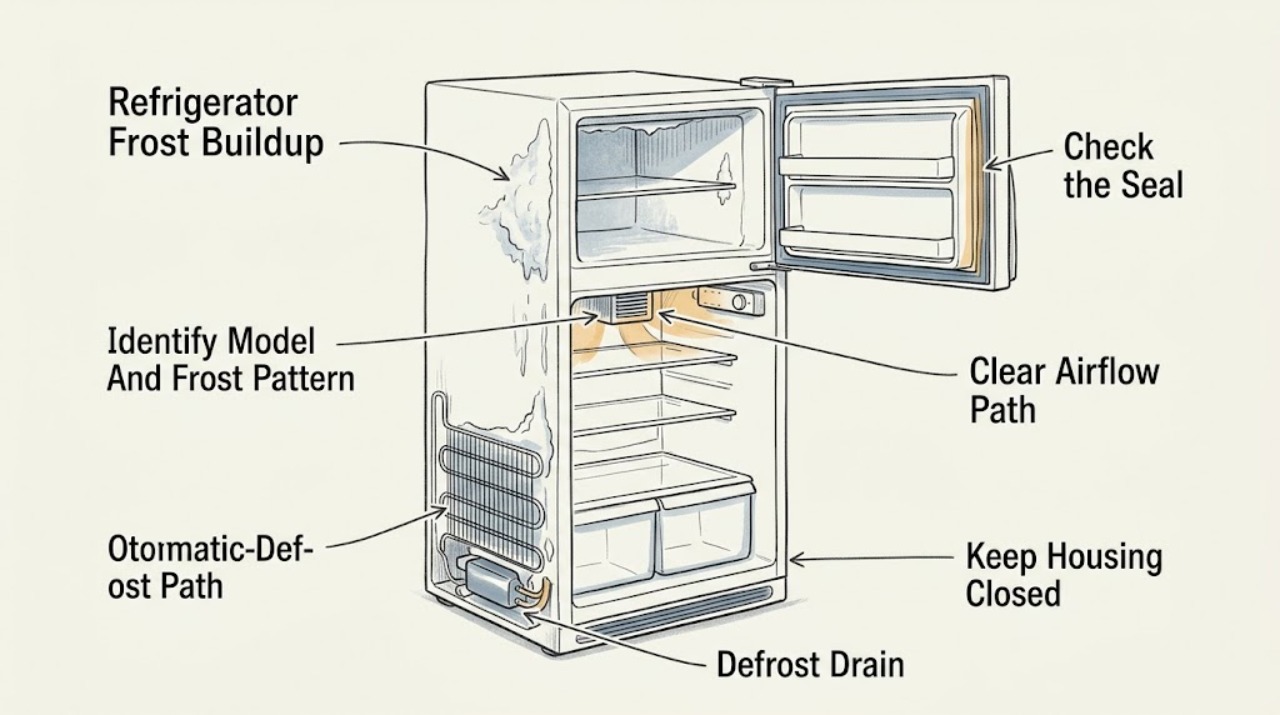
Work through in order
Diagnostic checks
Use only checks that match the exact appliance or system and its official guide.
-
Check 1
Photograph the rating plate and record the complete Inglis model and serial information. Without removing panels, map where frost is first and heaviest: freezer back wall, around an air vent, along the door edge or gasket, on food, in the refrigerator compartment, or in more than one area. Note whether it is a thin layer or thick/recurring ice.
Expected result: The model and compartment layout are known; frost is thin and even; frost is localized near a gasket or vent; or the model and frost source cannot be identified safely.
Next step: Use the matching Inglis guide and follow the corresponding branch below. If the model, compartment, or frost location remains uncertain, document it for service and stay with external checks only.
Stop if: Do not remove an interior cover, probe an air duct, or borrow a defrost instruction from another refrigerator model.
Why this matters
Why: Identity and pattern determine which manual and architecture apply. Light, even frost can be normal in some designs, while a door-edge or vent-localized pattern changes the next check. Unidentified hidden frost is not enough evidence to select a part or internal procedure.
-
Check 2
Check the accessible door area with the refrigerator not being forced or moved: look for a package, shelf, bin, or ice container holding the door open; clean and dry the gasket as directed by the exact guide; and look for visible dirt, a displaced section, or damage. Close the door normally and observe whether the gasket contacts the cabinet continuously.
Expected result: The door is obstructed, does not close squarely, the gasket is dirty or not contacting, the gasket is damaged, or the door and gasket appear clear and snug.
Next step: Remove only an accessible obstruction and clean the gasket using the manual’s method. Do not operate with a damaged seal or recurring gap; arrange service for hinge/alignment or gasket replacement that requires model-specific parts or appliance movement.
Stop if: Do not pry, heat, stretch, glue, or permanently reshape the gasket, and do not disassemble the door or hinge.
Why this matters
Why: A closure or gasket gap admits humid room air and makes frost near the door more likely. A clean, intact, continuous seal makes a door-leak explanation less likely, but it does not rule out blocked airflow or an internal defrost fault.
-
Check 3
Using the exact model guide to locate the vents, move packages away from the freezer-to-refrigerator air openings and leave a small circulation gap at the back. Check whether the room is unusually humid, doors have been opened often, liquids or food are uncovered, or a large warm load was just added. Confirm that controls are not set outside the guide’s recommended range; do not guess at hidden service settings.
Expected result: A vent is blocked, the cabinet is overpacked, doors are frequently or prolongedly opened, warm/uncovered food is present, the room is humid, or airflow and moisture conditions are normal.
Next step: Rearrange only accessible contents, cover liquids, let hot food cool before storage, minimize door-open time, and allow the refrigerator to stabilize per the exact guide. If the frost remains heavy or returns, continue to the safe-defrost/service branch rather than repeatedly changing controls.
Stop if: Do not block, tape open, or remove a vent, and do not make repeated extreme temperature adjustments to force a test.
Why this matters
Why: Blocked vents reduce circulation, while humid air and warm or uncovered food add moisture that can freeze on cold surfaces. Correcting those conditions may stop a one-time light buildup; normal external conditions with a persistent localized sheet make a hidden airflow or defrost issue more likely.
-
Check 4
If the matching Inglis guide identifies condenser-coil cleaning as an owner task, first make the refrigerator safe from a dry position and clean only the accessible external coils using the guide’s method. Do not touch the compressor, fan, wiring, refrigerant tubing, or any guard, and do not move the appliance unless the manual explicitly permits a safe owner step.
Expected result: The manual permits accessible coil cleaning and the coils are visibly dirty; the coils are clear; or the coils/fan are behind a guard or cannot be reached without moving or opening the appliance.
Next step: Perform only the manual-approved external cleaning and monitor. If cleaning is not an approved accessible task, or frost/temperature symptoms persist, provide the model and observations to qualified service.
Stop if: Do not remove guards, touch moving or energized parts, use live voltage tests, or handle sealed-system tubing or refrigerant.
Why this matters
Why: Inglis notes that dirty condenser coils can restrict air transfer and make the motor work harder, but coil condition does not prove the cause of a frost pattern. Inaccessible coils or a need to reach a fan or wiring crosses the owner boundary.
-
Check 5
When the exact guide allows owner defrosting, remove food, isolate the appliance from a dry safe position, leave doors open, place towels or a pan for meltwater, and let the frost melt naturally until no ice remains. Dry the interior and restart only as the guide directs. Record whether the same location frosts again and whether cooling and drainage return to normal.
Expected result: The frost melts completely and does not return; heavy or localized frost returns; water remains or leaks; the refrigerator stays warm; or ice is behind a panel or near wiring/fan hardware.
Next step: Arrange model-specific qualified service for recurring/hidden frost, warm food, water problems, or any internal component concern. Keep food at safe temperatures during the shutdown and do not intentionally repeat a cycle to reproduce the frost.
Stop if: Never chip ice, apply direct heat, remove panels, bypass a defrost control, or perform energized electrical testing.
Why this matters
Why: A one-time light buildup can follow humidity or door use. Recurrence after a complete defrost, poor cooling, drainage trouble, or hidden ice points to an airflow, drain, fan, or automatic-defrost system that cannot be identified safely from the symptom alone.
Use your observations
Decision map
Find the observation that best matches what you see, then follow the next safe action.
-
PATH 01Next step
What you see
Frost is a thin, even layer or light dusting that follows humid conditions, door openings, warm groceries, or a recent load and clears after normal operation.
Do this next
Keep doors closed as much as practical, cover liquids, cool hot food before storing, keep vents clear, and use the exact guide’s settings. Monitor for a change in thickness, location, or cooling.
Why this path and its safety boundary
Why it matters: Normal condensation or a model’s ordinary defrost behavior is more likely than a failed part, provided the doors seal and the cabinet holds temperature.
-
PATH 02Next step
What you see
Frost or ice is concentrated along the door edge, while packages, shelves, or a dirty/displaced gasket can prevent a continuous closure.
Do this next
Remove only accessible obstructions and clean/dry the gasket as directed. Stop using the appliance for a recurring gap or damaged seal and arrange model-specific service; do not reshape or glue the seal.
Why this path and its safety boundary
Why it matters: Humid air entering at the door is more likely. A damaged gasket, misalignment, or hinge problem cannot be distinguished from a simple obstruction without the exact model and physical inspection.
-
PATH 03Next step
What you see
Frost is localized around an air vent or a section of the freezer back wall, with otherwise clear doors and normal external humidity.
Do this next
Clear only accessible contents from the model-identified vents and allow the refrigerator to stabilize. If the pattern is thick, the cabinet is warm, or it returns after a complete safe defrost, arrange service without opening the panel.
Why this path and its safety boundary
Why it matters: Blocked circulation or a model-specific defrost/airflow path becomes more likely than a general door-opening explanation. A localized pattern does not identify a fan, heater, thermostat, drain, or control.
-
PATH 04Safety boundary
What you see
Frost becomes heavy again after a complete natural defrost, appears behind a cover, blocks a fan or vent, or occurs with poor cooling, unusual water, or a persistent running complaint.
Do this next
Keep the appliance safe and arrange Inglis/Whirlpool-authorized or qualified appliance service with the model, frost map, temperature symptoms, and defrost history. Protect food while the refrigerator is out of service.
Why this path and its safety boundary
Why it matters: A hidden airflow, drain, automatic-defrost, control, or sealed-system issue is more likely. The visible frost is not enough evidence to choose a part or owner repair.
Safety stop: Do not remove interior panels, melt hidden ice with direct heat, bypass a sensor, or perform live electrical or sealed-system work.
-
PATH 05Safety boundary
What you see
Meltwater reaches electrical equipment, the plug or outlet is wet or hot, there is smoke/burning odor, power trips, the cabinet cannot hold safe food temperature, or the appliance has an unknown electrical warning.
Do this next
Do not touch wet electrical parts. Isolate power only from a dry safe position, keep the refrigerator off, protect the floor, move perishable food to a safe cold source, and obtain qualified appliance/electrical help.
Why this path and its safety boundary
Why it matters: Containment, electrical safety, and food safety override frost diagnosis. A normal-looking frost explanation must not be used to justify operation under a hazard.
Safety stop: Do not reset a tripped protective device repeatedly, restart to test, or dry energized equipment.
Helpful context
Understand the symptom
Confirm the Inglis refrigerator architecture first
Inglis’s official site is a Whirlpool Canada LP brand site, and its troubleshooting material separates top-mount and side-by-side refrigerator behavior. That does not make every Inglis refrigerator identical: controls, vent locations, manual-versus-automatic defrost behavior, and access boundaries vary by model. Photograph the rating plate and use the matching Inglis Use & Care Guide before changing a control setting, attempting a defrost procedure, or ordering a part.
Read frost by thickness, location, and recurrence
A light, even layer or moisture that clears after normal operation can follow humid air, a recent grocery load, or door openings. Frost concentrated along a door edge points first to closure and gasket contact. Frost around a vent or on one section of a back wall makes airflow or a model-specific defrost path more relevant. Frost that becomes heavy again after a complete safe defrost is not proof of one failed part; it is a reason to provide the pattern and model to service.
Make the external checks that can change the diagnosis
Confirm that shelves, bins, packages, or an ice container are not holding the door open. Clean and dry the accessible gasket with the method in the exact guide, and check for visible cuts, displacement, or a section that does not contact the cabinet. Keep the model-specific air vents clear, leave room for circulation, cover liquids, and allow hot food to cool before storage. Only clean condenser coils if the matching guide identifies them as owner-maintainable and the appliance can be made safe first.
Use natural defrosting only within the manual’s boundary
If the exact Inglis guide permits owner defrosting, remove or protect food, switch the refrigerator off or unplug it from a dry, safe position, leave the relevant doors open, and use towels or a pan to contain naturally melting water. Allow the ice to melt completely rather than scraping it. Do not use a knife, screwdriver, pick, hair dryer, heat gun, open flame, or other direct heat: these can injure the user or damage liners, wiring, or refrigeration components. Do not remove an interior panel to reach a hidden frost or defrost component.
Escalate when frost is a system symptom
After a safe, complete defrost and restart exactly as the model guide specifies, monitor whether the same localized or heavy pattern returns and whether food remains at the expected temperature. Recurrence, a cabinet that is warm, water that does not drain, frost behind a cover, a fan or defrost component that cannot be inspected safely, or any electrical warning requires qualified Inglis/Whirlpool-authorized or appliance service. The visible frost does not identify a compatible heater, thermostat, fan, drain, control, or sealed-system part.
Safety boundary
Stop conditions
- Stop and isolate the refrigerator from a dry, safe position for wet or hot electrical equipment, smoke, burning odor, sparks, repeated power trips, or unsafe water near the outlet.
- Do not chip or pry frost with a knife, screwdriver, pick, or other sharp tool, and do not use a hair dryer, heat gun, open flame, or other direct heat.
- Do not remove interior panels, touch the compressor, fan, wiring, defrost heater, thermostat, drain, refrigerant tubing, or sealed system, and do not perform live electrical testing.
- Do not order a heater, fan, gasket, drain, thermostat, control, or sealed-system part from the frost symptom alone; confirm the exact model and qualified diagnosis first.
Only after diagnosis
Potential parts
- model-specific door gasket or door-closure component
Consider only if qualified diagnosis confirms a damaged seal or closure fault after accessible loading and gasket-contact checks.
Inglis refrigerator layouts and regional models differ; confirm the complete model before ordering. - model-specific defrost drain, fan, heater, thermostat, or control component
Consider only after service localizes a recurring vent/back-wall frost problem to a particular internal component.
Frost location alone cannot distinguish these components, and access or replacement is not an owner-level step. - model-specific airflow or sealed-system service component
Consider only when qualified service confirms an airflow, control, compressor, or sealed-system cause rather than humidity or door leakage.
Do not select or install a fan, control, compressor, or refrigerant-related component by brand or symptom alone.
When checks do not resolve it
Need a professional?
Arrange Inglis/Whirlpool-authorized or qualified appliance service when frost is heavy or recurring after a complete natural defrost, appears behind a panel, accompanies warm food or persistent running, causes water or drainage problems, follows a damaged or misaligned gasket, or requires access to a fan, defrost assembly, drain, wiring, controls, or sealed system. Use qualified electrical help for a wet/hot outlet or plug, burning odor, sparks, or repeated trips.
Safety scope: The owner boundary is model identification, visual frost mapping, accessible door/gasket/load/vent checks, and only manual-approved external cleaning or natural defrost. Internal panels, fans, heaters, drains, thermostats, controls, wiring, compressor, refrigerant, and energized testing belong to qualified service.
Common questions
FAQ
Is frost in an Inglis refrigerator always a failure?
No. Official Whirlpool guidance says light, thin, even frost or brief moisture can be normal after door openings, humid conditions, or warm food. Heavy, localized, or recurring frost, especially with poor cooling or a door-seal gap, needs further checks and possibly service.
Why is frost forming around the Inglis refrigerator door?
A package, shelf, or ice container may hold the door open, or the gasket may be dirty, displaced, damaged, or not sealing. Check only accessible closure and gasket contact; do not reshape the seal or dismantle the door.
Can I remove Inglis refrigerator frost with a hair dryer or knife?
No. Use the exact model guide’s natural-defrost method, with the appliance safely isolated, doors open, and meltwater contained. Sharp tools and direct heat can injure you or damage the liner, wiring, or refrigeration components.
What if the frost returns after I defrost the Inglis refrigerator?
A recurring pattern after a complete safe defrost is not a reason to keep repeating the test. Record the frost location, cooling and water symptoms, and exact model, then arrange qualified service for an airflow, drain, automatic-defrost, control, or sealed-system diagnosis.
Does every Inglis refrigerator use the same defrost procedure?
No. Inglis’s official material covers more than one refrigerator configuration, and the use-and-care guide is model-specific. Confirm the rating plate and follow only the matching guide rather than applying a procedure from another model.
Read the exact guide
Official sources
- Inglis Home AppliancesInglis Home Appliances · Official Inglis Canada site; brand and support relationship is Canadian/region-specific.
- Inglis Use and Care GuideWhirlpool Canada LP / Inglis · Official Inglis-hosted PDF for the named ITW4971DQ model; it is evidence of the brand/manual relationship, not a universal manual for every Inglis refrigerator.
- How to Help Eliminate Condensation and FrostWhirlpool Product Help · Whirlpool-family product-help guidance used for shared brand-family principles; exact Inglis model controls and vent locations must be checked in the Inglis guide.
- What’s Normal Condensation or FrostWhirlpool Product Help · Whirlpool official product-help page; normal patterns are general guidance and do not replace the exact Inglis manual.
- TroubleshootingInglis Home Appliances · Official Inglis Canada troubleshooting page; exact controls and procedures remain model-specific.
- Door Not SealingWhirlpool Product Help · Whirlpool official product-help page; gasket and leveling details remain model-dependent for Inglis appliances.
Community feedback
Share a repair observation
Share a plain-text repair observation. Accepted observations are published automatically; this page may take a moment to update.