
On this page
Start here
Quick answer
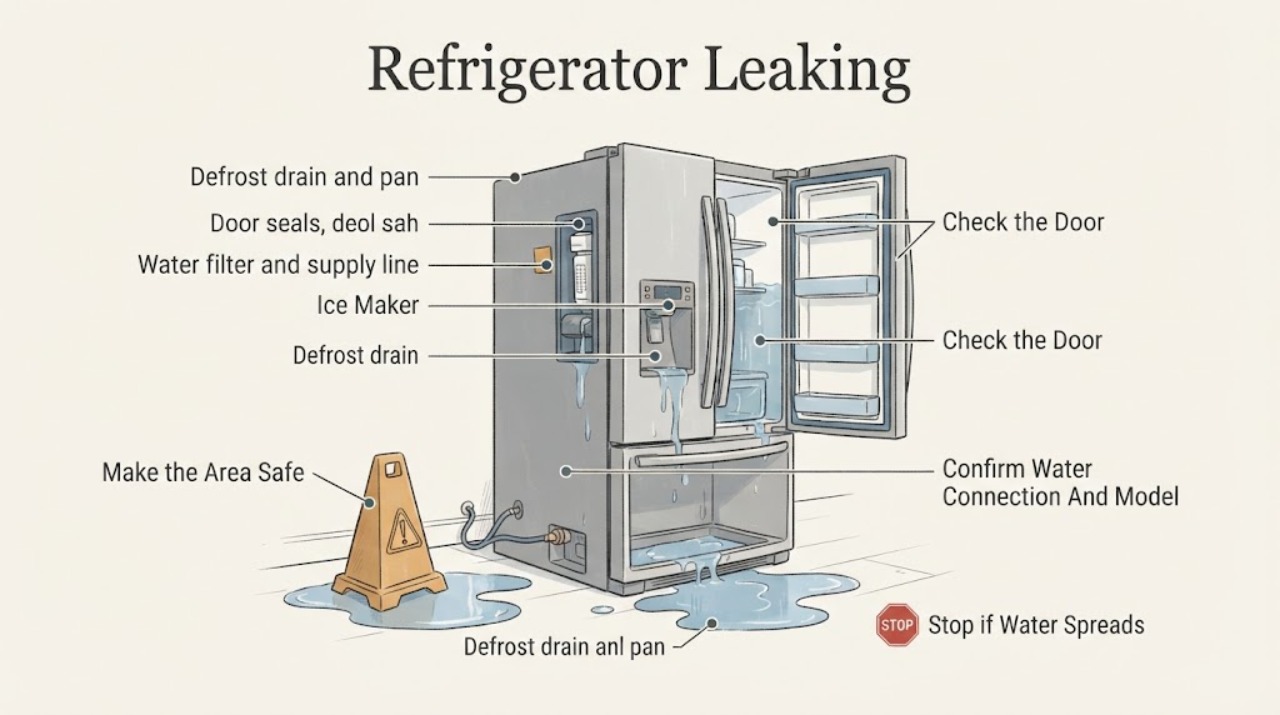
First stop water from spreading and determine whether this Inglis refrigerator has a household water connection, ice maker, or dispenser; many models have none, so do not assume a supply line exists. Identify whether the water is inside under drawers, in a defrost pan, at the dispenser/filter, behind the cabinet, or on the floor, and whether it appears only during defrost or after using ice/water. Keep food and hands away from standing water near electrical parts. If it is safe, close the refrigerator water shutoff valve and disconnect power from a dry position before inspecting an accessible line or connection; do not pull the unit out or touch a wet or damaged plug. Inglis’s official troubleshooting guidance separates top-mount and side-by-side refrigerators and describes automatic defrost water, drain pans, door seals, filters, ice makers, and supply lines as model-dependent checks. Inspect only visible door closure, gasket, drain-pan overflow, filter seating, and accessible tubing according to the exact Use & Care Guide. A blocked internal defrost drain, cracked pan, concealed hose, damaged valve, or leak behind the cabinet needs qualified service. Do not run the appliance to reproduce a leak, puncture ice, dismantle the water system, or tighten inaccessible fittings. Stop immediately for uncontrolled water, a leak near electrics, smoke, sparks, burning odor, a hot cord/socket, or repeated protective-device trips; isolate only when safe and arrange authorized Inglis/Whirlpool service or a qualified plumber for the household supply.
Before you begin
Safety first
- The owner may stop water use, isolate water/power only when safe, document the model, and inspect dry visible closure, loading, accessible drain/pan, filter, and tubing conditions as the manual permits. Qualified personnel must handle concealed drains/pans/valves/hoses, cabinet movement, live electrical work, and internal refrigeration components.
Work through in order
Diagnostic checks
Use only checks that match the exact appliance or system and its official guide.
-
Check 1
Stop dispensing water or ice and keep people away from the puddle. From a dry, safe position, note the highest visible wet area: inside under drawers, at a rear drain, in a defrost pan, at a dispenser/filter, beneath the front, or behind the cabinet. Do not touch wet electrical parts.
Expected result: Water is near a socket or cord; there is uncontrolled flow; the source is inside, at the dispenser, at the rear, or only a normal-looking pan; or the source cannot be seen safely.
Next step: For a hazard, keep clear and isolate power only if safe. Otherwise place a safe catch container, close doors, stop water use, and continue with the architecture and connection check without moving the unit.
Stop if: Stop immediately for water entering electrical areas, smoke, sparks, burning odor, heat, damaged cord/socket, or repeated protective-device trips.
Why this matters
Why: An electrical/water hazard takes priority. Location and timing separate defrost drainage, dispenser/supply plumbing, door/condensation, and concealed leaks, but a wet surface alone does not name a failed part.
-
Check 2
Record the exact Inglis model and whether it has a water dispenser, ice maker, filter, and household water connection. Use the Use & Care Guide to determine whether the refrigerator is top-mount, side-by-side, or another layout; do not pull out an integrated or tightly installed unit to find a label.
Expected result: A water line and shutoff valve are present; the model has no water connection; only an ice maker/dispenser feature is known; or the model/architecture is uncertain.
Next step: Use the exact model guide. If a line is present and the area is dry, close the shutoff valve before any visible tubing inspection; if identity is uncertain, stop at safe observation and arrange service.
Stop if: Do not move the appliance, remove a rear cover, disconnect tubing, or reach through standing water to identify the line or label.
Why this matters
Why: A connected model can leak from supply, filter, inlet, ice-maker, or dispenser parts. A model without a water line cannot have a supply-line leak, so defrost, drain, pan, door, or condensation branches become more relevant.
-
Check 3
With power left off only if the manual directs and hands dry, check that doors close fully, the accessible gasket is clean and contacting, food is not blocking closure, and any visible defrost pan or drain opening is not overflowing. Observe whether water appears during an automatic defrost period or after frequent door opening.
Expected result: The gasket has a gap or damage; the door is obstructed; water is under drawers or around a rear drain; the pan is receiving water but not overflowing; or the pan/drain is cracked or concealed.
Next step: Correct only visible closure or loading conditions and follow the manual for a user-accessible drain/pan check. Do not scrape ice or remove panels; arrange qualified service for persistent interior or pan leaks.
Stop if: Stop if water is near electrical parts, the door cannot seal without hinge work, or the drain/pan cannot be accessed without dismantling.
Why this matters
Why: Door/condensation or a visible drainage condition is more likely than a connected water-line leak. A pan that overflows, a blocked internal drain, or a cracked/concealed part needs service.
-
Check 4
Only for a model with a household water connection: close the water shutoff valve and unplug from a dry safe position before inspecting accessible tubing, the filter seating, and visible fittings. Look for cracks, kinks, moisture, a filter that is not seated, or a dispenser chute/trap door that remains open; do not disconnect the line or tighten hidden fittings.
Expected result: The line is cracked/kinked; a fitting or filter is visibly wet/loose; the dispenser drips after use; an ice maker is jammed or not supplied; or all visible connections are dry.
Next step: Keep the shutoff closed for a damaged or leaking line/filter and arrange service or qualified plumbing help. If the visible branch is normal, leave the refrigerator isolated as appropriate and use the model-specific service route.
Stop if: Do not reconnect a cracked line, open a filter head under pressure, pull the refrigerator out, or handle tubing in a wet electrical area.
Why this matters
Why: A visible supply/filter/dispenser condition can explain water outside the cabinet. A dry external check does not rule out a concealed valve, internal tube, drain, or pan fault.
-
Check 5
If the leak continues, the source is behind a panel, the water connection is uncertain, or the refrigerator has a damaged pan, valve, drain, filter head, hose, or door seal, stop user troubleshooting. Provide the model, water-connection status, leak location, timing, photos taken safely, and checks performed to Inglis/Whirlpool service or a qualified plumber.
Expected result: The leak stopped after a visible correction; it recurs; water remains or spreads; an internal part is suspected; or electrical/fire warning signs are present.
Next step: Keep the water valve closed when applicable and the appliance out of service as appropriate until qualified assessment. Protect food and flooring using safe alternatives.
Stop if: Do not run cycles to reproduce the leak, reset protection repeatedly, open panels, bypass a water valve, or reconnect a damaged appliance.
Why this matters
Why: A temporary dry surface does not prove the source is repaired. Recurrence or concealed water paths exceed safe generic checks; electrical/fire symptoms require immediate isolation.
Use your observations
Decision map
Find the observation that best matches what you see, then follow the next safe action.
-
PATH 01Safety boundary
What you see
The Inglis refrigerator has no household water line, dispenser, or ice-maker supply, and water is inside under drawers, at a rear drain, in a pan, or on the floor.
Do this next
Check visible door closure, gasket, loading, and user-accessible drain/pan conditions using the exact guide. Arrange service for an internal blockage, cracked pan, or recurring floor leak.
Why this path and its safety boundary
Why it matters: A supply-line leak is not possible; defrost drainage, condensation, door sealing, leveling, or a concealed pan/drain is more likely.
Safety stop: Do not add a water line, probe a drain with sharp tools, move the cabinet, or open a rear cover.
-
PATH 02Safety boundary
What you see
The model has a dispenser/ice maker and water is wettest at the rear, filter area, or an accessible tubing/fitting after water use or filter work.
Do this next
Close the water shutoff valve and unplug only from a dry safe position; leave a damaged or leaking connection isolated and arrange qualified appliance/plumbing service.
Why this path and its safety boundary
Why it matters: A supply connection, filter seating, line kink/crack, or inlet fitting is more likely than ordinary defrost-pan water.
Safety stop: Do not pull the refrigerator, disconnect tubing, tighten hidden fittings, or reconnect a cracked line under pressure.
-
PATH 03Safety boundary
What you see
Water or ice appears at the dispenser after dispensing, the chute/trap door remains open, the filter was recently installed, or the ice maker has a visible jam or supply symptom.
Do this next
Stop dispensing, follow the exact manual for a visible chute, bin, or filter check, and close the water valve for persistent dripping. Use service if the filter head, valve, internal tube, or ice-maker mechanism is involved.
Why this path and its safety boundary
Why it matters: The leak is linked to the optional dispenser/ice-maker system rather than a refrigerator with no water features.
Safety stop: Do not reach into moving/energized mechanisms, remove the filter head under pressure, or run repeated dispensing tests.
-
PATH 04Safety boundary
What you see
Water appears under drawers or in/around the defrost pan, with no connected water-line symptom, or the leak follows a defrost period.
Do this next
Follow the manual for a visible drain/pan check and keep the cabinet level as directed. Arrange professional inspection for a blocked internal drain, cracked pan, or recurring leak.
Why this path and its safety boundary
Why it matters: Defrost water, a blocked drain, pan overflow, humidity, or leveling is more likely. A small amount in the pan can be normal, but overflow or a recurring floor leak is not resolved by mopping.
Safety stop: Do not chip ice, probe behind a liner, remove the pan, or continue if water reaches electrical parts.
-
PATH 05Safety boundary
What you see
Water reaches electrical parts, the source is behind the cabinet, the leak is uncontrolled, the cord/socket is wet or damaged, or smoke, sparks, burning odor, heat, or repeated trips occur.
Do this next
Keep clear, close the water shutoff if safely reachable, and disconnect power only from a dry safe position. Obtain emergency, qualified electrical, appliance, or plumbing help as appropriate.
Why this path and its safety boundary
Why it matters: Safety takes priority over tracing the leak; continued operation can cause shock, fire, water damage, or food loss.
Safety stop: Do not touch wet electrical parts, pull a plug from a wet socket, move the refrigerator, reconnect to reproduce the leak, or reset protection repeatedly.
Helpful context
Understand the symptom
Start with the water source and the leak location
A small amount of water in a defrost pan is not the same as a line leak onto the floor. First identify whether the appliance has a water dispenser, ice maker, filter, or household water connection. Then trace the highest wet point without reaching behind the cabinet: under a crisper, around a rear drain opening, at a dispenser/filter area, beneath the front edge, or behind the unit. If the floor or electrical area is wet, safety and isolation come before tracing.
Inglis refrigerator architectures are not interchangeable
The official Inglis support page has separate side-by-side and top-mount refrigerator sections. A side-by-side with dispenser and ice maker can have a supply line, filter, chute, or inlet connection; a top-mount or refrigerator-only model may have only an automatic defrost drain and pan. Do not open a hidden panel or assume that a water-line instruction applies to a model that was never plumbed.
Check only visible closure, drain, and pan conditions
Confirm that doors close completely, the accessible gasket contacts the cabinet, and food is not preventing closure. Check for a visible drain opening or pan overflow only as the Use & Care Guide permits. Inglis notes that defrost water may collect in a pan and evaporate, while Whirlpool explains that a blocked defrost drain can cause water to pool inside or reach the floor. An internal blockage or cracked pan requires service rather than a sharp tool or cabinet access.
Treat connected water systems as a separate branch
If the Inglis model has a dispenser or ice maker and is connected to household water, inspect only visible tubing and fittings after safe power isolation and closing the shutoff valve. A kink, crack, loose fitting, incorrectly seated filter, ice in a line, or dispenser chute can produce different symptoms. If the refrigerator has no water connection, skip this branch; a puddle must be traced to defrost, condensation, leveling, or another source instead.
Escalate persistent or concealed leaks
Do not keep running the refrigerator to reproduce a leak. Record the model, water-connection status, leak location, timing, whether defrost or dispenser use preceded it, and any water near electrics. Whirlpool advises professional inspection for a persistent leak and model-specific parts; Inglis provides a schedule-service route. A hidden drain, valve, pan, hose, filter head, or internal connection is not an owner-level repair without the exact manual and qualified training.
Safety boundary
Stop conditions
- Do not run the refrigerator or dispenser to reproduce a leak, especially when water is near electrical parts or the floor is wet.
- For connected models, close the water shutoff and unplug only from a dry safe position before visible line/filter inspection; do not pull the cabinet or disconnect tubing.
- Do not probe drains with knives, wire, or sharp tools, remove rear covers/pans, bypass valves, or repair hidden hoses and fittings.
- Stop for uncontrolled water, smoke, sparks, burning odor, heat, wet/damaged cord or socket, or repeated protective-device trips; keep clear and obtain qualified help.
- Do not assume every Inglis refrigerator has a dispenser, ice maker, water filter, or supply line; confirm the exact model and use the matching manual.
Only after diagnosis
Potential parts
- defrost drain or drain-pan component
Consider only after a qualified diagnosis confirms a blocked concealed drain or cracked/failed pan following visible water-source and door checks.
Verify the exact Inglis model and fitment; do not remove a pan or liner based on a generic leak symptom. - water supply line or inlet fitting
Consider only for a model actually connected to household water when an inspection confirms a cracked line or failed fitting after safe shutoff.
Confirm the complete model, tubing specification, connection type, and local plumbing requirements before ordering or installation. - refrigerator door gasket
Consider only if a model-specific closure check confirms the gasket is damaged or cannot seal after visible obstruction and cleaning are ruled out.
Confirm exact model fitment; door seals are not universal across Inglis configurations.
When checks do not resolve it
Need a professional?
Arrange Inglis/Whirlpool authorized refrigerator service when the leak recurs after a visible closure or accessible check, the source is behind a panel, a defrost drain or pan is blocked/cracked, a door seal or leveling adjustment needs hardware work, or a valve, filter head, internal tube, ice-maker, or dispenser component is suspected. Use a qualified plumber for the household shutoff or supply line when that part is implicated. Stop immediately for uncontrolled water, water near electrics, smoke, sparks, burning odor, heat, a wet/damaged cord or socket, or repeated protective-device trips; isolate water and power only when safe. The owner may identify the model and water-connection status, map the leak, check visible closure/loading, and inspect accessible tubing/filter/pan conditions as the manual permits. Cabinet access, concealed drain/pan/valve work, live electrical testing, and refrigerant or sealed-system repair require qualified service.
Safety scope: The owner may stop water use, isolate water/power only when safe, document the model, and inspect dry visible closure, loading, accessible drain/pan, filter, and tubing conditions as the manual permits. Qualified personnel must handle concealed drains/pans/valves/hoses, cabinet movement, live electrical work, and internal refrigeration components.
Common questions
FAQ
Why is my Inglis refrigerator leaking water?
First identify whether it has a household water line, dispenser, ice maker, or filter, then locate the highest wet point. A refrigerator without water plumbing cannot have a supply-line leak; water under drawers or in a defrost pan points to drainage, door/condensation, leveling, or a concealed pan instead.
Do all Inglis refrigerators have a water line or ice maker?
No. Inglis provides separate top-mount and side-by-side guidance and treats water lines, filters, dispensers, and ice makers as model-dependent. Check the exact model and Use & Care Guide before inspecting a supply system.
Is water in the Inglis refrigerator defrost pan normal?
A small amount during an automatic defrost can be normal, but overflow or water reaching the floor is not a repair by itself. Check visible door closure and leveling as the manual permits; a blocked internal drain or cracked pan needs qualified service.
What should I do if my connected Inglis refrigerator leaks from the back?
Stop water use, close the household shutoff valve, and unplug only from a dry safe position. Inspect visible tubing and fittings for a crack, kink, or moisture without pulling the refrigerator or disconnecting the line. Keep a damaged connection isolated and arrange appliance or plumbing service.
Can a door seal cause an Inglis refrigerator to leak?
An incomplete door seal can increase condensation and allow water to escape, while a door obstruction or leveling problem can prevent proper closure. Check only the accessible gasket and door path. Do not remove hinges or replace the seal without exact model instructions.
When does an Inglis refrigerator leak need a technician?
Use service for a recurring leak, concealed drain/pan/valve/hose, damaged filter head, failed dispenser or ice-maker plumbing, a door seal needing hardware work, or any source behind the cabinet. Stop for water near electrics, smoke, sparks, burning odor, heat, a wet cord/socket, or repeated protective-device trips.
Read the exact guide
Official sources
- Customer CareInglis Home Appliances · Opened official Inglis customer-care page; used only to route unresolved leaks to the official troubleshooting and service channels.
- TroubleshootingInglis Home Appliances · Opened official Inglis troubleshooting page; used for the conditional refrigerator architecture, automatic-defrost pan, door/gasket, connected water, filter/dispenser/ice-maker, temperature, and technician branches.
- How to Fix a Refrigerator That Is Leaking WaterWhirlpool · Opened official Whirlpool leak guide; used as manufacturer-group guidance for drain blockage, water-line, leveling, door-seal, model-manual, and technician boundaries, without assuming an Inglis model has every feature.
- How to Check the Water Supply LineWhirlpool Product Help · Opened official Whirlpool Product Help page; used only for connected-model water-line checks and the boundary against hidden or unsafe plumbing work.
Community feedback
Share a repair observation
Share a plain-text repair observation. Accepted observations are published automatically; this page may take a moment to update.